It’s New Year’s Day according to our liturgical calendar, and special prayers for God’s blessing were included in our service this morning. What better time could there be for thinking about progress… or would devolution and even defeat be more realistic? I happened to read this passage today (I didn’t hear it in church) and just realized how it is connected, sort of. From a letter written by the Apostle Paul to his coworker Timothy:
“But know this, that in the last days perilous times will come: For men will be lovers of themselves, lovers of money, boasters, proud, blasphemers, disobedient to parents, unthankful, unholy, unloving, unforgiving, slanderers, without self-control, brutal, despisers of good, traitors, headstrong, haughty, lovers of pleasure rather than lovers of God, having a form of godliness but denying its power.
…Now as Jannes and Jambres resisted Moses, so do these also resist the truth: men of corrupt minds, disapproved concerning the faith; but they will progress no further, for their folly will be manifest to all, as theirs also was. But you have carefully followed my doctrine, manner of life, purpose, faith, longsuffering, love, perseverance, persecutions, afflictions, which happened to me at Antioch, at Iconium, at Lystra– what persecutions I endured. And out of them all the Lord delivered me. Yes, and all who desire to live godly in Christ Jesus will suffer persecution. But evil men and impostors will grow worse and worse, deceiving and being deceived.” (2 Timothy 3:1-13)
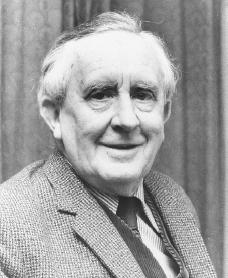
Father Stephen Freeman has written over the years about how this passage is in agreement with what J.R.R. Tolkien wrote in a letter many centuries later:
“Actually I am a Christian, and indeed a Roman Catholic, so that I do not expect ‘history’ to be anything but a ‘long defeat’— though it contains (and in legend may contain more clearly and movingly) some samples or glimpses of final victory” (Letters 255).
This narrative of a long defeat was assumed among ancient peoples, Fr. Stephen tells us, and only changed to one of progress in recent centuries, especially during the 19th century. But the defeat of history is not really pessimistic. It is part of the greater story of Christ’s Kingdom that has come, and is coming:
“I would go further and say that the final victory already “tabernacles” among us. It hovers within and over our world, shaping it and forming it, even within its defeat. For the nature of our salvation is a Defeat. Therefore the defeat within the world itself is not a tragic deviation from the end, but an End that was always foreseen and present within the Cross itself.”
The liturgical calendar doesn’t have much to do with that long defeat. You can go to any timeline of history to see the kingdoms that have risen and fallen, and the many wars and tribulations, the violence and suffering that have filled the earth since the beginning. Taken as a whole it’s hard to see any true progress there, unless you are talking about Wonder Bread or flush toilets.
No, the liturgical New Year begins the commemorations of Great Feasts of the Orthodox Church, following the sequence of events in what is sometimes called our Salvation History. The birth of Christ’s mother, the birth of Christ, the Presentation of Christ in the Temple, and so on. The death and resurrection of Christ are the peak season on that calendar. Christ’s defeat, and death — swallowed up in victory. That is cause to say “Christ is risen!” and “Happy New Year!” God is with us.
On my last night with my family in Colorado, I took a turn along with their parents to read aloud to the children a chapter of The Hobbit. They had all been enjoying the book together before Christmas visitors and pastimes interrupted their usual routine, and the chapter we read that night took us suspensefully close to the end of the tale.
What a joy it was to read more of J.R.R. Tolkien’s sublime storytelling; I was uncommonly grateful to be a narrator of his prose, and by that means to take part in the culturally lifesaving work of telling good and true — and fun! — stories.
Since then I have been hoping to post something related on Tolkien’s birthday, but I almost missed it again — it is today! Instead of trying to come up with something new, I am re-posting this article that I wrote a few years ago about the Tolkien Ensemble:
I feel a bit foolish, having written in my last book review that I had been put off from “all things Danish.” The fact is, I was that very week exulting in what I had forgotten was a Danish phenomenon, the Tolkien Ensemble and their achievement of composing and performing music for all of the songs in The Lord of the Rings trilogy.
It was a blog discussion of poetry that alerted me to the existence of this group, founded in 1995, and their recordings on four CD’s. I’m surprised that I never heard of them in the last fifteen years. As a mom reading the trilogy aloud to my children 25 years ago, I vaguely remember feeling inadequate when we came to one of the many songs in the novels. Tolkien’s verse has meter, and the poetry is affecting, but they are songs to the hobbits and other characters, and one longs to really sing them. I am not good at composing tunes on the spot; I wonder if Tolkien hummed appropriate melodies as he was writing? [Update: evidently he did!]
A 4-CD set was compiled after all of the recordings had been made over several years. There seem to be slight variations in the different editions and collections, but I have all four CD’s now, totaling 69 tracks, which I bought separately and mostly used. I’ve listened to some of songs many times, and I continue to be amazed at the quality of the music, and how each song is fitted with a composition that seems to me to be just right for it. I admit to being an amateur music critic, but I’m going to plow on ahead. If any of my readers are familiar with these recordings and know more about the field of music, maybe you can further instruct or correct me, or just tell me what are your favorite songs.
Tolkien Ensemble 2000
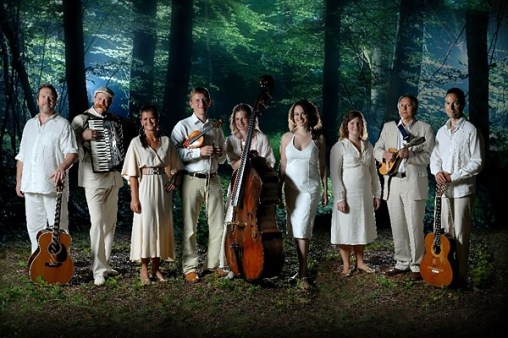
Caspar Reiff, one of the composers, founded the Tolkien Ensemble in Copenhagen when he was in his late 20’s and studying guitar at the Royal Danish Academy of Music. His former guitar teacher and “multi-musician” Peter Hall joined as co-composer, along with fellow students from the music academy. They are a convincing advertisement for that school.
The Ensemble manages to create a fitting expression for every mood and activity that was put to verse in these books. The song of “Tinúviel” captures the urgency and enchantment of Beren who falls in love with an Elven maid and chases her through the forest and the seasons, calling achingly, “Tinúviel! Tinúviel!” until she in turn falls under his spell, and in her eyes “The trembling starlight of the skies/He saw there mirrored shimmering.” The drinking song Frodo sings at the Inn of Bree is a lot of fun, with accordion and fiddle, spoons and dishes. There are riddles, laments, and even a bath song. We have a hearty upbeat walking song as the few Hobbits are starting out bravely:
Farewell we call to hearth and hall!
Though wind may blow and rain may fall,
We must away ere break of day
Far over the wood and mountain tall.
To Rivendell, where Elves yet dwell
In glades beneath the misty fell,
Through moor and waste we ride in haste,
And whither then we cannot tell.
With foes ahead, behind us dread,
Beneath the sky shall be our bed,
Until at last our toil be passed,
Our journey done, our errand sped.
We must away! We must away!
We ride before the break of day!
Contrast this with Frodo’s more melancholy mood when he sings alone the song he learned from Bilbo. Update: “Old Walking Song” It seems like the theme song for the entire tale:
The road goes ever on and on
Down from the door where it began.
Now far ahead the road has gone,
And I must follow, if I can,
Pursuing it with weary feet,
Until it joins some larger way,
Where many paths and errands meet,
And whither then? I cannot say.
Many of the songs are sad. The whole story is rather bleak, of course, with the growing and unrelenting awareness that the former glory of kings and elves is fading fast and can’t be regained. The unhurried drama enacted in a lumbering musical conversation between the separated Ents and Entwives is heartbreaking, but it is one of my favorites.
They call to one another in their stately Ent voices that convey their tree-like, large physiques and great age. The Ent sings stanzas in a beautiful but heavy tone, with the refrain, “Come back to me,” and she replies, “I’ll linger here,” until the last verses when he says he will come to her, and then they sing in unison of a time when they will converge on a journey to where their hearts may be at rest.
The Elf Legolas sings a “Song of the Sea” that I didn’t like at first, I think because it put me off balance, as though I were on a ship being buffeted by the waves. But after a few times through, I got my sea legs and began to enjoy the feeling of the moist wind in my hair, and the sense of adventure.
The women of The Tolkien Ensemble have lovely voices that one imagines might be heard among those “misty glades” where Elves dwell and sing. They use them to good effect in several tracks about the lands and heroes of these wise and ageless creatures.
What might be called a Thinking Song, “Bilbo’s Song,” is one that he sings meditatively. The guitar accompaniment reminds me very much of the way my own mind can go round and round on a subject, ruminating. The strings are plucked in a quick and repetitive rhythm, perhaps with a drone note coming back frequently.
I sit beside the fire and think
of all that I have seen
of meadow-flowers and butterflies
in summers that have been;
Of yellow leaves and gossamer
in autumns that there were,
with morning mist and silver sun
and wind upon my hair.
I sit beside the fire and think
of how the world will be
when winter comes without a spring
that I shall ever see.
For still there are so many things
that I have never seen:
in every wood in every spring
there is a different green.
I sit beside the fire and think
of people long ago
and people who will see a world
that I shall never know.
But all the while I sit and think
of times there were before,
I listen for returning feet
and voices at the door.
The group in 2007
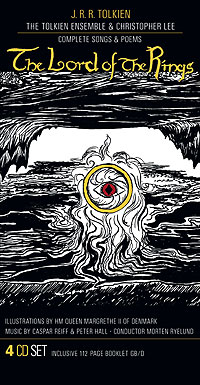
At right is the cover of the set of two disks I first bought, to find out if even liked them. It’s hard to find samples of the music online; you might pull up one or two on YouTube, and then you might find them taken down the next minute. If bought separately, the disks in order of production are:
1 An Evening in Rivendell
2 A Night in Rivendell
3 Dawn in Rivendell
4 Leaving Rivendell
But don’t worry – not all the action takes place in Rivendell. Those are just the disk titles, and the songs included on each disk are not necessarily in an obvious order, either.
I immediately found so much to love in those first two collections that I shopped sources for the other two disks. And after listening for a day or two, it was clear: I must read the trilogy again to put the newly appreciated songs in their context. That had been my desire after watching Peter Jackson’s film interpretation that was so disappointing, but I hadn’t followed through. So I dropped all my other Currently Reading books to read The Fellowship of the Ring. Now I am on to The Two Towers, still in the Company!
When I am listening to the recordings, and now reading the novel again, I often think about those days when I had my children gathered around me and we were all vicariously traveling across the mountains and wastes of Middle Earth. If it had been only ten years later, we could have paused at each song as it appeared in the story to play the companion track on a CD, and let the music sink into our consciousness and draw us deeper into the story. That kind of enrichment would have raised the quality of our literary immersion a notch, to be sure. The Tolkien Ensemble gave their final concert in 2008, but I’m confident that the fruits of their project will continue to give joy to Tolkien-lovers for a long time.
Update:At the time of the original posting of my music review, I couldn’t find any samples of the music to share, but just now I found the songs compiled on YouTube. Now you can listen for yourselves!
While at Pippin’s I had the great satisfaction of reading Christmas stories for a total of several hours during my stay. The genre seems most appropriate for reading aloud, but when we have our larger family gatherings, there doesn’t seem to be much opportunity for it. Meanwhile, my collection grows.
Recently I acquired Letters from Father Christmas by J.R.R. Tolkien, though in this case I think “recent” means 10-15 years ago. I’d glanced at them myself, but I think I was waiting to share the experience — to peek in on the Tolkien family and the stories that Tolkien the father created every year for his children. He wrote and illustrated them for over 20 years, starting by writing to three-year-old John, and continuing until he was only writing to his fourth child, Priscilla, with hopes that she will be hanging up her stocking “just once more.”
It is particularly interesting to me how Father Christmas refers to world events, in terms that place them in the context of the ages-long attempt of evil spiritual forces to destroy humanity once and for all. He first mentions goblins in 1932 and ’33, after he has written letters for about 12 years, and his goblins remind me of those in George MacDonald’s stories. They are a nuisance, and sometimes very scary —“Goblins are to us as rats are to you,” — but if you stand up to them they flee. They have no real power.
Most of the letters from the North Pole are about the mischief and adventures of all the people and creatures who live there: elves and snowmen, reindeer — and the North Polar Bear, who drew a bath, climbed in, and fell asleep with the water running, flooding the cellars full of toys.
But in 1932 the same bear had an encounter with a goblin:
“…he smelt a goblin! and became interested, and started to explore. Not very wise; for of course goblins can’t hurt him, but their caves are very dangerous.” In the next letter things are still heating up:
“Another Christmas! I almost thought at one time (in November) that there would not be one this year. There would be the 25th of December, of course, but nothing from your old great-great-etc. grandfather at the North Pole.
“Goblins. The worst attack we have had for centuries….”
More than once he mentions the last worst battle with these creatures, “the goblin-war in 1453, that I told you about.”
From then on the goblins show up regularly. The children are old enough to understand about the world situation as it affects them, and in 1940 F.C. writes more plainly, “We are having rather a difficult time this year. This horrible war is reducing all our stocks, and in so many countries children are living far from their homes. Polar Bear has had a very busy time trying to get our address-lists corrected. I’m glad you are still at home!”
The text of the 1935 letter above reads: “[North Polar Bear] says that we have not seen the last of the goblins — in spite of the battles of 1933. They won’t dare to come into my land yet; but for some reason they are breeding again and multiplying all over the world. Quite a nasty outbreak. But there are not so many in England, he says. I expect I shall have trouble with them soon.
“I have given my elves some new magic sparkler spears that will scare them out of their wits. It is now December 24, and they have not appeared this year — and practically everything is packed up and ready. I shall be starting soon.”
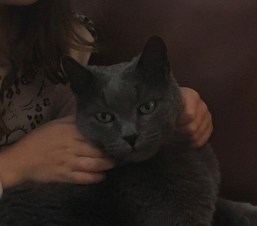
I’ve interspersed Tolkien’s illustrations with the last images from my northern adventure. Pippin and the children and I walked by the lake, and the stream flowing into it. We came home and snuggled again on the couch, with cats, and finished the last letters. I think we were all sad that the Tolkien children grew up!
“In my story Sauron represents as near an approach to the wholly evil will as is possible. He had gone the way of all tyrants: beginning well, at least on the level that while desiring to order all things according to his own wisdom he still at first considered the (economic) well-being of other inhabitants of the Earth. But he went further than human tyrants in pride and the lust for domination, being in origin an immortal (angelic) spirit.
“In The Lord of the Rings the conflict is not basically about ‘freedom’, though that is naturally involved. It is about God, and His sole right to divine honour. The Eldar and the Númenóreans believed in The One, the true God, and held worship of any other person an abomination. Sauron desired to be a God-King, and was held to be this by his servants; if he had been victorious he would have demanded divine honour from all rational creatures and absolute temporal power over the whole world.”
“You can make the Ring into an allegory of our own time, if you like: an allegory of the inevitable fate that waits for all attempts to defeat evil power by power.”
 It’s New Year’s Day according to our liturgical calendar, and special prayers for God’s blessing were included in our service this morning. What better time could there be for thinking about progress… or would devolution and even defeat be more realistic? I happened to read this passage today (I didn’t hear it in church) and just realized how it is connected, sort of. From a letter written by the Apostle Paul to his coworker Timothy:
 Father Stephen Freeman has written over the years about how this passage is in agreement with what J.R.R. Tolkien wrote in a letter many centuries later: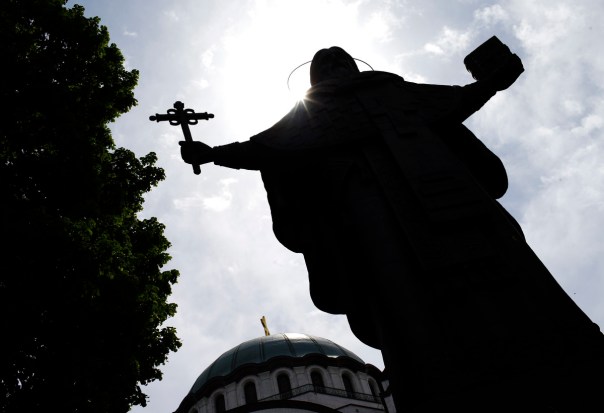
 On my last night with my family in Colorado, I took a turn along with their parents to read aloud to the children a chapter of The Hobbit. They had all been enjoying the book together before Christmas visitors and pastimes interrupted their usual routine, and the chapter we read that night took us suspensefully close to the end of the tale.


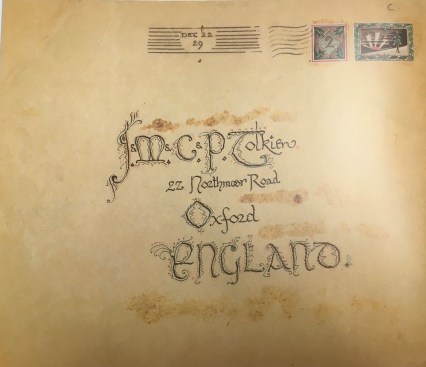
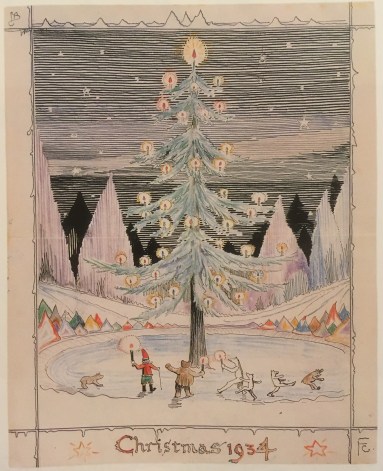 Recently I acquired Letters from Father Christmas by J.R.R. Tolkien, though in this case I think “recent” means 10-15 years ago. I’d glanced at them myself, but I think I was waiting to share the experience — to peek in on the Tolkien family and the stories that Tolkien the father created every year for his children. He wrote and illustrated them for over 20 years, starting by writing to three-year-old John, and continuing until he was only writing to his fourth child, Priscilla, with hopes that she will be hanging up her stocking “just once more.”

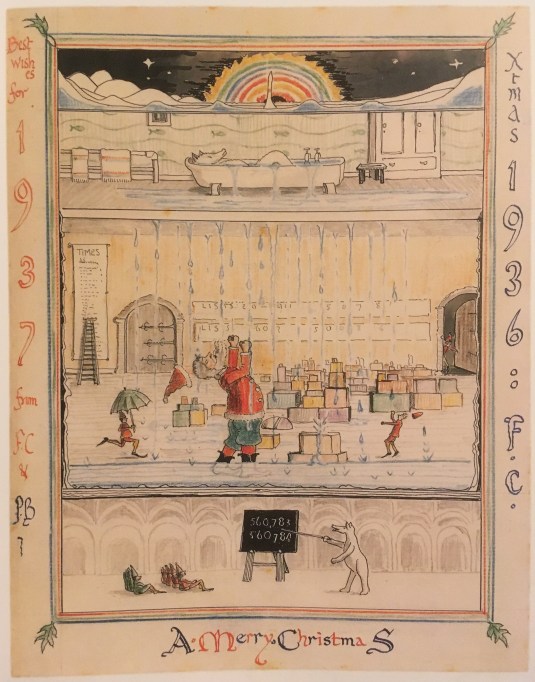
 “Another Christmas! I almost thought at one time (in November) that there would not be one this year. There would be the 25th of December, of course, but nothing from your old great-great-etc. grandfather at the North Pole.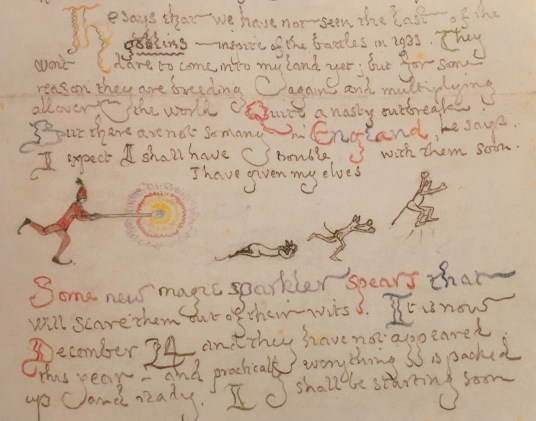


 have demanded divine honour from all rational creatures and absolute temporal power over the whole world.”
