Tag Archives: trees

Refreshed by a thousand things.

P1110460

Rain was forecast for both days that Mr. Glad and I had planned to be on California’s North Coast for immersion in the sights and sounds of the sand and waves. But we were undaunted; we just packed extra clothes in case we got soaked on our beach walks, and noted that our hotel room had a (gas) fireplace we could sit next to and cozy up.

P1110483The drive over was only drizzly, and by the time we arrived and ventured out on the bluffs and the shore, the clouds only threatened and did not drip. All the rain fell when we were eating dinner, and while we slept. Wasn’t that a sweet gift from the Father?

We spent our first day in the town of Fort Bragg. This small town did start out as a military fort in 1857, established for the sole purpose of maintaining order on an Indian reservation.

Lumber milling is part of the town’s history, too, and of its presenP1110486t. The old railroad trestle left from when logs came by train from the north evolved into a road and then into its current use as a pedestrian bridge over Pudding Creek where it empties into the Pacific.

At the southern end of the trestle is Glass Beach, another attraction with interesting history. According to the man who has set up the Sea Glass Museum (and store) in town, it has been common through the ages for seaside communities to have garbage dumps at the beach, and much of the garbage would wash out to sea. At Fort Bragg, he says, the ocean currents were atypical, and kept the garbage close to shore. The broken glass was kept in the swirling seawater-tumbler close at hand.P1110494

We didn’t take the time to visit the beaches with the most abundant fields of sea glass, but even the little cove we did examine was thick with fragments of colored and frosty white, what started out as clear, glass.P1110592

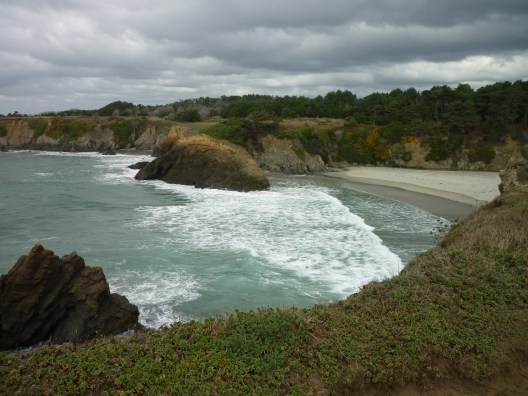
MacKerricher State Park is just north of Fort Bragg, and there we walked on the boardwalks that get you out to the beach with as little damage as possible to the coastal plants. We spent most of our time gazing out at the surf, and walking along the bluffs. We looked into tidepools and watched seals bobbing in the waves. This map of the whale migrations may also help some of you simply to get an idea of where we were.P1110579


I found myself this far behind my husband because I made so many stops to shoot photos of little wild radish flowers that were in the lee of the boardwalk and not blowing too wildly.


P1110577crp

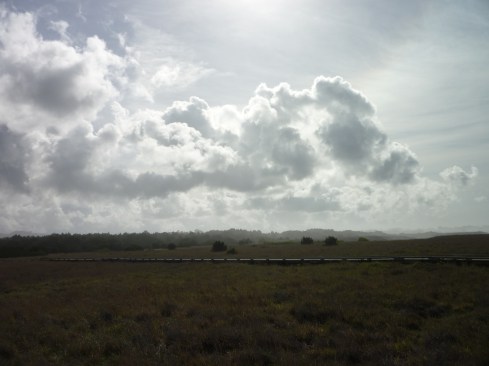
At this time of year the dominant colors are blue and brown and grey, and it’s easy to overlook points of contrasting brightness.
P1110581

Back in our room resting before dinner, we were able to leave the door open to the breeze and the cool, damp air, to listen to the surf and watch the gulls swooping past. Below our balcony was the nearly 10-mile long local section of the California Coastal Trail, this part stretching from Fort Bragg to MacKerricher Park. Under the roar of the surf we could hear voices of people walking or bicycling by.

P1110498crp


Even in the middle of the night Mr. Glad opened that door and the instant refreshment invigorated my dreaming.


P1110554

But I must backtrack and show the one food picture I took. Cheesecake is somewhat conventional and boring as a photographic subject, but we wondered how the stellar rasberry decoration was created – shot from a gun, perhaps?

P1110504

Our breakfast was delicious but even more commonplace. It was the compact little restaurant that was unique and appealing; we had eaten here once years ago and wanted to return. The place is called EP1110518gghead’s, and the theme is The Wizard of Oz. The room is about as wide as Dorothy and her companions standing in a row, and all its decor relates to the story: red shoes, posters of the movie or play, photos of Judy Garland.

Above the kitchen door at the back is a sign: “Nobody Gets in to See the Wizard, Not Nobody Not Nohow.” But actually, to use the restroom one must go through that very kitchen out the back door, where one finds a Yellow Brick Road leading to this shack:

P1110521…where even the comics taped to the wall keep to the theme.

We left Oz fortified for our remaining day of explorations. In addition to more beach time, there were art galleries to peruse, a visit to the Mendocino Headlands and a lunchtime experience that requires a separate posting.

Last, the long drive back through Anderson Valley where we hadn’t been in so long. When we turned away from the coastal bluffs the scent of the air lost the elements of kelp and salt and moisture. Suddenly the smells of the dry conifer forest, with its spicy bay tree accents, filled my senses. We drove along like this for an hour, and I was contented.P1110650crp1
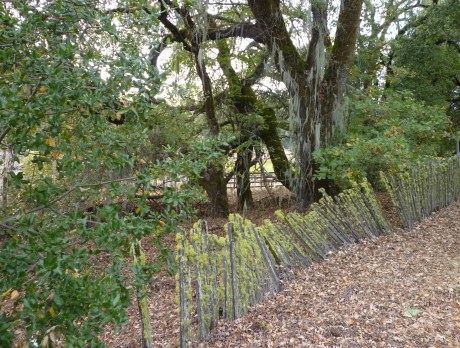
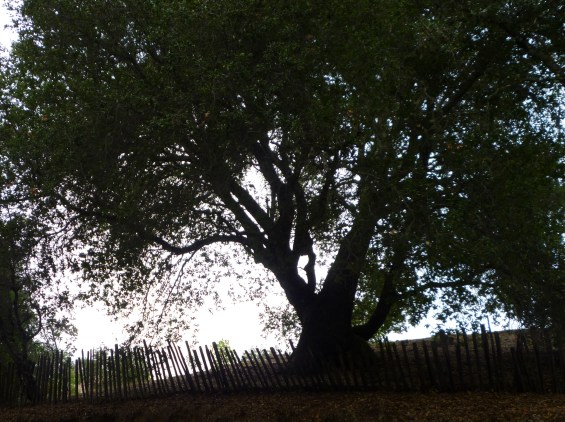
Except for a bit of queasiness from the windy road, which forced us to stop and get out for a few minutes, but it was at a comfortable and lonely place featuring aromatic oaks, a fence overrun with moss and lichen, and the glossy leaves of madrone trees. The leaf mulch under these trees was incredibly thick and spongy. If we’d had a picnic, and preferably a picnic table to go with, it would have been the perfect place to prolong our mini-vacation.

But lacking those amenities, we continued on our way back to civilization, and here we are again. We may look and feel pretty much the same as we did a few days ago, but our quiet adventures have changed us. At the least, we have a thousand more things to thank God for.
P1110654


Ántonia’s apple orchard

Willa Cather’s novel My Ántonia holds a special place in the hearts of both Mr. Glad and me, perhaps in our conjugal heart ? by reason of our sharing the story together more than once, and reading it on our own as well. When I’ve read it aloud it’s not uncommon for me to start sobbing at places in the narrative where the pathos hits home.

I was surprised to read recently a review in which the reader did not enjoy Cather’s writing, saying it was dry and lacking emotion. Those qualities might be why I appreciate her skill at capturing the story and drawing us in. Cather gives us the perspective of Jim, and we experience with him as narrator the various levels on which he is in love with our heroine and all that she represents, and he makes us fall in love with her, too.

Our differing response from the reviewer above probably has something to do with what we bring to the story. Though we haven’t lived in Nebraska or known any Bohemians, perhaps we are like Jim (and Willa Cather) in our grieving for the past, for the lifestyle of the pioneers and their farm life, for the good hardworking people we have lost; as I understand it, that was a theme that reappears in many of her works, but she accomplishes it without what might be called “emotional” prose. Mr. Glad and I both have farming in our roots, and our love for nature and the outdoors (and for people) is only encouraged and expanded by reading books like this.

I thought to transcribe some passages from the book on my blog, representative snatches for my own enjoyment and yours, as a way to savor again some moments from my reading experience, and perhaps introduce people who haven’t yet made friends with these characters and their world.

In the novel, there is no question but that Jim must leave the country life and go away to school and to city life. The passage below is from the last part of the book when he returns many years later for a visit, and I appreciate the way it conveys something of Ántonia’s character and also the mood of this season of the year.

At some distance behind the house were an ash grove and two orchards: a cherry orchard, with gooseberry and currant bushes between the rows, and an apple orchard, sheltered by a high hedge from the hot winds. The older children turned back when we reached the hedge, but Jan and Nina and Lucie crept through it by a hole known only to themselves and hid under the low-branching mulberry bushes.

“As we walked through the apple orchard, grown up in tall bluegrass, Ántonia kept stopping to tell me about one tree and another. ‘I love them as if they were people,’ she said, rubbing her hand over the bark. ‘There wasn’t a tree here when we first came. We planted every one, and used to carry water for them, too — after we’d been working in the fields all day. Anton, he was a city man, and he used to get discouraged. But I couldn’t feel so tired that I wouldn’t fret about these trees when there was a dry time. They were on my mind like children. Many a night after he was asleep I’ve got up and come out and carried water to the poor things. And now, you see, we have the good of them. My man worked in the orange groves in Florida, and he knows all about grafting. There ain’t one of our neighbors has an orchard that bears like ours.’

“…The afternoon sun poured down on us through the drying grape leaves. The orchard seemed full of sun, like a cup, and we could smell the ripe apples on the trees. The crabs hung on the branches as thick as beads on a string, purple-red, with a thin silvery glaze over them. Some hens and ducks had crept through the hedge and were pecking at the fallen apples.”

–Willa Cather

wintertime loves

We in the arid parts of the West have been exulting in rain the last week or so. It’s so comforting and even glorious to wake in the night and hear the rain still coming down. Then to wake in the morning and see it is still falling. We had puddles in the back yard! Thank you, Lord!
Mr. Glad and I do live in northern California, but daughter Pippin lives even farther north in the state, and we drove there early this week for a short visit. Often February is a very snowy month at her place, but this year they’ve had more dry weather and rain than snow, and even the rain stopped while we were there, so we could get outdoors easily for work and recreation.

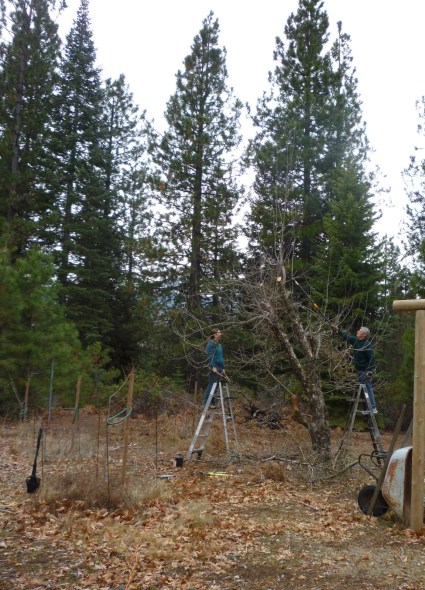
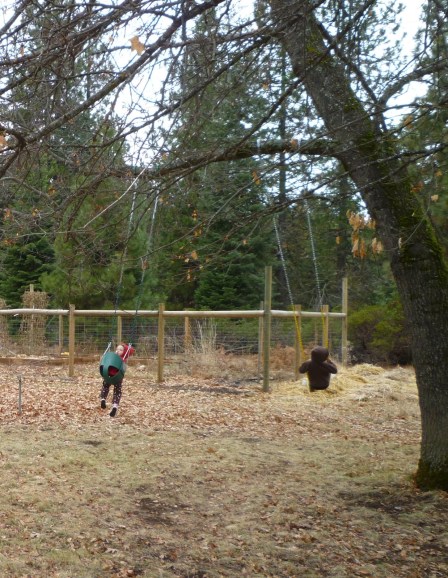
One day we made a family project out of pruning old apple trees that Pippin and The Professor are trying to revive from years of neglect. I floated back and forth between lopping branches and swinging the kids.

I would get Scout and Ivy going and then run over
to take a picture of the adults on ladders.

Another day we took a short trip to Castle Crags State Park and walked a trail alongside the Sacramento River. Considering the dryness of this year, I was amazed at the thick moss and ferns.

 A pale green, almost white lichen grew on rocks and tree stumps.

yew trees on the riverbank

Everything was wet from the recent rains, and many times our feet slipped on the invisible mosses — or was it algae? — growing on wooden bridges or river rocks.Ivy practiced throwing pebbles into the river, and once she got the hang of it she did not want to do anything else. The supply of rocks was endless.We went to the confluence of Castle Creek (in the foreground below) and the Sacramento River, from which you can get great views of the jagged rocks above, called the Castle Crags. They are high enough that the recent precipitation there was in the form of snow, and some was still unmelted and visible.


My dear husband showed me this large and artsy rock, which you can also see in the photo at the very top of this post, in its original setting. I wanted to take it home. It was a little too heavy for me to carry, so The Professor hauled it back to the car. It came with us on our journey home and is now living by our house. Mr. Glad classified it as a confluitic rock. 🙂

Winter days are short enough that at the end of our busy days there was plenty of time for cozy gatherings in the kitchen or by the wood stove. I read many books to the children. Scout’s current favorite, which I read about on a blog before Christmas and gave to him, is Bumblebee at Apple Tree Lane, and we read it several times.

Ivy likes The Little Fur Family best right now. We danced to the children’s favorite recordings, and also listened to bird calls on the Stokes Field Guide to Bird Songs CD. After ten minutes of loons and other waterfowl, Ivy must have deduced that those bird songs were some kind of dance music, too, and she started twisting and prancing around.

Hot soup is what you need on a winter’s night, so Pippin and I learned how to make French Onion Soup, using the recipe in The New Best Recipe: All-New Edition by Cook’s Illustrated Magazine. The secret that the Cook’s testers learned is that red onions give the best flavor. Our result was sooo good.

And cookies! Pippin had some dough left in the freezer from her Christmas Peppernuts, the recipe that I concocted a long time ago but haven’t made for years. We like our nuts to be nut-sized, so we always cut the frozen dough into little cubes and bake them long enough that they come out crispy. Next Christmas I’ll give the recipe.But for now, since I do love cookies, they make a good ending to my story of a wintry family visit that was warm and sweet.

peppernuts 13-14

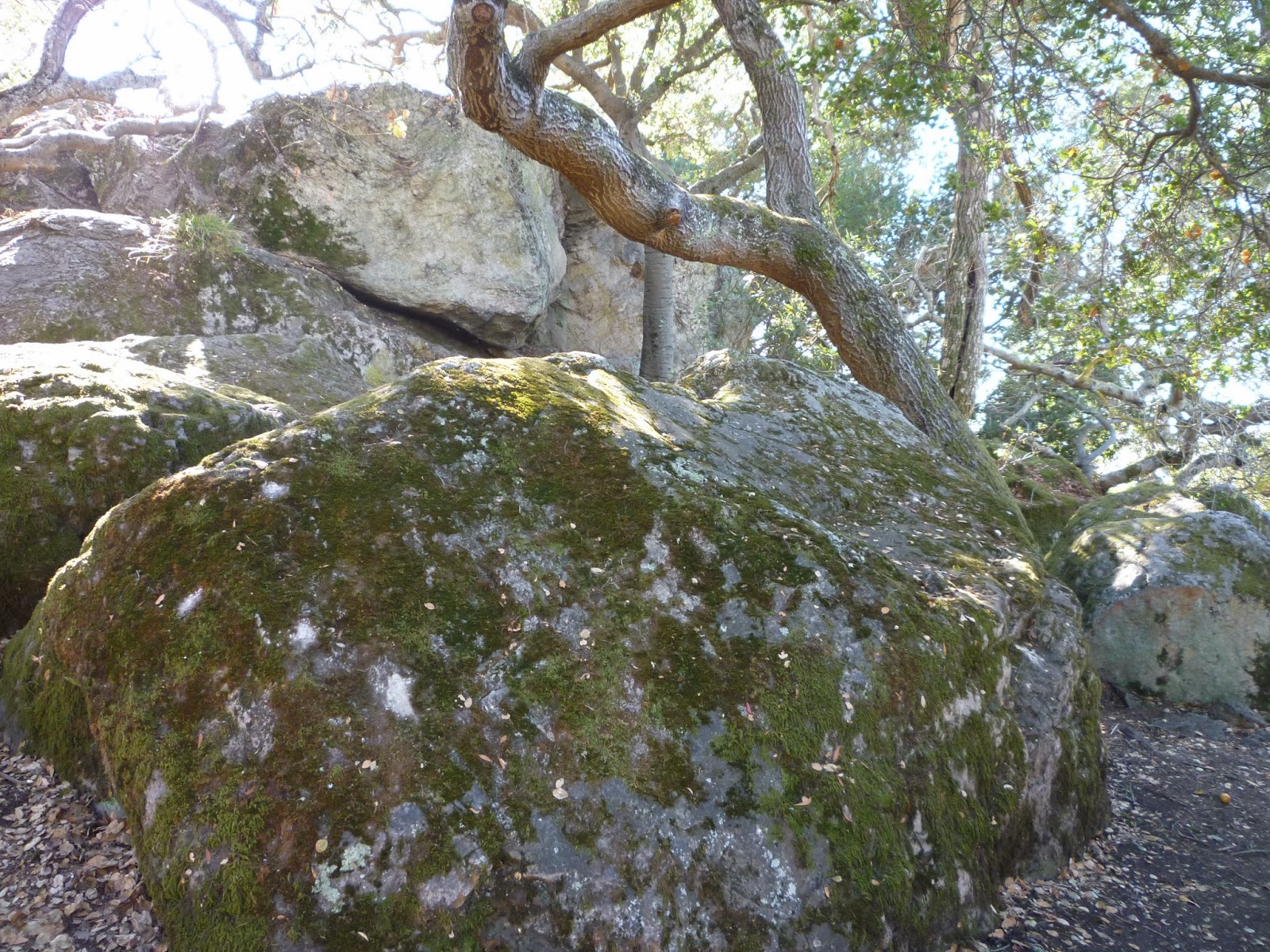
How long will the rocks of Berkeley last?

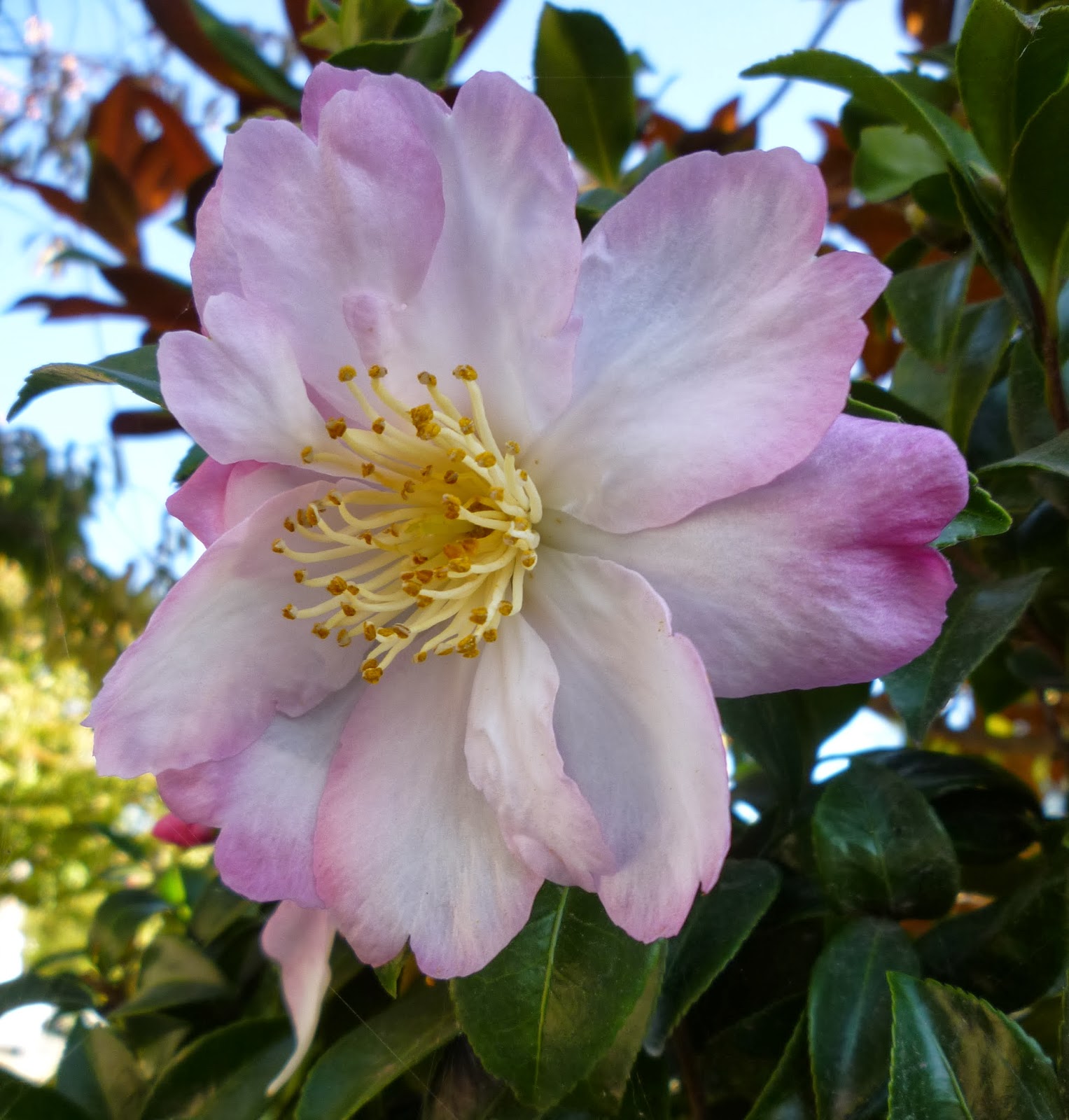
Berkeley Camellia in October

My sisters came to visit, and for the first time in about 50 years we returned together to places in Berkeley where we used to play. None of us has ever lived there, but as children we visited our maternal grandparents every summer.

Both of our parents had grown up in Berkeley, and last week we walked and drove the mostly hilly streets to find several of the houses in which our grandparents and our father and his sisters had lived. Of course we also stopped and stared at our other grandma’s house, savoring the memories that had been born in us there.

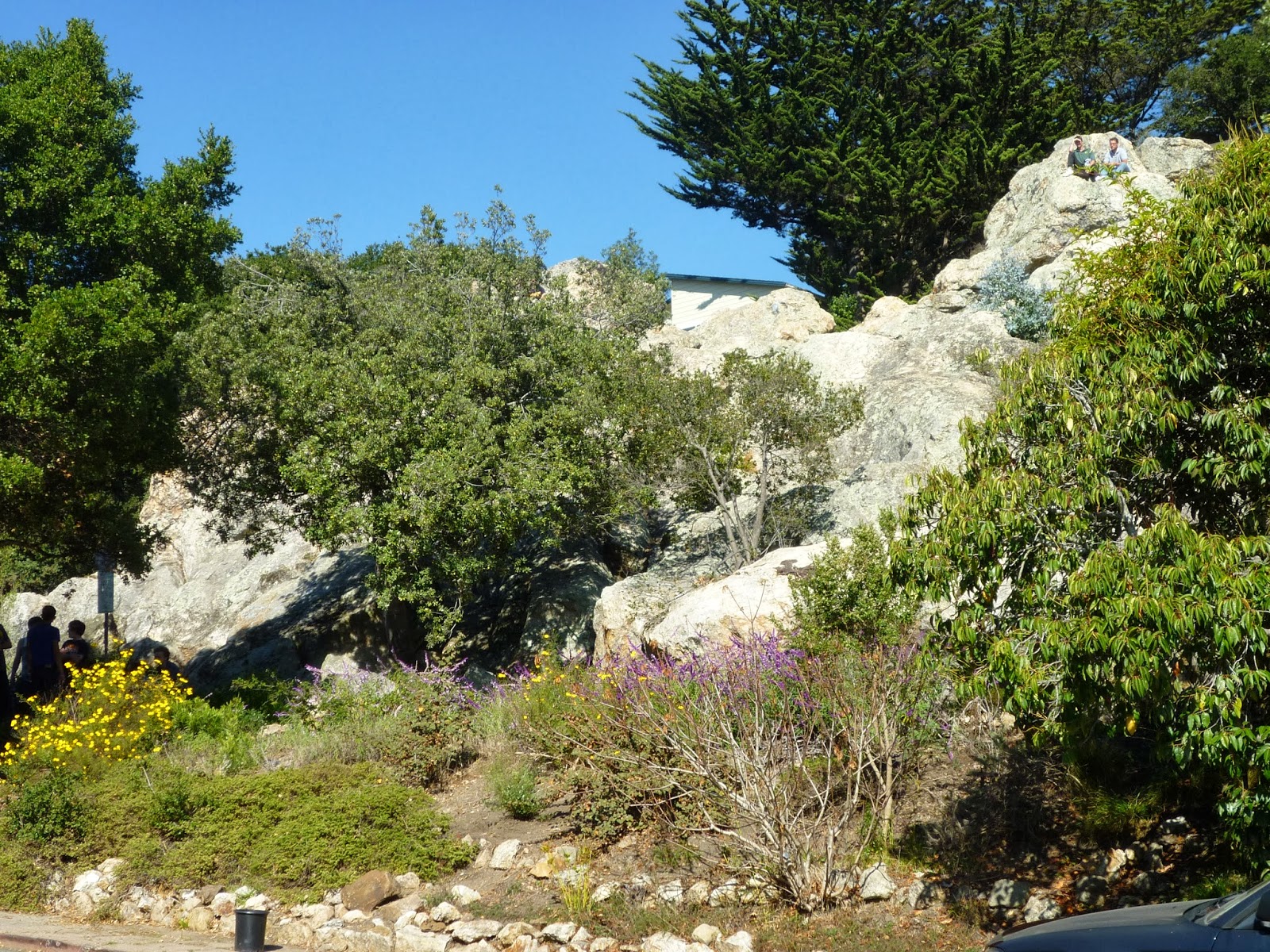
Not far away is Indian Rock Park, of which you can see pictures in my post about the neighborhood where Grandma and Grandpa lived for half a century. Indian Rock is huge — but not as big as we remembered it. And the park includes massive slabs and lava stones directly across the street, which I don’t know if I’ve ever played on. We didn’t go there this time, either, but climbed to the top of Indian Rock itself and sat a while, looking out over the tops of a thousand houses to San Francisco Bay.

Down Indian Rock Path

Not for very long, though, because we wanted to skip on down the steps of Indian Rock Path to Solano Avenue shops. Well, maybe not skip. But skipping is probably what we used to do!

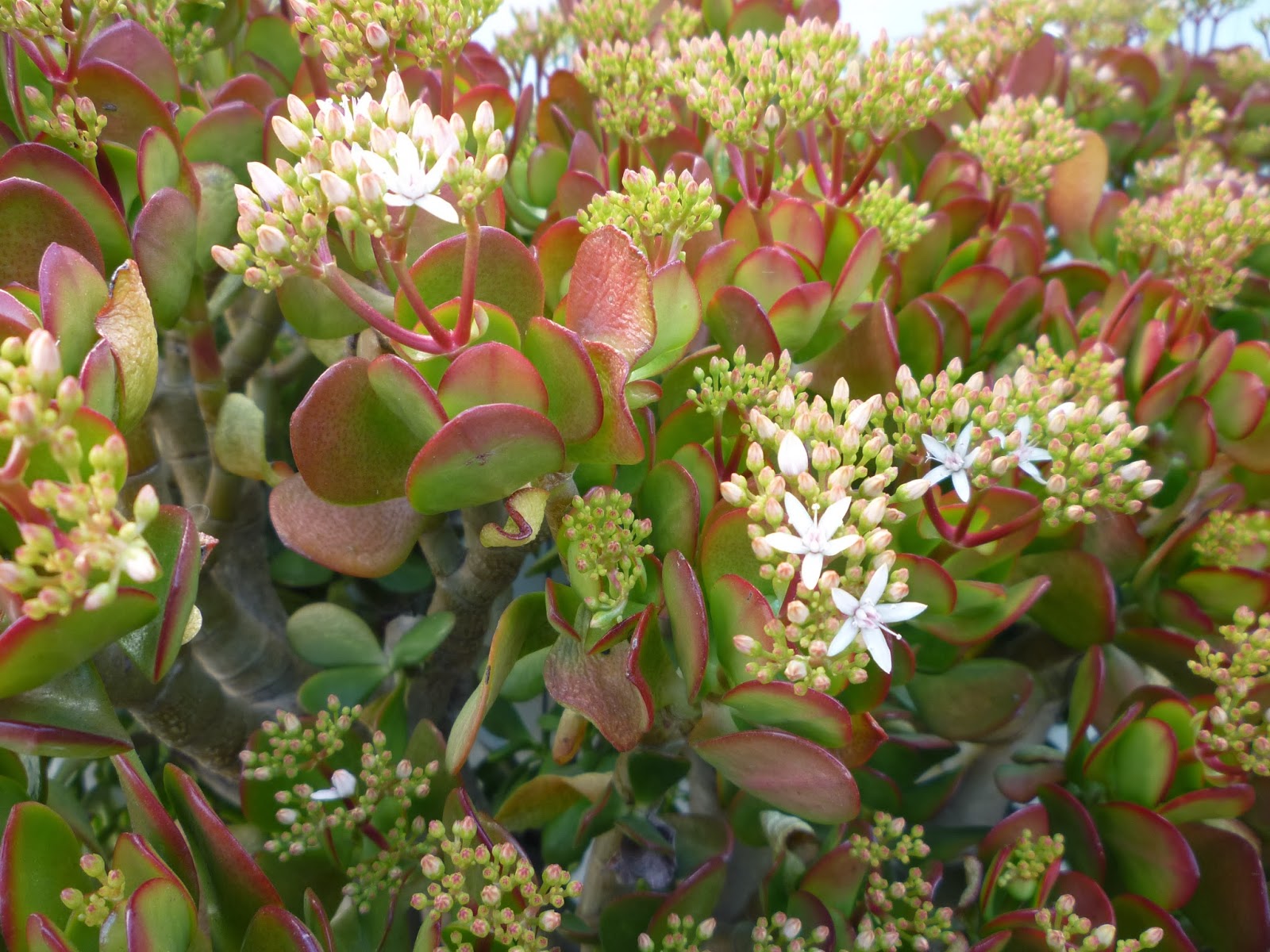
Jade plant in bloom on the path

In our memories the excursion to the ice cream parlor took much longer than what we found this time, even though we have passed the age when one can be unconscious of one’s legs and feet whether walking uphill or down. That shop has a new name, but the wares are similar, and you can look at old scoops while you wait.

After lunch, because we wanted to return to the higher neighborhood, it was necessary to hike up, and this time we took the steep route of Marin Avenue. Again my experience seemed altogether different from that of years ago, when most evenings after dinner Grandma, at an age greater than any of us have reached yet, would lead us on brisk neighborhood walks. It was slower than then. And the crucial person was missing.

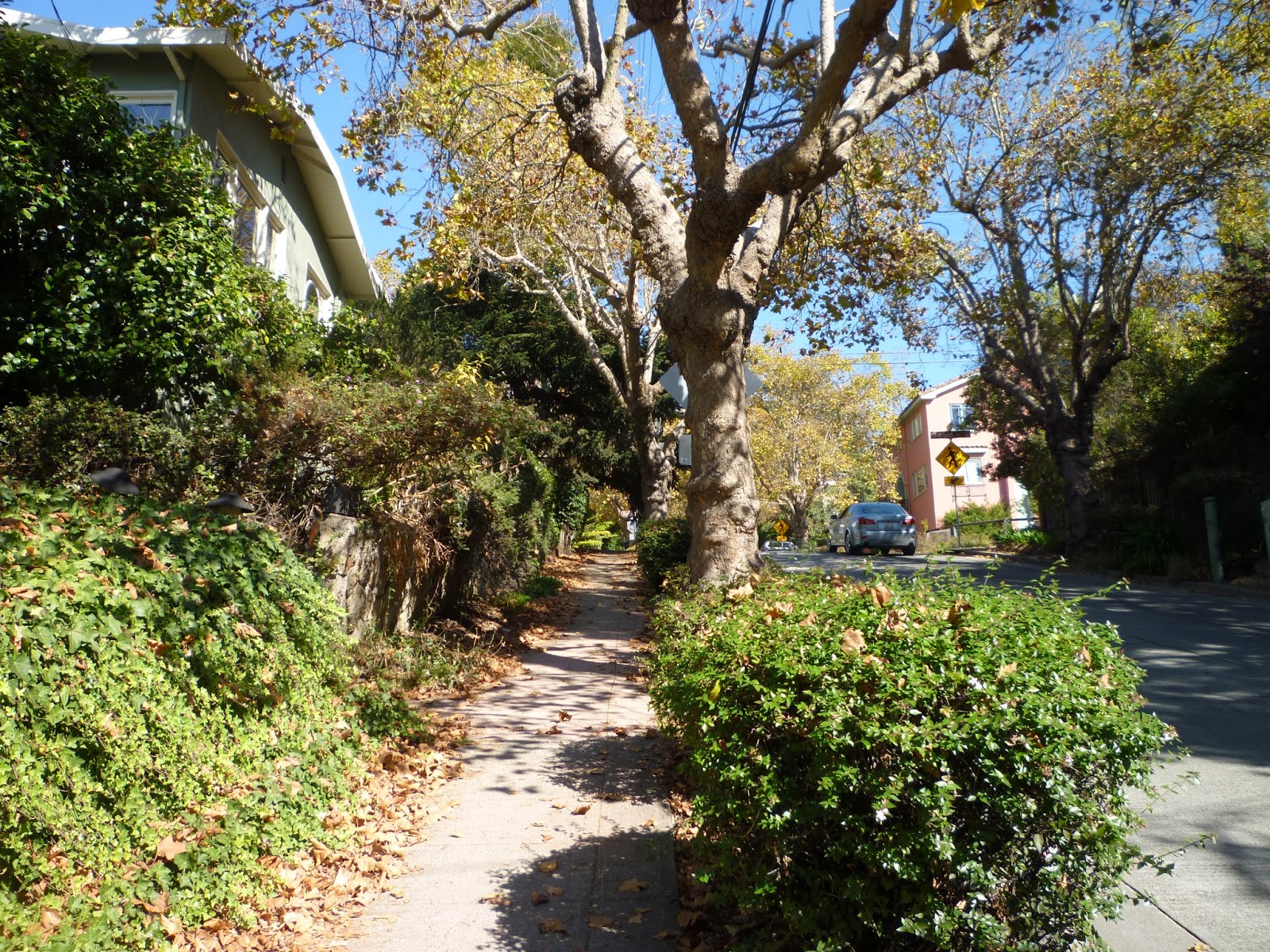
Marin Avenue is a hike.

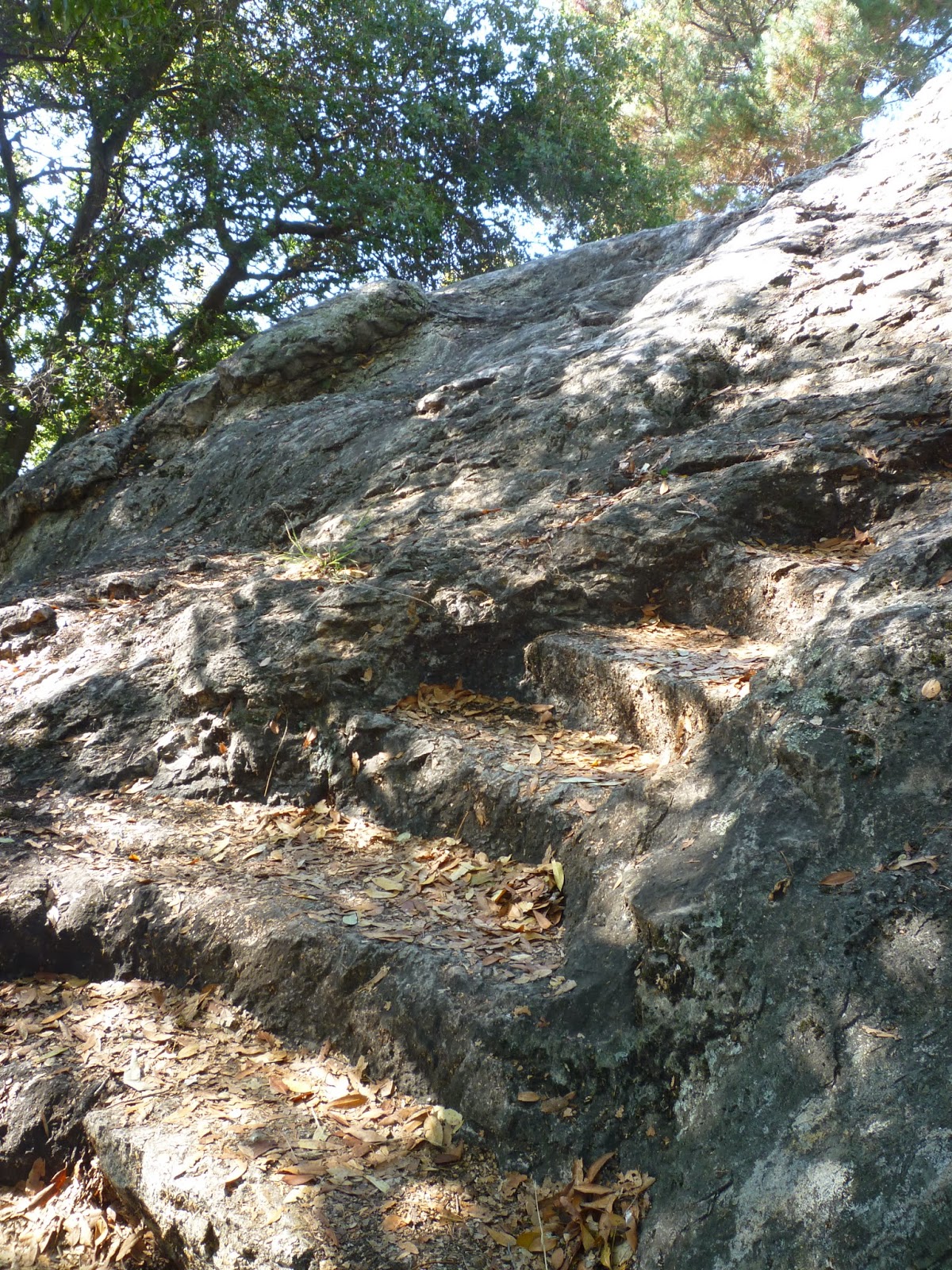
Mortar Rock steps

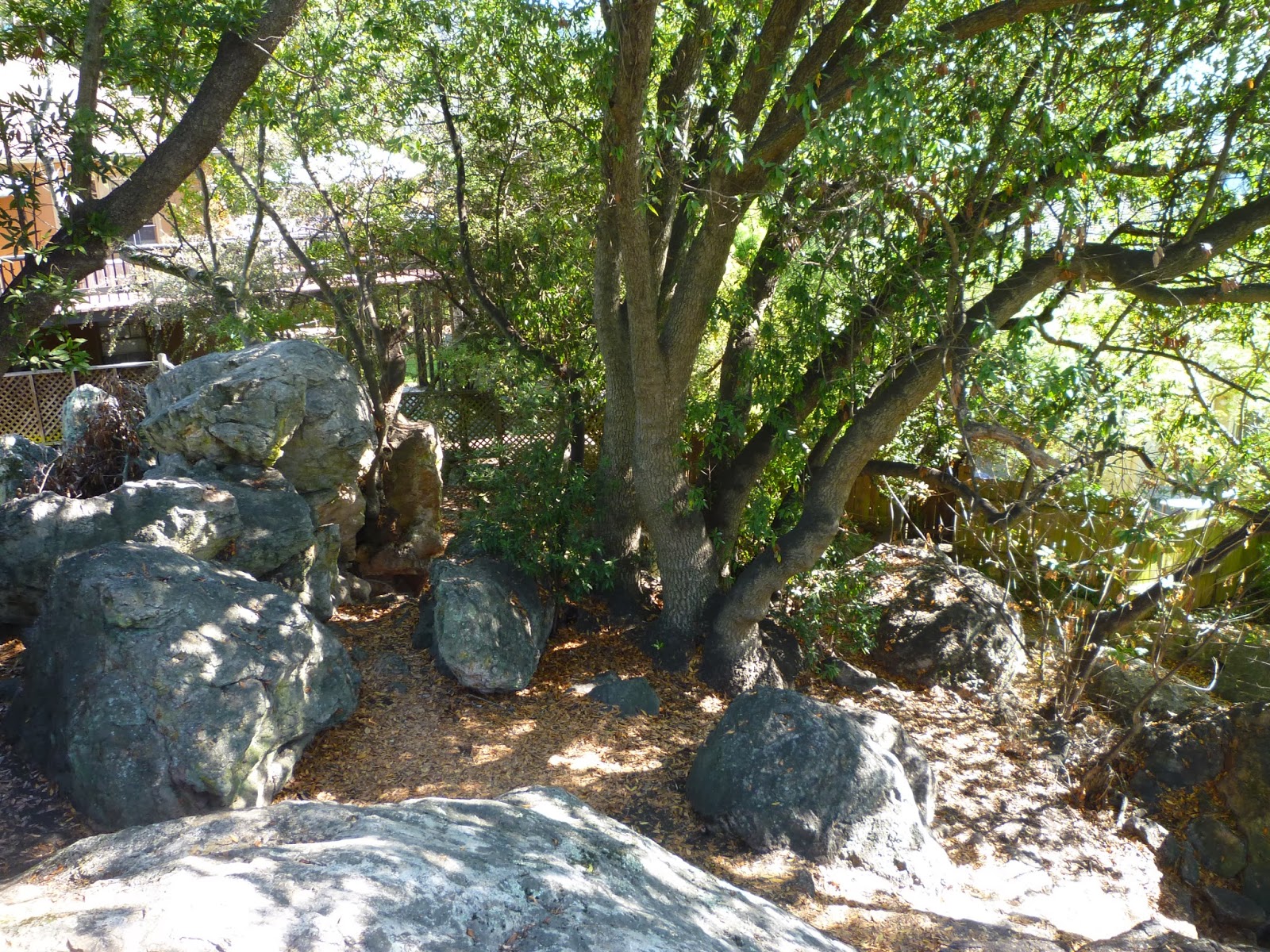
We circled back to Mortar Rock, just around the corner from Indian Rock, and wandered there longer, just as we used to play there longer in our childhoods. More of those stone surfaces are easily climbable, and Grandma always felt better about us going by ourselves, because we didn’t have to cross a busy street to get there.

The houses next to these parks and paths don’t have much privacy. In this picture you can see how close they are, and how there are not fences blocking them from park goers and their glances.

When I first put my feet on the dry paths of Mortar Rock Park, suddenly a familar herby smell registered in my senses, making me look down to see long pointy dead leaves underfoot, just as my mind was linking to “bay tree.” I lifted my head and saw that the dappled shade was cast by at least two tall old California Bay Laurels (along with oaks and buckeye) whose several large trunks were curving high over the rocks.

And yes, there were the grinding mortars in the rock, empty of anything but leaves at this time of year. Do children still pretend to be Indians grinding acorns in them?

One of the houses we were searching for was only a few blocks from here, so we walked up the street, admiring the many flowers still in bloom in this mild climate. Banks of fuchsias always remind us of the long row of them that grew along the brick path in Grandma and Grandpa’s back yard.

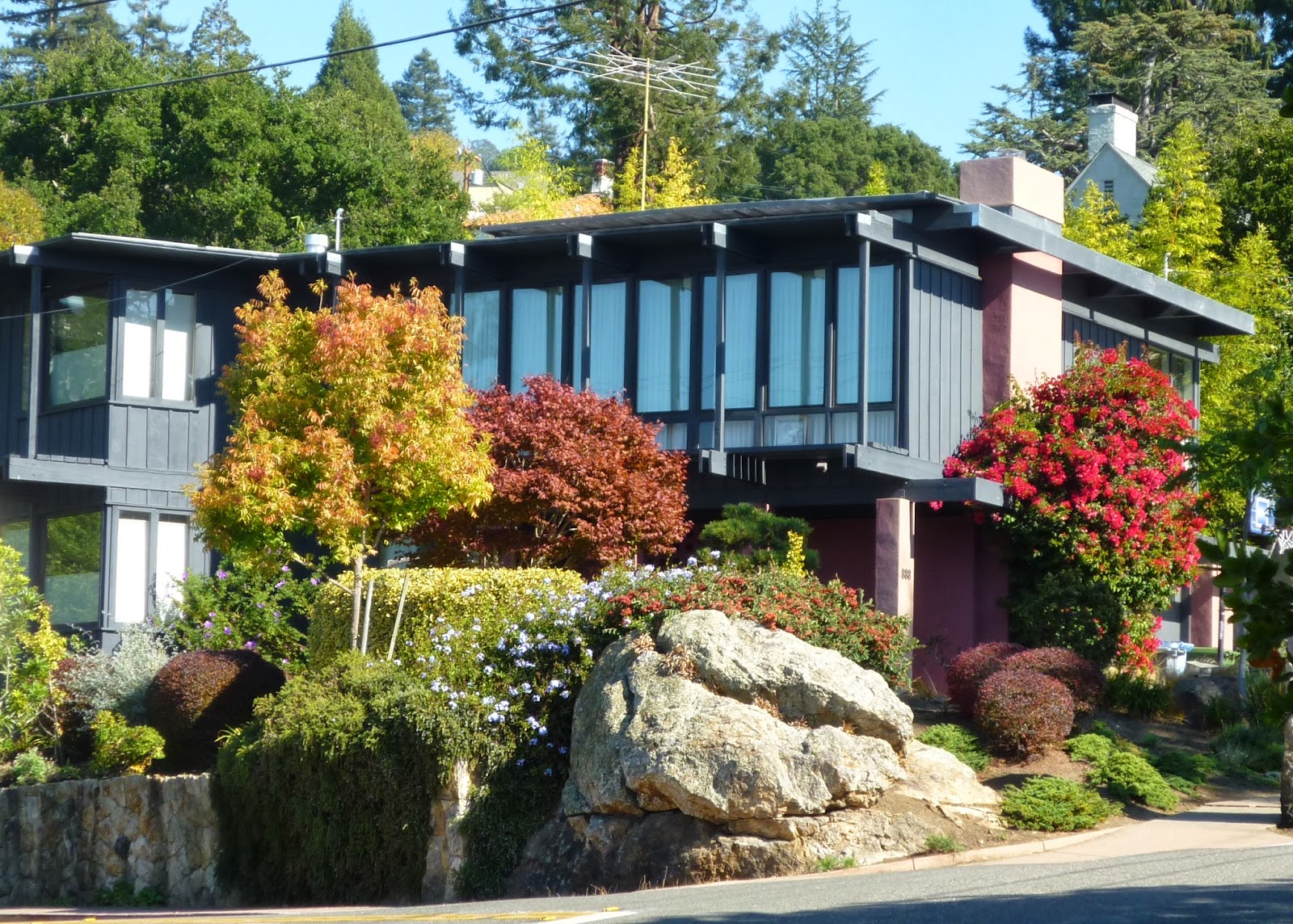
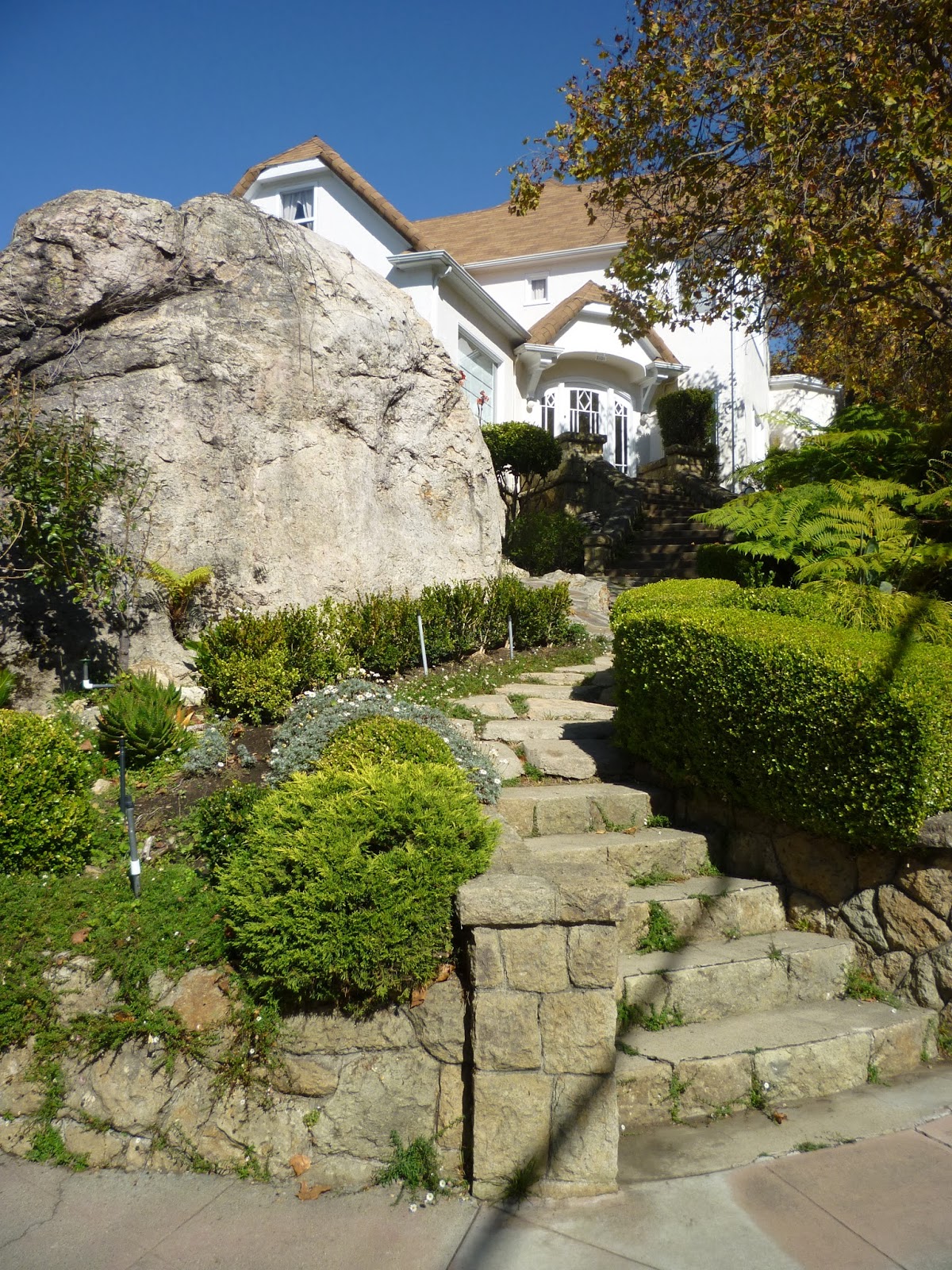
More rocks! This house, though modern in design, has a very traditional and unchanging boulder to distinguish its front yard.


This one’s even more of a monolith. Having such a thing in your front yard would certainly lend drama to the landscaping. I wonder if the owners of the house are helped to keep a humble perspective on their lives, with the antiquity of their mineral friend constantly looming. So solid, and not going anywhere.

Lots of giant volcanic rocks dot the neighborhood. I saw these I didn’t remember on Santa Barbara Avenue, taking up a lot or two.

Rocks on Santa Barbara Ave., Berkeley CA

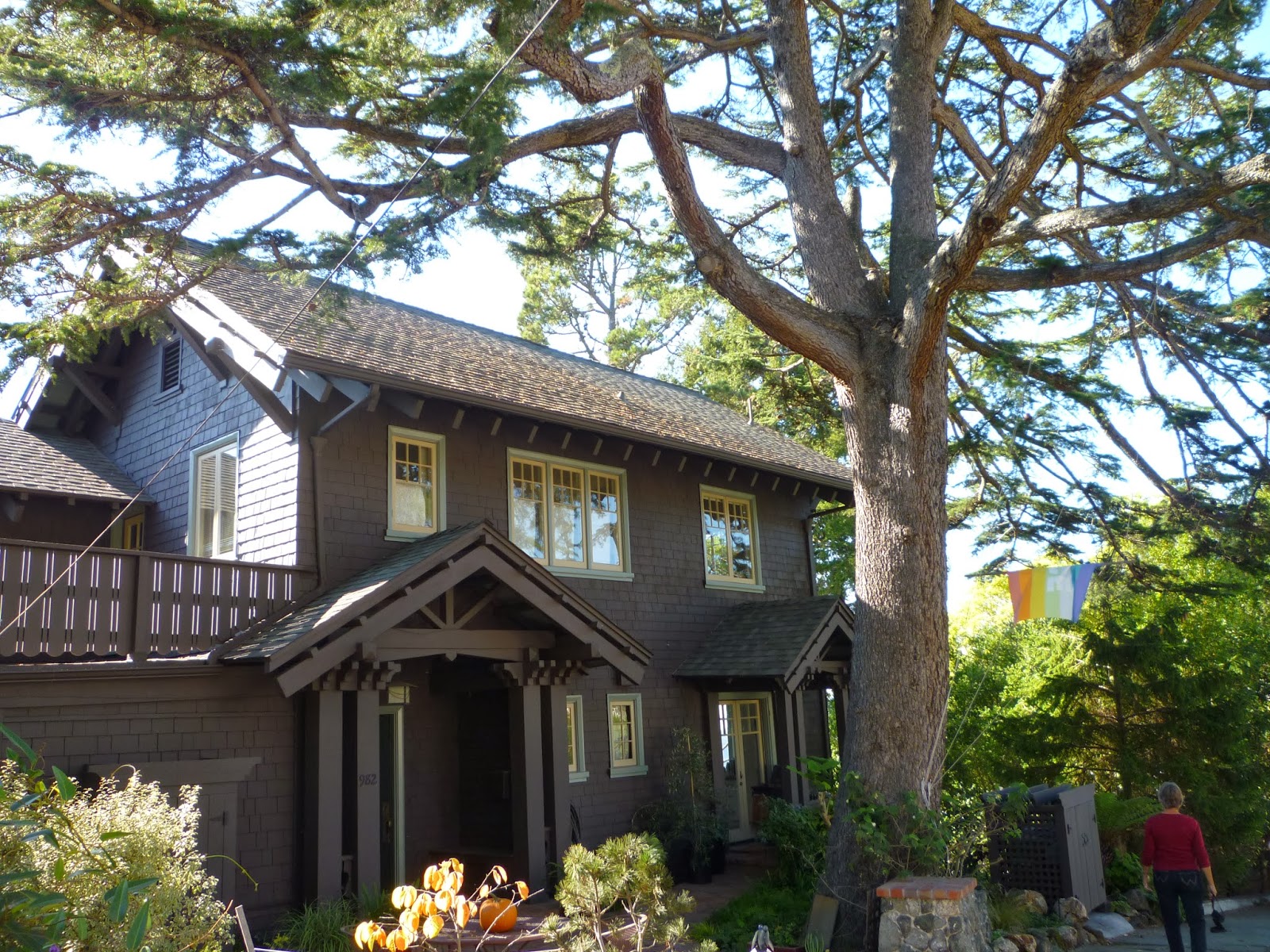
The weather was summery, and we seemed to walk always up, and up. It felt good to stop frequently to snap pictures of fall color or late summer flowers. Eventually we arrived at the first house of our father’s on our list, on Santa Barbara Avenue.

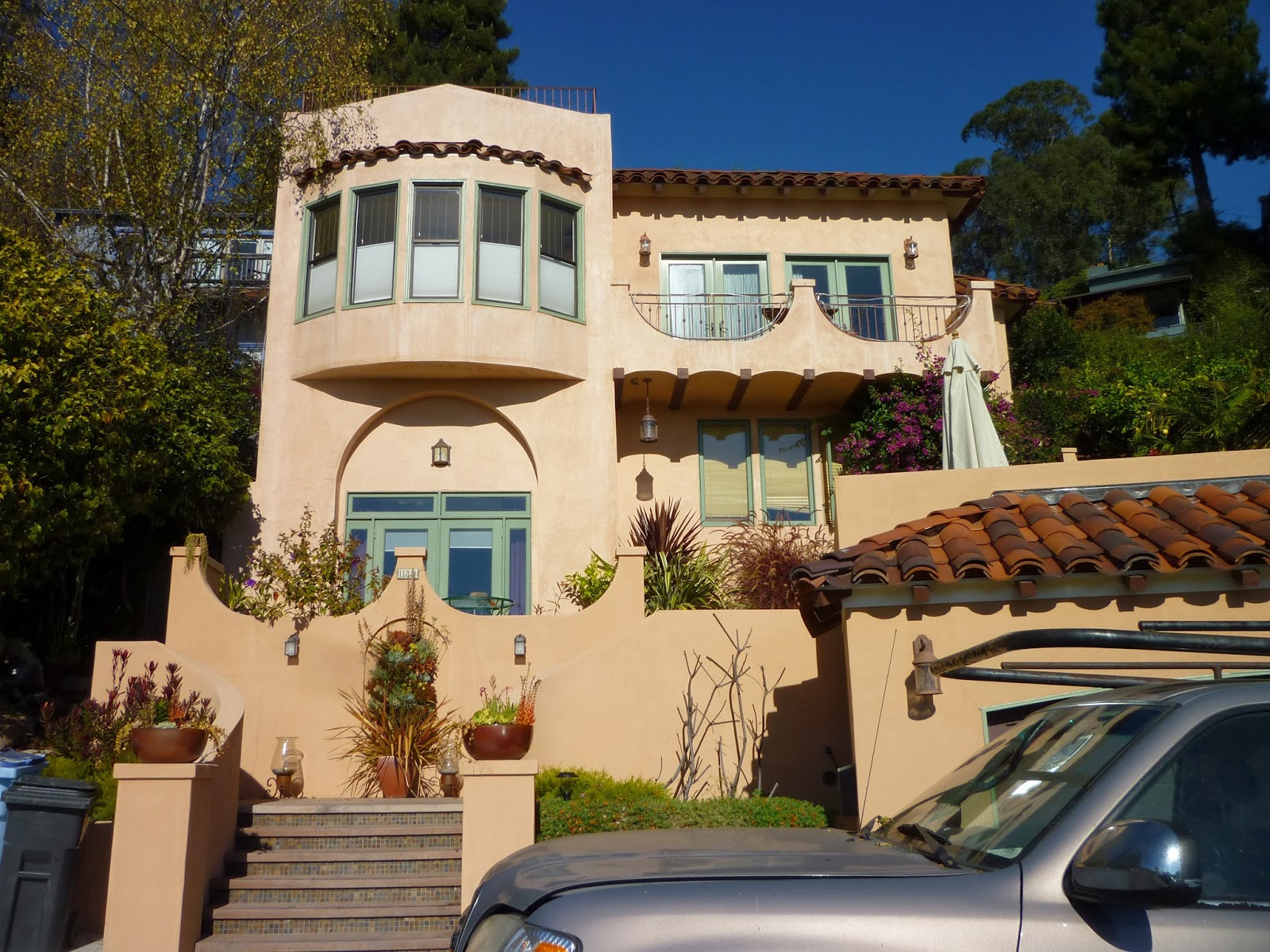
Another childhood home of my father, on Euclid, has had a facelift recently — we compared it with photos from 15 years ago when a patriarchal tree must have blocked the view and the warming sunlight, and the color was white. Paint and trees and even whole houses are easier to change or remove than those giant rocks.

Euclid house

And though it seems ages ago that we walked these streets together, and slept in the Berkeley bedroom wondering at the city lights spread out before us, most of these houses are not more than a hundred years old. Young things, really.

We went back to our car and drove to a few more houses, none so photogenic now. We bought gas at the station where our grandma used to buy hers, and we shopped at the market where she used to shop. We ate dinner at Spenger’s Fish Grotto where we’d eaten many times with our grandparents. And then my dear sisters and I finished our day with shopping at our grandma’s favorite Park & Shop market, now Andronico’s.

But a little earlier in the evening we’d added to our tour a visit to the cemetery where both Grandma and Grandpa are buried. None of us had visited since the last graveside service almost 20 years ago, and it took some exploring to find the marker. I felt closer to Grandma and Grandpa there at their grave than I had on the street in front of their house.

Cemeteries are where one finds another sort of stone, markers of lives that grew up like grass, and withered and died, most with life spans briefer even than flimsy wooden houses and certainly shorter than those huge stones people built neighborhoods around fairly recently. At the end of time, we read in 2 Peter, “… the day of the Lord will come as a thief in the night; in the which the heavens shall pass away with a great noise, and the elements shall melt with fervent heat, the earth also and the works that are therein shall be burned up.”

Indian Rock and all the granite in the Sierras, though it’s been around longer than we can imagine, will be gone, along with houses and gravestones. Then what is most enduring, the souls into whom God breathed life, will be raised. We are what on this earth is eternal.