Granddaughter Maggie was here for a few days with her mother Pearl. Maggie continued her road trip back to college but Pearl is with me still. They fill my heart and my days by being their sweet selves. Since I typically do all my own work, I am constantly startled when I notice that someone is loading the dishwasher or shredding the lettuce for tacos or whatever task, before I even get to the point of realizing it needs doing.
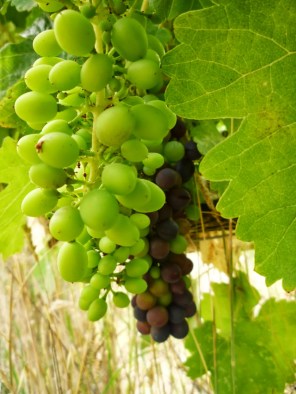
We went wine tasting for a short while one day; at one vineyard we took a one-mile walk through the rows of vines, and it smelled really good in there: chardonnay, cabernet, syrah, viognier, dried grass, all lending their scents to the air, but mildly, because it was a coolish day.
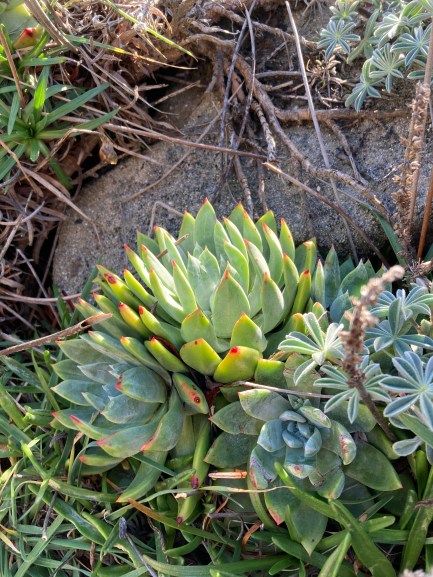
Ice plant at the beach.
The next day, to the beach! Pearl and I walked down the shore quite a way, and when we came back we all just lay there in the sun. I lost consciousness for at least a few minutes, lying on my back with the sun heating my face through my hat. As we stared out past the edge of land to the vast Pacific, Maggie said that the ocean seems to our eyes as big as outer space. I thought how nice it would be if I could restart the regular beach outings that I made so often in 2020 and 2021.
My granddaughter spent quite a while collecting tiny pieces of sand. She was conceiving a plan to use them in the Instagram-alternative scrapbook she is starting; she will glue them on to the page and then paint over them with clear nail polish so they might continue to look wet.
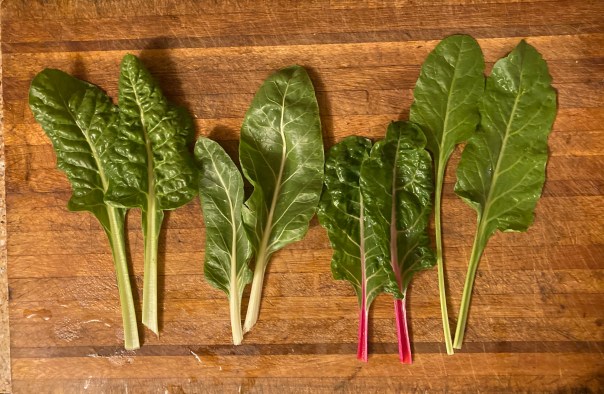
That evening we were able to sit on the patio for a dinner that I made, which included chard from my garden. I had washed it up a few days before, during which process I realized that I had four varieties of Swiss chard growing out there.
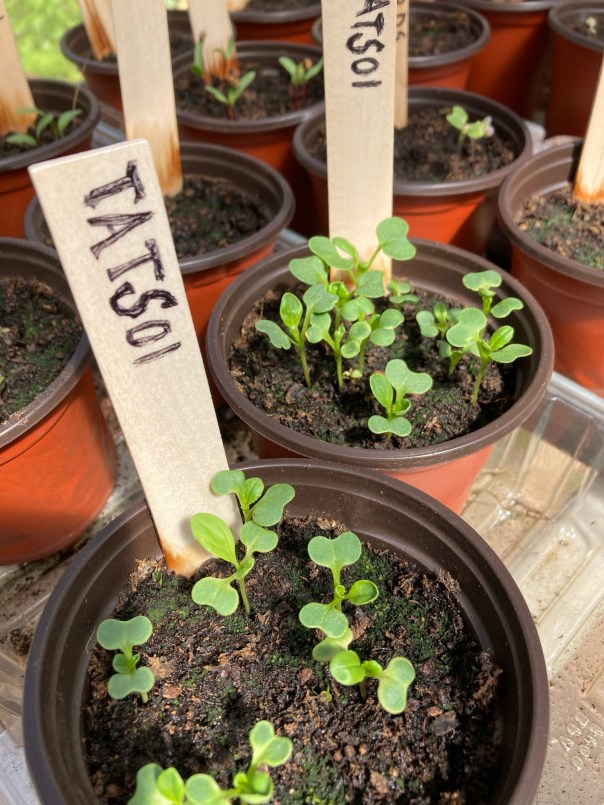
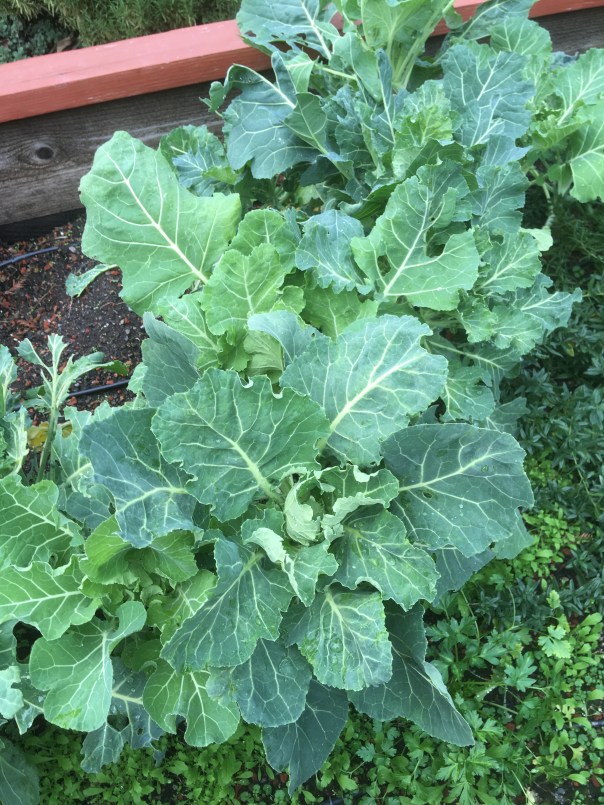
I pulled out some of that chard, to make room for new plants that I grew from seed in the greenhouse over the last month, and most of which I have set out in the planter boxes. Portuguese Kale, two varieties of collards, Italian Silver Rib Chard — and a new one from the mustard family: Tatsoi. Here it is when its true leaves were barely emerging.
Also Detroit Red Beets. If half of the seedlings I set out thrive, I should have plenty of greens to get me through the winter and into next spring.
Lastly, I show you the barrel planter, where the the snapdragons and Tropical Sage seem to take care of themselves and keep reseeding and blooming. The salvia that was pink for two or three years just last week sprouted stems of red-orange flowers. I saw them from the kitchen window, and had to run out right away to see what they could possibly be. When I give my attention to the garden, even just a little bit, it rewards me abundantly.
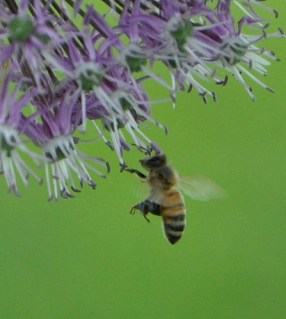
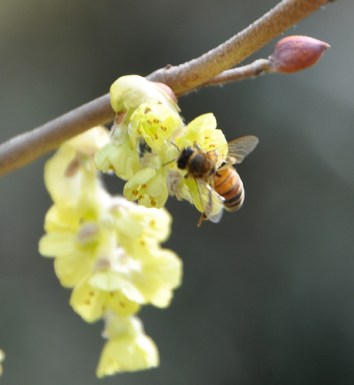
It’s eleven years !! since I wrote thispost at the Feast of Transfiguration, and focused on honey and bees. Since then I’ve posted several times about various aspects of the feast, and now I’m going to return to this one focusing on honey, that marvelous substance in great abundance all over the earth. Who can believe it? Only God could have thought of such a food. I’ve updated the following with some bee photos of my own, and kept my favorite honey pictures:
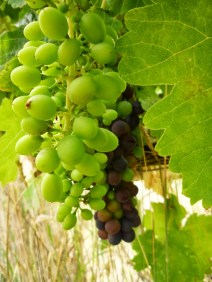
My parish is lucky enough to have our own vineyard right behind the church. This is very handy on the Feast of Transfiguration; at the end of the liturgy we can process out the doors and around the vineyard, to bless the grapes. It’s traditional to bless grapes or apples or any fruit, really, on this day.
Earlier on the feast day morning people brought into the church baskets of fruit and herbs and flowers. I carried a wooden bowl of blueberries and peaches. While we sang and communed and focused on the main event being commemorated, the fruit waited. The incense was particularly sweet that day, and I didn’t notice the smell of the beeswax candles as much as I usually do. Though I could see basil in a couple of the baskets, I didn’t catch its aroma either.
At the end of the service, with the prescribed prayers for the event, our priest (and all of us) thanked God for all His bounty, and then he sprinkled holy water over the representative sampling.
He explained to us that this is not a superstitious rite we perform, using holy water to do magic on the fruit. When we bless anything in this way we do not make it into something other than what it is, but ask God to reveal it to be what it has always been.
Whatever created things we are talking about, they have always been meant by God to bring us into communion with Him. The service of blessing of fruit brings our thoughts back to Paradise, and the right and good use of the fruits of the earth that God has given us. We are reminded of how in the beginning God made Adam and Eve to be stewards over the Garden of Eden; human beings were called to exercise a loving and thankful dominion over the earth.
Russia
But we by our sin have instead caused destruction on the earth. Mankind more often than not has overused, abused and consumed in perverse ways the gifts of the Creator. Personally, I often gobble my food and eat without attentiveness to Him.
We have prayers for the blessing of bees and beehives and honey, too, usually in a separate service. Around here it’s August 1st, but I found pictures of honey blessings in Bulgaria where they do it dramatically on February 10 (see the bright cross picture down the page).
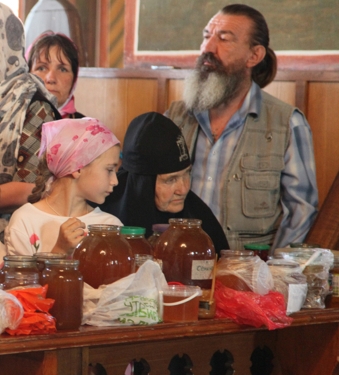
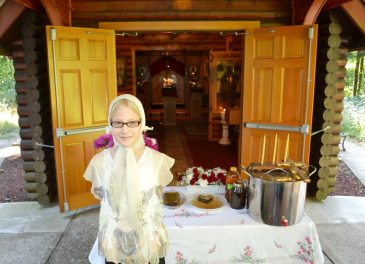
People like to take pictures of little girls and honey, I was happy to discover, and I am posting some of them here. The Russian ones are from Optina Monastery, and the Oregon photos from the Facebook page of New Martyrs of Russia Orthodox Church.
Father Ted Bobosh has posted a large photo collection of bees and other pollinators, along with quotes about bees and Orthodox prayers for them. Just looking at the pictures will likely make you burst into prayer, too. Here is one of the prayers he posted:
O God, who knows how to work benefits through human labor and irrational living things, You instructed us in your loving-kindness to employ the fruits and works of the bees for our needs. Now humbly we beseech Your majesty: Be pleased to bless the bees and increase them for the profit of the human race, preserving them and making them abundant. Let everyone hoping in Your majesty and Your boundless compassions, and laboring in the care of these living things, be counted worthy to receive abundant fruits of their labors and to be filled with heavenly blessings in Christ Jesus our Lord, to whom is due glory, honor and worship unto ages of ages. Amen.
The photo above is from my church on Transfiguration, baskets of all kinds of fruits of the earth waiting for the prayers of blessing. Some of them were inspiring in the variety and arrangement of items, but one of my favorite baskets is the big one in front, full of apples picked just that morning.I don’t eat much honey these days, but I get a whiff of it in the candles every Sunday in church, and I can imagine the heady scent emanating from these tables laden with jars and bowls and plates of honey.
Doesn’t it just tell you something about our God, how sweet He is, and how extravagantly generous, that He would give us something as intense and rich as honey? The bees, of course, are also in the business of pollinating the fruit. The whole Creation and its interconnectedness is reflected in the Church and in our salvation history, all of a piece and orchestrated in love by our dear Father God.
Blessing of beehivesBlessing honey in BulgariaHoney blessing in OregonOregon honeycomb
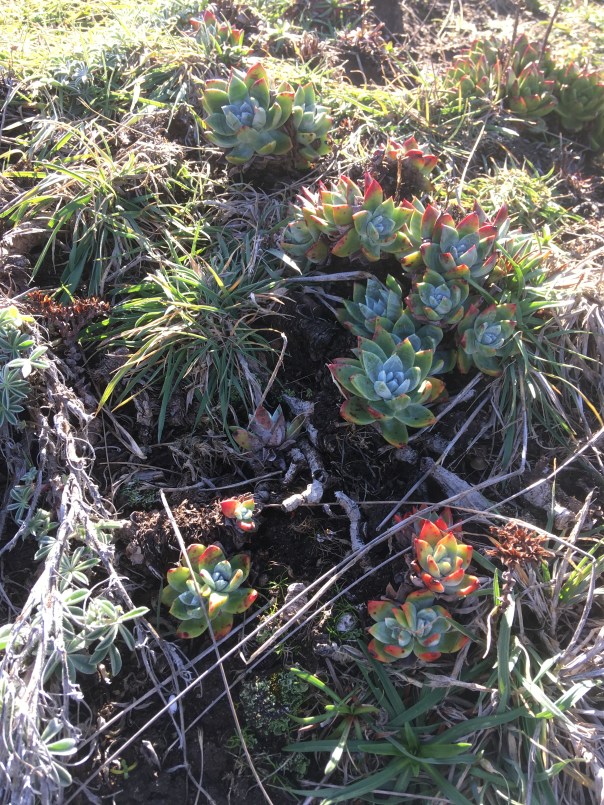
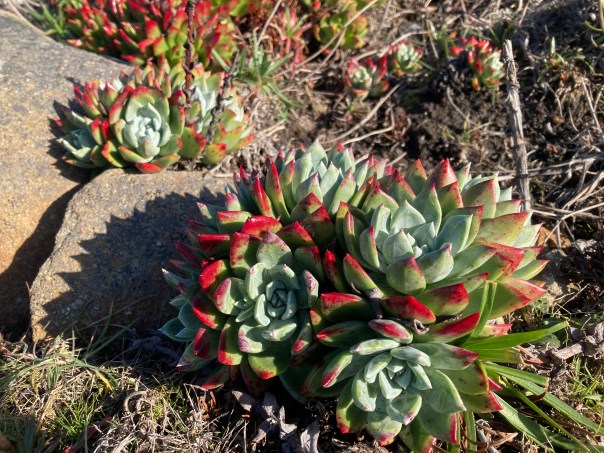
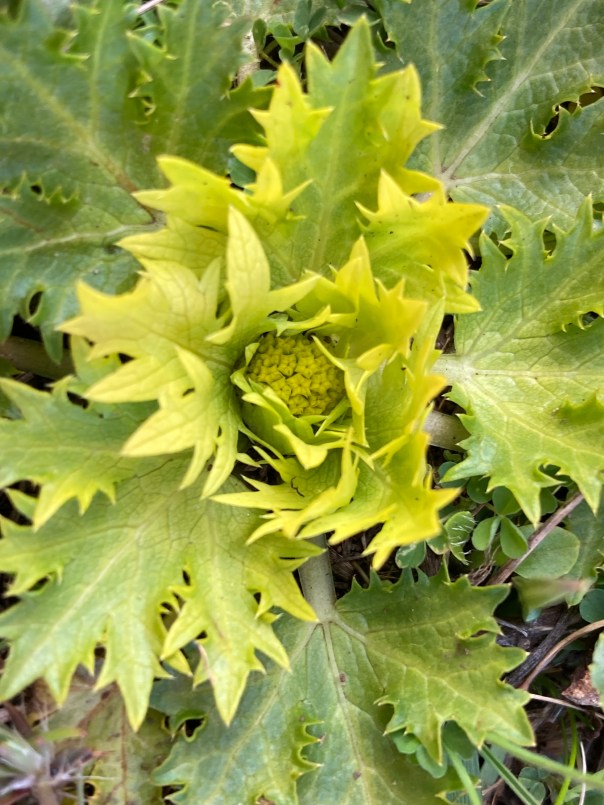
Succulents and mustard are related by their mutual membership in the plant kingdom, but also by being bright particulars of my weekend that also included lots of ocean watching.
“Why pay a premium for organic brassicas like kale and broccoli at the farmer’s market when all the free wild mustard you could ever ask for is likely waiting right around the corner?”
This question was posed in an article about food foraging that I read last weekend. Pippin’s family was here and we had opportunity to explore the topic. On Saturday we took a long drive to Salt Point State Park, farther north on the coast than I have been in many years, and passed by many vineyards looking like this:
We tried to remember whether the mustard we are used to seeing in springtime in California is at least a near relation to what one buys prepared in a jar, and that night we researched further, finding once again how many good edibles are in the Brassica family. We had no idea we’d get the chance to taste some very soon.
Yes, that mustard above ismustard, and in this context it isn’t considered a weed that needs eradicating. It actually helps suppress the nematode population among the grapevines, because mustard contains high levels of biofumigants in the form of glucosinolates. Evidently the sharp flavor isn’t appreciated by the nematodes. However the mustard got there, it’s ubiquitous now, and beneficial.
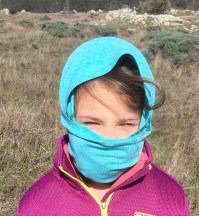
At Salt Point the sun shone on us brilliantly, and made us squint. The wind pushed us this way and that, and the sound of crashing surf thundered up the cliffs to where we walked along the headlands. Some of us had gaiters around our necks, which we pulled up to keep our hair out of our eyes and our cheeks warm.
We wanted to climb that “castle rock,” but Pippin thought she better go scout ahead for poison oak. She found a lot of it, so we gave up on that idea.
Most of the plants out there hug the ground or the rocks where they are growing. Even the milkmaids stay under cover. When Ivy took off her gaiter scarf, her hair needed re-gathering into its scrunchie; once we accomplished that, she bounced off musing, “Some people say, ‘Another day, another dollar;’ but we always say, ‘Another day, another hair out of place!'”
MilkmaidsSome brassicas are likely in this mix.saniclelupine
Where the trail dropped down close to the shore, we explored the sandstone that has been carved into strange shapes by the wind. The surface of the rocks with the smoothest appearance, where I grabbed when I felt buffeted off balance, was like the coarsest sandpaper.
The children all napped on the way home that evening, but slept long in their bags after they went to bed again later that night. Before we knew it we were all up and going again, but southwest this time, aiming for a hike along the Marin Headlands. Marin County is the one just north of San Francisco County/City, and it soon became evident that this destination, so much closer to a large population, was going to be too crowded. There was nowhere to park at the trailhead.
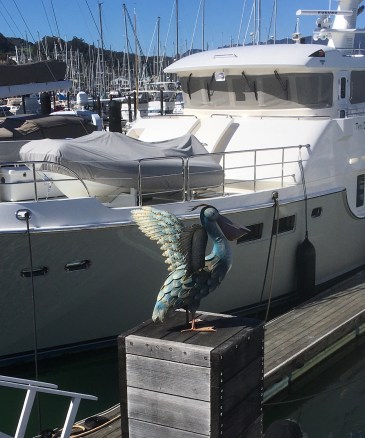
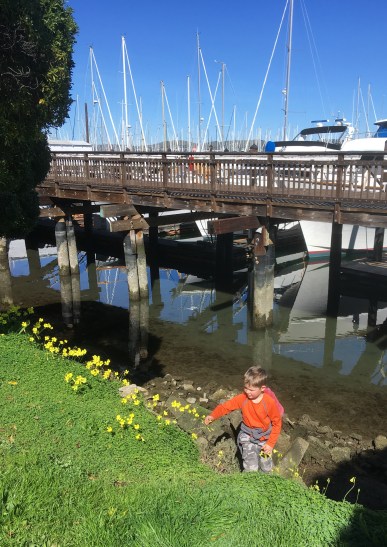
So we went into the town of Sausalito and looked at boats in the harbor, and ate our lunch at a little park with a view of Angel Island, and the Bay Bridge to the southeast.
The first wild thing we found to eat that morning was oxalis, or sourgrass, also called wood sorrel. Once I told the children about it, they continued to break off stems and chew on it for the rest of the day, it being everywhere we went. Ivy liked the flowers best, but most of us preferred the stems.
Plantain was growing everywhere beneath our feet, mixed in with the oxalis. Scout told me that if you get a rash from stinging nettle you can chew some plantain and put it on the rash to soothe it. But there were no nettles in this neighborhood, and we left the plantain alone.
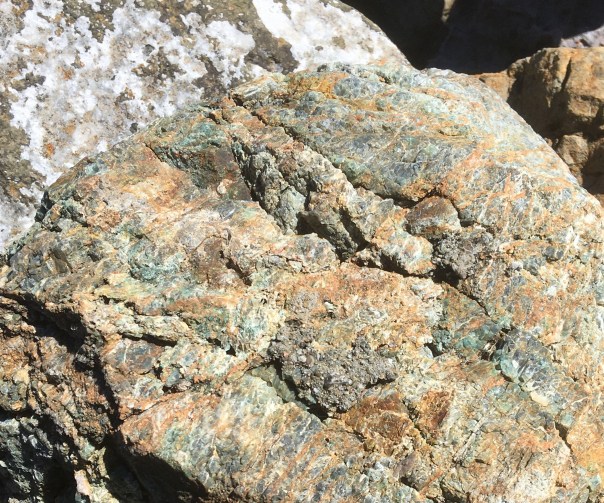
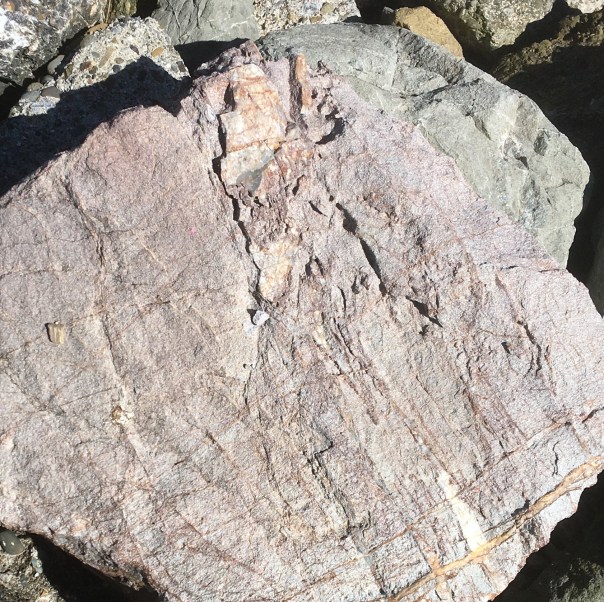
The water was glittering, and the children discovered countless crabs as they peered into their dark caves among the rocks. While the more agile folk spied on crabs, I admired the colorful minerals in the giant specimens bordering the sidewalk.
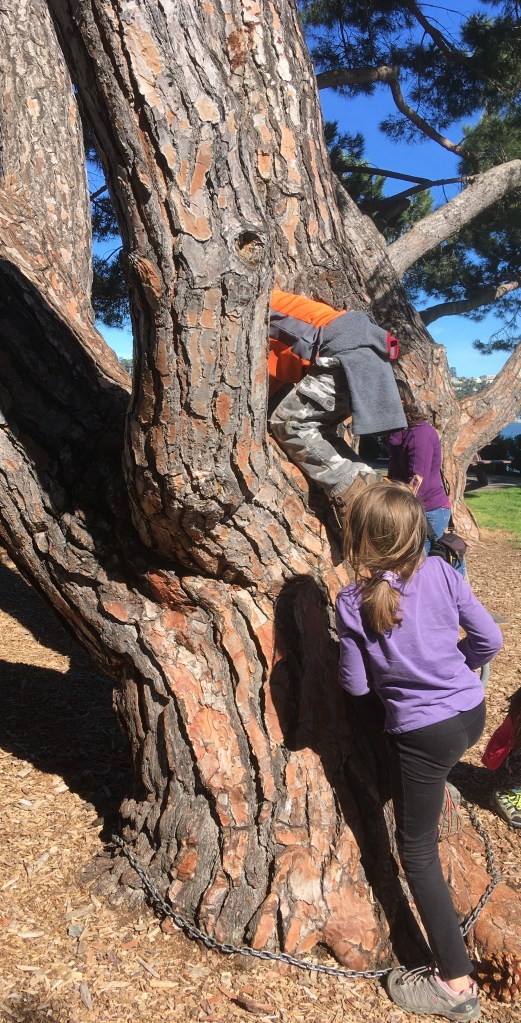
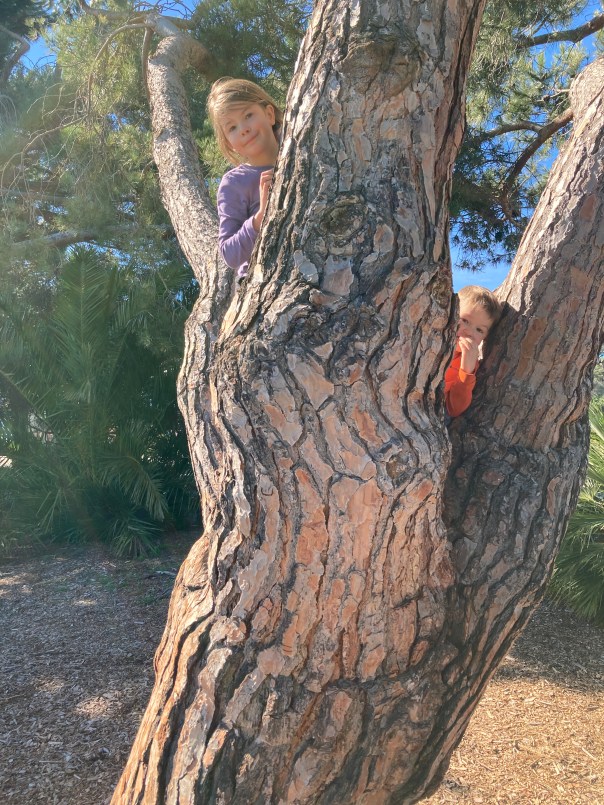
Big pine trees with gorgeous trunks shaded us at the park. Ivy and Jamie took on the challenge of climbing one of them. Their mother gave them tips from time to time; eventually Ivy gave Jamie her knee for a footstool, and he was up! Pippin then helped Ivy, and they finished their lunch in an elevated position.
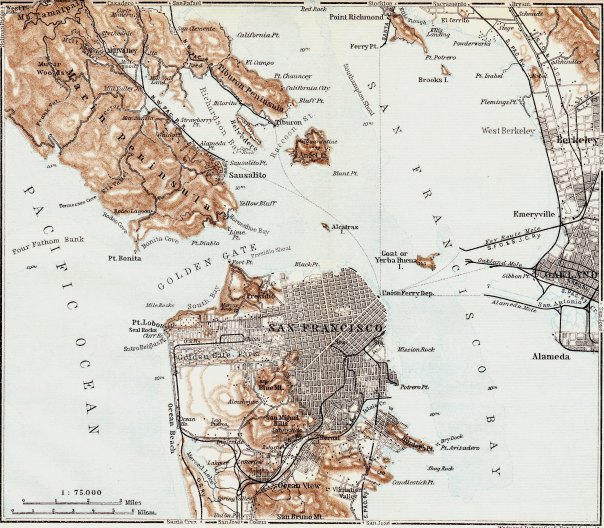
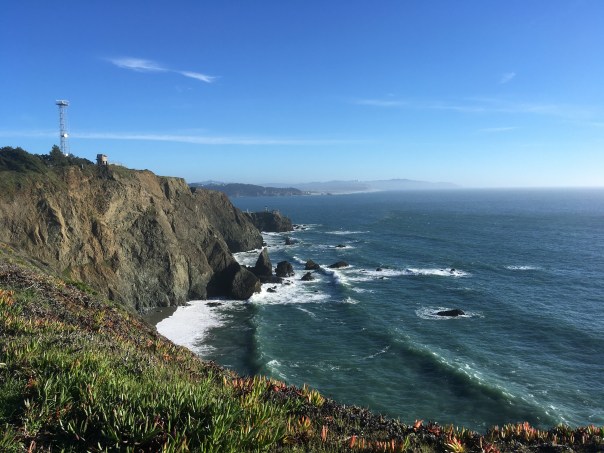
We drove to a different access point for the Marin Headlands and ended up at Point Bonita. Here is a map on which you can see the point, right where a lighthouse needed to be, outside San Francisco Bay at its north entrance. The lighthouse itself is closed currently, but we walked down the little peninsula as far as possible.
We stared and stared at the Golden Gate Bridge, from that perspective that we rarely get, looking in toward the bay. That narrow entrance to a huge bay was named the Golden Gate Strait by John C. Fremont:
“In 1846, when soldier, explorer and future presidential candidate John C. Fremont saw the watery trench that breached the range of coastal hills on the western edge of otherwise landlocked San Francisco Bay, it reminded him of another beautiful landlocked harbor: the Golden Horn of the Bosporus in Constantinople, now Istanbul. Fremont used a Greek term to name it: Chrysopylae – in English, Golden Gate. In his 1848 ‘Geographical Memoir,’ Fremont added another layer of meaning: The rugged opening to the Pacific, he wrote, is ‘a golden gate to trade with the Orient.'”
Here is another map of the bay from 1909, before the Golden Gate Bridge was built.
A couple dozen harbor seals were sunning themselves on rocks in Bonita Cove. We could see Ocean Beach in San Francisco to the south, and the skyline of the city with its new, tallest building, the Salesforce Tower, and indeed it towers over the others. I don’t think it’s as ugly as its name, which speaks volumes about our society. But let’s get back to more interesting things…
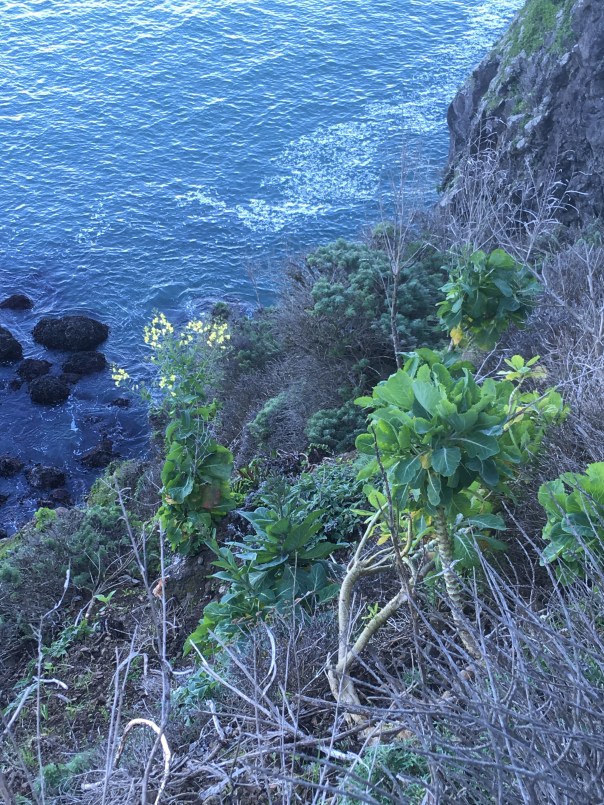
… And what do you think we saw at our feet? Mustard! I wouldn’t be surprised if these plants or their grandparents have been hanging around these bluffs for a hundred years or more; they are obviously robust and venerable.
Quite recently they’ve had baths and blow-drys, and the leaves looked so juicy…
… it’s no wonder Pippin wanted to taste a leaf. I of course had to follow suit… Yikes! That is the strongest tasting Brassica I ever hope to sample.
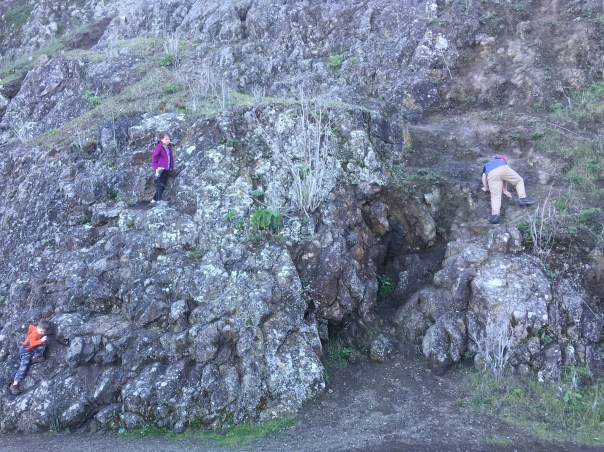
Ivy tried a periwinkle flower and spat it out. Then, the kids interacted with their environment with hands and feet, making their way up the rocky wall to our west.
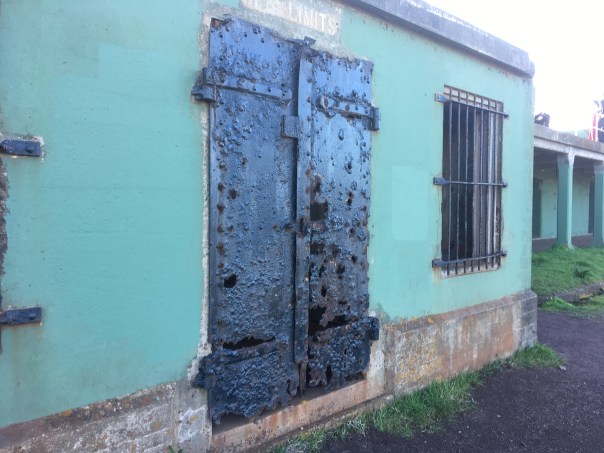
We walked back up the path and drove around the corner to the former Fort Cronkhite, now part of the Golden Gate Recreational Area. From the batteries we could see north up the coast and south to the lighthouse.
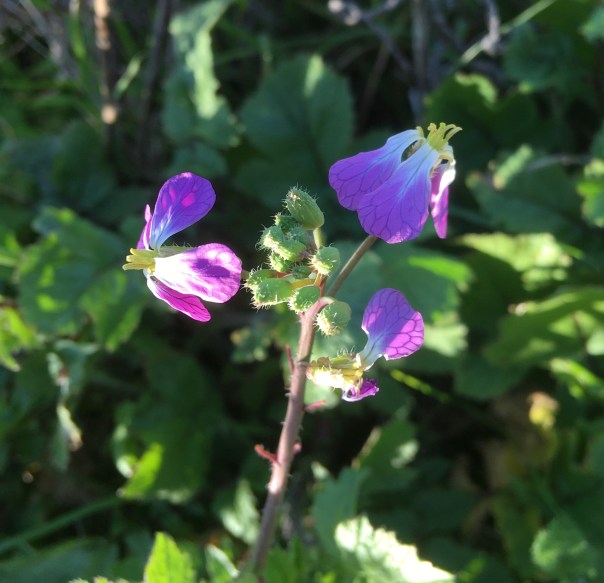
Another Brassica lives on that side, the very common wild radish, raphanus raphanistrum; shown here with violet blooms, though white and yellow are common, too. I used to notice these flowers as I walked home from the bus stop as a child. We didn’t taste this one.
wild radishCalifornia Manroot
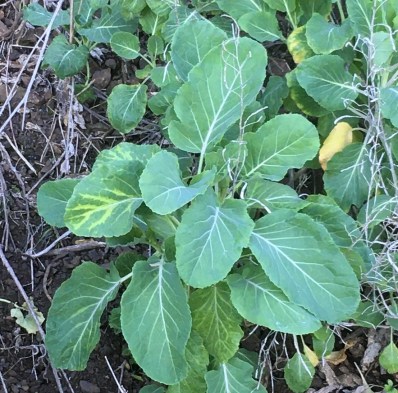
The last Brassica experience of the weekend was the next morning when Pippin took a little tour of my garden before they started home. She told me she’d eaten some of the flower buds of my collards. How did they taste? “Like broccoli.” I don’t normally eat my collards raw, but I decided to snap off all the developing flower stems, and I ate them right then. Mm-mm — they were so sweet and tender. And just around the corner of my own house.
My parish is lucky enough to have our own vineyard right behind the church. This is very handy on the Feast of Transfiguration; at the end of the liturgy we can process out the doors and around the vineyard, to bless the grapes. It’s traditional to bless grapes or apples or any fruit, really, on this day.
Earlier on the feast day morning people brought into the church baskets of fruit and herbs and flowers. I carried a wooden bowl of blueberries and peaches. While we sang and communed and focused on the main event being commemorated, the fruit waited. The incense was particularly sweet that day, and I didn’t notice the smell of the beeswax candles as much as I usually do. Though I could see basil in a couple of the baskets, I didn’t catch its aroma either.
At the end of the service, with the prescribed prayers for the event, Father L. (and all of us) thanked God for all His bounty, and then he sprinkled holy water over the representative sampling.
He explained to us that this is not a superstitious rite we perform, using holy water to do magic on the fruit. When we bless anything in this way we do not make it into something other than what it is, but ask God to reveal it to be what it has always been.
Whatever created things we are talking about, they have always been meant by God to bring us into communion with Him. The service of blessing of fruit brings our thoughts back to Paradise, and the right and good use of the fruits of the earth that God has given us. We are reminded of how in the beginning God made Adam and Eve to be stewards over the Garden of Eden; human beings were called to exercise a loving and thankful dominion over the earth.
Russia
But we by our sin have instead caused destruction on the earth. Mankind more often than not has overused, abused and consumed in perverse ways the gifts of the Creator. Personally, I often gobble my food and eat without attentiveness to Him.
We have prayers for the blessing of bees and beehives and honey, too, usually in a separate service. Around here it’s August 1st, but I found pictures of honey blessings in Bulgaria where they do it dramatically on February 10 (see the bright cross picture down the page).
People like to take pictures of little girls and honey, I was happy to discover, and I am posting some of them here. The Russian ones are from Optina Monastery, and the Oregon photos from the Facebook page of New Martyrs of Russia Orthodox Church.
These honey and bee pictures are so enjoyable that I ended up with way more of them than of fruit. I hope you will hop over to the blog of Father Ted Bobosh where he posted a large and glorious photo collection of bees and other pollinators, such as the one I put at the very top, along with quotes about bees and Orthodox prayers for them. Just looking at the pictures will likely make you burst into prayer, too. Here is one of the prayers he posted:
From Father Ted
O God, who knows how to work benefits through human labor and irrational living things, You instructed us in your loving-kindness to employ the fruits and works of the bees for our needs. Now humbly we beseech Your majesty: Be pleased to bless the bees and increase them for the profit of the human race, preserving them and making them abundant. Let everyone hoping in Your majesty and Your boundless compassions, and laboring in the care of these living things, be counted worthy to receive abundant fruits of their labors and to be filled with heavenly blessings in Christ Jesus our Lord, to whom is due glory, honor and worship unto ages of ages. Amen.
The photo above is from my church on Transfiguration, baskets of all kinds of fruits of the earth waiting for the prayers of blessing. Some of them were inspiring in the variety and arrangement of items, but one of my favorite baskets is the big one in front, full of apples picked just that morning.I don’t eat much honey these days, but I get a whiff of it in the candles every Sunday in church, and I can imagine the heady scent emanating from these tables laden with jars and bowls and plates of honey.
Doesn’t it just tell you something about our God, how sweet He is, and how extravagantly generous, that He would give us something as intense and rich as honey? The bees, of course, are also in the business of pollinating the fruit. The whole Creation and its interconnectedness is reflected in the Church and in our salvation history, all of a piece and orchestrated in love by our dear Father God.
Fr. L blessing beehivesBlessing honey in BulgariaHoney blessing in OregonOregon honeycomb



 It’s eleven years !! since I wrote this post at the Feast of Transfiguration, and focused on honey and bees. Since then I’ve posted several times about various aspects of the feast, and now I’m going to return to this one focusing on honey, that marvelous substance in great abundance all over the earth. Who can believe it? Only God could have thought of such a food. I’ve updated the following with some bee photos of my own, and kept my favorite honey pictures: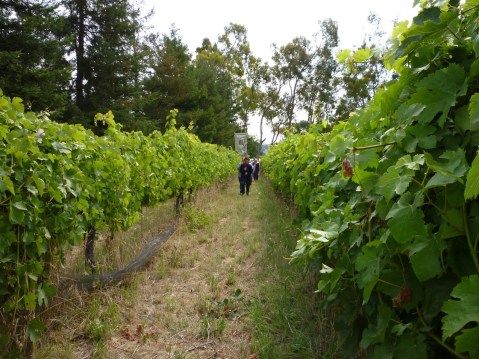

 O God, who knows how to work benefits through human labor and irrational living things, You instructed us in your loving-kindness to employ the fruits and works of the bees for our needs. Now humbly we beseech Your majesty: Be pleased to bless the bees and increase them for the profit of the human race, preserving them and making them abundant. Let everyone hoping in Your majesty and Your boundless compassions, and laboring in the care of these living things, be counted worthy to receive abundant fruits of their labors and to be filled with heavenly blessings in Christ Jesus our Lord, to whom is due glory, honor and worship unto ages of ages. Amen.




 Yes, that mustard above is mustard, and in this context it isn’t considered a weed that needs eradicating. It actually helps suppress the nematode population among the grapevines, because mustard contains high levels of biofumigants in the form of glucosinolates. Evidently the sharp flavor isn’t appreciated by the nematodes. However the mustard got there, it’s ubiquitous now, and beneficial.







 Plantain was growing everywhere beneath our feet, mixed in with the oxalis. Scout told me that if you get a rash from stinging nettle you can chew some plantain and put it on the rash to soothe it. But there were no nettles in this neighborhood, and we left the plantain alone.







 Gladsome Lights