Tag Archives: Wallace Stevens

He breathed its oxygen.

THE POEM THAT TOOK THE PLACE OF A MOUNTAIN 

There it was, word for word,
The poem that took the place of a mountain.

He breathed its oxygen,
Even when the book lay turned in the dust of his table.

It reminded him how he had needed
A place to go to in his own direction,

How he had recomposed the pines,
Shifted the rocks and picked his way among clouds,

For the outlook that would be right,
Where he would be complete in an unexplained completion:

The exact rock where his inexactnesses
Would discover, at last, the view toward which they had edged,

Where he could lie and, gazing down at the sea,
Recognize his unique and solitary home.

-Wallace Stevens

Paul Henry – Errigal, County Donegal

The house had to be quiet.

T.F. Simon

Oh, how I love this aspect of the experience of summer as I have known it,
in my youth and now in my older years… 

The House Was Quiet and The World Was Calm

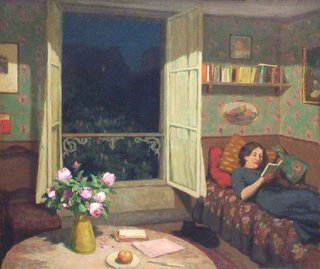
The house was quiet and the world was calm.
The reader became the book; and summer night
Was like the conscious being of the book.
The house was quiet and the world was calm.
The words were spoken as if there was no book,
Except that the reader leaned above the page,
Wanted to lean, wanted much most to be
The scholar to whom his book is true, to whom
The summer night is like a perfection of thought.
The house was quiet because it had to be.
The quiet was part of the meaning, part of the mind:
The access of perfection to the page.
And the world was calm. The truth in a calm world,
In which there is no other meaning, itself
Is calm, itself is summer and night, itself

Is the reader leaning late and reading there.

-Wallace Stevens

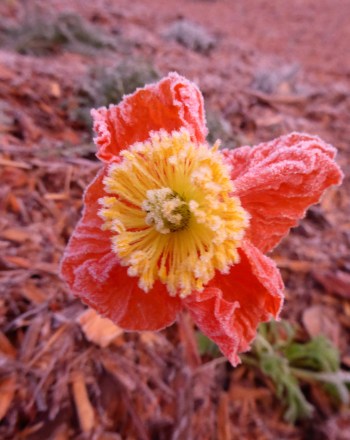
Everything falls back to coldness.

THE READER

All night I sat reading a book,
Sat reading as if in a book
Of sombre pages.

It was autumn and falling stars
Covered the shrivelled forms
Crouched in the moonlight.

No lamp was burning as I read,
A voice was mumbling, “Everything
Falls back to coldness,

Even the musky muscadines,
The melons, the vermilion pears
Of the leafless garden.”

The sombre pages bore no print
Except the trace of burning stars
In the frosty heaven.

-Wallace Stevens


The Plain Sense of Things

THE PLAIN SENSE OF THINGS

After the leaves have fallen, we return
To a plain sense of things. It is as if
We had come to an end of the imagination,
Inanimate in an inert savoir.

It is difficult even to choose the adjective
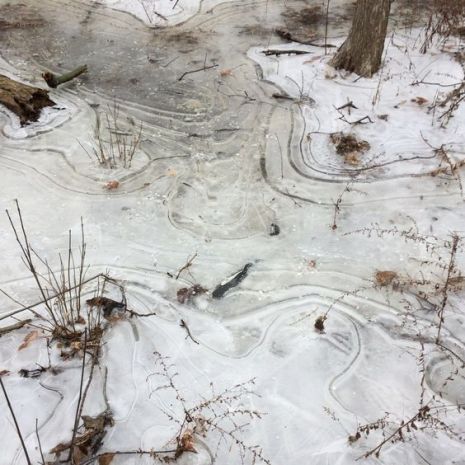
For this blank cold, this sadness without cause.
The great structure has become a minor house.
No turban walks across the lessened floors.

The greenhouse never so badly needed paint.
The chimney is fifty years old and slants to one side.
A fantastic effort has failed, a repetition
In a repetitiousness of men and flies.

Yet the absence of the imagination had
Itself to be imagined. The great pond,
The plain sense of it, without reflections, leaves,
Mud, water like dirty glass, expressing silence

Of a sort, silence of a rat come out to see,
The great pond and its waste of the lilies, all this
Had to be imagined as an inevitable knowledge,
Required, as a necessity requires.

-Wallace Stevens

By Oksana Berda