Tag Archives: weakness

The face was seeing things.

A few years ago I posted a poem by Clive James, the title poem “Sentenced to Life,” from the collection written after he became ill, and he began to consider his life from the perspective of a dying man. When I opened that book again recently I immediately was taken by another reflective poem with similar themes.

Reportedly James maintained confidence to the end that there is no afterlife, but I suspect he was cured of that delusion as he was crossing over. He did realize and admit publicly that he had been a “bad husband” (by long infidelity) and he regretted it. In his poems he compares his years of strength, the exciting years of his life, with the last decade when he was facing death, and he judges the recent, shorter season to be the time during which he was restored to sanity by facing the truth about himself.

LANDFALL

Hard to believe, now, that I once was free
From pills in heaps, blood tests, X-rays and scans.
No pipes or tubes. At perfect liberty,
I stained my diary with travel plans.

The ticket paid for at the other end,
I packed a hold-all and went anywhere
They asked me. One on whom you could depend
To show up, I would cross the world by air

And come down neatly in some crowded hall.
I stood for a full hour to give my spiel.
Here, I might talk back to a nuisance call,
And that’s my flight of eloquence. Unreal:

But those years in the clear, how real were they,
When all the sirens in the signing queue
Who clutched their hearts at what I had to say
Were just dreams, even when the dream came true?

I called it health but never stopped to think
It might have been a kind of weightlessness,
That footloose feeling always on the brink
Of breakdown: the false freedom of excess.

Rarely at home in those days, I’m home now,
Where few will look at me with shining eyes.
Perhaps none ever did, and that was how
The fantasy of young strength that now dies

Expressed itself. The face that smiled at mine
Out of the looking glass was seeing things.
Today I am restored by my decline
And by the harsh awakening it brings.

I was born weak and always have been weak.
I came home and was taken into care.
A cot-case, but at long last I can speak:
I am here now, who was hardly even there.

-Clive James
 

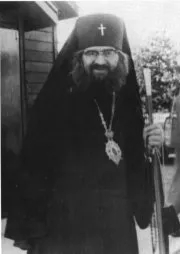
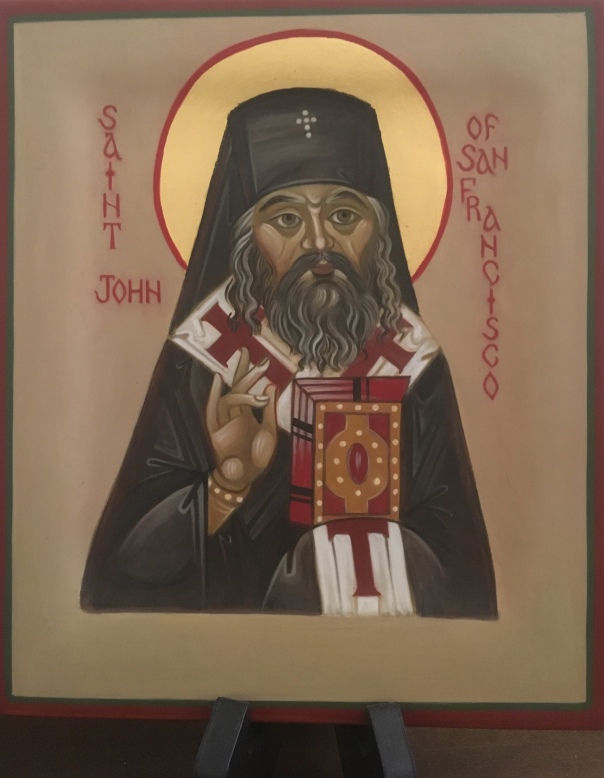
An anniversary for St. John of San Francisco.

It is the 30th anniversary of the canonization of St. John (Maximovitch), Archbishop of Shanghai and San Francisco. At Holy Virgin Cathedral, “Joy of All Who Sorrow,” the celebration of the feast will spread over three days this week, and members of my parish expect to travel there to participate.

You can read the life of St. John and why he is called “The Wonderworker” – here.

On this joyous occasion I want to share this exhortation from the saint:

Though a man may be found in a weak state, that does not at all mean that he has been abandoned by God. On the cross, the Lord Jesus Christ was in trouble, as the world sees things. But when the sinful world considered Him to be completely destroyed, in fact He was victorious over death and hades. The Lord did not promise us positions as victors as a reward for righteousness, but told us, “In the world you will have tribulation – but be of good cheer, for I have overcome the world”.

-St. John of Shanghai and San Francisco


The weakness of God.

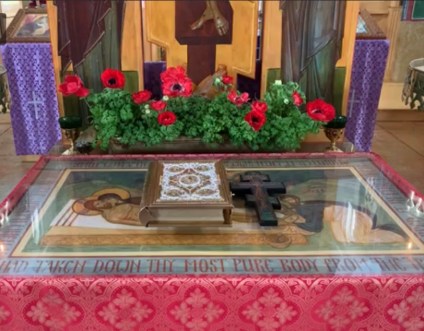
From the readings for Holy Friday:

For the message of the cross is foolishness to those who are perishing, but to us who are being saved it is the power of God. For it is written:

“I will destroy the wisdom of the wise,
And bring to nothing the understanding of the prudent.”

Where is the wise? Where is the scribe? Where is the disputer of this age? Has not God made foolish the wisdom of this world? For since, in the wisdom of God, the world through wisdom did not know God, it pleased God through the foolishness of the message preached to save those who believe. For Jews request a sign, and Greeks seek after wisdom; but we preach Christ crucified, to the Jews a stumbling block and to the Greeks foolishness, but to those who are called, both Jews and Greeks, Christ the power of God and the wisdom of God. Because the foolishness of God is wiser than men, and the weakness of God is stronger than men.

For you see your calling, brethren, that not many wise according to the flesh, not many mighty, not many noble, are called. But God has chosen the foolish things of the world to put to shame the wise, and God has chosen the weak things of the world to put to shame the things which are mighty; and the base things of the world and the things which are despised God has chosen, and the things which are not, to bring to nothing the things that are, that no flesh should glory in His presence. But of Him you are in Christ Jesus, who became for us wisdom from God—and righteousness and sanctification and redemption— that, as it is written, “He who glories, let him glory in the Lord.”

-From I Corinthians 1

(Screen shots from Great Vespers, streamed)

Love stands weakly at the border.

It is said by some that God has no boundaries regarding us, that He is God and may do with us (and to us) whatever He wills. This, of course, is true in an abstract sense. However, it is not true of God as He has made Himself known in Christ. Christ is a God who “asks.” He is the God who allows a freedom so great that it can kill Him. 
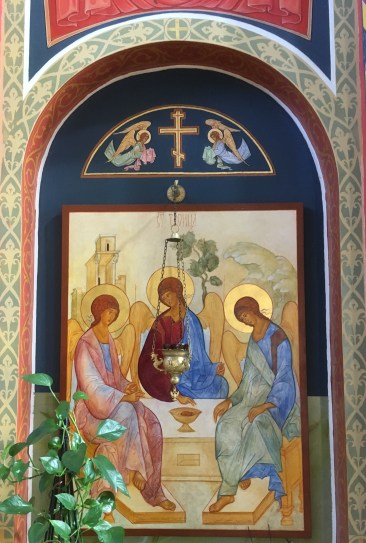
-Fr. Stephen Freeman in “Love and Freedom.”

I had just returned from a talk on the Holy Trinity when I read Fr. Stephen’s article quoted above. Our lecturer told us that the Cappadocian fathers of the 4th century, St. Basil the Great, St. Gregory the Theologian, and St. Gregory of Nyssa, developed the Trinitarian theology of the church from their answers to questions raised by their knowledge of Greek and Hebrew ideas of God. One idea, from the Greeks, was that God is forced by overflowing love to create man, and they did not believe that God is forced to do anything.IMG_0083

So why did He? Because He wanted to give humans the opportunity, the freedom to respond to His love, and by communion with the Holy Spirit to be transformed into true persons .

In another article Fr. Stephen wrote: The knowledge that comes through communion is not a fact to be considered, rather, it is a knowledge that in the very act of knowing becomes part of you. The knower and the known share some manner of common existence.

A last snippet from Love and Freedom: When I have written that Pascha is at the heart of everything (and I believe this faithfully represents the teaching of the Church) this weakness born of love is its consequence. It is the love of God that surrounds us and calls us to be His friends. It seeks us, face to face, even searching for us when we hide. But it is a love that stands weakly at the border of our freedom, and waits for our invitation.