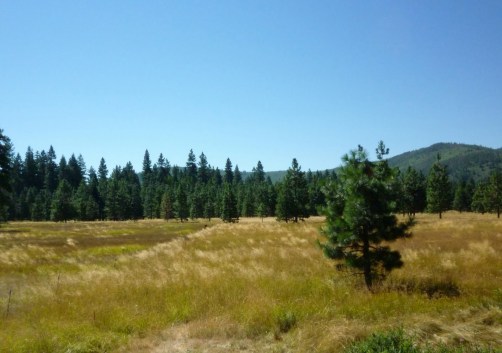
I’m back up at Pippin’s place as of last night, and this morning took Baby Scout for a walk in his jogger. It was an hour’s walk, but that doesn’t translate to much exercise when you figure in all the stops for gawking and picture-taking. On my drive up I listened to most of My Ántonia and was struck by the evocative descriptions of the prairie; here the meadows are in their late summer glory of gold tones, with runnels of pale green. My photos don’t serve nearly as well as Willa Cather’s prose in conveying a scene.
In this case there were jays scraping the air with their calls, and smells of drying grass and a dozen trees coming at me in the breeze. Scout hummed as we bumped along. The air was crisp at first, but the little currents of warm spread out to fill the morning so that it soon felt like an August day.
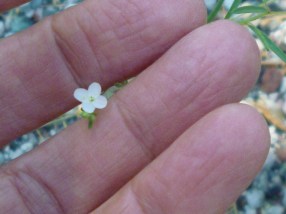
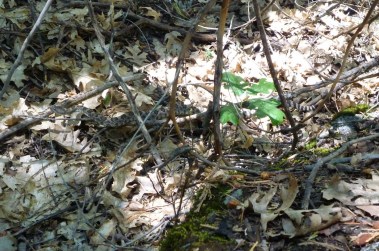
I couldn’t precisely identify any of those aromas; it made me envy the animals with their good noses –but when I do get to know a plant, I can also have the word for it, and that makes me happy. Fact is, I don’t know the word for very many of the thousands of lovely things around me. Like this tiny flower that I spied on the roadside, and a while later in Pippin’s tomato garden, volunteering along with mullein and ferns.
In the meadow I saw a place where the grass was all mashed down. Maybe the deer had rested there, maybe even the one I saw munching on tree branches by the side of the road. She gave me one look, and then refused to pay any more attention to me, even though I kept asking her to look at the camera.
I slept through the woodland noise last night, of Mama Bear tearing down bird feeders to spread the seed on the patio for her two cubs. It’s the second time this week, which pretty much means the end of watching birds close by the kitchen window. That’s about the only way I can seem to notice them, as I did last May when I took this picture. Birds are more fun to watch than bears, for many reasons, one being that you don’t have to be wakened at midnight in order to see them.
Certainly one of the warm smells on our walk was of oak trees. Oak was likely one of my first nature words, as I lived most of my childhood under a giant oak in the Central Valley. I think it was a Valley Oak. There are only nineteen Quercus native to California, I just this minute read in a tree guide, so perhaps it wouldn’t be impossible, as I have previously thought, for me to learn which are which. This one I photographed today is certainly not a Scrub, Live, Leather, Muller or Blue Oak…perhaps it is a California Black Oak. Hello, Mr. Oak; I hope to get to know you better.
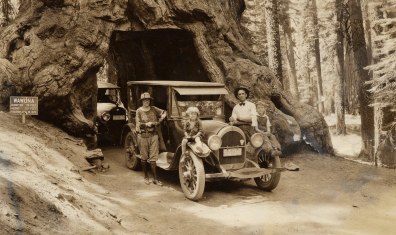
Probably it never happened before this, that we camped in Yosemite two summers in a row. But this year and last, we have been that fortunate. The park is so vast and varied, one could easily stay a month and never get bored; our ancestors often did just that. This old photo from before 1930 shows my mother as a child there.
Farewell-to-Spring
Nowadays there is a one-week limit on camping, and it’s a rare person who can do the phone work and combine it with luck enough to secure a site or a cabin in Yosemite Valley, where whole campgrounds have been eliminated since our little family started camping there in the 70’s. Pippin’s mother-in-law is one of those dedicated and generous people, and this year Mr. Glad and I benefited from her labors and came along as the second set of grandparents, joining Baby Scout and his parents.
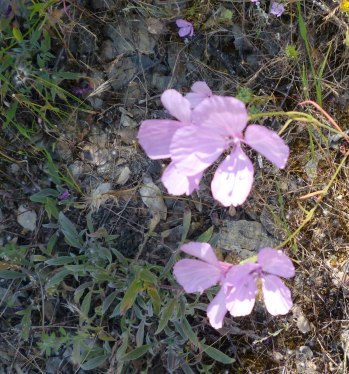
Being there in June meant that we got to see a different batch of wildflowers from those in July. All along the Merced Canyon coming in from Mariposa, the hills and roadsides were covered with these flowers that I am pretty sure are Farewell to Spring, otherwise known as Dudley’s Clarkia, a type of clarkia that reportedly only grows in California. Clarkia is named after William Clark of the Lewis and Clark Expedition, and I wasn’t surprised to learn that it is in the evening primrose family. It reminds me of the Mexican Evening Primrose by my driveway at home.
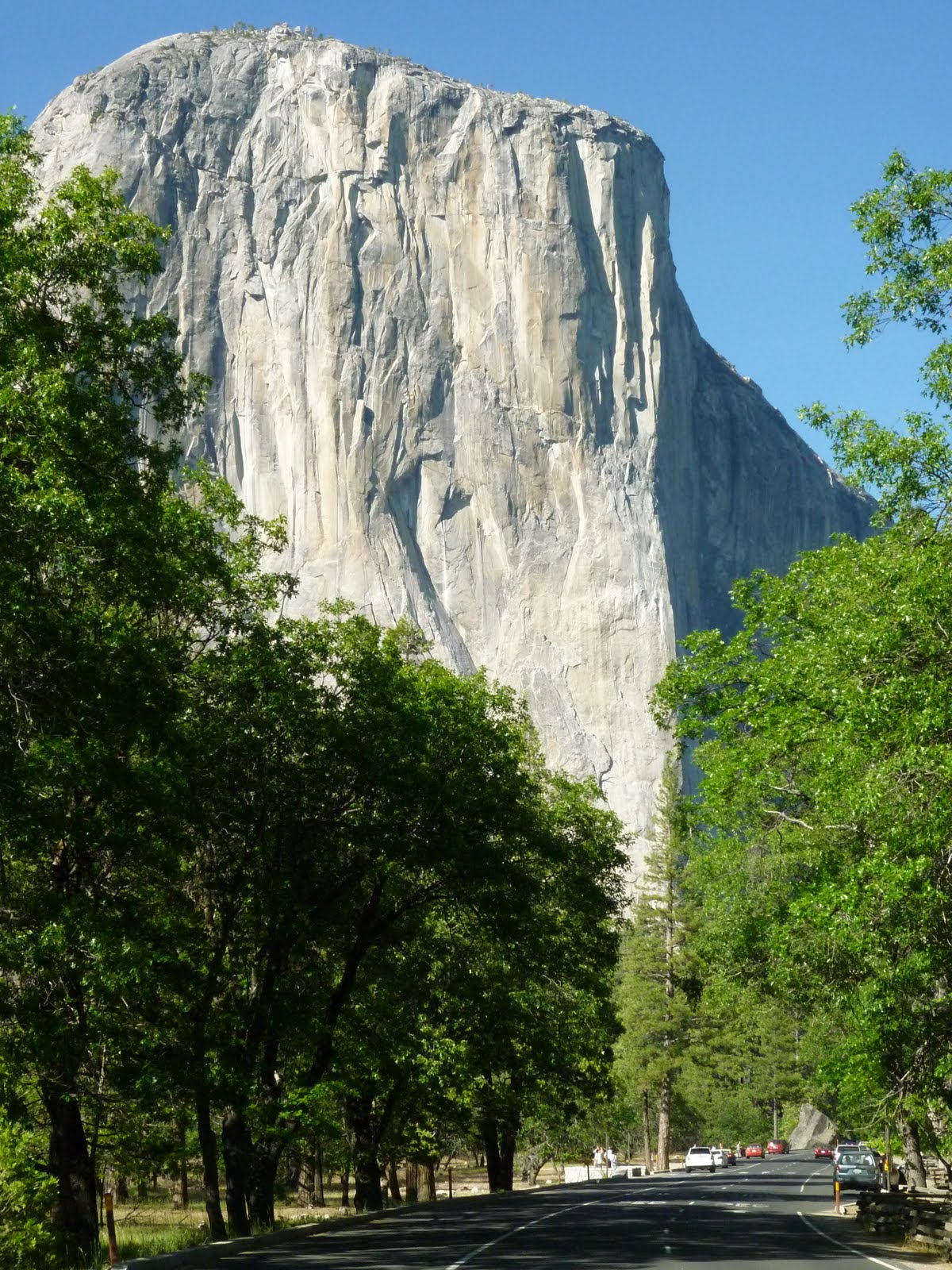
El Capitan
The massive rock that speaks to me of God took my breath away
as we entered the valley, and this time I took my own photo.
All six adults in our extended family group were veteran campers with hearts thankful to the Creator for lavishing such beauty on us. One grandfather prayed thanks for the “familiness” we were enjoying and when I heard the word I knew it would be in the title of my blog.
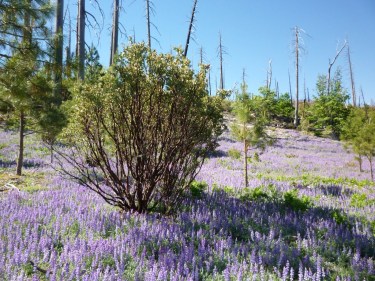
The first day some of us went on an expedition to gather firewood in an area that had been severely burned in 1991. Pippin took pictures of Scout sitting in the middle of acres of purple lupine, and later we went into the woods and found the colorful Harlequin Lupine as well–two sisters in that family group.
That afternoon the same group of us hiked past Mirror Lake to Hidden Falls. The last time I had seen the lake it was just a swamp full of horsetail and other such stuff. But this year every body or stream or fall of water in Yosemite is at its fullest and highest, and many families with children were playing in the sandy boulder-studded water as we tromped past.
Rattlesnakes! We saw two on the trail– One crossed silently, completely ignoring us. But the second one shook his rattle as he slithered into the leaves. I took his picture, too, but he is well camouflaged.
Hidden Falls wasn’t easy to get to, not with my stiff and unreliable joints and sinews. There was much clambering up steep hunks of granite and even some log-walking, but before long we came to the spot on Tenaya Creek where all my senses were bombarded.
There is little dirt in that place; towering all around are trees with thick trunks, growing out of granite slabs and boulders as big as houses. And water, torrents of it this wet year, pouring off the top of more speckled gray rock in falls that remained hidden somewhat behind huge craggy stones. The water’s roar echoed off all the rocks and made talking nearly impossible, and the brightness of the white foamy water glared somewhere out of every photo frame.
Child Pippin some decades ago
Scout had come along in the backpack. His parents sat him down in a flat place next to the falls and me, while they tried to scramble a little higher, and he started singing and squealing. He liked the excitement in the air, I think, all the fine cold spray and the tempest blast of sound. Clean and fresher than anything.
All the waterfalls are exciting this rainy year of 2010. Mr. Glad and I hiked together part way to Vernal Falls, and I read a book while he completed the ascent to the top of the falls. High steps are cut out of the rock next to the canyon, where spray from the waterfall drenches the hikers on the Mist Trail, some on their way back from the summit of Half Dome.
We have hiked the Mist Trail several times as a family, but this year my knee hurt just thinking about climbing those steps. The photo above right is of Pippin on that trail, aged three, with her papa. It was a new kind of camping for us, in Housekeeping, where you get three walls surrounding beds with mattresses, canvas roofs over your head, electricity in your cabin and patio area, and hot water in the restrooms nearby. Not like our tent camping at Crane Flat in the past, pictured.
Tent camping in Yosemite in the past
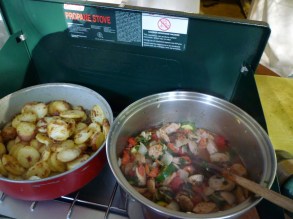
Cooking was fun, shared by the three women. I had a new and hot propane canister stove to replace our old one that was of a kind that we had to pump what seemed to be every few minutes, and even then the burner farthest from the tank never got very hot.
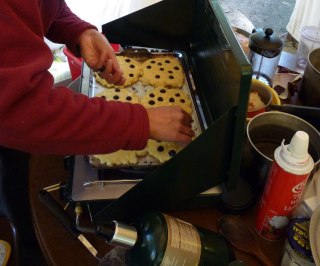
Pippin made a version of Power Pancakes with blueberries. No one had brought a large enough bowl for the batter so we made do with a dishpan.
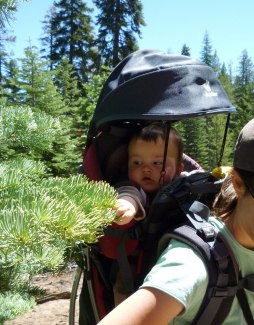
Scout missed his routine, and seemed to get more overtired and cranky day by day. This is a shot of him sleeping early in the week, after being lulled to sleep on a wheeled walk. He often enjoyed his outings in the baby backpack, with its pauses next to trees and rocks where he was given time to feel the textures.
Our last full day in the park Mr. Glad and I went with our daughter to Taft Point. It’s a short hike after you drive up toward Glacier Point for an hour or so. Still, the trail involved a bit of “boulder-hopping” as I heard it described.
The streams are full and the distances between the rocks that stick up sometimes require a leap. It’s not that the water is deep; I could have taken off my shoes and walked across if I wanted to lessen the risk of wet boots or a sprained ankle. I managed without doing that–but on the homeward crossing, it took me about half a minute to coordinate my eyes, legs and courage and figure out how to spring–or lunge.
From Taft Point you look down into Yosemite Valley where the Merced River is snaking along, and across the canyon to perhaps the most thorough view of Yosemite Falls possible. The day before, we had stood at the bottom of that waterfall; the experience from Taft Point is much quieter and drier.
You can also see down to El Capitan, that mass of rock one often sees from the bottom on entering the valley. It’s in the upper center of this photo, sloping down to the trees.
We ate our trail mix and crackers sitting on the rock slabs, and let Scout out of the pack to wiggle his toes in the granite dust.
So many wildflowers up there remain a mystery to me, even though I have prolonged my vacation (Yes, yes, I know, I should finish putting my kitchen back together or prepare for my soon arriving house guests.) researching them online and writing this blog.
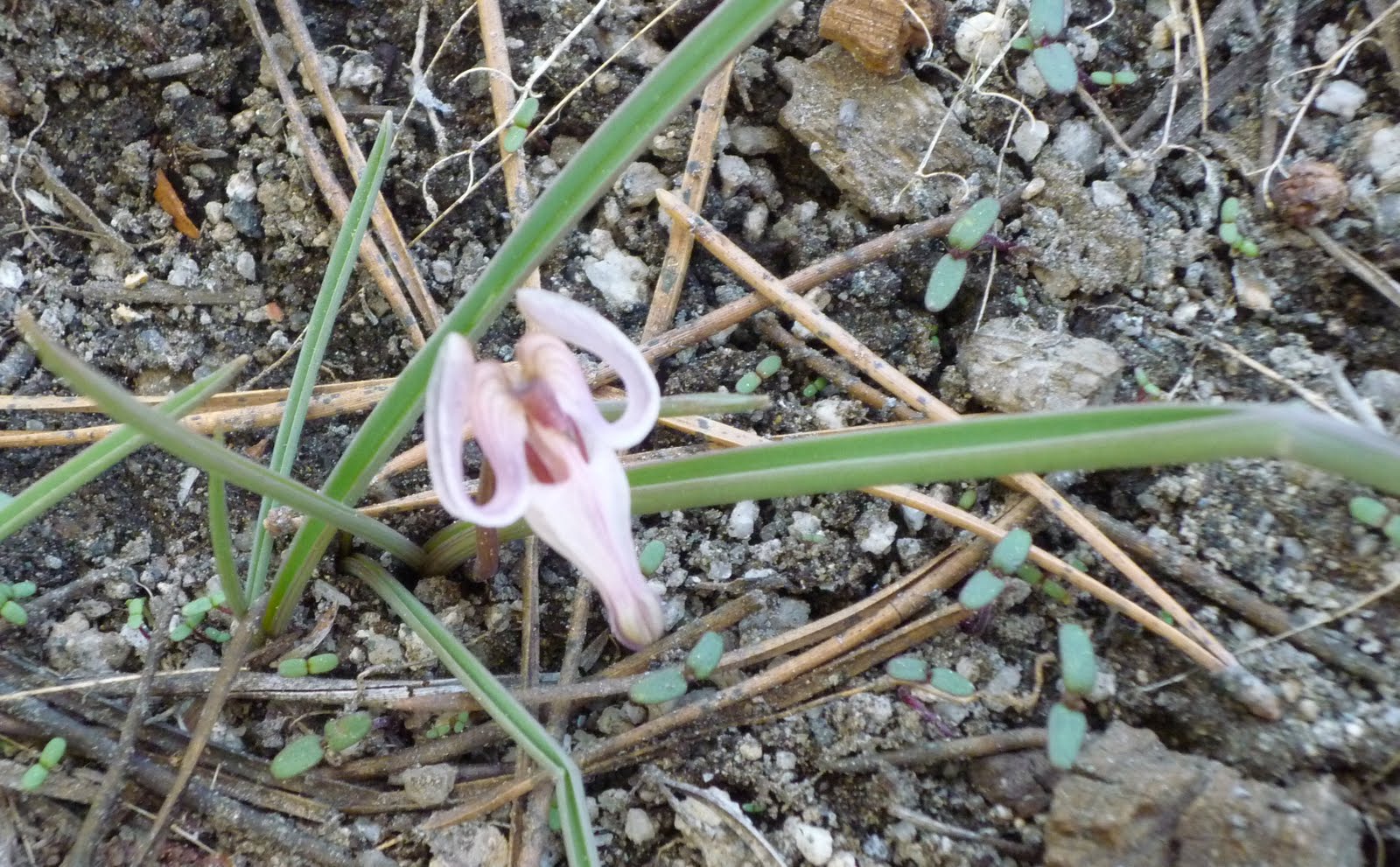
The curious specimen here, for example, has the look of a Longhorn Steershead–the descriptive common name of a flower, Dicentra uniflora–but it doesn’t have the leaves to match that identity, which would be a relation of Bleeding Heart. Is it an imposter steer? How could there be two flowers so similar, that are not at least in the same family? Those blade-like leaves must go to something else…but where are steershead’s leaves? Very odd.
But I can’t let that problem distract me from the main point of this flower: God is amazing!I saw chamomile ready to bloom, and the tiniest alliums: each plant consisted of a single thin stem that I’d have thought was a frail blade of grass sprouting out of the sand up there where there is only wind and rock and sun. But at the tip of a few “blades” were the remains of a half-inch spherical tuft, lying down on the ground at that point because the thin stem couldn’t bear it up.
These leafy plants at left were scattered profusely over the meadows and forests at about 7,000 ft.; when the buds open they will make for a lot of color–we think yellow–and then they will really be attention-getters.
After taking in the views from Taft Point we hiked back to the road and drove on to Glacier Point, the most popular viewing spot in Yosemite National Park. No matter how often I visit the park, I appreciate the broad perspective. You can see where you camped or hiked over the last few days when you were down in the trees.
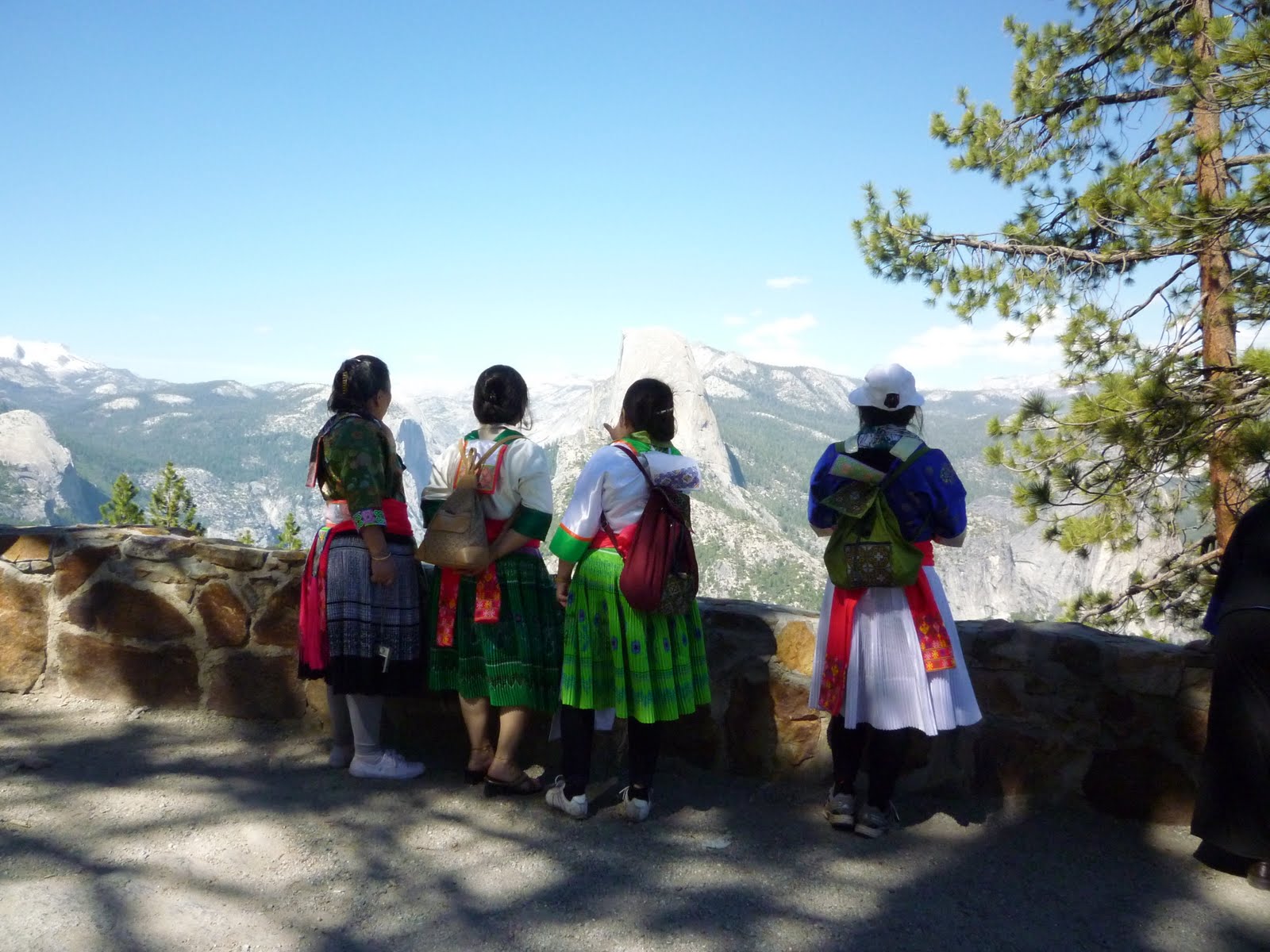
At Glacier Point the people-watching is unbeatable, because the population is international (Yosemite belongs to the world, or the U.N., or something, after all, which doesn’t please anyone I know), and there are so many people. After driving up the mountain all that way they aren’t in any hurry to leave, so everyone can watch everyone else as well as the scenery. We wondered if this pink-and-black woman might be on her honeymoon…anyone have a guess as to the origin of what looks like a traditional costume?
I didn’t know what a ghillie suit was until I asked Moss Boy if I could take his picture, and why he was dressed like that.
Kate as a child
“I love your dress,” I said to the woman with the long yellow costume. It was also quite pretty from the front, as was she.
Kate was dressed in our family’s traditional outdoor clothing when we took this picture of her at Glacier Point nine years ago.
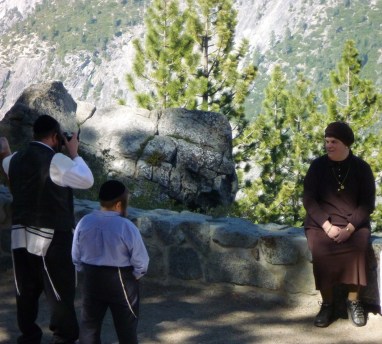
But Glacier Point was not the last view; we always love to see things from Washburn Point as well; it’s just a bend or two of the road back from Glacier Point. Additional exotic members of the Family of Man could be viewed there, like Hasidim taking pictures.
What first caught our ear was a shiny man standing on a prominence and turning to and fro, singing over the treetops an Asian style of chant, a cell phone in one hand and a camera in the other. Two or three other men–one dressed all in black– and four women were singing nearby at the same time, and the women were tapping their feet.
I asked one of the women, when she was finally walking back to the parking lot, what she was singing about. She was beaming smiles as she said, “Oh, I sing to myself.” I didn’t want to pry, but she didn’t seem in a hurry to get away, so I pressed, “What were you singing about?” She was happy to tell me, “About mountains, high, lonely.”
There is no last word that seems to fit after that, unless it would be Psalm 104, revealing to us our Lord,
Who walketh upon the wings of the winds….The mountains rise up and the plains sink down, unto the place where Thou hast established them….He sendeth forth springs in the valleys; between the mountains will the waters run….He watereth the mountains from His chambers; the earth shall be satisfied with the fruit of Thy works….How magnified are Thy works, O Lord! In wisdom hast Thou made them all; the earth is filled with Thy creation….
When I went to the northernmost reaches of California to deliver the quilt I wrote about in my last post, I was able to hang around a while afterward and get a tour of the house my daughter recently bought with her husband. The outdoor setting and my nature walk are the subject of this post.
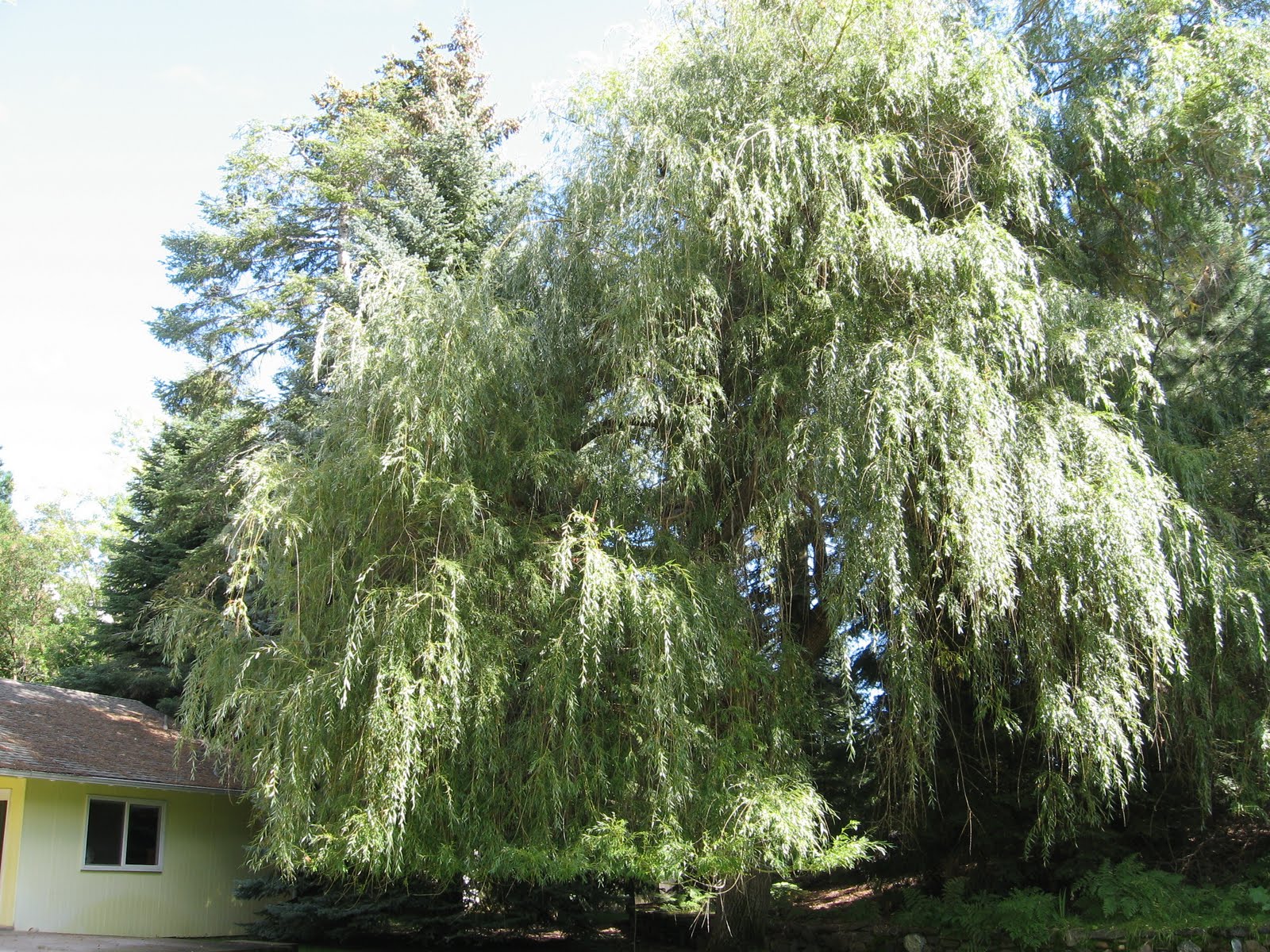
Living in suburbia as we have for nearly 20 years, I’ve noticed that trees more often than not are a problem, because they are too big for the small spaces allotted to them. But this property had plenty of space for trees to grow for 30 years, into their majesty. In the center of the photo above is a Douglas Fir with a cave-like space underneath where I told Pippin I could envision children playing.
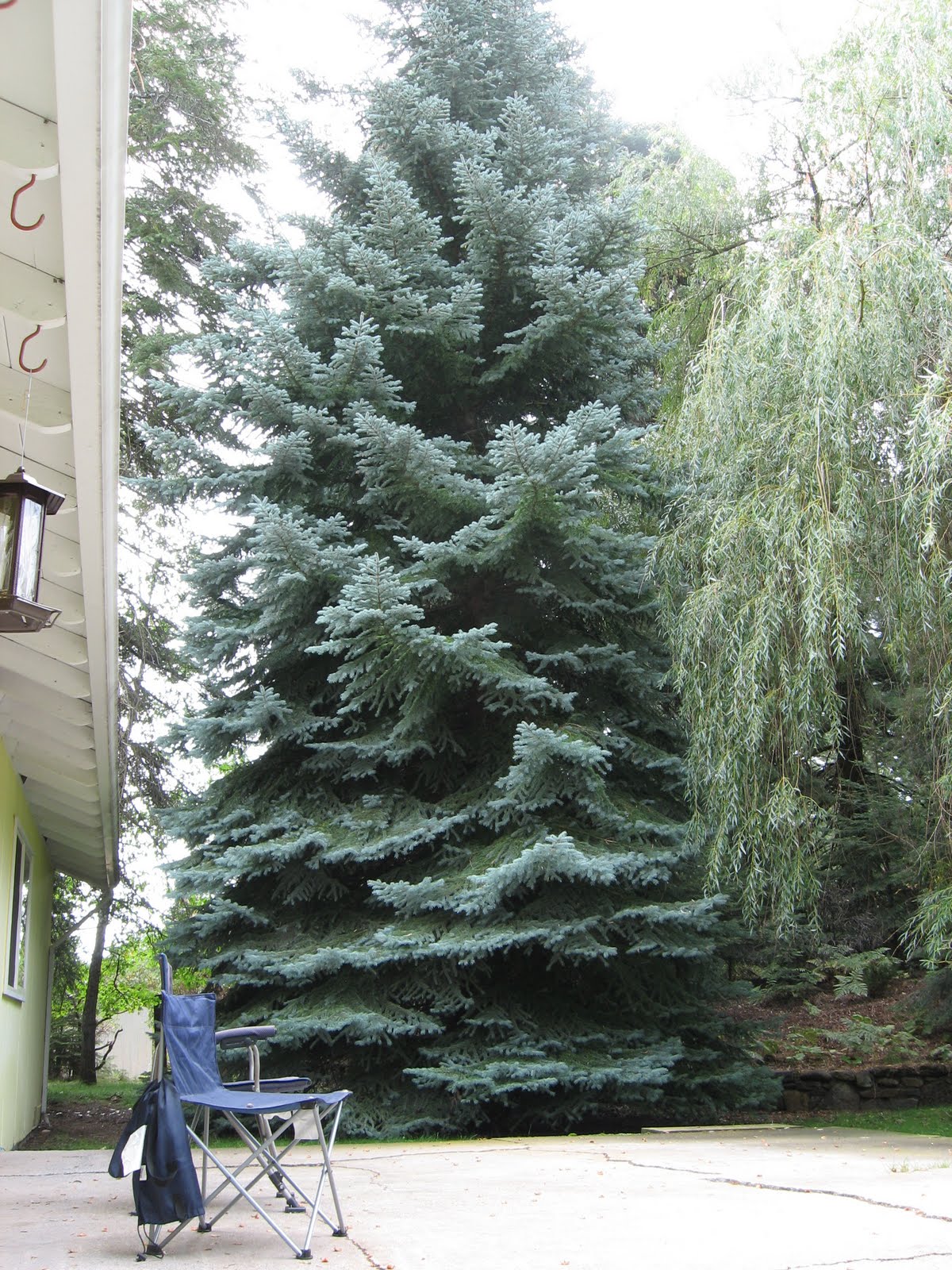
It’s like a park, what with the forest next door, and the tall trees nearer the house. Here is a Blue Spruce.
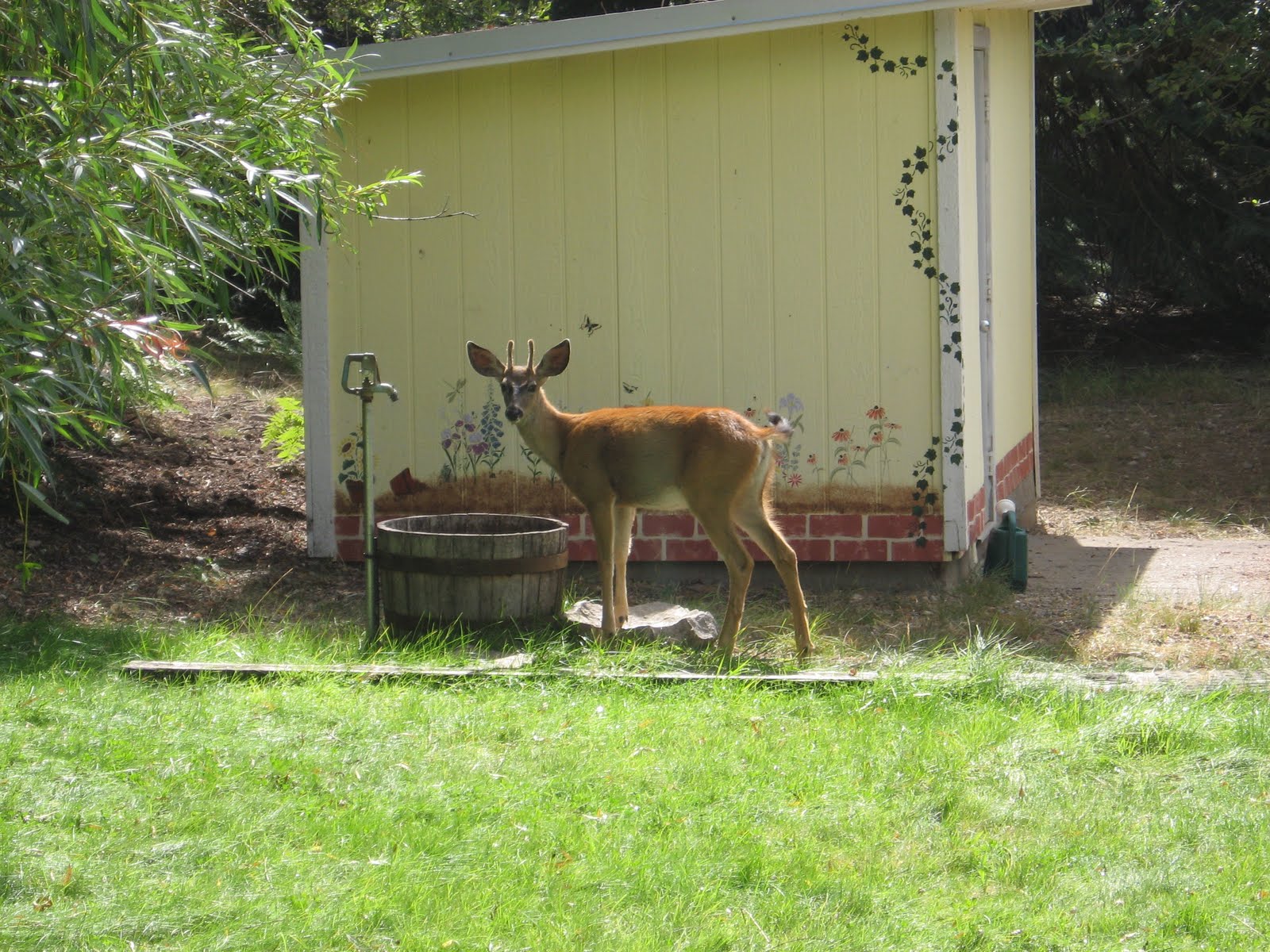
The house was unoccupied for more than a year, but the deer included the yard in the territory they considered home. This fellow is one of a family of the critters that live here, whom the new owners call Spike.
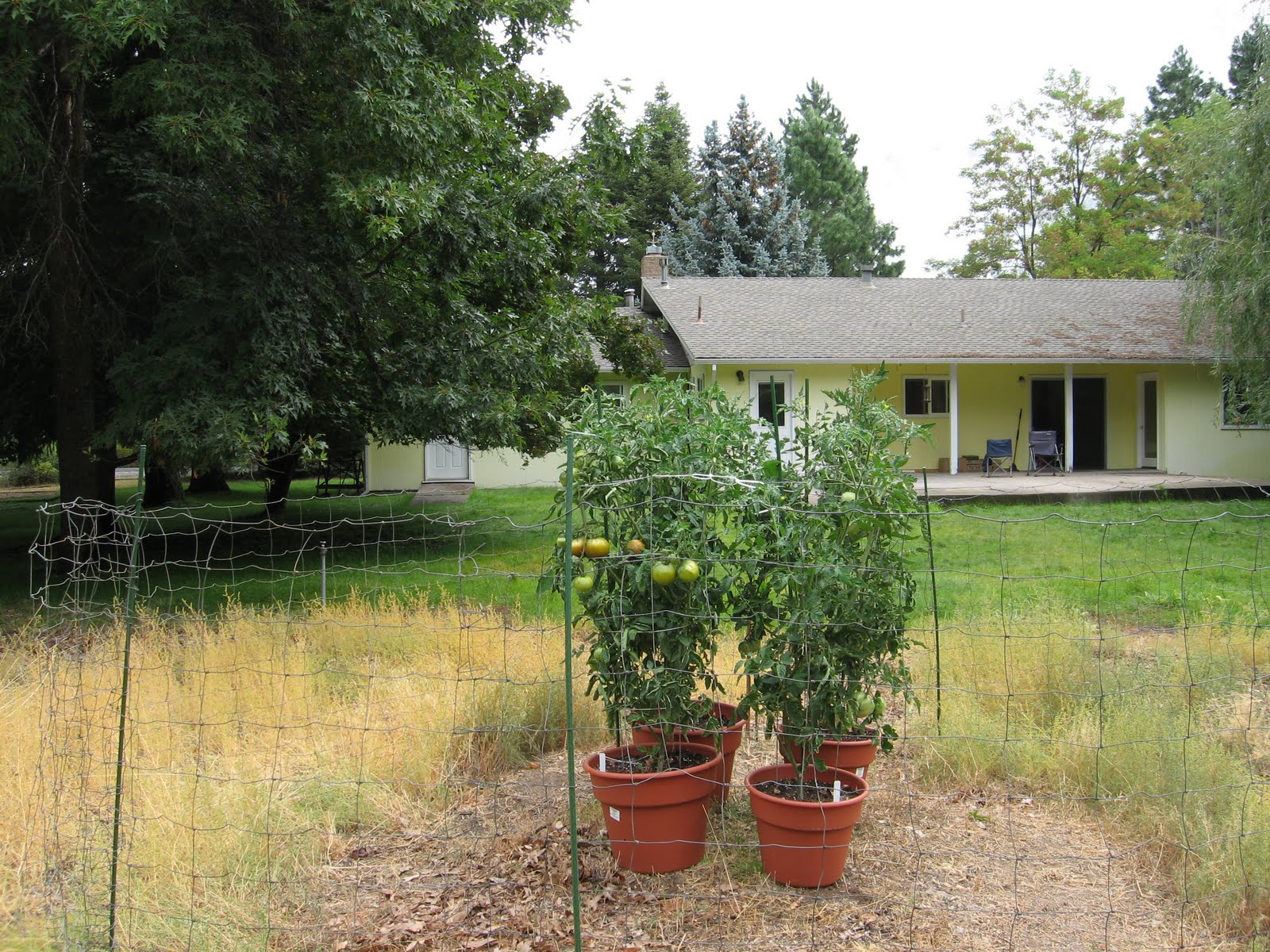
Spike and his kin watched as The People moved some pots into a sunny spot in the back yard, and a few weeks later they watched some fruits get big. One day they ate all the topmost barely-pink tomatoes.
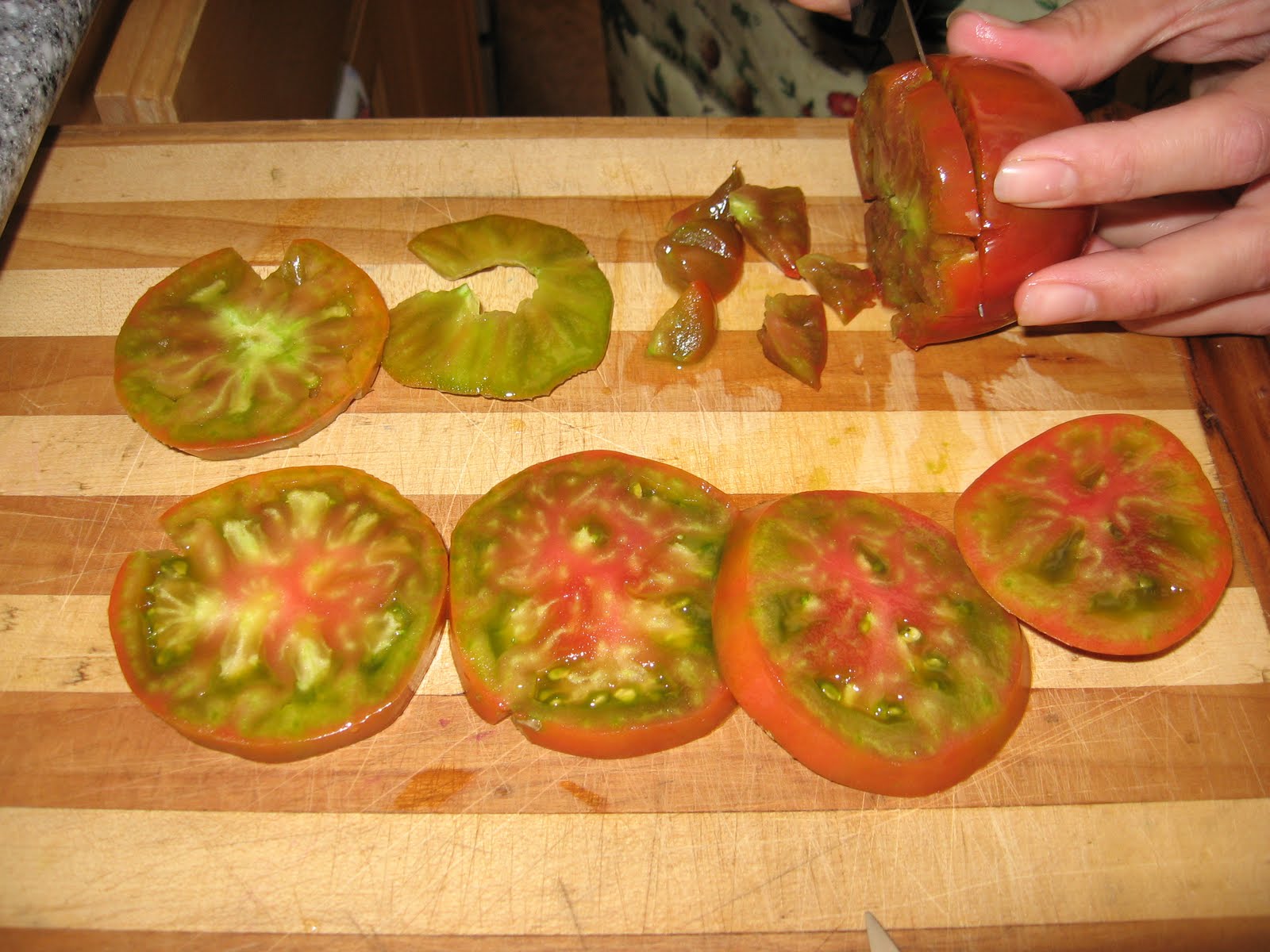
The People made a wider fence so that hungry animals couldn’t reach the next fruits that ripened, and in the middle of September two of the Belgian heirloom variety called Ananis Noir, or Black Pineapple, were finally ready.
I was on hand to enjoy their really good flavor!
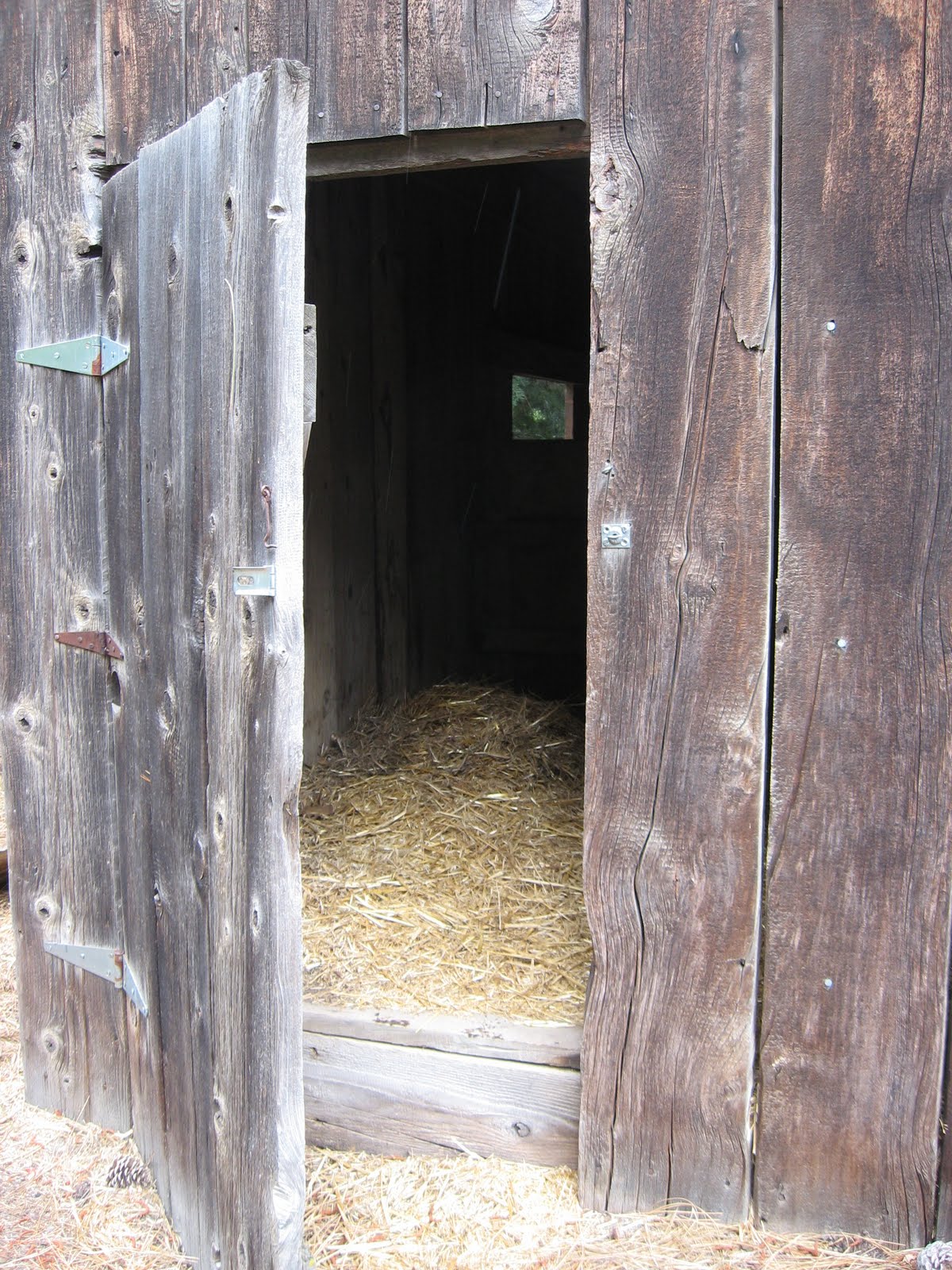
There are some outbuildings on the property, such as this one that is begging for some chickens or goats to move in.
And “next door” is a huge meadow, where I rambled with Pippin, my nature girl. We went through some forest on the way. I hope you will come along on our exploration.
This is the fence through which we trespassed.
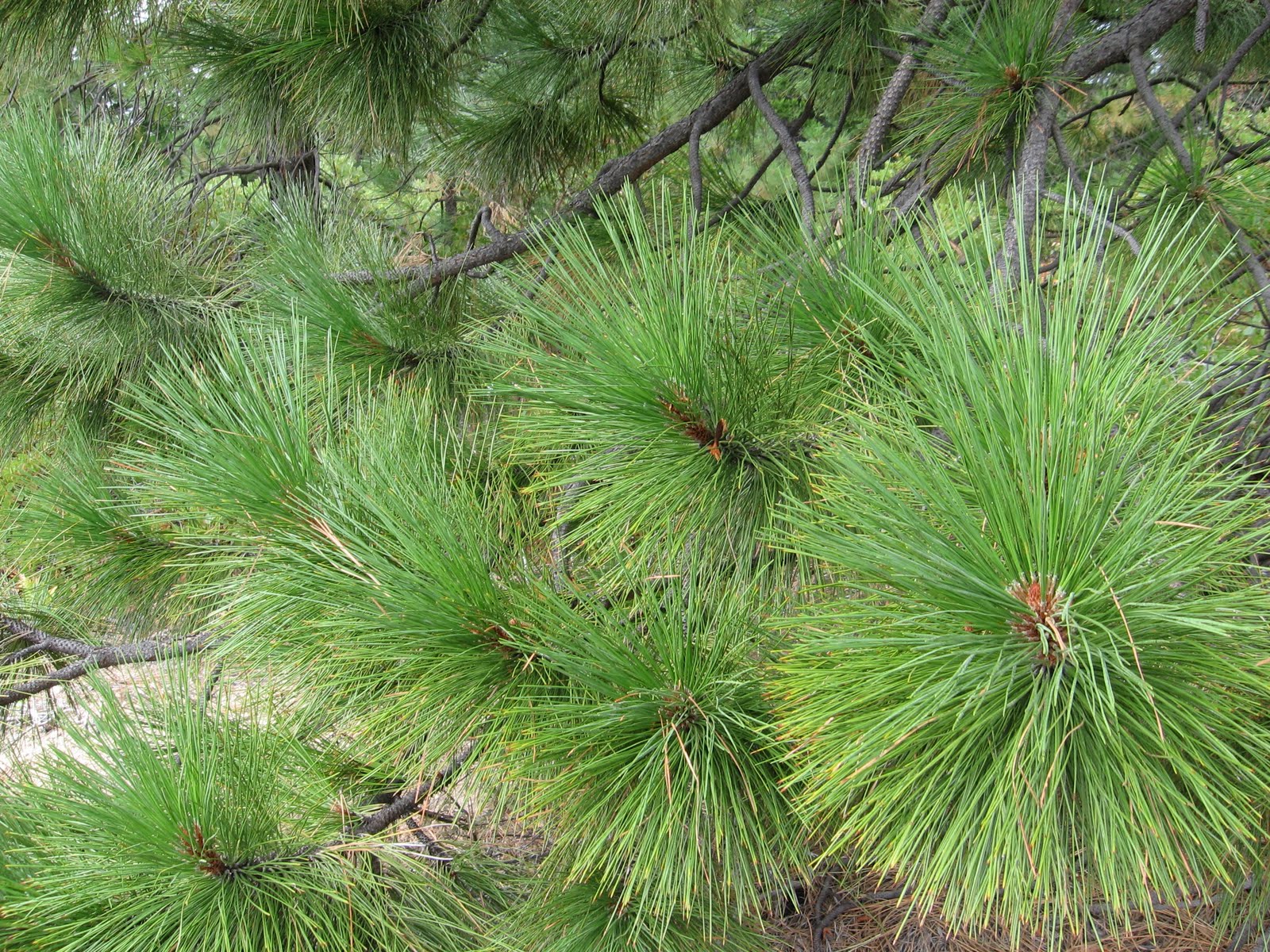
In our yard at home we have a pine tree that always looks dry and scraggly, so I was immediately impressed with the robust green needles on this Ponderosa Pine.
My guide let me know that it is hard to tell a Ponderosa from a Jeffrey Pine, they are such close cousins. But the barbs on the Ponderosa cone point outward and prick you when you hold it. The Jeffrey cones slant inward.
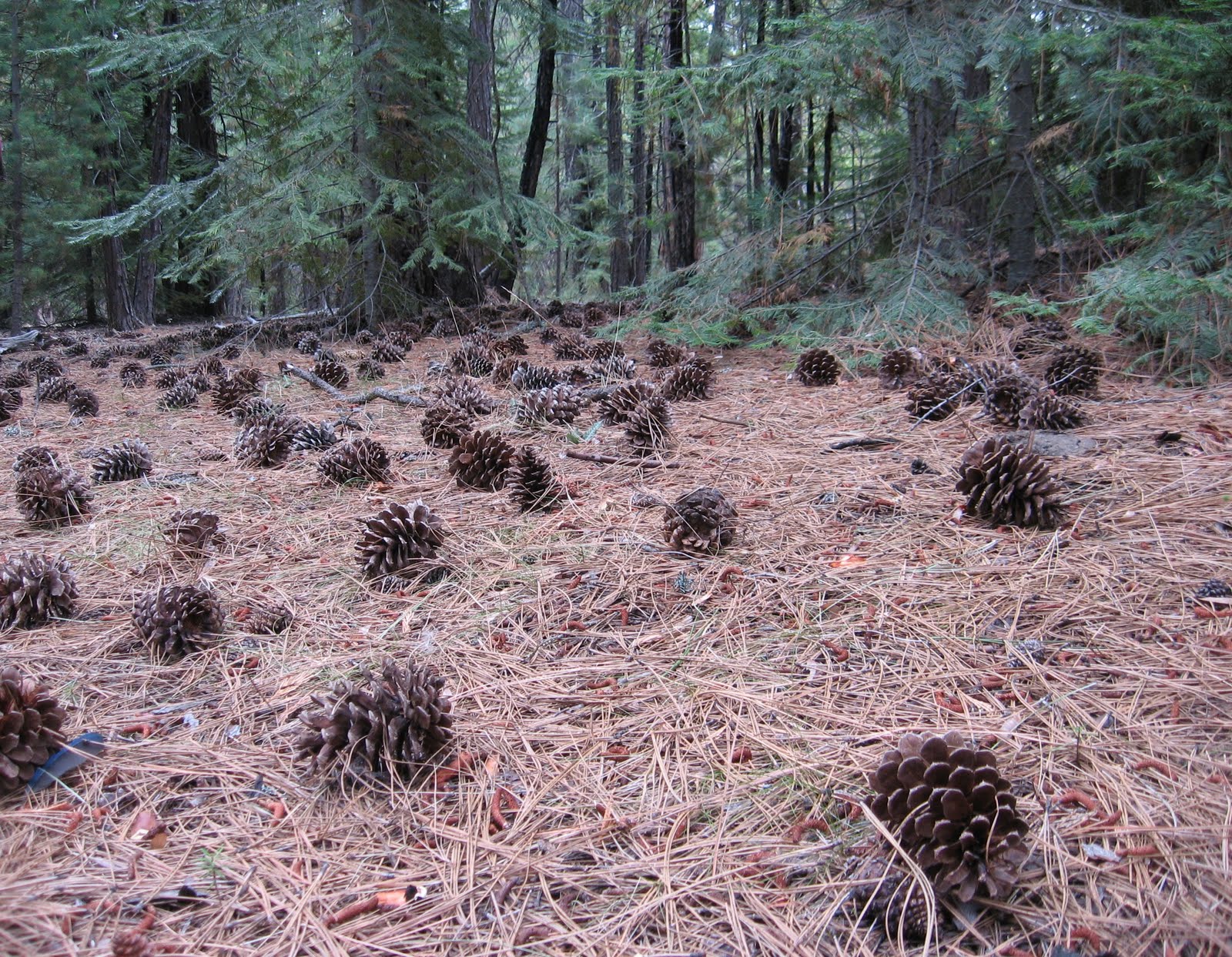
The forest floor is dense with needles and cones. Is that a blue jay feather I see on the left?
All over the woods were little piles where squirrels had made a meal of the Ponderosa cones and left the remains.
Sugar Pines are spindly, but their cones are bigger, like this.
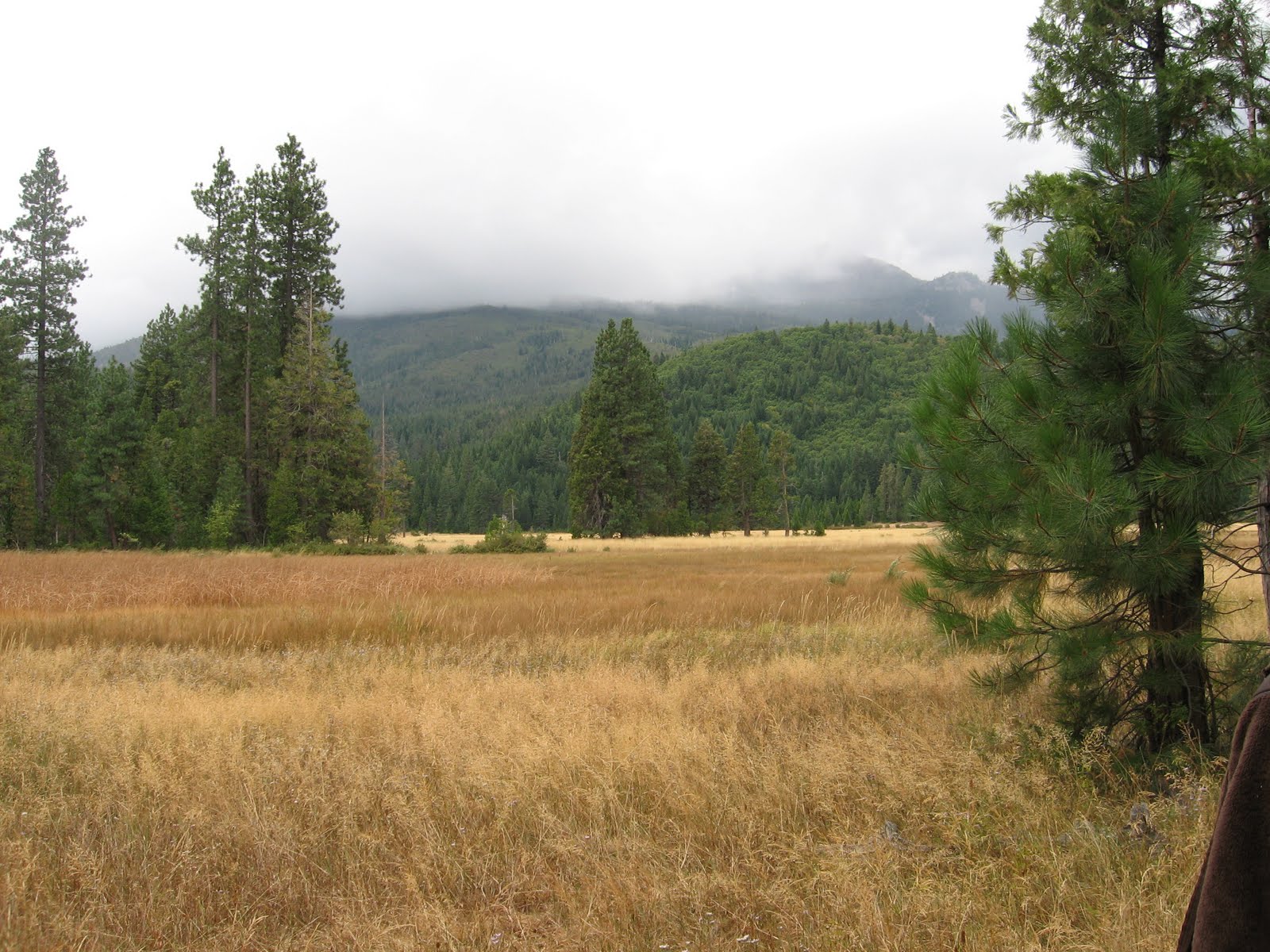
We came out of the trees to see the expanse of meadow, with clouds blocking our view of the peaks. It looks pretty monotonous, doesn’t it? But there were a thousand different plants waiting to be discovered by a patient eye.
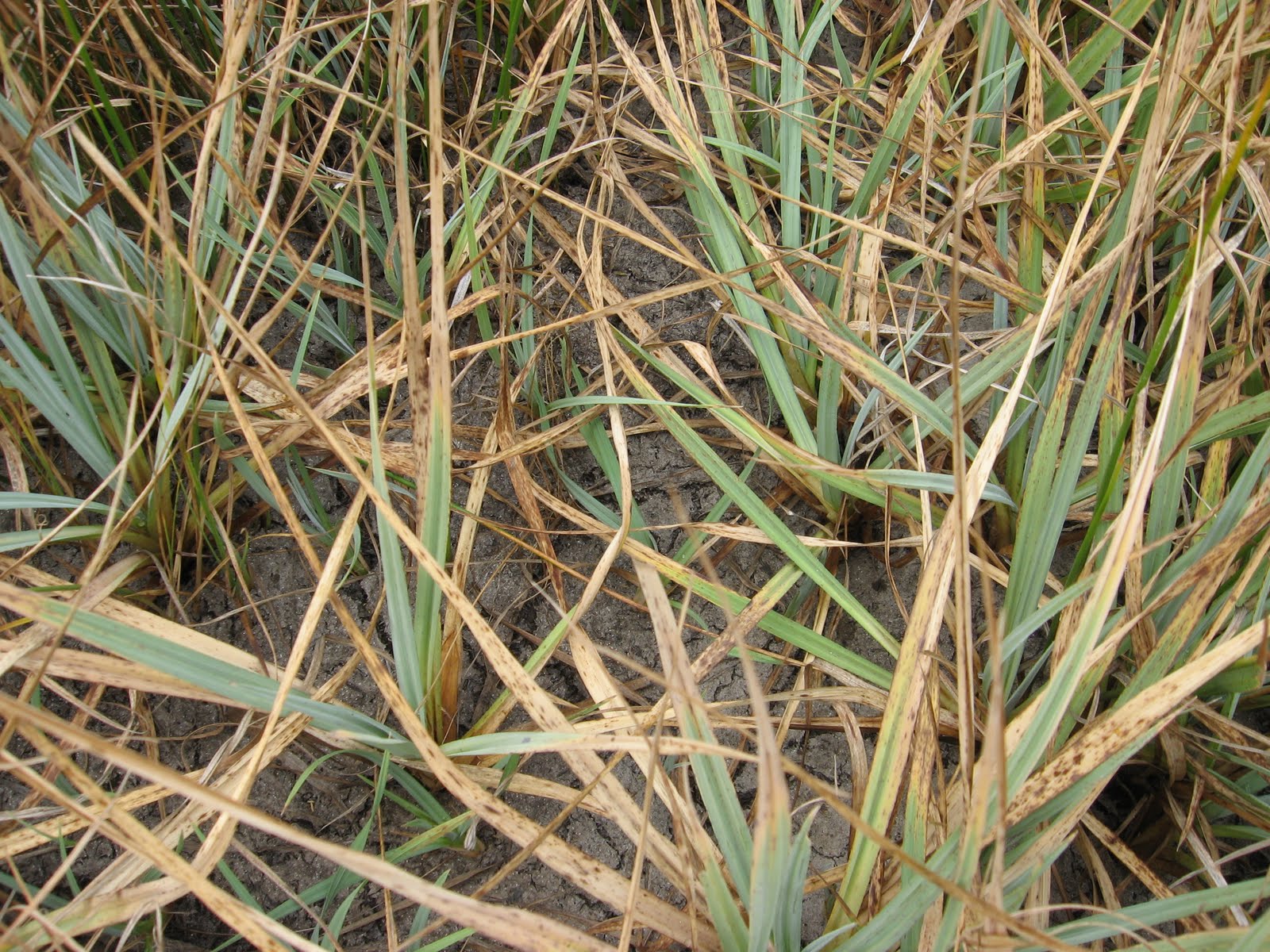
The ground under our feet felt odd. I looked down and saw this. The floor of the meadow is spongy, with a papery crust–the dried-up bog that makes walking out there difficult for most of the year.
Yarrow is one of those plants that blends in with the general golden tones of a California summer.
This looks like a member of the pea family.
The darker swath through this part of the meadow is where a stream ran in the wet season.
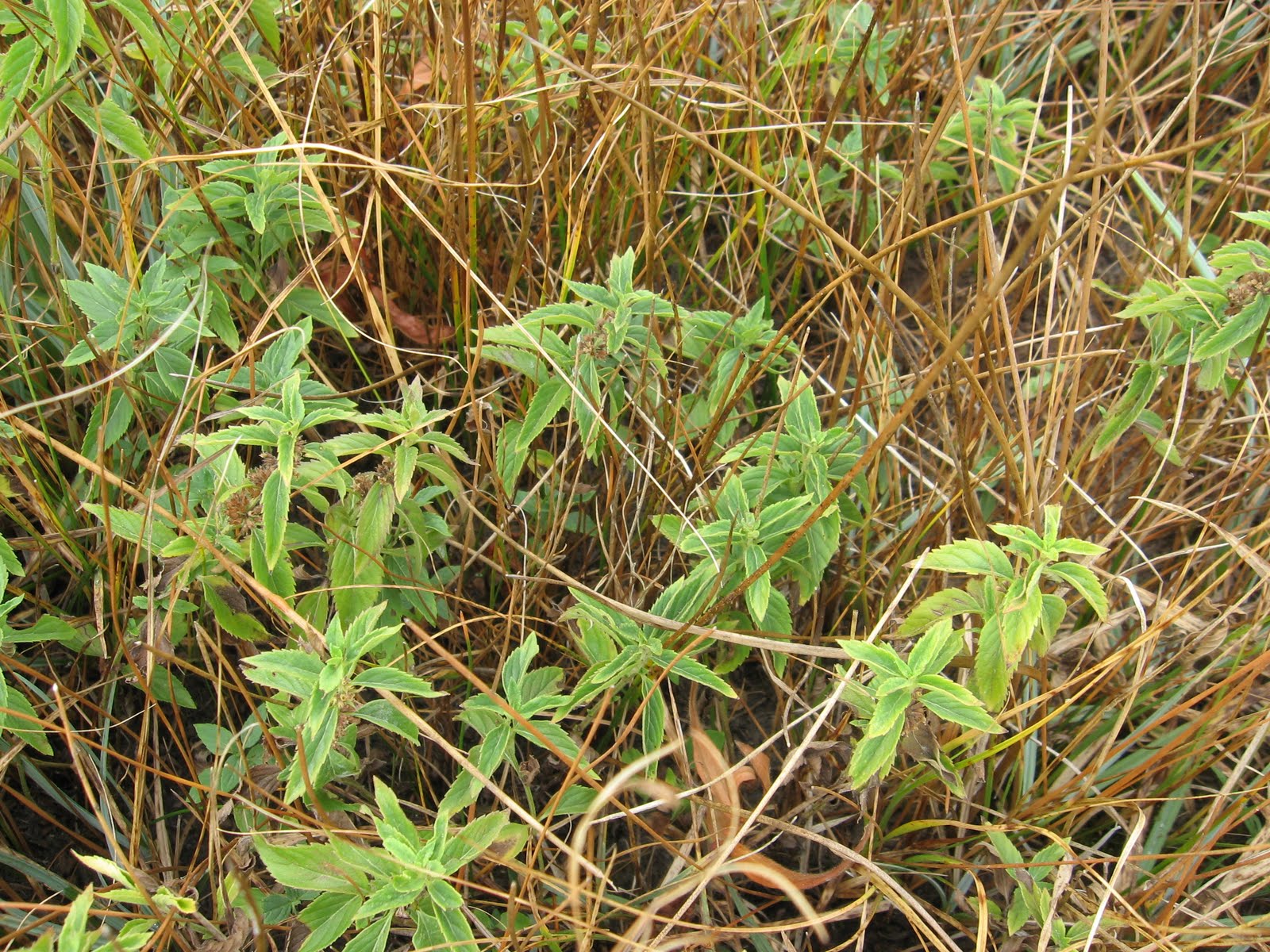
I guessed by the distinctive minty smell that this was a type of pennyroyal.
A tiny yellow flower seen only by God and us.
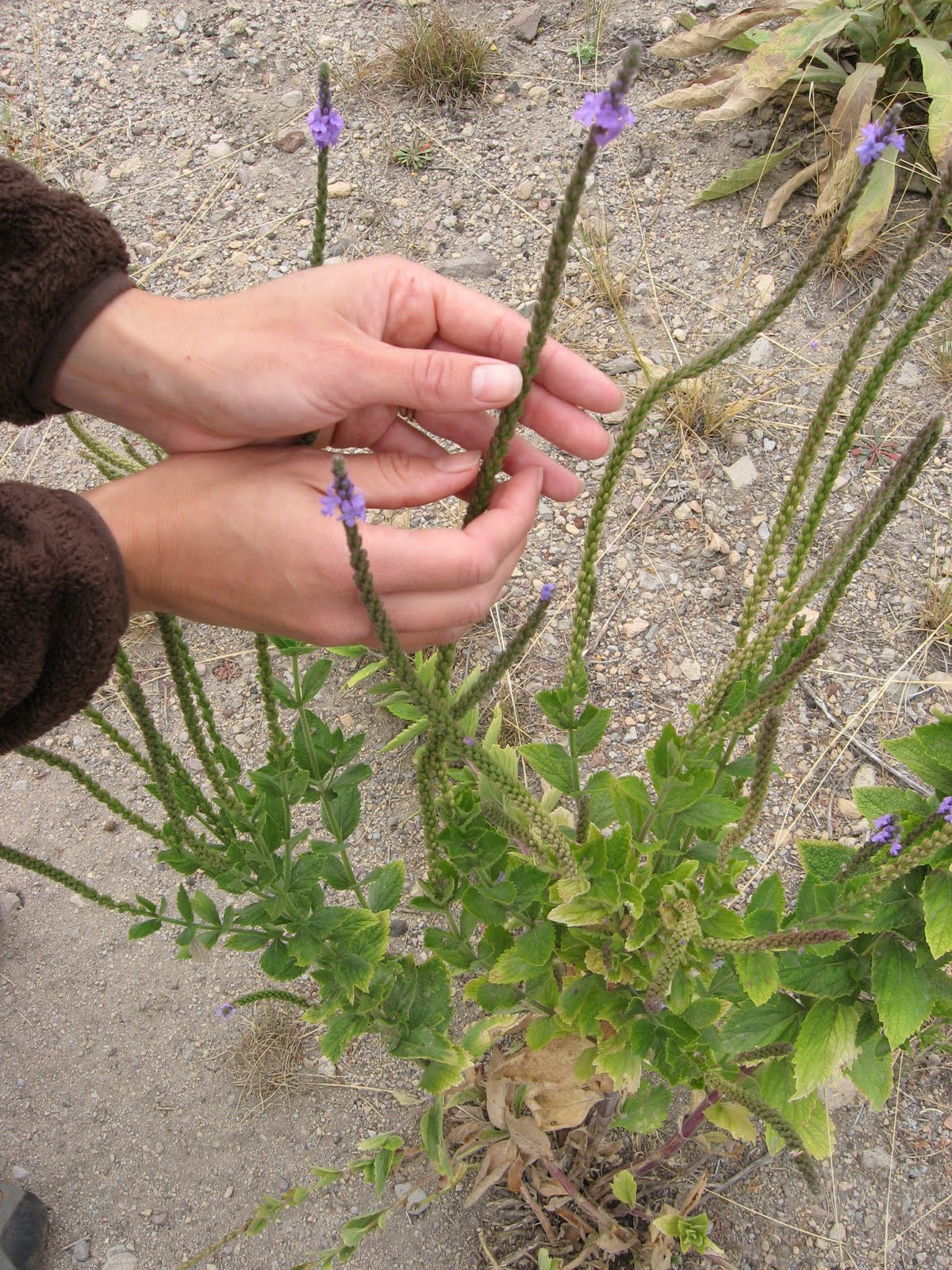
This plant below with tall purple blooms Pippin had never seen before. I hadn’t either, but that is more to be expected.
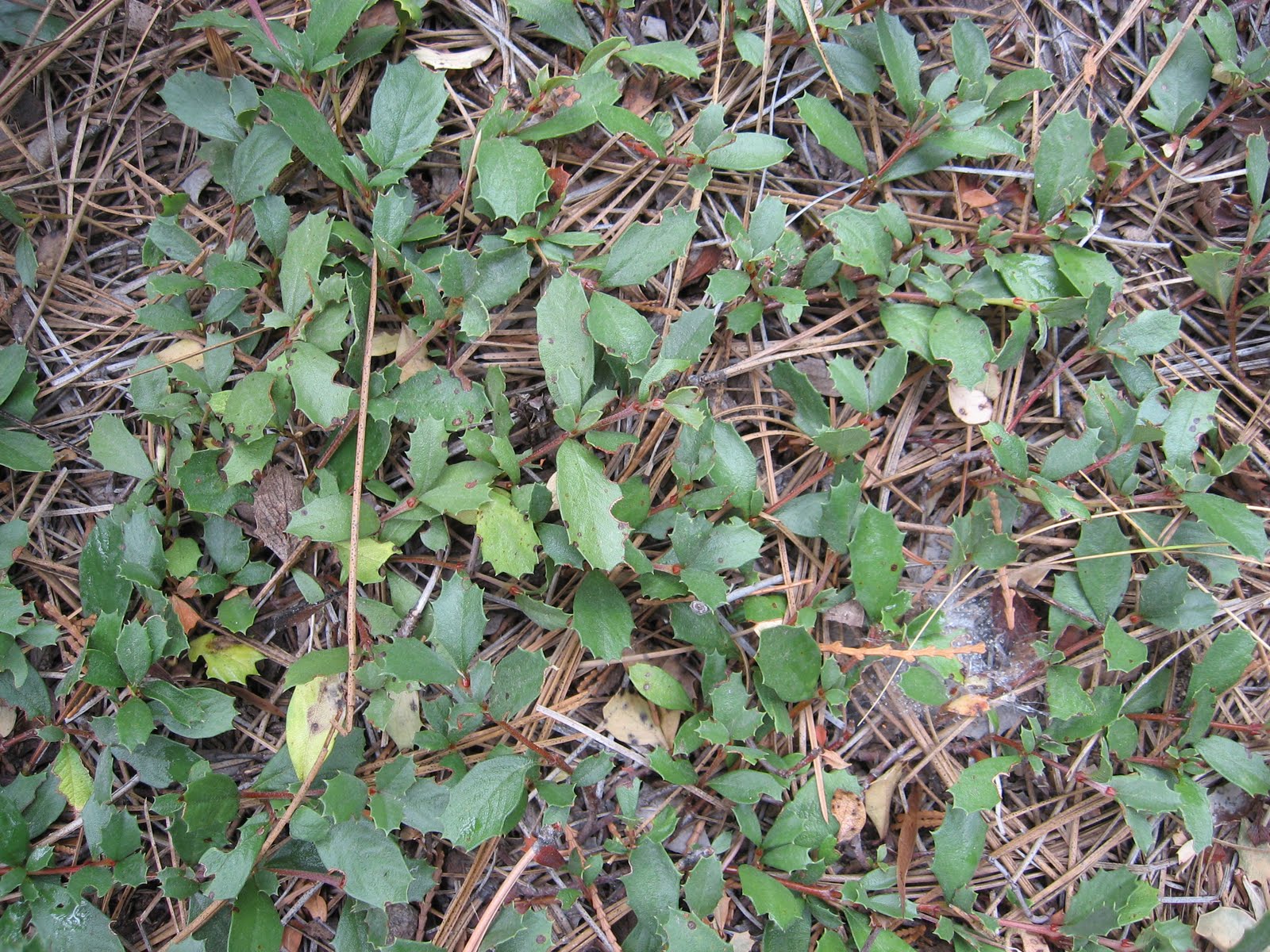
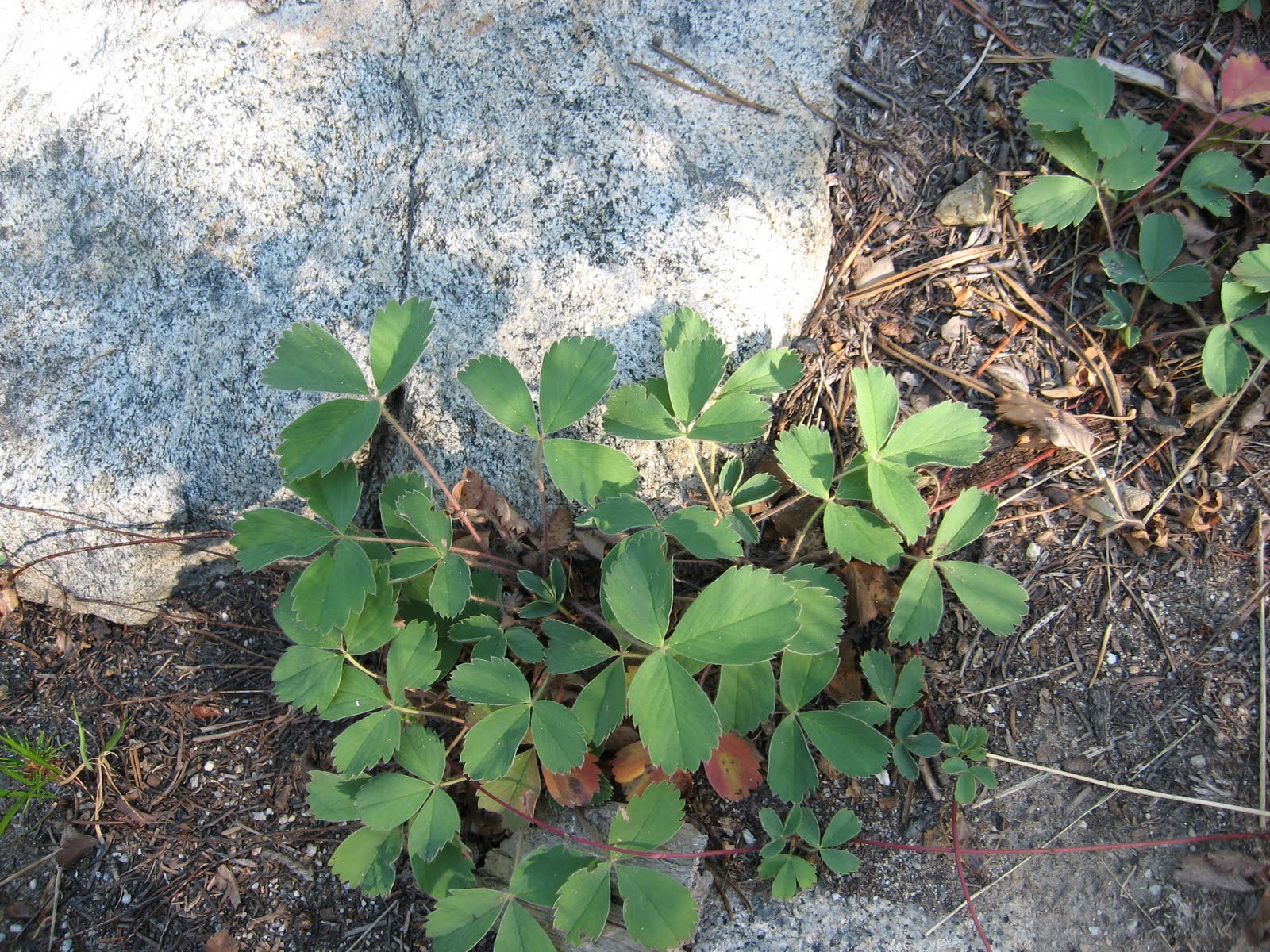
When I first glanced down at this plant, I thought of wild strawberry. But upon closer inspection, it didn’t have that kind of leaf.
My daughter knew that it was actually a type of ceanothus called Squaw Carpet. As I was taking these pictures, the drizzle was becoming rain, and we were headed back.
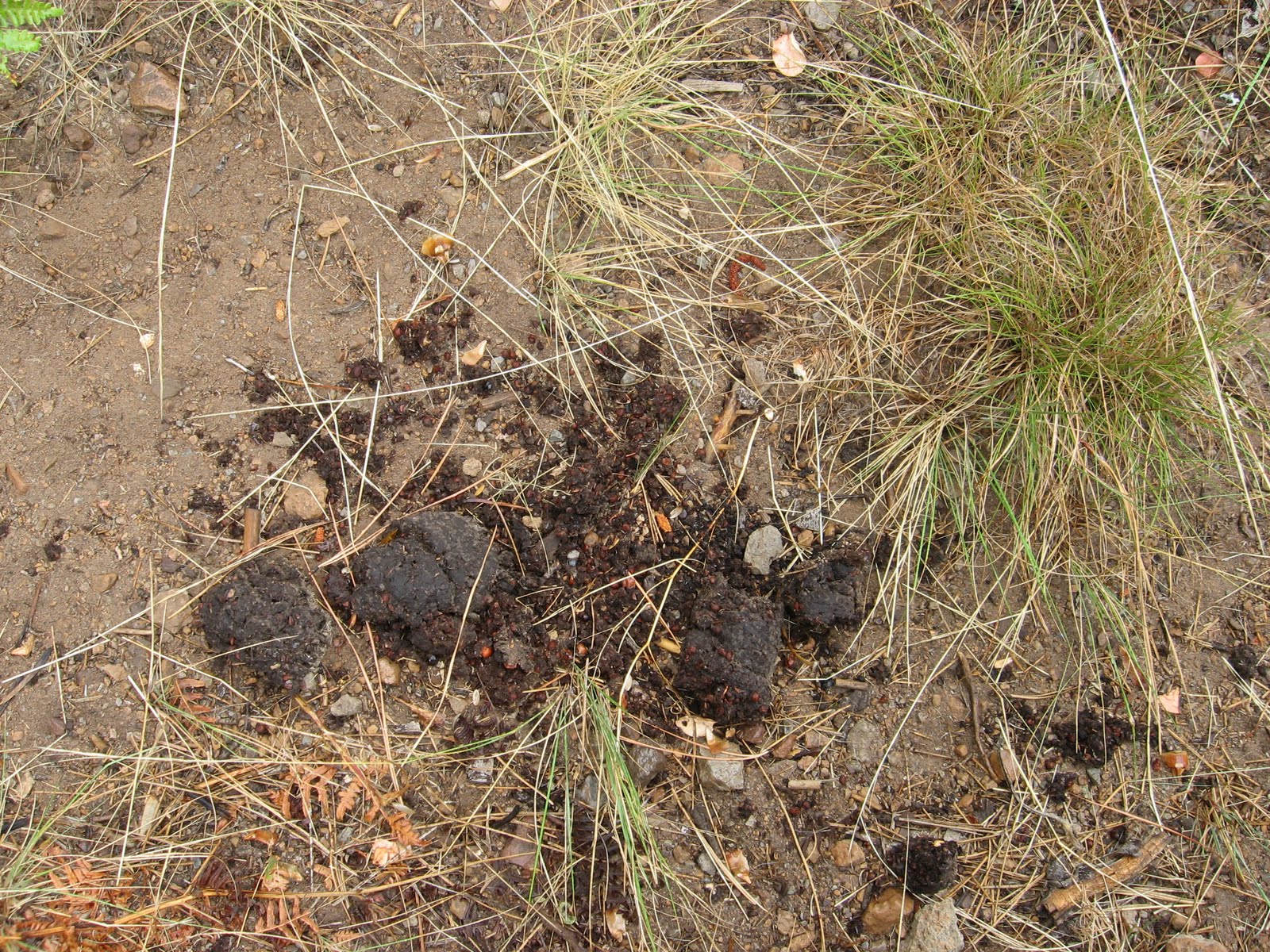
Less tame animals come around their place. This bear scat was fresh when they first saw it near the house, not long after the bear had gorged on manzanita berries.
Incense Cedars grow in the neighborhood. This little fruit is all the cone they make. But they aren’t true cedars.
Douglas Firs make these cones with “rattails” sticking out. But they aren’t true firs.
I’m happy that among the imposters stand trees that are true to their name, like this fir. See how its needles stand upright? True firs, and not the Douglas kind, make good Christmas trees.
Remember my first picture, of the tree branches arching over a cozy den? Spike was resting there later, and didn’t mind me taking his picture. I wonder who will next be enjoying that spot, his grandchildren or mine?
As I wrote in my last post, I was departing for a mountain retreat. And I made such a big deal of my delight in anticipating it, I also promised a report.
It takes a full six hours to cover the 300 miles to my destination, and most of that time I listened to various things on tape or CD. As the library didn’t have anything promising on my last-minute visit there, I was forced to remember that we had taped readings of the New Testament in the cupboard. As with books, I took way more CD’s and tapes than I could possibly use….
On the trip down I listened to the latest Mars Hill Audio tape. Please ask them for a free sample if you’ve never heard their interviews with various authors, teachers, musicians. It’s like an audio magazine where you eavesdrop on discussions between thoughtful people. And I heard the whole Gospel of Matthew on tape–what a perfect intro to a prayerful couple of days!
Sierra vinegarweed
My least beautiful photo, but the best of my attempts to capture this flower that graces the roadway, around 5,000 to 6,000 ft elevation, with a misty lavender haze. When you get close, the effect is spoiled as the plants are revealed as dry and stickery, puny individuals. (That sounds like a description of us Christians relative to the whole Church.) I don’t know what it might be, do you? It was the first of my pictures on this expedition.
It’s about this point on the driving, an hour and 3,000 ft down the mountain from Our Lake, I always have to turn off all recordings or radio and have quiet, so I can focus on the smells of the trees and hear the quiet of the forest.
Incense Cedars contribute one of the aromas. As a child with my family, on trips up the mountain it was filling my senses about the time I got carsick, and it took me most of my adult life to get over this association and develop an appreciation for the tree. But I haven’t known just what they looked like, so I found this photo on the Net.
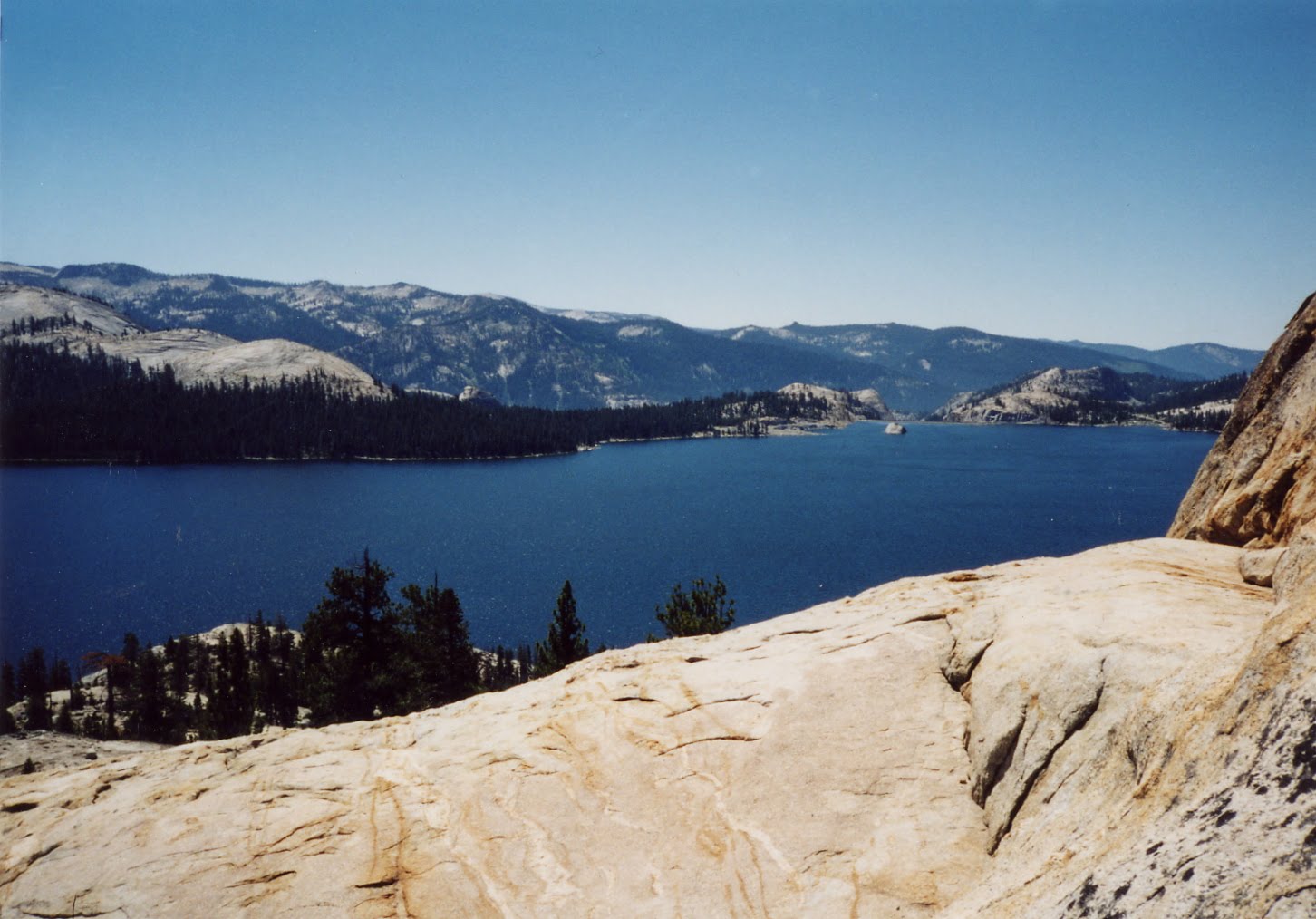
Far in the distance at left you can see a lake that is not our lake. But this photo was mostly for the sake of the manzanita that I love, and in the absence of the wildflowers that catch your eye earlier in the summer, it takes center stage for me, so I made it fill the foreground here.
Ah…the first view of Our Lake. Other than that purple haze, all the wildflowers I saw at high elevations were white. Like this Pearly Everlasting. I just looked up its name this morning.
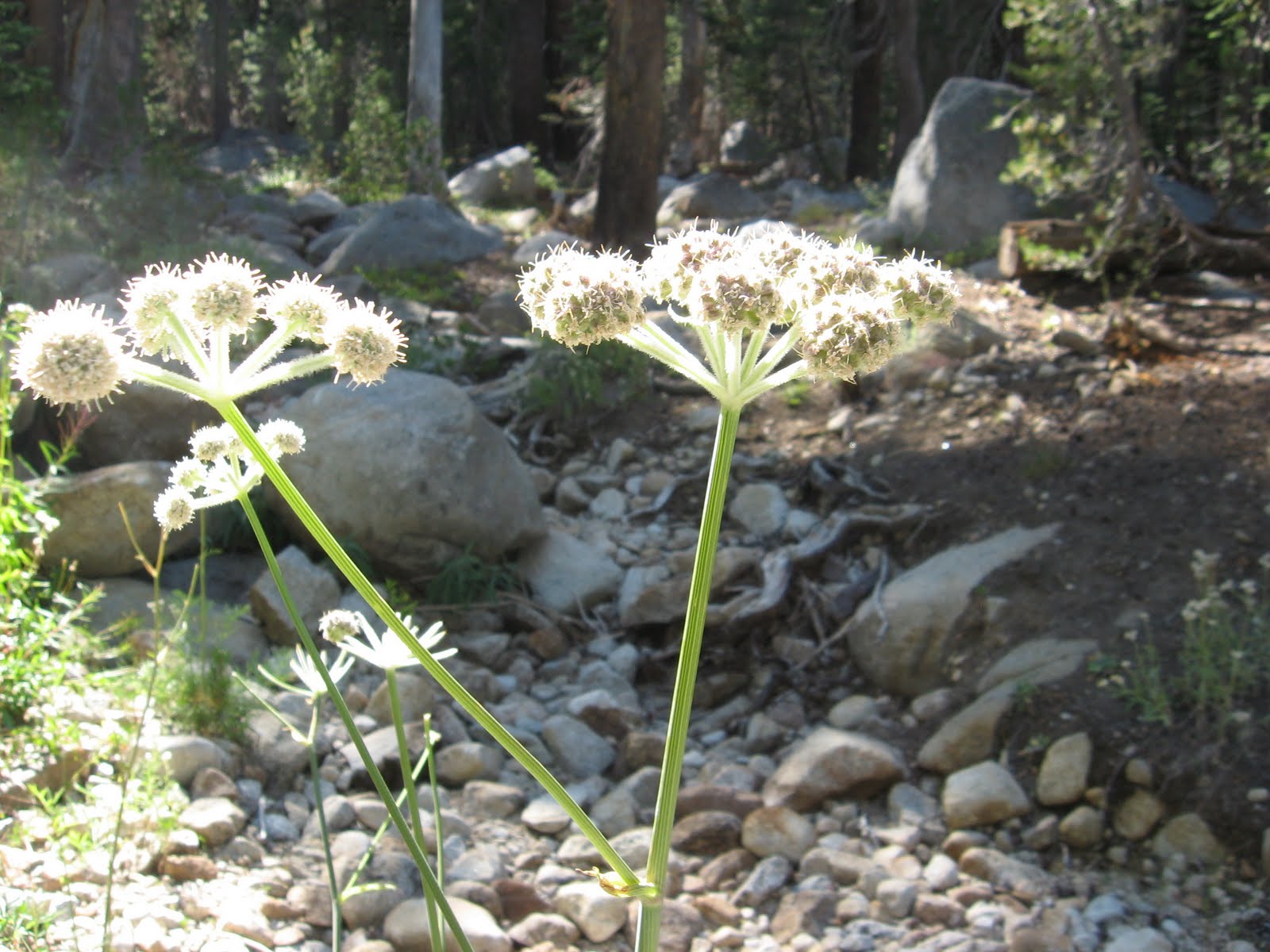
Ranger’s Buttons along the road going in. I picked up some granite rocks near here for the garden at home.
Yarrow was growing next to the cabin. I saw it when I was turning on the water down the hill. There are various things to do when you first arrive: turn on the water, turn on the solar, turn on the water heater. Bring your stuff in from the car. My legs were so heavy and I felt generally exhausted, so much that I wondered if I could resist falling on a bed and sleeping immediately. It must be the altitude. All evening my brain was slow, and I was so sl-e-e-py.
yarrow
For that reason I didn’t start right in on heavy reading, but took advantage of the magazines my sister had left. When my father’s mark was more on the place, you would find old issues of California Farmer,National Geographic and Sunset piled up everywhere. Now I find the New Yorker! Well, as I haven’t been on the treadmill for some time, where I used to read New Yorker, it was a welcome change, and just the thing for an oxygen-deprived brain. The most interesting article I read was in two parts, on Siberia, by Ian Frazier. His book on the subject is due to come out next year, and it looks to be worth reading.
This old coffee table caught my eye when I walked through the cabin door, the only furniture from our childhood home that never varied or wore out, and the only piece that we have (just since my last visit) installed in the cabin. Either my father or another ancestor built this table, I’m pretty sure, but none of my siblings can remember, so I guess we will never know its origins.
I brought some candles for indoor prayer times, and then was pleased to discover I had a little icon card of Christ the Shepherd in my purse to display with them. I prayed He would shepherd me through my weekend in the way of the 23rd Psalm, and give me light, and Himself as Light.
Speaking of light, I did lie out under the stars in my sleeping bag the first night, for a couple of hours, until my narrow bed (a lounge chair cushion) made it impossible to sleep. The stars and night sky were comforting, like an angelic blanket. This time little wisps of clouds were decorating the constellations; I could smell the trees, sweet and dry and piney-sharp, with a bit of wood smoke from the campground down the hill in the mix.
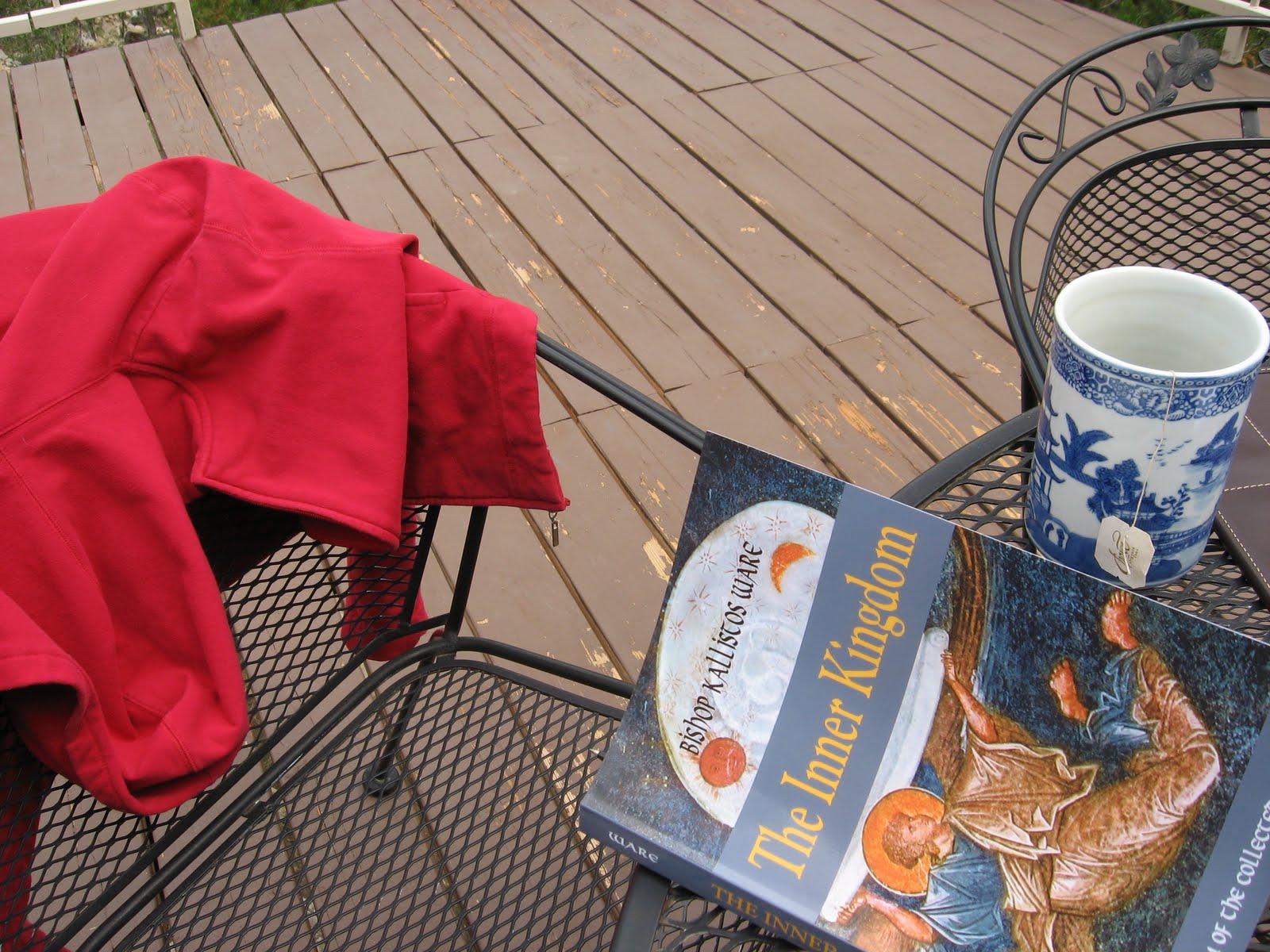
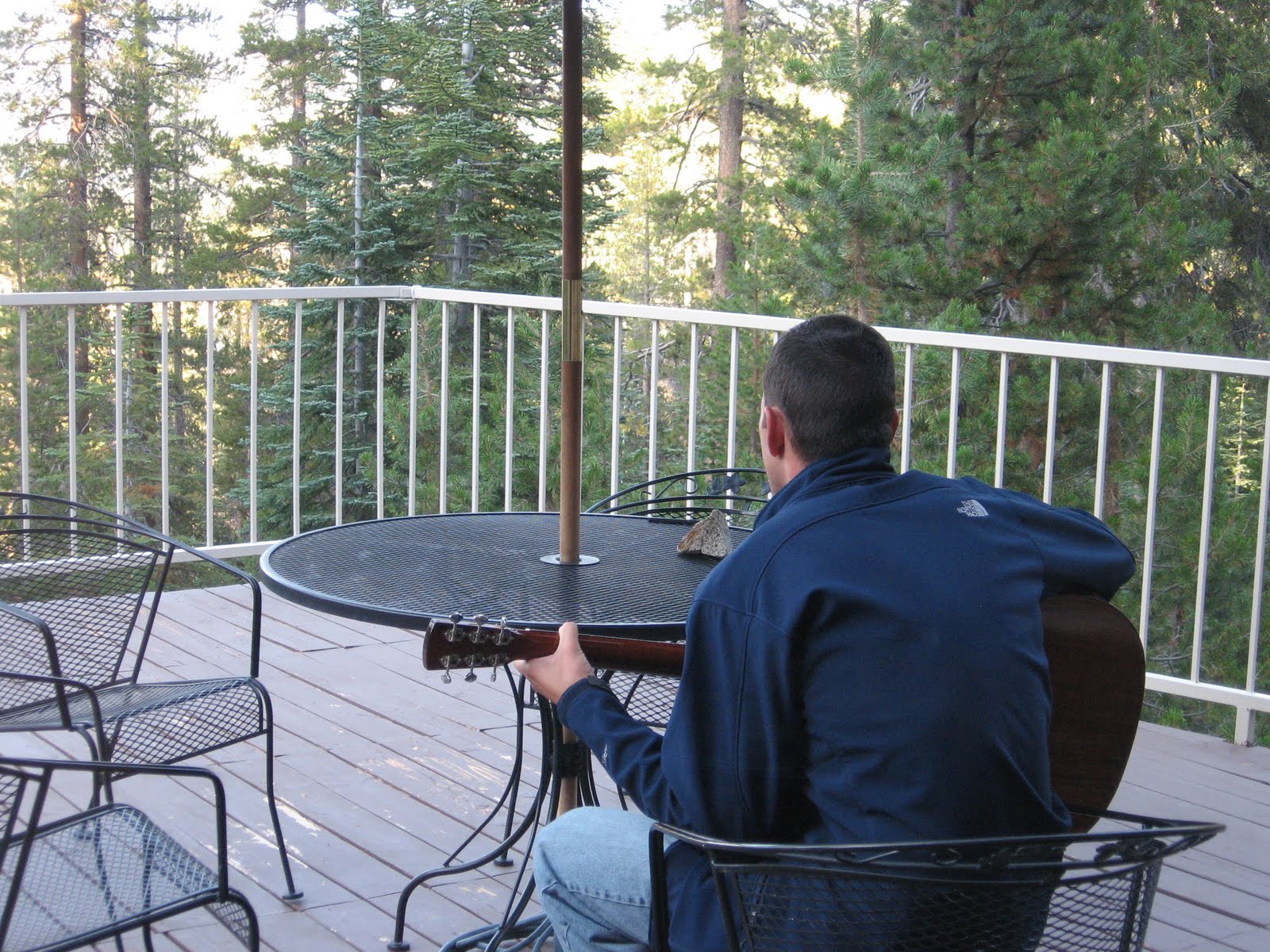
Much of the time I spent on the deck, reading this book, drinking tea, and watching the hummingbirds battle over the feeder. If the sun goes behind a cloud, or a breeze comes up, the temperature drops, so you find yourself putting on and taking off your sweater, moving under the umbrella and then back out in the sunshine again.
When I was wearing my red sweatshirt the hummingbirds would buzz threateningly behind my head as long as it took them to figure out that I wasn’t a giant flower.
The Inner Kingdom had been on my shelf for a year; I’m so glad I threw it in the box to take up! The author Kallistos Ware was a convert to the Orthodox Church as a young man in Britain and was a lecturer at Oxford for a long time. I have read other books by him, as a catechumen and since, and was able to hear him speak in 2008, which was pure pleasure.
This one is first in a planned six-volume collection of his works. He is a wonderful writer–so scholarly yet easy to read. I’d say he is more teacherly than devotional in his style, and he treats the subject matter so thoroughly that most every intellectual question I might have was answered; I was spurred on to love the God he so lovingly describes. I finished the whole book! What a satisfaction to finish something so nourishing.
Soldier came up to be with me for part of the time. He also read a lot, and hiked, and played his guitar, everything from Dylan to gospel. It was a rare treat to be just the two of us together.
Here are the books all packed up and ready to carry home again. I only used about half of them, and there is an extra in the box going home, the novel by Jane Smiley that my sister had left in the cabin and that I am borrowing. It looks small enough for reading in bed, but I didn’t take the time to dip into it yet.
On the way down the mountain I had to stop and try once more to capture the beauty of the manzanita. I couldn’t, of course. And those tree smells wouldn’t be bottled up. I could never get a picture of the night sky that would make you feel the weighty silence of the Holy Spirit in it. But you know how it is–I had to try!
 I’m back up at Pippin’s place as of last night, and this morning took Baby Scout for a walk in his jogger. It was an hour’s walk, but that doesn’t translate to much exercise when you figure in all the stops for gawking and picture-taking. On my drive up I listened to most of My Ántonia and was struck by the evocative descriptions of the prairie; here the meadows are in their late summer glory of gold tones, with runnels of pale green. My photos don’t serve nearly as well as Willa Cather’s prose in conveying a scene.
 In this case there were jays scraping the air with their calls, and smells of drying grass and a dozen trees coming at me in the breeze. Scout hummed as we bumped along. The air was crisp at first, but the little currents of warm spread out to fill the morning so that it soon felt like an August day.

 Probably it never happened before this, that we camped in Yosemite two summers in a row. But this year and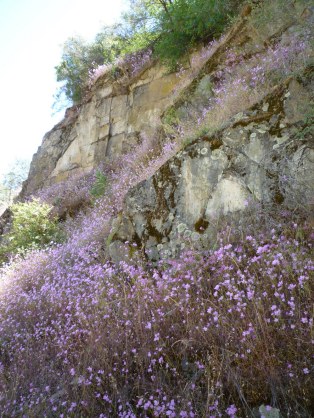



 It was a new kind of camping for us, in Housekeeping, where you get three walls surrounding beds with mattresses, canvas roofs over your head, electricity in your cabin and patio area, and hot water in the restrooms nearby. Not like our tent camping at Crane Flat in the past, pictured.

 Scout missed his routine, and seemed to get more overtired and cranky day by day. This is a shot of him sleeping early in the week, after being lulled to sleep on a wheeled walk. He often enjoyed his outings in the baby backpack, with its pauses next to trees and rocks where he was given time to feel the textures.


 After driving up the mountain all that way they aren’t in any hurry to leave, so everyone can watch everyone else as well as the scenery. We wondered if this pink-and-black woman might be on her honeymoon…anyone have a guess as to the origin of what looks like a traditional costume?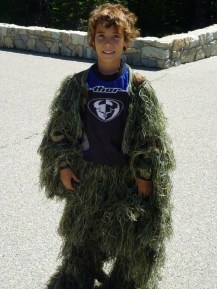














 ow in the neighborhood. This little fruit is all the cone they make. But they aren’t true cedars.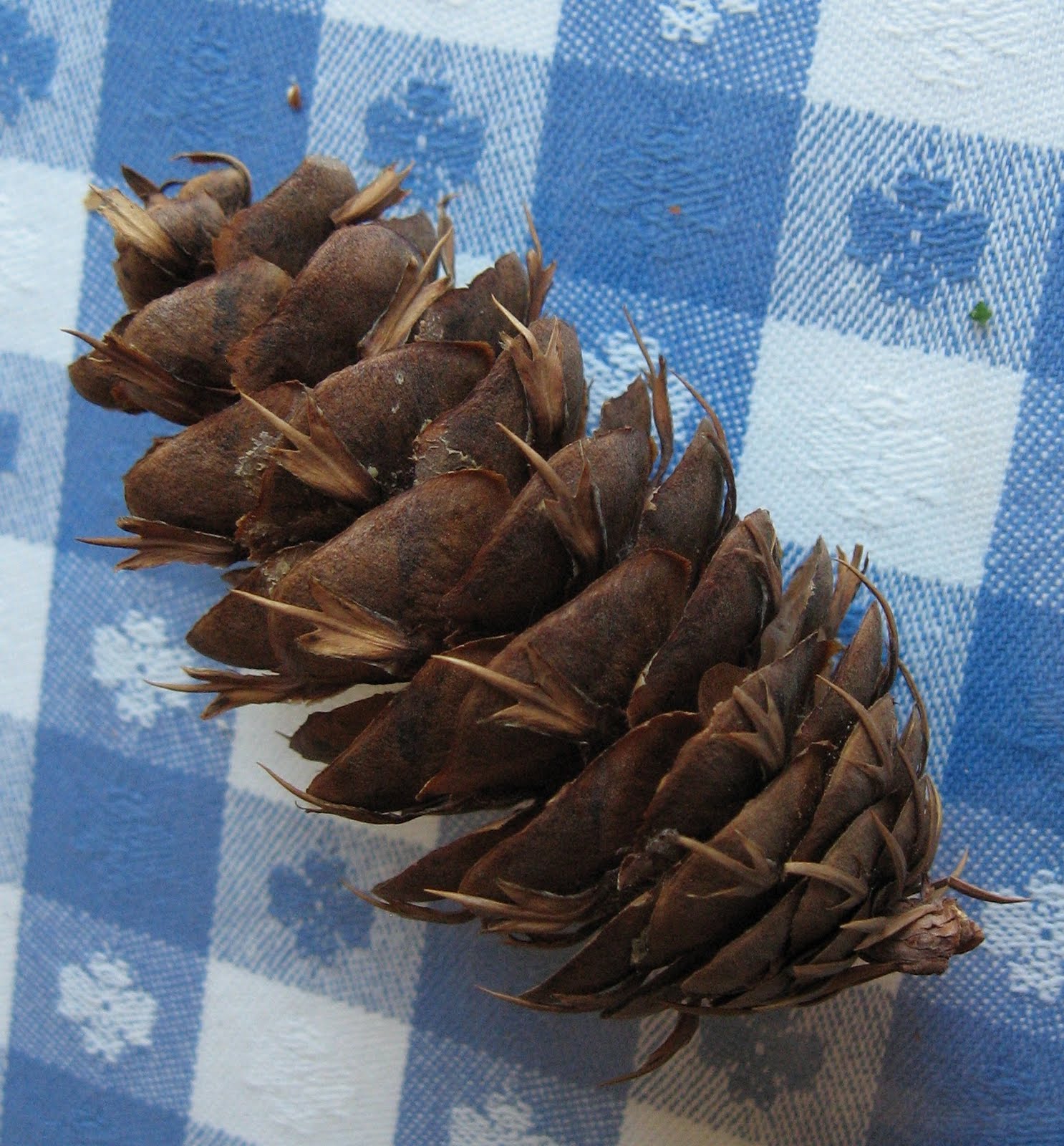








 Gladsome Lights