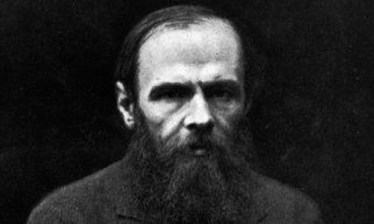
Today Nun Cornelia has kindly given us a reading recommendation in her article, “Time to Read (or Reread) Dostoevsky.” Her reason for putting forth the idea at this time is partly that today is the 140th anniversary of the death of Feodor Dostoevsky. And not only that, but 2021 marks 200 years since his birth in 1821.
 Even if you haven’t read his works, you are likely to recognize his name as a writer, whose skill Sister Cornelia describes: “The details of all his characters, their mannerisms, their actions, their thoughts and words, even their names, all paint individual pictures of the human condition in relation to God and the devil—pictures that don’t fade with time, and are applicable in any culture.”
In a short essay she gives details about his childhood and temperament as described by his parents (hot-headed and cheeky), and his “morose” youth, during which he spent time in military service and then began to study literature.
“His compassion for humanity led him to socialist circles, which, as he would eventually understand, were in fact seething with anti-humanity. These attempts at social reform would also end in failure for him, and he nearly lost his life in front of a firing squad. His sentence was commuted at the last minute, and he was sent to Siberia for prison and then exile. In prison he was respected by all, but at the same time considered a dangerous revolutionary and kept in shackles and manacles for his entire sentence.”
The upbringing he was given, and the era he was given to live and suffer in, certainly contributed to his great soul; and because his writing “could not be separated in any way from his own deep convictions, his books lead us in a mysterious way to those deep convictions.”
Sister Cornelia details some of the many ways that Dostoevsky suffered, and the way his wife suffered with him for his sins and weaknesses. She ends with thanks for all his works that she hopes we will read, and read again.
“But neither can we forget that an underlying quality present in him from childhood was also key to producing the literary heritage that we have today: stubbornness. Through all his failures—and apparently, he took critical failure very hard as his epileptic fits were brought on by them—he never gave up his calling and forged ahead with novels that change people’s lives.”
At the bottom of the article are links to several others on Feodor Dostoevsky. You can find it all here.

 The constant revelation of what goes on in her highly analytical mind, her wanting to understand the meaning of things, and her sureness that there is something numinous behind the visible world, all draw me to the stories. (She makes me love just being with the characters — I never want to leave them — which is probably a greater reason, but it deserves its own post.)
 “We were not surprised when the war came, for we had heard our father prophesying it all through our childhood… We had also been warned by our music. Great music is in a sense serene; it is certain of the values it asserts. But it is also in terror, because those values are threatened, and it is not certain whether they will triumph in this world, and of course music is a missionary effort to colonise earth for imperialistic heaven. So we were not so sorely stricken by August, 1914, as many other people. Indeed we had our consolations. It was proved to us that music was not making a fuss about nothing, and that the faces of our parents had been distorted out of common placidity not by madness but by the genuine spirit of prophecy.”




 Gladsome Lights