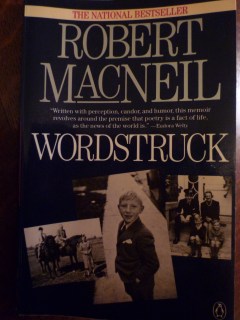
 A friend gave me a used paperback copy of Wordstruck, a memoir by Robert MacNeil, of the MacNeil/Lehrer NewsHour that he hosted in different formats from 1975-1995 on TV. I had heard his name during those years, but our family didn’t watch television, so we didn’t pay attention until he co-authored the book The Story of English in 1986. It was quickly made into a TV series that we watched on our video player at home some time later.
I have often thought of renting the films again, because they were so fascinating in our fairly brief viewing. Now I find that Netflix doesn’t have them, and they are out of my price range to buy. There are some excerpts on YouTube.
Wordstruck chronicles MacNeil’s life up until the time he wrote the book in 1989, focusing on his love for the English language, including an account of the early influences that he thinks may have encouraged it. On the first page he describes an evening in chilly Nova Scotia when he was still a little boy, his mother reading to him while he snuggled in his pajamas on the sofa. She is reading the Robert Louis Stevenson poem “Windy Nights” that I read year after year to my own children — so I knew from the beginning that I would enjoy considering the author’s family life.
His parents loved books, and books were the main diversion of their life as “members of the large, scraping middle classes.” Mrs. MacNeil’s voice “was multi-hued, like glass fused of many bottles in a fire, with wisps of Lowland Scots and Highland Gaelic, Irish, Hanoverian German, Acadian French, and the many flavours of English deposited by generations of British soldiers and sailors,” and “She sounded enthralled, as full of wonder and close-rivetted attention as I was.”
And for MacNeil’s father, “Whatever he was doing, his books were a constant; even when he was short of cash for anything else, like paying bills, books appeared. In fact, he used books to hide the bills he couldn’t pay. Occasionally I found little nests of them when I pulled out a book. My mother said scornfully that was Irish–dealing with unpleasant reality by putting it away somewhere, out of mind. She never knew which books to look behind. It made her both furious with him and tender.”
 “He always wrote on the flyleaf of each new book the date and where he was, so I can follow him: reading Chesterton just after they were married in November 1929, Scottish poets the following spring, Conrad through the early thirties, and Proust at sea in wartime….” Ah, what a life people lived before television!
MacNeil the Shakespearean actor explains how the words and rhythms and story of a poem like “Windy Nights” were so effective at training his mind to appreciate poetry without him being aware of anything except that he didn’t want his mother to stop reading. His grandmother loved that one, too, and made him memorize it on walks through the public gardens.
Stories of Robinson Crusoe, Gulliver’s Travels, Winnie-the-Pooh and Peter Pan; authors like Kipling and Dickens–they all contributed to a rich mental landscape, as words and word patterns populate the mind:
“They accumulate in layers, and as the layers thicken they govern all use and appreciation of language thenceforth. Like music, the patterns of melody, rhythm, and quality of voice become templates against which we judge the sweetness and justness of new patterns and rhythms; and the patterns laid down in our memories create expectations and hungers for fulfillment again. It is the same for the bookish person and for the illiterate. Each has a mind programmed with language–from prayers, hymns, verses, jokes, patriotic texts, proverbs, folk sayings, clichés, stories, movies, radio, and television.”
“I picture each of those layers of experience and language gradually accumulating and thickening to form a kind of living matrix, nourishing like a placenta, serving as a mini-thesaurus or dictionary of quotations, yet more retrievable and interactive and richer because it is so one’s own, steeped in emotional colour and personal associations.”
Obviously MacNeil’s mind has a very thick matrix, and the book is full of his sharing various experiences of his life in all its cultural wealth, riches I think are made more valuable by being able to speak and write articulately about them from a broad knowledge background.
So far I’ve just drawn from the introductory chapters, but there are a few incidents later on that I want to mention. During WWII when he was still a boy, MacNeil paid ten cents for a tour of a captured German fighter plane, and while he sat in the cockpit the inspection of the inside “convinced me that Germans were real people, human beings….The few instruments had German labels and the realisation that the man who flew this had to be able to read the words which I could not made him intelligent, alive–a real person with a name. So were the Germans who had designed and built this beautiful machine, even if it was no match for our Spitfires, of course.”
From singing in the choir in the Anglican Church:
“There was poured into the porches of this child’s mind a rich echoing soup of sound which made literal sense only when recollected years later. If scientists could examine my brain, as they do the contents of murder victims’ stomachs, they would find that I had gorged myself when young on plum puddings and fruitcakes of this seventeenth-century prose; each word simple in itself, the combination rich and fruity, loved for the taste on the tongue, through years in the digesting; words for their own sake. That was particularly true of the often-repeated passages from the Book of Common Prayer, paraphrases of biblical verses that constitute English worship since the sixteenth century.”
“All this exposure to the King James Bible, the Book of Common Prayer, and the hymns seasoned me with the words and the forms that had launched British navies and armies into battle and imperial civil servants on their missions; the words that had christened the babies, married the daughters, and buried the dead of the Empire….It was like the tannin of English tea staining our souls for life. You do not lose it ever.”
God willing, His words have not stopped their work on the soul of this man who loves them so dearly as mere words, and not for His meaning that they carry. MacNeil tells us also about many of his favorite non-church words, like reek, and how they came to be and to change over time. He says of Old English: “The words are usually small, like nuts, with strong vowel sounds for flavor and a hard shell of consonants.”
In school the author was good at public speaking and reciting poems, and acting in plays. Then at seventeen, he fell in love–with Shakespeare. “On a winter afternoon in 1948….I didn’t find God but I found William Shakespeare, a piece of God’s work so extraordinary that he comes close to divinity itself.”
“The ironic cast of Shakespeare’s words released me a little from the prison of my self-absorption, and hooked me into a wider, grander scheme of things. They made me larger, freer.”
Of course, it is the language and literature of Shakespeare that MacNeil loves — but he also loves every other variety of English from limericks to slang. Being the author of The Story of English, he’s not afraid to acknowledge that language is always changing, and quotes Otto Jespersen, who wrote in 1905, “The English language would not have been what it is if the English had not been great respecters of the liberties of each individual and if everybody had not been free to strike out new paths for himself.”
There are some changes that do concern MacNeil: he wonders if we are losing our ear for the language because we have consigned good English to the printed page, and also started to depend on computers to choose our syntax and vocabulary. This makes us “more remote from the sound of our language, and therefore from a feeling for the weight of words.”
“There must be some living connection between the weight of words and truth….Today, it seems, words increasingly mean nothing to the person using them….The public words of public men seem to be used increasingly like aerosol room fresheners, to make nice smells.”
It was a very agreeable acquaintance to make, of Robert MacNeil and his love for the English language. I do like him, and spending time with him I was reminded of my own efforts to give my children a rich literary diet in their youth. I certainly did love to read to them; I even made them memorize poetry. But I know I haven’t loved the language as much as this man.
I’m impressed with his writing skill and glad to meet someone who rejoices in so many aspects of his humanity, but it is the Creator of us humans who ultimately deserves our adulation and love. For a fact, Shakespeare and even Robert MacNeil are examples of God’s handiwork and make us know something of the divine, because they are made in God’s image. I can’t revel in the language very long before I start to praise the God who gave us the gift of language and speech.
Just thinking about speech and language brings Psalm 19 to mind. I pray that the literature of the Psalter is a powerful part of the matrix of my own children’s minds and hearts — now I feel that we didn’t read from it enough. Here is part of that particular psalm to help me bring my review to an end:
The heavens declare the glory of God; and the firmament sheweth his handywork.
Day unto day uttereth speech, and night unto night sheweth knowledge.
There is no speech nor language, where their voice is not heard.
Their line is gone out through all the earth, and their words to the end of the world.
….Let the words of my mouth, and the meditation of my heart, be acceptable in thy sight, O LORD, my strength, and my redeemer.
 This morning it all seemed too much, as I add another item to the list of things that make us happy as kings: We are going to the cabin! There will be stimulating conversation on the way, as our numbers will be doubled by the presence of our dear Art and Di. (That will add pieces, to be sure.)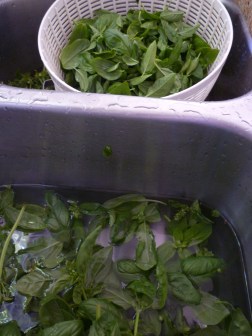

 Not me. I have mostly been whining about everything, including the reality of all the work undone and how I hate leaving home. I was standing at the sink this afternoon whimpering as I pulled leaves off stems, when it hit me that making pesto is one of my most favorite things to do. How wonderful is it that I have a garden that grows basil, from which a woman can create one of the wonders of the culinary world?
 If Grandma had been washing basil and found a Japanese beetle in the sink, she’d have said, “Tch, tch!” with disgust, but I saw it as a photo opportunity. I could feel this way because this summer I’m not growing green beans. Japanese beetles have ravaged many a crop of green beans here, and in the past I developed a quickness in squishing them between my fingers.
 It’s probably easy to guess what is another favorite activity I will indulge in before the sun goes down: gardening. I need to spread some manure around where I thinned the perennials yesterday. Maybe I will run out of energy to clean up all the basil-tinged oil smeared around the kitchen before I fall into bed, but it’s very comforting to have a few little tubs of that tasty stuff in the freezer when we haven’t even got to August.






 Gladsome Lights