Monthly Archives: November 2010

Grousing About Grammar – Bad Sentence

One thing I didn’t tell you in my recent review of Wordstruck by Robert MacNeil is how he gave an admonition that made me wonder if I am the right kind of influence on people:

“If you love the language, the greatest thing you can do to ensure its survival is not to complain about bad usage but to pass your enthusiasm to a child. Find a child and read to it often the things you admire, not being afraid to read the classics.”

MacNeil quotes a man named Hugh Kenner, who said of some people that they “took note of language only when it annoyed them.” In the days when I frequently read to my children, especially when they were older, I must say in my defense that I do remember stopping at least occasionally to point out particularly well-written sentences. But when the bad sentences force you to stumble or pause or halt completely as you try to figure out what is going on, you can’t help but be annoyed and take note of them, too.

This happened to me just today, and once again I will reveal myself in full nitpickerliness. The sentence that held me up fails in more than one way, so it’s very useful. I’m not going to tell you where it came from, but the author has a (recent) doctoral degree in Intellectual History. I’m not sure why I think that should mean something pertinent to my complaint…but let’s just get on with the beginning of his article:

F.M. [abbreviation mine] lived his life as a poet, a playwright, a novelist, a journalist, and a Roman Catholic. Born in Bordeaux during the year 1885 to a bourgeois family, M.’s mother tenaciously held to her religiosity. His father’s side of the family, on the other hand, sported Voltairean, republican, and anticlerical sentiments.

You can probably guess what happened to me as I was reading briskly along in the first sentence, then cruising through the stop sign period and on to the comma in the second sentence, fulling expecting that M. would be there after the pause — Oh! M’s mother is here, how odd…that must mean the author was talking about the mother’s birth in Bordeaux…strange that he would start out telling us about M., and then in the very next sentence start in on the mother…and there is his father in the following sentence…hmm…I don’t know much about M., but I don’t actually think he is recent enough that his mother could have been born that late…the author must be talking about M.’s birth, then. Too bad, now I have stopped thinking about M. and his mother and am all focused on this writer, poor boy, who spent so much effort in school and can’t get his lovely article off to a decent start.

Before moving on to find out more about M., I had to skip to the end and read the blurb on the author… next I began a rewrite of his problematic beginning in my head — so many times I have done this for myself and five children, trying out different arrangements of words and clauses so that you say what you mean and your reader can read you as effortlessly as possible.

What happened here is called a dangling participle or dangling participial clause. The “Born in Bordeaux” clause actually has no subject (it’s dangling there unattached), but we naturally expect the subject to be close by, so we try to attach the clause to M.’s mother, but it doesn’t really belong to her. The Wikipedia article to which I linked tells it all very clearly, along with other examples that are often funny.

One way that this particular beginning could have been rescued would be to make it slightly longer. Sometimes it just gets awkward, trying to pack too much into a sentence, and the best thing is to make one or two more sentence so you don’t muddle things. To put his birth and his mother’s religious attitude into one sentence seems to be hurrying along too fast, as though the author were just stringing his notes together.

And don’t try to be too clever in switching the order of your clauses and phrases. That’s partly how this writer got into trouble. It’s only the second sentence of your whole article, so certainly you can afford another sentence with the direct and simple subject-verb order.

To say that M. was born “during the year 1885″….It must just be a careless wordiness, because “in 1885” would do nicely, and during gives the impression of an ongoing activity. The time of birth is a date, not a duration.

How about this re-do of the second and third sentences, putting the mother into the father’s sentence, and we don’t even have to add lines. Taking out some commas makes it a  little cleaner, too:

He was born to a bourgeois family in Bordeaux in 1885. M.’s mother tenaciously held to her religiosity, while his father’s side of the family sported Voltairean, republican, and anticlerical sentiments.

Now that I’ve got that settled, I can go to bed. I’ll take the article along and hope I can keep my mind on M. this time.

Journal of October Trip South

As we were getting ready to go on a weekend trip, I was more calm than usual, because we’d only be gone one night, then home again. And it appeared to be the last trip I would make for months to come. The occasion was a gathering with my sisters and brother, in a countryside place spread with orange groves. One brother and sister live within a couple of miles of each other, but with mailing addresses in different towns, and neither of them close to even a village. We drove south, instead of my more frequent northward to Pippin’s, but about the same distance, 5+ hours.

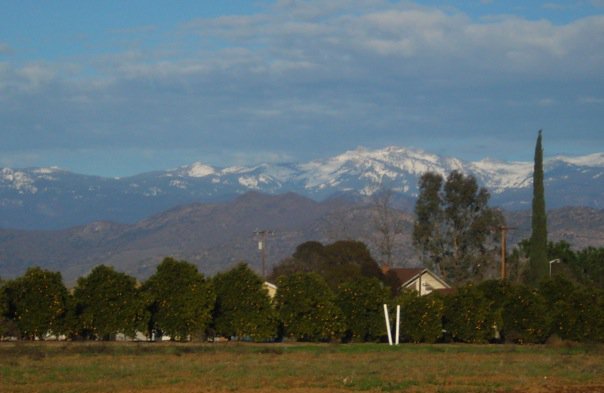
Mr. Glad and I stayed overnight with my brother, who lives in the house my dad built over 50 years ago, where I mostly grew up. This morning I got up early and sat in a big stuffed chair in the living room, tucking my feet under me the way I used to as a girl. The house feels so quietly solid. It’s a wood-frame stucco house on a concrete slab, and you never hear any creaks walking around the ranch-style layout. A big picture window looks out on the foothills that are dotted with oaks, and behind them shady layers of taller and taller mountains forming the Sierra Nevada. Curving grids of trees like dark green pom poms hug the lower slopes nearby. The first time I went home after living in Northern California for a while, I was struck with how short all the orange trees were, not even as tall as nut trees or peach trees, but certainly dwarfed by the Coast Redwoods and other tall trees we have up here where the rainfall is doubled.

The net effect is of a lush but flattish scene, house and orchards keeping close to the earth. The sky is bigger therefore. This October we got quite a bit of rain; all the autumn landscapes were more beautiful having been washed by the rains, making every tree and bush stand out brightly against the background of greening fields. I had my usual thrill of watching the cloud performances all the way down and up the center of the state. We saw black cattle grazing in a pasture, and in the middle of the herd, a white egret standing at attention.

Over a big dinner, we siblings talked about our mountain cabin and how to manage things as the new owners since our father passed it to us just over a year ago. We hadn’t all been together for more than a year, and we aren’t big phone or e-mail users, so we had a good time catching up. We always have to hear as well the news of our mutual old school and neighborhood friends, and the goings-on of the farming community there.

Some citrus crops are being picked already, by crews of Mexican farm workers. And olives are at the peak of harvest in the same general area. Cell phones have created changes in the way the picking crews operate. You might say they have created some degree of anarchy, or at least free-lance options that didn’t exist before. My sister Farmer Woman told us about how some growers were having difficulties getting enough pickers for the oranges, because they could make more money in olive-picking, at least until the frost cuts off that opportunity.

Because of the shortage, a crew was enlisted one day to drive down from the county to the north, in several cars. At least one car-full never arrived, because on the way someone got a call on his cell phone with a tip from a friend, that a different grower was paying $1 more per box, so they detoured that way. This sort of thing happens all the time now.

Dinner was over, and we were sitting lazily around a big table when Farmer Woman’s cell phone rang. The screen said it was her nephew, our Soldier, who was calling. As she talked to him it became apparent that he and Joy were in the area, too, having been to a wedding nearby. Neither of us had told the other that we were making a trip down there this weekend, so it was a pleasant surprise for everyone when they were able to join us for breakfast this morning, and a bigger family get-together than they had hoped for.

After that, they took off northwesterly, and we more to the north, but evidently we both wandered around the next city of over 100,000 population for a while, getting fueled up or something, because when we were leaving town, there we were driving alongside one another. Twenty minutes later, merging on to the interstate, we were right behind them. It was the kind of happenstance that would make a child happy, and it did me, too.

On the way home I read the Forward, the Introduction, and the Preface to a book by Leon Kass that I plan to write about at length later on. It’s philosophy, and as I had nothing much else to do, I could put the book down every few minutes and chew on the ideas. I read it two years ago and might need to read the whole thing again before I’ll be able to know and express why I love it so much.

Then I dozed for a while, and when I woke up my husband was playing parts of his iPod collection. I asked again, for the fortieth time, “Who is singing that song?” It was Police. So I worked on a mnemonic that would make me learn this fact for once and forever. They were singing, “There’s a little black spot on the sun today,” so I imagined that the black spot was a black Police car driving around. I watched them in my mind for a few minutes, and then on the iPod they were singing a different song, “Every little thing she does is magic,” very ardently, so I amplified my image so that the Police car driving over the sun’s surface was full of Policemen who were loudly singing these very words about a magical woman. I can’t lose it now.

Getting closer to home, I was more and more excited about the beauty of the world. Rows of eucalyptus trees form windbreaks here and there, and beneath them the colors of a dahlia farm don’t seem to have faded in the rains.  On the slopes in our county it’s the vineyards that catch your eye, and they are starting to turn gold and orange. Flocks of starlings were swooping like fluttered polka dots. I understand that they are eating insects as they do their dances. That reminded me of my book, which is about eating, nature, our souls, the unity of reality. There is a wholeness to life, because God in His Holy Spirit fills all things.

I guess that’s the reason I’m content to write about our trip without trying to find a theme for it. The entire weekend seems of a piece, a large piece of joy.