Monthly Archives: November 2011

Long and Boring Road

Our family loves the books by Byron Barton, like Trains and Machines at Work. Plenty of everyday and exciting things happen in these books, and the stories are told with few enough words that toddlers end up memorizing the text and can “read” the book to themselves or to others.
  
Along a Long Road seems like it is trying to be such a book, but I think it fails miserably. Unfortunately I don’t have a toddler to try it out on. On second thought, I wouldn’t try it out on anyone, because I don’t do that. I have to preview a book and make sure that I like it before I will read it to a child, and I could barely get through this book by Frank Viva.

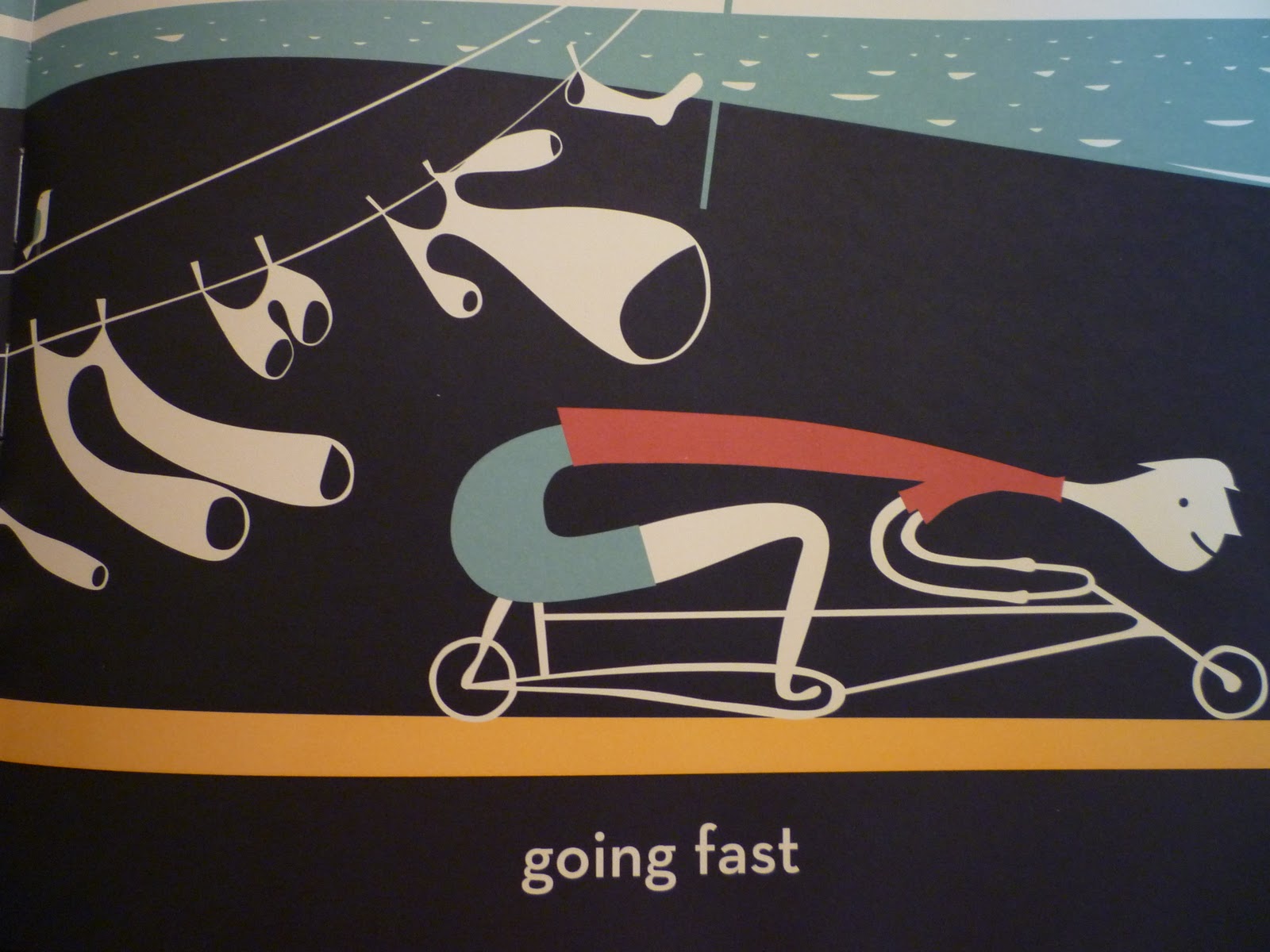
The picture book features stylistic pictures of the long road, made shiny by some plastic coating, and a very long man riding his long and stretchy bicycle. According to the text he rides and rides, “again and again.”

I haven’t known small children to be very interested in bicycles. They like their trikes, and boys especially seem to love heavy road equipment, trains, and motorcycles. One more reason to pass on this book.

About the only thing both my husband and I liked was the picture of a pregnant woman whom the cycling man passes. I suppose there are plenty of items along the road that one could talk about with a child, but no story to keep the long road from getting tedious.

I quickly got tired of the man and his weirdly shaped vehicle, expressed in only three colors, plus black. The artwork reminds me a little of an odd and favorite book of ours, The Clock, by Esphyr Slobodkina of the abstract expressionist movement. Slobodkina is better known for her picture book Caps for Sale, but long ago I found a beat-up copy of The Clock, which is a captivating story.

Maybe Along a Long Road would be pleasing to a very early reader, or a delayed reader, who might be able to relate to the sign for lottery tickets or a distant view of a carnival, and who would find satisfaction in reading the words “again and again” again and again. Not that I can imagine a child like that. If anyone out there has had another experience with Viva’s arty book, I would like to hear about it, even though I will soon take it back to the library for good. Give me Barton any day.

Limón in the Cazuela

The Cazuela That the Farm Maiden Stirred by Samantha R. Vamos is a delightful Hispanic incarnation of The House that Jack Built. It tells the story of a rice pudding from the farm to the table. The reader is introduced to two new words, first in English, every time he turns the page. From then on, those key words are only written in Spanish.

Before I opened the book, Mr. Glad was enjoying it and noticed that the word for lime was much like our lemon. That made me wonder what the word for lemon is.

New World Spanish-English Dictionary sits on the reference shelf here as a leftover from the days when four of our children in turn studied Spanish. Even though their father and I never did study that language that is so useful, almost essential, in California, we’ve lived here our whole lives and have picked up some vocabulary, sometimes by consulting this word book, as I did on this occasion.

The hen helps by grating the limón

I don’t know why, but my dictionary is wrong about limón. It says that it means lemon, and that if you want to talk about a lime you say lima. I found it hard to believe that this book written by a woman with a Hispanic name, illustrated by a man with a Hispanic name, with the intent of teaching 21 words, would get any wrong.

But I have a friend who is married to a Mexican man and teaches at a bilingual school, and I couldn’t pass up the opportunity to ask my local expert. She wrote, “Okay babe. Limón means lime and limón agria or limón Amarillo can mean lemon. There is a lemon-like fruit called Lima limón. There are not lemons like we have here in the U.S. in Mexico.” That seemed a pretty authoritative word on the subject.

This is a picture book, an Easy Reader, so I must not forget to mention the illustrations, which as you can see from these sample pages I photographed are party-bright, full of the joy and fun of cooking together.

At the back you will find a glossary with pronunciations, in case your Spanish is rusty, and best of all, a recipe for rice pudding. What I would love to do with a young child is read the book, make the pudding together while using the English and Spanish words to talk about the ingredients, and then read the book again while the cazuela simmers.

I would rather one of my grandchildren helped me in the kitchen, while we keep the animals outdoors or in the pages of the book. But an arroz con leche pudding with plenty of crema and some zest of limón would suit me just fine.

Glorious Mud

Homeschooling Beach Babies enjoy playing in the mud. The sight of these darlings and the memory of my own children in similar settings brought to mind the song I used to sing to them. Nowadays it’s easy to find such things on YouTube, which I did.

It turns out what I had gleaned from who-knows-where was only the chorus of a long song titled “The Hippopotamus,” by Flanders and Swann, which tune and words form the soundtrack of a suitably watery video.

One can find the words of the verses online, but they aren’t really for children. The chorus alone was sufficient to spark up our family’s muddy excursions, and it goes like this:

Mud, mud, glorious mud,
Nothing quite like it for cooling the blood.
So follow me, follow,
Down to the hollow,
And there let us wallow
In glorious mud!

Have fun!

Hold On! and be saved by grace

From The Prologue of Ohrid, by St. Nikolai Velimirovich, for today’s date:

HOMILY
on saving grace — By grace ye are saved (Ephesians 2:5, 8.

Who can comprehend and acknowledge that we are saved by grace — that we are saved by God’s grace, and not by our merits and works? Who can comprehend and acknowledge that?

Only he who has comprehended and seen the bottomless pit of death and corruption in which man is engulfed by sin, and has also comprehended and seen the height of honor and glory to which man is raised in the Heavenly Kingdom, in the realm of immortality, in the house of the Living God — only such a one can comprehend and acknowledge that we are saved by grace.

A child was traveling by night. He stumbled and fell into hole after hole and pit after pit, until he finally fell into a very deep pit from which he could in no way escape by his own power. When the child gave himself over to the hands of fate and thought his end was near, there was suddenly someone standing over the pit, lowering a rope to him and telling him to grab the rope and hold firmly to it. This was the king’s son, who then took the child home, bathed him, clothed him and brought him to his court and set him beside himself.

Was this child saved by his own deed? By no means. All he did was to grab the end of the rope, and hold on. By what, then, was the child saved? By the mercy of the king’s son. In God’s relationship with men, this mercy is called grace. By grace ye are saved. The Apostle Paul repeats these words twice in a short span, that the faithful might recognize and remember them.

Brethren, let us comprehend and remember that we are saved through grace by the Lord Jesus Christ. We were in the jaws of death, but have been given life in the courts of our God.

O Lord Jesus Christ our Savior, by Thee are we saved. To Thee be glory and praise forever. Amen.