Monthly Archives: March 2014

defeat of the bogey

Fairy tales do not give the child his first idea of bogey. What fairy tales give the child is his first clear idea of the possible defeat of bogey. The baby has known the dragon intimately ever since he had an imagination. What the fairy tale provides for him is a St. George to kill the dragon.

― G.K. Chesterton, Tremendous Trifles

 Linking up to Weekends With Chesterton

A breathing.

THE END OF SLEEP

The eyes are about to open.
Through fog, Sleep crosses the great water—
See how it sails in the little boat?
Slowly, such a long journey,
Bits of light
Catch colors in the mirrored hull.
Beneath the glassy surface, a glimpse
Of your dreams: the lake, the boat, with you
In it. Now a shadow
Falls over you: above the surface,
The figure of Sleep
Has leaned over its boat.
Hear Sleep’s feet plop in the shallows—
It pulls the boat to shore.

— Elizabeth Twiddy

This morning as I neared the shore of full consciousness, what I saw through the fog was myself, getting dressed and going to church for a Presanctified Liturgy. I was full of happy anticipation. Then I pulled the blinds open and was surprised to see, not the sunny and warm skies of the last few days, but thick and cold white fog.

I’ve read many people who say they love the fog, and I thought of them right away, wondering why I couldn’t be like them. Then I remembered the foggy days of my childhood when in the winter the damp cold would settle over California’s Central Valley like a perverse blanket. Not your normal blanket that makes you cozy, but something more like a conduit of chill. My fifth-grade teacher Mrs. Wicks, who came from South Dakota, said she was never so miserable in the dry winters of her youth as she was in our “temperate” weather that froze her to the bone.
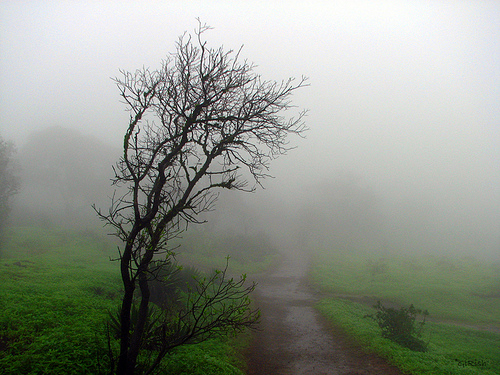
The natural and normal tule fog that emerges from the ground after the first winter rains became a dangerous foe once I learned to drive and became aware of all the car crashes on the highways that are a frequent accompaniment to the season. I became familiar with the stiff neck you get peering intently through the wall of white trying not to run into something.

But this morning in March, all of that is far behind me, and for the Valley-dwellers it is likely passed as well by this time of year. So I thought I would look for a poem by one of those fog-lovers. The fog that’s outside my window is still a little too cold for my old bones to thoroughly enjoy, but I’m working on it. After all, it’s another part of our earthly home that is filled with the breath of God.

THE BREATHING

An absolute
patience.
Trees stand
up to their knees in
fog. The fog
slowly flows
uphill.
White
cobwebs, the grass
leaning where deer
have looked for apples.
The woods
from brook to where
the top of the hill looks
over the fog send up
not one bird.
So absolute, it is
no other than
happiness itself, a breathing
too quiet to hear.

~ Denise Levertov
Pressing on to the wasteland.

Another good quote for Lent, thanks to s-p at Pithless Thoughts (posted a while back), from a Malcolm Muggeridge essay on life at the end of the last century. It seems to me still applicable in the 21st, as he describes how direly we need the Savior:

As the astronauts soar into the vast eternities of space, on earth the garbage piles higher, as the groves of academe extend their domain, their alumni’s arms reach lower, as the phallic cult spreads, so does impotence. In great wealth, great poverty; in health, sickness, in numbers, deception. Gorging, left hungry; sedated, left restless; telling all, hiding all; in flesh united, forever separate. So we press on through the valley of abundance that leads to the wasteland of satiety, passing through the gardens of fantasy; seeking happiness ever more ardently, and finding despair ever more surely.

On the ground with the White Horse.


Last week The Garners posted about G.K. Chesterton’s Ballad of the White Horse, which caused me to dig out my cassette tapes of the author reading his own poem — how thrilling! Too bad they were made from a scratchy recording so that it’s very hard to appreciate the poem itself. Still, the directness of the connection to the very voice and person of the poet mean a lot to me.

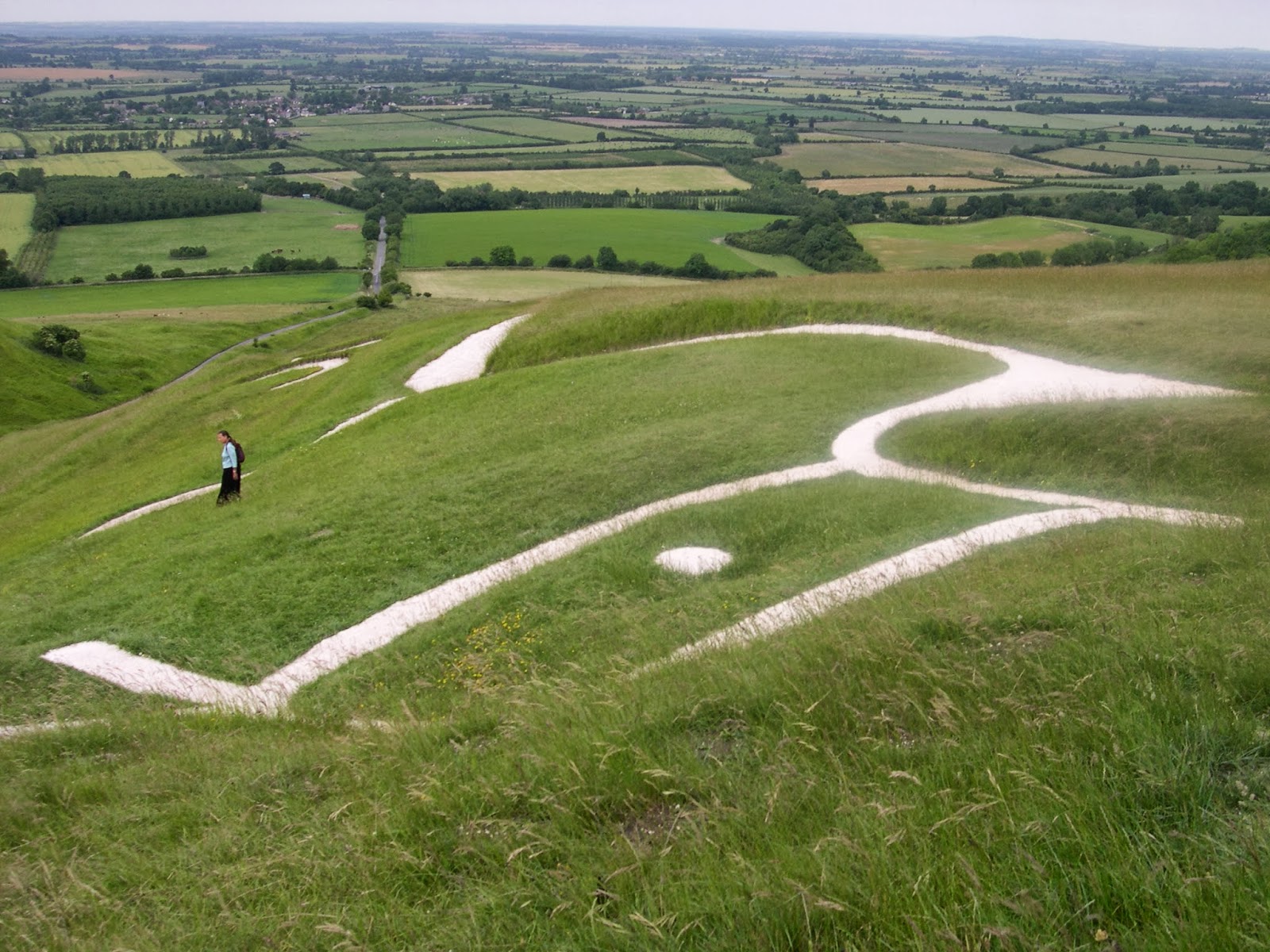
What made me interested in the Ballad in the first place was taking a trip to Britain with daughter Pippin nine years ago. We both very much wanted to see White Horse Hill in Uffington while we were there, and we found it quite empty of any other humans the day we visited. We hiked up the hill to the chalk art that is thought to be 2,000 to 3,000 years old, and wandered around the horse’s anatomy. We couldn’t pull ourselves away. I just could not get over — here it is again — the earthy material link to ancient peoples and the mysteries of their culture and history.

One thing we share with the ancient people who carved the trenches of this design is human nature, the gifts of the Creator who made us in His image, glorious even in a tarnished condition. The horse reveals the creative aspect of that image, and Chesterton’s ballad shows his own artistry while it tells a human and Christian tale set in King Alfred’s day. The imagery in this stanza, which I think pertinent to the Lenten season, illuminates another aspect of our humanity that we share with our ancestors: the impulse to stand before God in worship, fighting with the desire to be God:

Pride juggles with her toppling towers,
They strike the sun and cease,
But the firm feet of humility
They grip the ground like trees.

–G.K. Chesterton, The Ballad of the White Horse                 

Thinking again about this world history and my history, I want to revisit the horse vicariously, by means of the poem slightly more removed from the poet than my old cassettes. So I just ordered this edition of the book, which I think is the one I bought two copies of in the past for gifts. The American Chesterton Society will be sending me this CD, read by Aidan Mackey, who sounds as though he is very likely, once I put that disk in the player, to send me right back to England and White Horse Hill.
[update: the recording was annoyingly scratchy and almost as bad as the old one of GKC himself. 😦  ]

Linking up to Weekends With Chesterton