From a certain angle, the spring seems so calm: warm, tender, each night redolent and composed. And yet everything radiates tension, as if the city has been built upon the skin of a balloon and someone is inflating it toward the breaking point.
 This paragraph from All the Light We Cannot See by Anthony Doerr conveys the tone of the whole book, which I am only halfway through. Too soon, certainly, to be writing a review, but I can’t help myself, I have to share the joy. My copy was a Christmas gift from Kate and Tom; Kate said it was the best book she’d read all year.
I got into it right away, but it isn’t the kind of book you want to rush through. In that way it reminds me of The Red Horse by Eugenio Corti. They are both set during World War II with all its horrors, but even they can’t blot out the love that glows in these novels. Reading them is like being in the company of the best sort of humans, illuminated by a wise and able storyteller, someone who seemingly effortlessly paints lush pictures in your mind of the landscape of humanity and even of the dark places in individual souls, but who somehow leaves you with hope. You don’t want to leave, and while you are at this feast you want to linger over every bite, every description and metaphor that wants to pull you into another aspect of life and reality.
One of the protagonists is a young blind girl, Marie-Laure. Doerr’s descriptions of her imagination make me wonder if he spent a lot of time under a blindfold, learning what sensory riches are available to those who can’t depend on their eyesight. Telling the story from her point of view enlarges the world that we get to live in as we read. One such moment is when she is accompanying the housekeeper on errands, often to give food to the needy:
…[Madame] burgeons, shoots off stalks, wakes early, works late, concocts bisques without a drop of cream, loaves with less than a cup of flour. They clomp together through narrow streets, Marie-Laure’s hand on the back of Madame’s apron, following the odors of her stews and cakes; in such moments Madame seems like a great moving wall of rosebushes, thorny and fragrant and crackling with bees.
The other protagonist is an orphan boy, to whose orphanage a Nazi officer pays a visit, in a moment that hints at the impending gloom:
The lance corporal looks around the room — the coal stove, the hanging laundry, the undersize children — with equal measures of condescension and hostility. His handgun is black; it seems to draw all the light in the room toward it.
I have read very little 20th, and less 21st-century fiction, but I can identify two elements of this novel’s style as those that I am more likely to encounter in newer books: Present-tense narration, and alternating chapters set in different time periods and about different characters whose lives, we predict, will merge in the end.
More than once in the past I’ve laid aside a book because one or more of these devices was annoying or contrived, but in this case the suspense is only heightened by getting glimpses of what the future will hold for for these young people. The plot was already deliciously thickened by the second chapter, because of these tiny bits of foreknowledge.
So many books I have gobbled up too fast, trying to get to the main point, to find out What Happened, promising myself that I will go back and read the story again so I can pay closer attention and do justice to the other facets of the creation the author has made. Doerr makes it so that I have no compulsion to rush. Everyone is in a process, we all have time. Take time to notice the feel of the air and the way the seasons are changing, the story progressing. Though the war is hanging over them (and the reader) and using them and hurting them, it is not everything. There is a bigger world, a whole universe, of which this one crazy man and his evil system is but a very small room.
Marie-Laure has felt trapped in her house near the sea for months — her father doesn’t think it safe for her to go out exploring the way they used to do back in Paris, now that they are occupied by the Germans. But Madame takes matters into her own hands and walks the girl down to the beach for the first time in her life. As they get close to the shore, Briny, weedy, pewter-colored air slips down her collar.
And then her feet touch the sand:
...wet, unwrinkled sand. She bends and spreads her fingers. It’s like cold silk. Cold, sumptuous silk onto which the sea has laid offerings: pebbles, shells, barnacles. Tiny slips of wrack.
Her world that was dreamily expansive when she was younger and raised by her doting father, and then became overshadowed and dirtied by the privations and separations of wartime, begins to open up again.
The German orphan boy Werner also has a rich childhood, because of kind people and in his exploration of the abundance of wonders in the physical world. He holds within himself a knowledge of the good even through years when he is victimized into participating in the wickedness.
The depictions of the heroes of this book, children growing up, ring true to me. I don’t think it is easy to get that right, and it’s not surprising. No accomplished author is that close to the experience of being a child, and no one can have had the experience of every child. It seems to me a very great gift to be able to “create” young people especially, and to reveal them so deeply and keep them real.
Maybe this will only be Part One of my review, but just in case, I will end with my own reflection of one theme that emanates from this novel: You are never ultimately trapped in a dark place. Light fills this universe of which the darkest moments are only specks, and light is in you.
 and I’m awfully thankful that I was able to accomplish it, but the circumstances surrounding its creation were not ideal for creating the space I really wanted. Just starting out on my lonesome own, in my shaken-up existence without my husband, I knew that I did not like the old arrangement — that is, the swimming pool — that was obviously not Me, because it had never been. How to get what I did want, given the limits of my suburban lot and of my financial means, and most importantly, my mental wherewithal that had been reduced to Where?
 yard to wait, and pull the tarp around the dirt in the driveway so the rain doesn’t soak it.
 er blocking the holes has become mulch. I decide as I’m completing the project that I should have bought some peat moss to tuck in around the root crowns to keep the dirt from escaping, but now I’m in the middle of it, and just cut some new pieces of newsprint to go around the plants. I will get some peat moss later and tuck it in after the fact.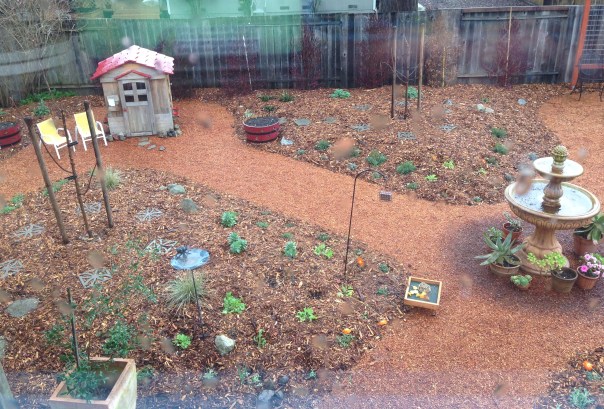

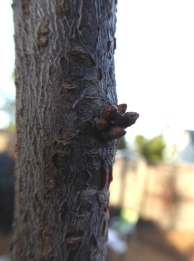
 ead quite a bit online and printed off some pictures and advice about how many inches between scaffold branches and what percentage of the length of the branch to cut off, etc. — things I don’t already know from pruning ornamentals.







 Gladsome Lights