Monthly Archives: February 2017

Jacobs on Scruton and platforms.

Alan Jacobs

Alan Jacobs thinks and writes on every topic imaginable. Not long ago he published The Book of Common Prayer: A Biography, which I think would be fascinating.  Before that, it was The Pleasures of Reading in an Age of Distraction. I’ve mostly been listening to him on Mars Hill audio interviews for a couple of decades, but more recently I like to read his blog Text Patterns [paused in 2018] on The New Atlantis.

This morning his brief article quoting and responding to Roger Scruton’s new book provided a refreshing take, by each of them in different ways, on an old and wearying phenomenon. Here are a couple of paragraphs:

“In the new edition of his book on the modern Left, which I review here, Roger Scruton writes,

‘Occasional lip service is paid to a future state of ‘emancipation’, ‘equality’ or ‘social justice’. But those terms are seldom lifted out of the realm of abstractions, or subjected to serious examination. They are not, as a rule, used to describe an imagined social order that their advocates are prepared to justify. Instead they are given a purely negative application. They are used to condemn every mediating institution, every imperfect association, every flawed attempt that human beings might have made, to live together without violence and with due respect for law.’

“Like Scruton and most other old-school conservatives, I believe that healthy mediating institutions are essential to a healthy society. And I think he is right in noting how relentlessly the Left attacks such institutions. But international capitalism does too, because every healthy mediating institution, by providing security and fellowship and belonging to its members, reduces its members’ dependence for their flourishing on what can be bought and sold. Neither the Left nor the Market want to see such institutions flourish, though their hostility sometimes stems from different agendas.

“I’m usually allergic to generalizations in these matters, but let me risk a big generalization: I think what we have seen and will continue to see in our social order is the fragmentation of institutions and their effective replacement by platforms.”

When I saw the word platforms I thought of the abstraction of a political platform, but that’s not what Jacobs is referring to. His meaning surprised me, but shouldn’t have. Read the rest of the article here.

Roger Scruton

What streams and shines.

gl-hellebore-2-8-17
hellebore

 
The abundant rain made January of 2017 less depressing than average for that dark and cold month of the year. It looks likely that my town will have received 40 inches for the season-to-date before the end of the week. Usually we get 20+ inches. When it rains the air is cleared of pollutants and the burn restrictions are lifted – so we had lots of wood fires which are always cheering!

gl-front-in-rain-crp-2-8-17

Christmas joy and lightness always carry me through Theophany on January 6th, but then I have the reality of a Christmas tree that needs taking down eventually. I strained my shoulder slightly a few weeks ago, which slowed me down, but it gave me time to read five books in just the first month of the year, often sitting in front of that woodstove. I started drinking coffee, which is a mood-elevator for sure… and now suddenly, it’s February, and the weather has been 20 degrees milder.

gl-manzanita-2-8-16-in-rain
manzanita

Flocks of goldfinches and juncos have returned to the garden, swooping down from the bare branches of the snowball bush. The juncos peck around on the ground, and the finches hang all over the nyger seed feeder, even in the rain.

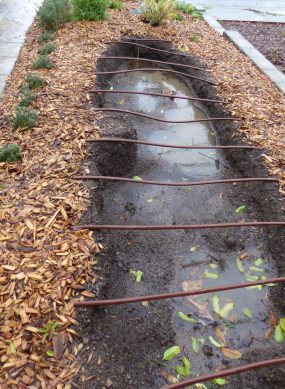
And flowersgl-asparagus-2-8-17-standing-water are coming on dear Margarita Manzanita, buds on the currant bushes and calla lilies. I went out and took pictures just now under the umbrella, so everything is too wet to be optimal, revealing how one of my asparagus beds is less than optimal – we didn’t dig down deep enough into the adobe clay, and now there is standing water. That may not portend good for the future of that planting.
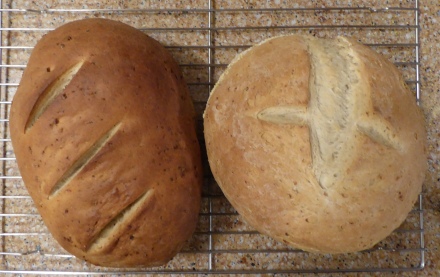


I made several gallons total of various soups in January, including Barley Buttermilk Soup, which I decided to try incorporating into bread yesterday. Here you have it, Barley Buttermilk Bread. It was enough dough that I ought to have made three loaves of it, but what I did was bake one oval loaf on my pizza stone, with butter brushed on top toward the end, and a round one in the Dutch oven. I added some oat flour which made it soft, but by this morning its crumb is very nice, and I like it very much… even too much.

gl-barley-buttermilk-bread-2-7-17

It’s been a long time since I had eggs from hens who ate lots of greens. My fellow communion bread-baker James brought some pale blue-green eggs from his Americaunas to our last baking session, and I was the lucky one to take them home, just as he had brought them, in the bottom of a paper shopping bag. They are so wonderfully orange-yolked, I had to take their picture, too. They go well with Barley-Buttermilk Bread. 🙂

gl-p1060609

Every week the peas and the poppies have been beaten down by the rain…

gl-poppies-p1060639But they keep growing and blooming. Overall, they appear to thrive in it. I am reminded of this verse from the hymn “O Worship the King,” which likens God’s provision for us generally to the moisture that falls.

Thy bountiful care, what tongue can recite?
It breathes in the air, it shines in the light;
It streams from the hills, it descends to the plain,
And sweetly distills in the dew and the rain.

Sometimes, it is not only a metaphor.

He does not try to pass the time.

Another paragraph from Out of Africa:

Natives dislike speed, as we dislike noise, it is to them, at the best, hard to bear. They are also on friendly terms with time, and the plan of beguiling it or killing it does not come into their heads. In fact the more time you can give them, the happier they are, and if you commission a Kikuyu to hold your horse while you make a visit, you can see by his face that he hopes you will be a long, long time about it. He does not try to pass the time then, but sits down and lives.

-Isak Dinesen

gl-tuli-safari-landscape

photo of Kenya from Internet

Roald Dahl fumes against the idiotic monster.

This morning I read an article in the Harvard Business Review about “How to Read More Books This Year.” The author quotes from this poem, which I had conveniently put into a draft post just last night. So this must be the time!

TELEVISION

The most important thing we’ve learned,
So far as children are concerned,
Is never, NEVER, NEVER let
Them near your television set –
Or better still, just don’t install
The idiotic thing at all.
In almost every house we’ve been,
We’ve watched them gaping at the screen.
They loll and slop and lounge about,
And stare until their eyes pop out.
(Last week in someone’s place we saw
A dozen eyeballs on the floor.)
They sit and stare and stare and sit
Until they’re hypnotised by it,
Until they’re absolutely drunk
With all that shocking ghastly junk.
Oh yes, we know it keeps them still,
They don’t climb out the window sill,
They never fight or kick or punch,
They leave you free to cook the lunch
And wash the dishes in the sink –
But did you ever stop to think,
To wonder just exactly what
This does to your beloved tot?
IT ROTS THE SENSE IN THE HEAD!
IT KILLS IMAGINATION DEAD!
IT CLOGS AND CLUTTERS UP THE MIND!
IT MAKES A CHILD SO DULL AND BLIND
HE CAN NO LONGER UNDERSTAND
A FANTASY, A FAIRYLAND!
HIS BRAIN BECOMES AS SOFT AS CHEESE!
HIS POWERS OF THINKING RUST AND FREEZE!
HE CANNOT THINK — HE ONLY SEES!
‘All right!’ you’ll cry. ‘All right!’ you’ll say,
‘But if we take the set away,
What shall we do to entertain
Our darling children? Please explain!’
We’ll answer this by asking you,
‘What used the darling ones to do?
‘How used they keep themselves contented
Before this monster was invented?’
Have you forgotten? Don’t you know?
We’ll say it very loud and slow:
THEY … USED … TO … READ! They’d READ and READ,
AND READ and READ, and then proceed
To READ some more. Great Scott! Gadzooks!
One half their lives was reading books!
The nursery shelves held books galore!
Books cluttered up the nursery floor!
And in the bedroom, by the bed,
More books were waiting to be read!
Such wondrous, fine, fantastic tales
Of dragons, gypsies, queens, and whales
And treasure isles, and distant shores
Where smugglers rowed with muffled oars,
And pirates wearing purple pants,
And sailing ships and elephants,
And cannibals crouching ’round the pot,
Stirring away at something hot.
(It smells so good, what can it be?
Good gracious, it’s Penelope.)
The younger ones had Beatrix Potter
With Mr. Tod, the dirty rotter,
And Squirrel Nutkin, Pigling Bland,
And Mrs. Tiggy-Winkle and-
Just How The Camel Got His Hump,
And How the Monkey Lost His Rump,
And Mr. Toad, and bless my soul,
There’s Mr. Rate and Mr. Mole-
Oh, books, what books they used to know,
Those children living long ago!
So please, oh please, we beg, we pray,
Go throw your TV set away,
And in its place you can install
A lovely bookshelf on the wall.
Then fill the shelves with lots of books,
Ignoring all the dirty looks,
The screams and yells, the bites and kicks,
And children hitting you with sticks-
Fear not, because we promise you
That, in about a week or two
Of having nothing else to do,
They’ll now begin to feel the need
Of having something to read.
And once they start — oh boy, oh boy!
You watch the slowly growing joy
That fills their hearts. They’ll grow so keen
They’ll wonder what they’d ever seen
In that ridiculous machine,
That nauseating, foul, unclean,
Repulsive television screen!
And later, each and every kid
Will love you more for what you did.

–Roald Dahl