I love the present with its layers
of seconds faceted like sparks
hammered off the glinting surface.
I want to stay here endlessly,
standing at the convergence of sand and water….
I dread the future, yet it arrives
little by little. Knowingly we disappear into it.
–Alan Soldofsky, from a longer poem, “Current.”

I like to think about time, even though it can be a little crazy-making, and this poem brought to mind the song by the Steve Miller Band (below), which I appreciate mostly for that one line that repeats and repeats like a clock ticking. Both the poet and the songwriter are using the present moments to anticipate the present becoming the past, which may not be a waste of time, because it is God Who made us to be philosophers after all….
Before my late husband became ill, he liked to take me every so often to a place where he could sing karaoke. There was a friendly man there always, whose name I think was Mike, and he often sang this song, which I never got tired of. If you don’t know it, you can click on the link to listen: Steve Miller Band
Time keeps on slippin’, slippin’, slippin’
Into the future
Time keeps on slippin’, slippin’, slippin’
Into the future
Time keeps on slippin’, slippin’, slippin’
Into the future
Time keeps on slippin’, slippin’, slippin’
Into the future
I want to fly like an eagle
To the sea
Fly like an eagle
Let my spirit carry me
I want to fly like an eagle
Till I’m free
Fly through the revolution
Just a little meandering meditation that is probably not edifying! And how much time slipped by while I was using it and musing over it…?
Well, let’s consider words about time that are certainly more grounding:
… Awake thou that sleepest, and arise from the dead, and Christ shall give thee light. See then that ye walk circumspectly, not as fools, but as wise, redeeming the time, because the days are evil. (Ephesians 5)

Lord, have mercy on us,
and keep us against the day when You wrap us and all of time into Your eternal Kingdom.
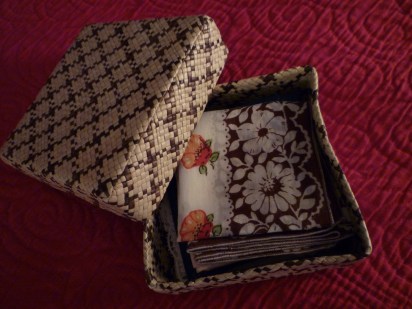 Once in Sunday School a missionary’s talk tugged at my ten-year-old heartstrings and my eyes and nose started leaking. My own Sunday School teacher Mrs. Montgomery saw my predicament and pressed her clean hankie into my hand. I was initiated.
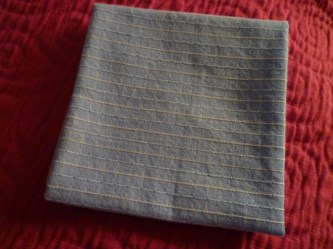 n Turkey, the oddest handkerchief I have ever encountered. I must not have had much experience after that missionary talk, or I would have known better than to buy a handkerchief with a grid of heavy stitching all over it, seemingly designed to irritate a nose that might already be red and raw. I keep it now only as a memento.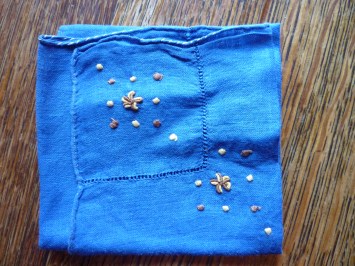

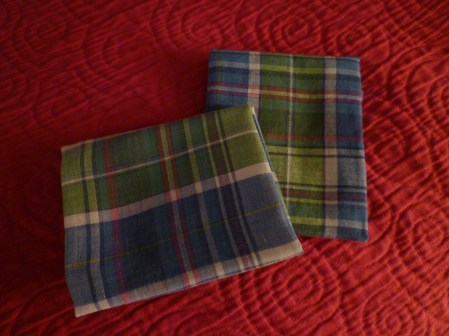 top using paper tissues so I made him quite a few of these plaid handkerchiefs out of an old skirt of mine. He typically had one sticking out of his back pocket, and now I’ve inherited this collection, too.
 I was so sorry to hear a couple of weeks after the event that the poet Richard Wilbur had fallen asleep in death. It’s interesting to read about the ambivalence within the community of literary critics regarding his work throughout his career and now at his passing.

 Gladsome Lights