I can’t help analyzing this poem a bit….. I am a book-lover, and if I didn’t know that the dead will be resurrected in glory, I might have liked to write this poem:
AND YET THE BOOKS
And yet the books will be there on the shelves, separate beings,
That appeared once, still wet
As shining chestnuts under a tree in autumn,
And, touched, coddled, began to live
In spite of fires on the horizon, castles blown up,
Tribes on the march, planets in motion.
“We are,” they said, even as their pages
Were being torn out, or a buzzing flame
Licked away their letters. So much more durable
Than we are, whose frail warmth
Cools down with memory, disperses, perishes. I imagine the earth when I am no more: Nothing happens, no loss, it’s still a strange pageant,
Women’s dresses, dewy lilacs, a song in the valley.
Yet the books will be there on the shelves, well born,
Derived from people, but also from radiance, heights.
In the Orthodox Church, near the end of Divine Liturgy, there is a prayer to God to “Sanctify those that love the beauty of Thy House.” Especially in my first months and years in the Orthodox Church I clung to that prayer, thinking, “Lord, there is a lot I don’t understand, and there are many ways in which I fail to live for You, fail to enter fully into the services; but one thing I know is that I do love the beauty of Your House.”
One aspect of that beauty that contributes to the worship I offer is incense. It is one of those elements that is left out whenever I post a picture taken in a church service. In those visual images you get, of course, only the visual.
When I shoot the photograph, it is in the midst of a lavish sensual experience: hymns and prayers being sung almost constantly, deacons and priests frequently censing everything and everyone in the temple, the smell of beeswax candles, and the touch of fellow worshipers as we bump past one another or when we arrange ourselves on the floor to hear the homily. Later when I look at the picture in my home, it so noticeably does not convey half of the sensations that were pressing upon my mind at the time. It is literally flat, and as a testimony of what went on, very lacking.
We believe that the heavenly Kingdom comes to us in the liturgy, so I can’t hope to give an inkling of what that is like to someone who has never been present, or whose heart is not ready to receive the Lord in these material ways. You really have to be there.
But I will include yet another image in this post, just to add visual interest, conceding to the limitations of this medium. This pic shows the people singing. Someone has said that the liturgy is like one continuous song.
I’ll let Wikipedia tell more about the tradition of censing: “As part of the legacy handed down from its Judaic roots, incense is used during all services in the Orthodox Church as an offering of worship to God as it was done in the Jewish First and Second Temples in Jerusalem (Exodus chapter 30). Traditionally, the base of the incense used is the resin of Boswellia thurifera, also known as frankincense, but the resin of fir trees has been used as well. It is usually mixed with various floral essential oils giving it a sweet smell. Incense represents the sweetness of the prayers of the saints rising up to God.”
From The Lament of Eve by Johanna Manley:
The fragrance of love! When we burn incense, we think of the fragrant heavenly aroma of love. The Holy Spirit, like a heavenly fire, brings the warmth of love into the human heart, and like a fresh wind, chases away the stench of sin and spreads the aroma of Christ to the world. That savor all the saints have borne within themselves. People have sensed it in living saints and in their relics. The Apostle speaks of this: “We are unto God a sweet savour of Christ,” the sweet perfume of recognition of the truth and the sweetness of love (cf. 2 Cor. 2:14-16).
Sooo slow I am in fully returning to Being Home. Though I suppose I never will be living in my house in quite the same way as before, having sojourned so distantly, and changed in God only knows what ways. I grew older, for sure. But maybe I grew younger, too?
clean air, vineyards and mustard bloom
I was so surprised, when I walked in the front door on my return from that other world, to see that I have wood floors. At that moment I didn’t feel the lack of windows and light, but only felt the warmth and welcome that my house had held in trust for me all those weeks, even though I had learned to live happily with hard and cool marble floors, and the strange light coming through a multitude of windows, reflected off the Arabian Sea and filtered through smog.
It’s taken me nearly three weeks just to fill and start up the fountain again. The finches were having to make do with winterized nyger seed, that is, frozen and thawed, rained on and packed down into a brick at the bottom of the feeder. But I fixed those things today and looked around some more at the garden. Rosemary is blooming and the fountain is now tinkling.
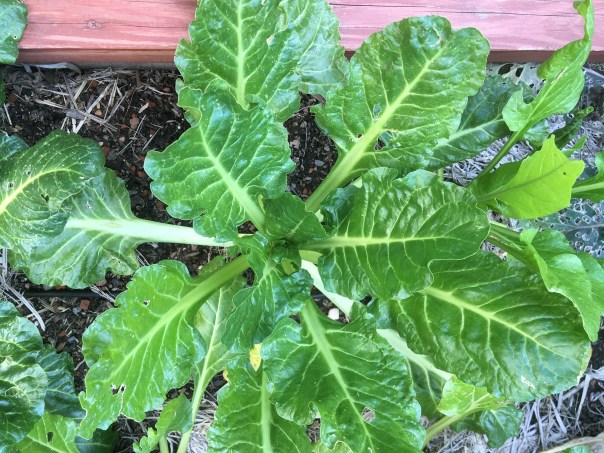
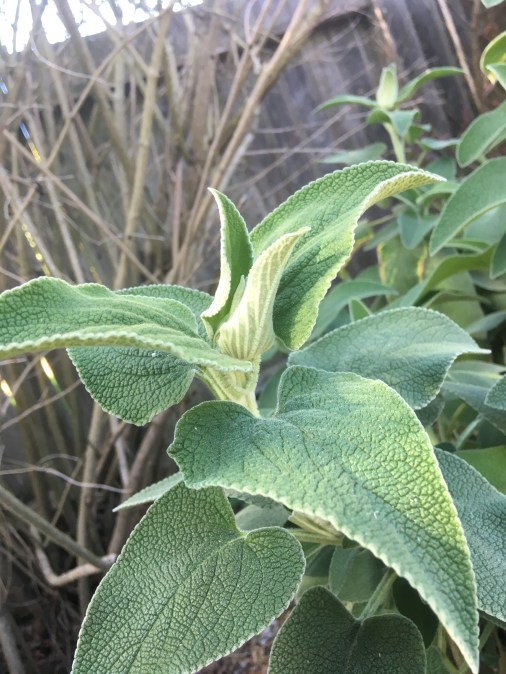
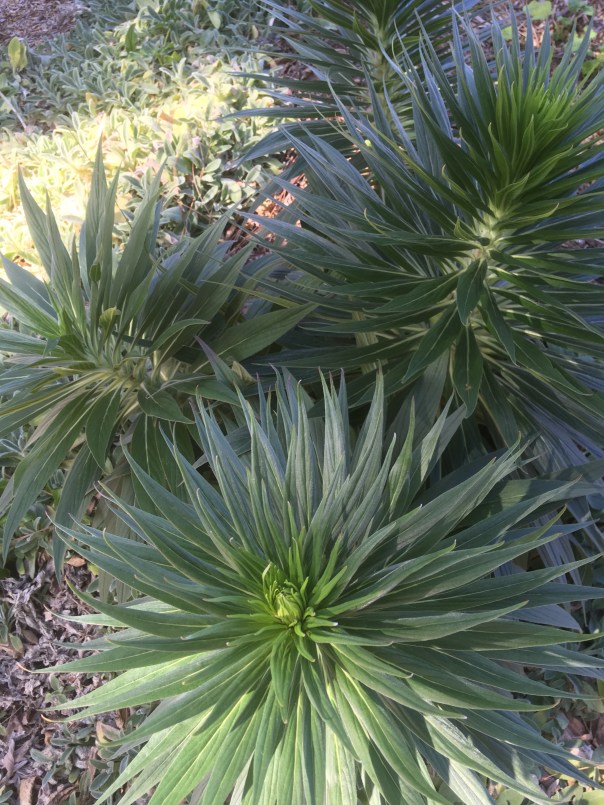
I just learned that Swiss chard is also called silverbeet!Jerusalem SagePride of Madeira with no blooms yet…
Do you remember Miss Grenadine? She was a gift from Mr. Glad. She kept watch over my bedroom while I was gone, and still does during the day:
I had lunch with my goddaughter last week. She and her husband lost their house in the fires that ravaged our area last October. A day or two after that dreadful event, she texted me, “Wherever our family is together, that is home.”
I understand some of that. Ever since my husband passed from this earthly life three years ago this month, I have felt most at home when I am with my children, wherever a few of us are gathered. I don’t think I would feel this way if we didn’t all agree on this: though we’ve been supremely blessed in this life, it’s not satisfying in itself, no matter what beautiful place you live in and with what dear humans.
At this moment I’m thinking about things homey and cozy (or cool, as we preferred, in Mumbai), but of course concurrent in all of our lives is pain and suffering. Wherever I go, I bring myself with my sin-sickness, and I carry in my heart the burdens of those whose suffering seems to me hardly bearable. But in every place, Christ is. He is the one who makes the atmosphere sweet with the scent of flowers or the affection of our children. He is always giving us Himself.
At the end of things, The Blessed will say, “We have never lived anywhere except in Heaven.” And the lost will say, “We were always in Hell.” And both will speak truly. ― C.S. Lewis
“… Adam chose the treason of the serpent, the originator of evil, in preference to God’s commandment and counsel, and broke the decreed fast. Instead of eternal life he received death and instead of the place of unsullied joy he received this sinful place full of passions and misfortunes, or rather, he was sentenced to Hades and nether darkness. Our nature would have stayed in the infernal regions below the lurking places of the serpent who initially beguiled it, had not Christ come. He started off by fasting (cf. Mk. 1:13) and in the end abolished the serpent’s tyranny, set us free and brought us back to life.”
 I can’t help analyzing this poem a bit….. I am a book-lover, and if I didn’t know that the dead will be resurrected in glory, I might have liked to write this poem:
 f that beauty that contributes to the worship I offer is incense. It is one of those elements that is left out whenever I post a picture taken in a church service. In those visual images you get, of course, only the visual.
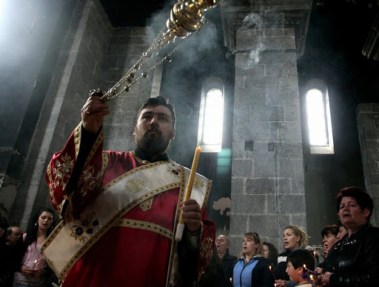 This pic shows the people singing. Someone has said that the liturgy is like one continuous song.


 “… Adam chose the treason of the serpent, the originator of evil, in preference to God’s commandment and counsel, and broke the decreed fast. Instead of eternal life he received death and instead of the place of unsullied joy he received this sinful place full of passions and misfortunes, or rather, he was sentenced to Hades and nether darkness. Our nature would have stayed in the infernal regions below the lurking places of the serpent who initially beguiled it, had not Christ come. He started off by fasting (cf. Mk. 1:13) and in the end abolished the serpent’s tyranny, set us free and brought us back to life.”
 Gladsome Lights