Monthly Archives: May 2023

Her love grew strong as an oak.

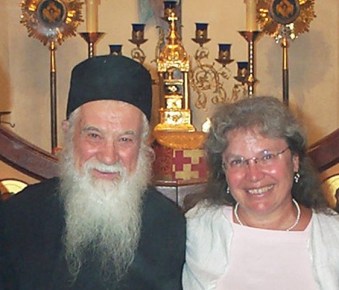
Just before I was to attend a recent baby shower, I found an article by Frederica Mathewes-Green, a sort of meditation on the power of a mother’s influence. It’s  primarily about Father George Calciu, who was “one of the great confessors of Christianity in the twentieth century. Having survived the diabolic prison experiments of Communist Romania, Fr. George went on to become an apostle to spiritual seekers in Romania and, eventually, throughout the world.”

Fr. George spent a total of more than 20 years in prison. When later he was a pastor in the United States, he became Frederica’s spiritual father and confessor.

Her thoughts about his relationship to his mother seemed perfect to share at a baby shower, so I read the whole article before gifts were opened. Putting together what she knew personally of Fr. George, and what he told her about his mother, Frederica concluded:

“I think that Fr. George’s mother planted something joyous in him, when he was still a baby in the cradle. Her love and her delight in him took root, and grew as strong as an oak tree.”

I have read many stories about people who, when as adults they found themselves in deep trouble and disorder from whatever source, for whatever reason, were sustained and preserved — and sometimes brought to repentance — by simple childhood memories of what was normal and good. Sometimes it was the thought of one sweet person, or one beautiful day, long ago embedded in their soul, like an ember still glowing. From this one bit of warmth and light they found the strength to pray and the courage to do whatever was necessary.

“We do not know where our children’s lives will lead them; they may have to undergo suffering that we will be unable to prevent. They may be somewhere far beyond our ability to help them. But in the loving care we give each day, we plant something for a lifetime. Each small thing we do can be preparing them to meet challenges that we cannot yet see.” 

Read the whole (short) article: “Father George Calciu, My Spiritual Father.”

Getting along in the garden.

The garden always seems to have an intention of its own, apart from what I have planned for it. Last year I planted several new milkweed varieties on the south side, and none of them has emerged as yet. But under the fig tree the hearty Showy Milkweed volunteers have arrived as a whole regiment, even sprouting up through the lithodora.

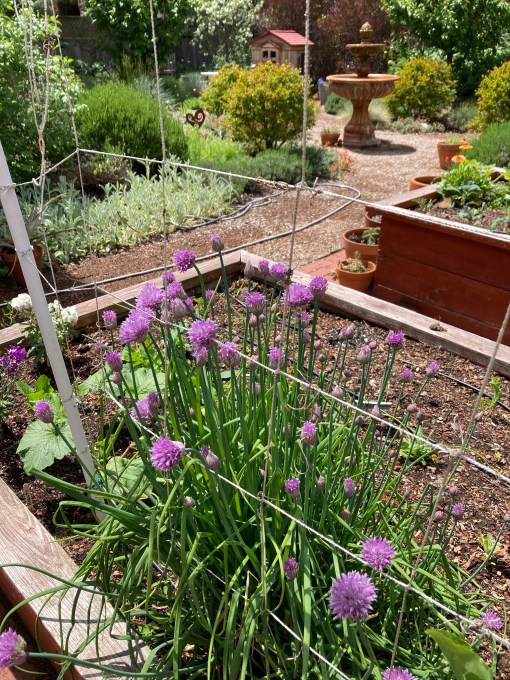
So many of the welcome flowers are of the blue and purple hues, like Blue-eyed Grass and the first salvia bloom. I planted the sweet pea flowers in a row where chives were already growing; the chives are huge now, and I might have to cut them back to clear the way for the sweet peas to see the sun.

A single anonymous sweet pea volunteered in a big pot, back in the fall, and was trailing all over the path, so that I was stepping on it. So I stuck a mobile trellis next to the greenhouse and tied it up there.

This pink jasmine is finally thriving on a trellis against the fence. It looks pretty right now, but soon the salvia will send out its long branches and hide it. The garden is definitely overcrowded in spots….

One of the areas that felt overcrowded was in the front garden where a False Cypress grew. It was getting too big for my taste, and it’s kind of scruffy, so I took it out. Now more sunlight can come into my living room. I will replace it with something smaller and more interesting in the fall.

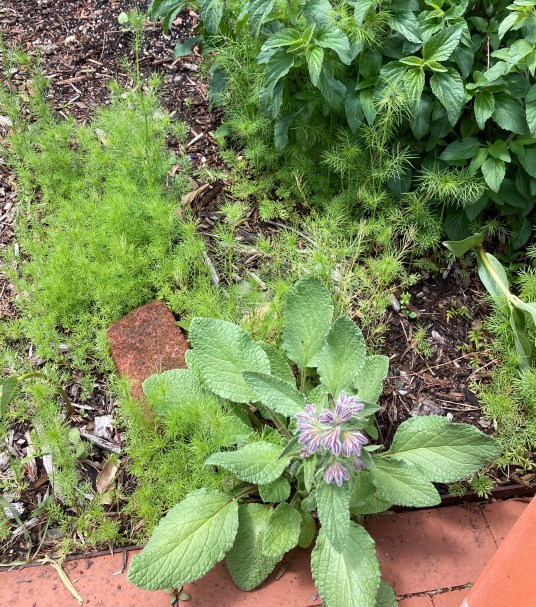
Borage has been surprising me by sprouting here and there, encouraged by all the rain; this is the most vigorous of the plants, and it’s in a place where I might remember to squirt it with the hose occasionally and keep it growing through the summer. (That ferny plant surrounding it is Love-in-a-Mist.) I don’t often use borage for anything, but the bees do! I hope it will grow away from the nearby fig tree, so that in late summer when I’m picking figs, I won’t be encroaching on the bees’ favorite feasting grounds. It will be interesting, day by day, to see how all the plants and insects and birds — and the gardener — coordinate their work for the maximum enjoyment of all.

Bee on milkweed 2019

Midfeast Blessing with babies.

Though it was a small crowd this evening for Vespers, two babies and a toddler were among our number. It is a great joy and encouragement to have a lot of babies in the parish at this time; I can think of five right off the bat who are still infants, plus several toddlers.

Of course the older children are beloved, but there is something special about the littlest ones, who look around curiously, and whom we get to know as we watch them “grow in wisdom and stature” from week to week. Our rector mentioned at the beginning of his homily last week, how wonderful it is to hear baby sounds in the church. He chose a moment when the baby noises were quiet and happy enough that he could be heard over them.

When we came into the church this evening, the infant baptismal font was set up in the middle, but inside was a big tub containing water to be blessed during the service, not for a baptism, but because it is the midpoint between Pascha and Pentecost, when this event always happens– as it always does at Theophany, when we celebrate Christ’s baptism.

The middle of the days has come,
beginning with the Savior’s Resurrection,
and sealed by the holy Pentecost.
The first and the last glisten with splendor.
We rejoice in the union of both feasts,
as we draw near to the Lord’s Ascension:
the sign of our coming glorification.

The toddler toddled, and one little girl crawled around, or was carried by her mother from icon to icon, where she reached out eagerly to touch the faces of the saints. The choir sang the Vespers service; it was a quiet and mild evening, but the sun had not gone down. The youngest baby present had been baptized only this week; she lay sleeping in her mother’s arms. After the blessing of the water, the priest walked all around the church sprinkling the icons and us. Then we drank.

One line read out from the choir was from Isaiah 55, “Ho, everyone that thirsts, Come to the water!” And we remembered the Gospel story from Sunday, about the healing of the Paralytic, and the water of the Pool of Bethesda that an angel would stir from time to time, giving it healing properties.

This prayer, based on another event in the life of Christ, expresses the tone of the evening’s service, and our joy:

Thou didst come to the Temple, O Wisdom of God,
in the middle of the feast
to teach and edify the Jews, the Scribes, and the Pharisees.
“Let him who thirsts come to Me and drink the water of life!
He will never thirst again!
Whoever believes in Me, streams of living water shall flow from him.”
How great is Thy goodness and Thy compassion!
Glory to Thee, O Christ our God!

Why nominalism is important.

“Now, what do we mean by nominalism, and why is it important? There are many aspects of the nominalist position, but the main one is just the denial that this created world is an icon of a heavenly reality. Instead, nominalists hold this world’s form to be arbitrary, a product of sheer divine will.

“As Orthodox, we still comfortably assert that the world is an icon of heaven, or is meant to be. But in the West this union of the symbolic and the real became rather vexed. Now, we have even developed this destructive iconoclasm around gender, the human body, human sexuality, and so forth. Outside the Church, we have come to think that we can simply posit whatever reality we wish about these things.

“The nominalist and the realist positions must be reconciled. We must see that the reality of the world depends upon its being a symbol of heavenly realities. If creation is not a symbol of heaven, then its essence, its substance, would be of little importance. For example, if the world is just the arbitrary product of God’s will, then God could have made some other world, or not have given us gender, and so forth. And if the world’s form is arbitrary, then it is no longer ‘good,’ no longer beautiful and holy.”

-Timothy G. Patitsas,  The Ethics of Beauty