Yesterday afternoon the garden was brilliant under the sunbeams that followed rain showers. This strip of purple caught my eye, revealing itself to be violets that had quietly grown lush over the wet winter, along the edge of the patio where they also had planted themselves years ago. Sometimes they volunteer in pots and choke out whatever I had intended to nurture, but this little border didn’t encroach on anything, so I was pleased to see them suddenly dressed in their purple gowns, as one more sign announcing: SPRING!
I’m afraid my grandchildren went home before the violets bloomed, but I will invite a few young outdoorsy friends over soon, and invite them to gather happiness in their small hands.
CHILDREN, IT’S SPRING
And this is the lady Whom everyone loves, Ms. Violet in her purple gown
Or, on special occasions, A dress the color Of sunlight. She sits In the mossy weeds and waits
To be noticed. She loves dampness. She loves attention. She loves especially
To be picked by careful fingers, Young fingers, entranced By what has happened To the world.
We, the older ones, Call it Spring, And we have been through it Many times.
But there is still nothing Like the children bringing home Such happiness In their small hands.
This Lord’s Day we were remembering the paralytic, who sat by the pool waiting for a chance to get into the water at those times when an angel stirred it, so that he might be healed. After 38 years, Jesus came by and healed him.
Father John in his homily highlighted one aspect of the Gospel story: how we are like that man in our seeming paralysis when it comes to overcoming our sins. Priests often hear in confession the lament of the Christian who continues to battle the same weaknesses and failings year after year, feeling that he makes little progress.
I think a lot about the truism that habits are like a second nature to us. As we read in Jeremiah 13:23: “Can the Ethiopian change his skin or the leopard its spots? Neither can you do good who are accustomed to doing evil.”
It sounds very little like one chipper exhortation you might have read: “It’s never too late to be what you might have been.” Well, yes, why not just start today? When I read that on Tuesday, I remembered the paralytic, and I thought on my own unchanged bad habits. After his 38 years, wasn’t it in fact too late for many things? (The assumption is that one might have been greater; the reverse is probably more true, that it’s never too late to start a downward spiral.)
George Eliot (Mary Ann Evans)
For myself, let’s see…how many years have I been cultivating certain of my bad habits? More than that, I’m afraid. But it’s a simple thing: “The only thing that stands between me and greatness is me.” (Woody Allen)
George Eliot is credited with having made that bold assertion, “It’s never to late to be what you might have been.” She was the subject of a New Yorker article from February, 2011, “Middlemarch and Me,” by Rebecca Mead, who questions the validity of the quote and whether it even reflects the true outlook of the author Mary Ann Evans.
Mead has been a lifelong lover of Eliot’s books, Middlemarch in particular, and she points out some hints that the author leaves in her novels, as well as forthright confessions from her journals, to show that her general attitude was wiser and more modest.
In Middlemarch, we read of the main character, “Dorothea herself had no dreams of being praised above other women, feeling that there was always something better which she might have done, if she had only been better and known better.”
Mead writes: “Middlemarch is not about blooming late, or unexpectedly coming into one’s own after the unproductive flush of youth. Middlemarch suggests that it is always too late to be what you might have been — but it also shows that, virtually without exception, the unrealized life is worth living. The book that Virginia Woolf characterized as ‘one of the few English novels written for grown-up people’ is also a book about how to be a grownup person — about how to bear one’s share of sorrow, failure, and loss, as well as to enjoy moments of hard-won happiness.”
Let’s look back at the Paralytic by the Sheep’s Gate Pool. He must have had some way to propel himself, perhaps one limb that was functional, so that he could sit there for much of his life hoping to get down to the water first. He certainly had patience — and perseverance, to keep trying.
Father John said that even if we feel we have nothing more than a big toe’s worth of strength against our sins, we must keep struggling. Because we never know when Jesus will come to us. When he came to the cripple by the pool, He Himself was the source of the healing, and the man was delivered from his afflictions and was able to walk and carry his bed. For most of us, we will not receive the equivalent healing until we are resurrected in the coming Kingdom.
In the meantime, we will have failures. Maybe we will even think we are failures. It is very discouraging when one realizes what Samuel Johnson found: “The chains of habit are generally too small to be felt until they are too strong to be broken.” On another aspect of this human experience, Dorothea said in Middlemarch about her husband’s intellectual labors: “Failure after long perseverance is much grander than never to have a striving good enough to be called a failure.”
The most helpful sort of activity to persevere in, if one wants to be on the path to God, is prayer. “A long perseverance” of this sort would never be disappointing. The very moments of prayer have the potential to be Heaven itself, in the presence of the God Who is Love.
“In patience you possess your souls,” we read in Luke 21, and Mark Twain elaborates: “Habit is habit, and not to be flung out of the window by any man, but coaxed downstairs a step at a time.”
Whether we are being too easy on ourselves is the question. If we are being lazy, of course, that is one of the sins we are trying to overcome. And pride in thinking we are equal to any task, we can be anything we put our minds to — that also must be set aside.
Mary Ann Evans put it this way in her journal: “The difficulty is, to decide how far resolution should set in the direction of activity rather than in the acceptance of a more negative state.”
But I like best the way St. Seraphim of Sarov speaks about this, and will close with his gentle words: “One should be lenient towards the weaknesses and imperfections of one’s own soul and endure one’s own shortcomings as we tolerate the shortcomings of our neighbours, and at the same time not become lazy but impel oneself to work on one’s improvement incessantly.”
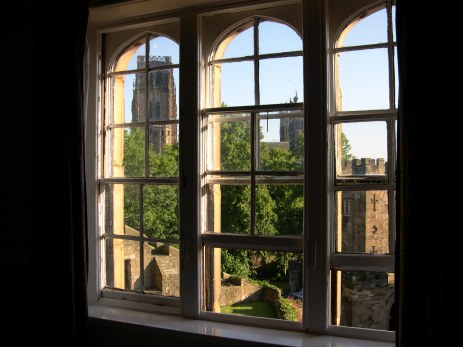
The birds are in their trees, the toast is in the toaster, and the poets are at their windows.
They are at their windows in every section of the tangerine of earth– the Chinese poets looking up at the moon, the American poets gazing out at the pink and blue ribbons of sunrise.
The clerks are at their desks, the miners are down in their mines, and the poets are looking out their windows maybe with a cigarette, a cup of tea, and maybe a flannel shirt or bathrobe is involved.
The proofreaders are playing the ping-pong game of proofreading, glancing back and forth from page to page, the chefs are dicing celery and potatoes, and the poets are at their windows because it is their job for which they are paid nothing every Friday afternoon.
Which window it hardly seems to matter though many have a favorite, for there is always something to see– a bird grasping a thin branch, the headlight of a taxi rounding a corner, those two boys in wool caps angling across the street.
The fishermen bob in their boats, the linemen climb their round poles, the barbers wait by their mirrors and chairs, and the poets continue to stare at the cracked birdbath or a limb knocked down by the wind.
By now, it should go without saying that what the oven is to the baker and the berry-stained blouse to the dry cleaner, so the window is to the poet.
Just think– before the invention of the window, the poets would have had to put on a jacket and a winter hat to go outside or remain indoors with only a wall to stare at.
And when I say a wall, I do not mean a wall with striped wallpaper and a sketch of a cow in a frame.
I mean a cold wall of fieldstones, the wall of the medieval sonnet, the original woman’s heart of stone, the stone caught in the throat of her poet-lover.
They talk of triumph of the machine,
but the machine will never triumph.
Out of the thousands and thousands of centuries of man
the unrolling of ferns, white tongues of the acanthus lapping at the sun,
for one sad century
machines have triumphed, rolled us hither and thither,
shaking the lark’s nest till the eggs have broken.
Shaken the marshes, till the geese have gone
and the wild swans flown away singing the swan-song at us.
Hard, hard on the earth the machines are rolling,
but through some hearts they will never roll.
The lark nests in his heart
and the white swan swims in the marshes of his loins,
and through the wide prairies of his breast a young bull herds his cows,
lambs frisk among the daisies of his brain.
And at last
all these creatures that cannot die, driven back
into the uttermost corners of the soul,
will send up the wild cry of despair.
The thrilling lark in a wild despair will trill down arrows from the sky,
the swan will beat the waters in rage, white rage of an enraged swan,
even the lambs will stretch forth their necks like serpents,
like snakes of hate, against the man in the machine:
even the shaking white poplar will dazzle like splinters of glass against him.
And against this inward revolt of the native creatures of the soul
mechanical man, in triumph seated upon the seat of his machine
will be powerless, for no engine can reach into the marshes and depths of a man.
So mechanical man in triumph seated upon the seat of his machine
will be driven mad from within himself, and sightless, and on that day
the machines will turn to run into one another
traffic will tangle up in a long-drawn-out crash of collision
and engines will rush at the solid houses, the edifice of our life
will rock in the shock of the mad machine, and the house will come down.
Then, far beyond the ruin, in the far, in the ultimate, remote places
the swan will lift up again his flattened, smitten head
and look round, and rise, and on the great vaults of his wings
will sweep round and up to greet the sun with a silky glitter of a new day
and the lark will follow trilling, angerless again,
and the lambs will bite off the heads of the daisies for very friskiness.
But over the middle of the earth will be the smoky ruin of iron
the triumph of the machine.
 CHILDREN, IT’S SPRING


 Gladsome Lights