Monthly Archives: August 2023

Thinking about babies and Barbie.

As I may have said here before, I have probably watched fewer movies than anyone you know. So I don’t often mention them. The two I saw most recently were “My Octopus Teacher” and “Babies,” both of which I’ve enjoyed more than once. I watched “Babies,” a 2010 French documentary, with my four-year-old grandson just last month. Its subjects are four babies in their first year of life, in Namibia, Mongolia, Tokyo, and San Francisco.

I very much love that movie, for the meditative and close-up way it shows vastly different styles of mothering across cultures and around the world. I admit, my own style doesn’t exactly fit with any of those shown, but if I had to choose among the four, I feel most akin to the Mongolian way. In any case, all the families in the movie are pretty traditional for the local culture in which they are raising their children.

The contrast between that movie and the current one everyone is talking about, “Barbie,” didn’t cross my mind until I read this article in Salvo Magazine“Existential Barbie: A World Without Love is Never Kenough,” by Annie Brownell Crawford. The author starts with a brief introduction:

“The plot begins when Barbie suddenly starts thinking about death, her feet fall flat, and she discovers cellulite on her thighs. To solve her existential crisis, Barbie travels to the real world with her unwanted Ken tagging along. When she arrives in California, Barbie is shocked to discover a world of exaggerated patriarchy where men think of her as an object and girls hate her for her beauty. Here, as the teen character Sasha explains, ‘Men hate women, and women hate women.’

Crawford notes that “the film moves chaotically between satire and sincerity,” and she wouldn’t be quick to draw conclusions from the above statement alone, but there are reasons to think it was meant seriously. So she responds,

“Modern feminists seem to hate women as much as they believe men do, for the female body confronts all of us with our intrinsic dependence on one another and ultimately upon God. As the apostle Paul reminds us, ‘woman is not independent of man, nor is man independent of woman. For as woman came from man, so also man is born of woman. But everything comes from God.’ (I Corinthians 11)  We only know ourselves as women and as men through our relationship with each other, and we only know ourselves as humans in relationship to the God we image. The female body reminds us of this interdependence and the givenness of our existence, for our mothers literally gave us life.”

Of course the biggest difference between these two movies is that one is all about babies, and the other one lacks babies entirely, except for the unfortunate baby dolls:

“The film opens with an origin story wherein the newly created Barbie rescues little girls from being forced to play with baby dolls. After independent, infertile Barbie arrives, the young girls of the world celebrate their liberation from motherhood by smashing their babies to bits.”

I’m not enough of a movie buff that I am likely ever to see “Barbie,” but if I did, I might afterward go on to read some of the critics who are saying that if you dig deep through those layers of irony and satire, it’s actually anti-feminist and conservative in its message. Maybe how you feel about that depends partly on what you think The Patriarchy is. Is Ken in or out of it?

I wonder if Kimberly Ells has seen “Barbie”…. She attended the Commission on the Status of Women at the United Nations this spring and heard much about the desire to “smash” and “eradicate” the patriarchy; so she started asking around at the event, What is The Patriarchy, exactly? She wrote succinctly about the answers she got in this article: “In Praise of Men.”

I’d be interested to hear if any of my readers has thoughts about these movies or the questions raised by “Barbie.” And if you haven’t seen “My Octopus Teacher” or “Babies,” I definitely recommend those!

A Mongolian mother and child.

With a leaf, and angels.

A LIST OF PRAISES

Give praise with psalms that tell the trees to sing,
Give praise with Gospel choirs in storefront churches,
Mad with the joy of the Sabbath,
Give praise with the babble of infants, who wake with the sun,
Give praise with children chanting their skip-rope rhymes,
A poetry not in books, a vagrant mischievous poetry
living wild on the Streets through generations of children.

Give praise with the sound of the milk-train far away
With its mutter of wheels and long-drawn-out sweet whistle
As it speeds through the fields of sleep at three in the morning,
Give praise with the immense and peaceful sigh
Of the wind in the pinewoods,
At night give praise with starry silences.

Give praise with the skirling of seagulls
And the rattle and flap of sails
And gongs of buoys rocked by the sea-swell
Out in the shipping-lanes beyond the harbor.
Give praise with the humpback whales,
Huge in the ocean they sing to one another.

Give praise with the rasp and sizzle of crickets, katydids and cicadas,
Give praise with hum of bees,
Give praise with the little peepers who live near water.
When they fill the marsh with a shimmer of bell-like cries
We know that the winter is over.

Give praise with mockingbirds, day’s nightingales.
Hour by hour they sing in the crepe myrtle
And glossy tulip trees
On quiet side streets in southern towns.

Give praise with the rippling speech
Of the eider-duck and her ducklings
As they paddle their way downstream
In the red-gold morning
On Restiguche, their cold river,
Salmon river,
Wilderness river.

Give praise with the whitethroat sparrow.
Far, far from the cities,
Far even from the towns,
With piercing innocence
He sings in the spruce-tree tops,
Always four notes
And four notes only.

Give praise with water,
With storms of rain and thunder
And the small rains that sparkle as they dry,
And the faint floating ocean roar
That fills the seaside villages,
And the clear brooks that travel down the mountains

And with this poem, a leaf on the vast flood,
And with the angels in that other country.

-Anne Porter

Restigouche River, New Brunswick, by Richard James Taylor

Man was also a culture-bearer.

The trees and bushes in my garden get bigger year by year, requiring more attention from me; and several other aspects of my present life prevent me from having the leisure I once had, to write reviews of the books I read. For example, A Canticle for Leibowitz, which I only finished this month. It is the first post-apocalyptic novel I’ve ever read, published in 1959.

It made a big impression on me, which I probably wouldn’t be able to analyze or articulate to my satisfaction, so I didn’t even begin to try, but immediately moved on to a different book. (It’s my experience that reading books doesn’t require the same quality of leisure as writing reviews.) But O happy day! Jeff Bilbro mentioned the book, with a quote, in the newsletter of The Front Porch Republic, so I will just pass that on, with thanks to him. I also commend the other articles on that site, or their print journal, as worthy of your consideration. Here’s Jeff:

“I recently read Canticle for Leibowitz by Walter M. Miller Jr., and I found it a moving narrative exploring the proper cultural and religious conditions for rightly valuing knowledge. The novel follows a monastic order that forms in the wake of a nuclear holocaust, and they carefully preserve remnants of the former industrial civilization through generations of warfare until human civilization is ready to rediscover natural science and its applications. Can such knowledge ever be used wisely, or does increased technical know-how inevitably lead cultures to abandon religious and moral wisdom? Miller offers no easy answers. In this passage, an abbot of this monastic order reflects on the significance of the rising interest in their archives:

‘Now a Dark Age seemed to be passing. For twelve centuries, a small flame of knowledge had been kept smoldering in the monasteries; only now were their minds ready to be kindled. Long ago, during the last age of reason, certain proud thinkers had claimed that valid knowledge was indestructible—that ideas were deathless and truth immortal. But that was true only in the subtlest sense, the abbot thought, and not superficially true at all. There was objective meaning in the world, to be sure: the nonmoral logos or design of the Creator; but such meanings were God’s and not Man’s, until they found an imperfect incarnation, a dark reflection, within the mind and speech and culture of a given human society, which might ascribe values to the meanings so that they become valid in a human sense within the culture. For Man was a culture-bearer as well as a soul-bearer, but his cultures were not immortal and they could die with a race or an age, and then human reflections of meaning and human portrayals of truth receded, and truth and meaning resided, unseen, only in the objective logos of Nature and the ineffable Logos of God. Truth could be crucified; but soon, perhaps, a resurrection.’

“Thanks for spending some time with us on the Porch,

Jeff Bilbro”

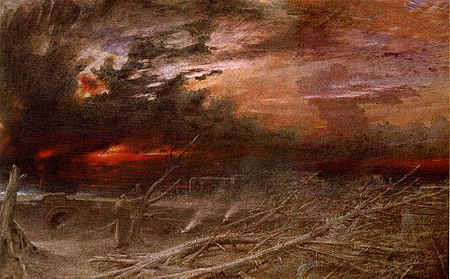
Apocalypse by Albert Goodwin