In the middle of the afternoon, a flock of little birds — maybe kinglets? — flew into the garden and frolicked all over, visiting the pomegranate flowers and the fig tree, but not the fountain. Their zig-zag swooping looked like play, but maybe they were finding various tiny things to eat. In less than five minutes they were gone.
I watched them all that time because I was leaning against the kitchen counter holding one of my favorite Dansko sandals braced against my body, as Shoe Glue cured in the cracks in the sole. I want to pack these shoes in my suitcase this evening to take on a trip tomorrow, and somehow this task got pushed to the last day possible.
 So many things got pushed here to today, or were left in a sort of limbo waiting for me to gather my wits — or something. I wish I could be more organized, but today has been fun, for the most part, after I got down to business.
Part of that work was cleaning out the refrigerator, or at least removing produce that won’t keep five more days. I had plans to make soup with whatever was there or in the garden. That would also have been good to do yesterday, but then, there was no pressure…
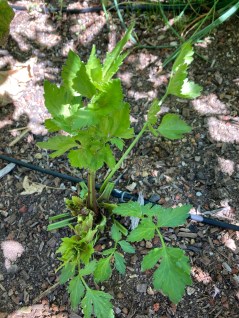
The initial reason for the soup idea was a head of celery I wanted to use up, but I found lots more in my own garden to add: tomatoes, lemon basil, tarragon, parsley, smallage, zucchini and eggplant. There was only one of the skinny long eggplants, so what else could I do with it but cut it into rounds and plop them in.

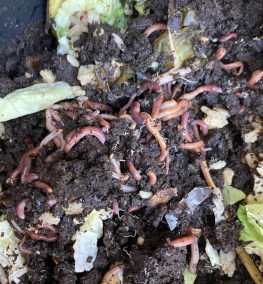
I watered all the newly planted irises, yarrow, lavender, etc. in the garden, and all the potted plants, and I fed the worms. My worms are doing great! I’ve had lots of vegetable trimmings and even whole leaves and fruits from the garden that were so damaged by birds or insects that I couldn’t use them, so my “vermis” had plenty to eat, and seem to be reproducing a lot. When I dig around a little in the bins I always see at least one big cluster of worms of all sizes, which I consider to be the “nests” of young ones.
The strangest thing about today was that I spent the very middle of it in a literature class online, the first time I’ve ever done such a thing. It’s to study Beowulf, and I couldn’t pass up the chance, and it started today. That was very satisfying. I’m sure I’ll have more to tell about it as the weeks go by.
It really wasn’t until after that class session that my serious flitting began — interspersed with hovering, which can mean to hang fluttering or suspended in the air. Or, to keep lingering about; wait near at hand. Those little birds I’d seen weren’t doing any of that, but then, my garden is not their home. I lingered in the garden as long as I could.
And then, I took time to start writing here, which probably means that I won’t get the floor swept before I go. These days when I live alone, I give myself permission to leave without putting everything shipshape; no one is here to care. I can sweep next week.
[Next morning, this morning]: So, I didn’t finish this soup-and-worm story before bed. Now I’m at the airport waiting for my flight that has been delayed two hours, and I can wrap it up here.
Once I got to the airport, I could calm down. The way from here doesn’t involve a multitude of things to remember or tasks to accomplish. I won’t have much time to think about my garden. But from now until I return, I won’t be fully settling. While my plane flies at great speed, my mind will still be hovering, and I don’t expect it to touch down until I am home again.

 On this feast day of St. Kassiani, I have a few items to share with you. Kassiani was a Byzantine abbess, poet, composer, and hymnographer, born at the beginning of the 9th century in Constantinople. This short biography is a good introduction:
  Though Faulkner wrote that in the 20th century, I doubt whether he would think the situation has improved in the 21st. In the same year as the Touchstone article, Czeslaw Milosz published this offering that is a form of therapy for our distorted vision: In the introduction to the anthology of poetry that he compiled, The Book of Luminous Things, he writes:
 Gladsome Lights