Monthly Archives: November 2023

St. Andrew — and then December.

Attending Divine Liturgy on the feast of St. Andrew — what a life-giving way for me to start the day. It was a long and busy day that had me driving back and forth and all over, which is why I am only now getting to the computer to tell about it, now that we are, liturgically, in the following day.

It was a chilly morning, in the middle of the week; the little church was cold in its bones and for the first half hour I stood so close I was almost touching the wall furnace. Who would come on such a morning for a relatively unimportant commemoration? The rector came, of course, with joy. The choir director led a choir of four singers, including a nun from the monastery in the next county.

Two men named Andrew and Andrei were there, because it is their saint’s day, and who would want to miss that? One mother of an Andrew came to remember her son’s saint.

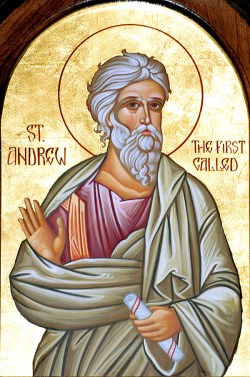
St Andrew's Day is a day of celebration in Scotland (Getty Images)Saint Andrew, the first of the men whom Christ called to be His disciples, eventually became the patron saint of Scotland, and Mrs. Anderson came in her tartan plaid skirt to remember that aspect. She also pointed out to me that her married name means Andrew’s Son.

I myself like to participate for the sake of the Scottish ancestors that both my late husband and I have; not only that, but two of my grandsons were born on this day, and that makes it special to me. Six or eight more people were present who weren’t obviously tied to this specific feast, but I’m sure all of us were happy to receive the Eucharist and be united to Christ in that way.

Mrs. Anderson had yet another reason to be there: She was very close to a very dear parishioner named Constantine, who died on this day more than ten years ago, and every time we celebrate the feast of the Resurrection with Divine Liturgy on November 30, we also sing memorial prayers for him. She made a small portion of the memorial dish of boiled wheat, called koliva, for us to eat together in his memory at the end of the service. You can’t see the wheat in this picture because she topped it with lots of dried fruit and fresh pomegranate seeds. It did make a good breakfast.

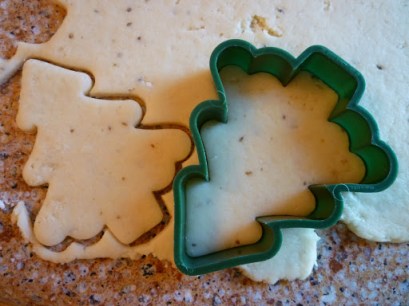
By then, the church was warmed up, but we could not linger as long as we might have liked. Out we went into the sunny day, and to all of our responsibilities. One of mine was going to the dentist, and I’m glad to get that out of the way. Afterward, I had the fun of shopping for special ingredients — and more butter– for baking Christmas cookies. The boys at the checkout stand got to talking about how they used to put out cookies for Santa. And here it isn’t even December yet! Although it likely will be before you read this.

So I wish you a December that is peaceful and bright.
(And don’t eat too many cookies before Christmas!)
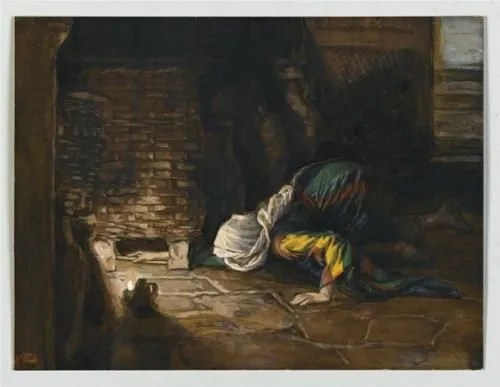
The Lord in the guise of a woman.

THE TEN DRACHMAS:
The Lord in the Guise of a Woman


“Can you believe that Christ the Saviour portrayed Himself in the guise of a woman in two of His parables? One is that of the woman who took three measures of flour and made dough. But first let us speak of the other one where the Lord tells us about the woman who had ten drachmas and lost one. These are the most mysterious of all the Saviour’s parables. As the parable of the lost drachma is short, we quote it in full.”

“Or what woman, having ten drachmas, if she lose one, does not light a candle and sweep the house and look diligently till she finds it? And after she has found it, she calls in her friends and neighbors and says, Rejoice with me, for I have found the drachma that I lost (Luke 15:8-9).”

“At first glance this parable seems so simple, or even naive, that it does not impress the reader of the Gospel. In fact, however, the mystery of the universe is revealed in this simple parable.”

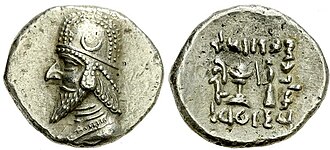
Drachma of Darius King of Persia, 1st century.

The paragraphs above are the first part of an article by St. Nikolai Velimirovich, which I’m happy to bring to your attention. From his statement about the mystery of the universe, the author goes on to point out the puzzling elements in this very short story, and to explain two interpretations, both of which he says are correct. I will let you read the whole exposition at your leisure: “The Ten Drachmas” (in which he also treats the second story, the “Three Measures of Flour,” in detail). But I want to share one more excerpt, which returns to the question of why the protagonist in “The Ten Drachmas” must be a woman:

“Our Lord described Himself as a woman because women are more careful than men in looking after property, in keeping the house in order and in receiving guests. If this short parable, which consists of only two sentences, is explained in this way, whose heart will not tremble? for it contains the whole tragedy of the world, visible and invisible. It explains why the Son of God came to earth. It sheds a bright ray of light on the history of mankind and the tragedy of each individual’s existence.

“It confronts us with an urgent decision, because our life is swiftly passing — a decision as to whether we want to be the lost drachma found by Christ or not. Christ is looking for us. Are we going to hide from him, or let ourselves be found by Him before death hides us from Him, from the world and from life?”

-St. Nikolai Velimirovich

“The Ten Drachmas”

The Icon of the Sign

Today is the commemoration of this particular icon of Mary and Christ, signifying the Incarnation: the Icon of the Sign.

OCA: “The Icon of the Mother of God ‘Of the Sign’
depicts the Most Holy Theotokos with prayerfully uplifted hands,
and the Divine Infant is at Her bosom in a mandorla (or sphere).”

Icon Reader also has an article about this icon, “The Theotokos ‘of the Sign’ Icon.” There are many, many renditions of this form, and I especially love the one at my parish:

“Her prayerful stance also gives the impression of presenting us with Christ,
and our attention is drawn – as always with icons of the Theotokos –
to her Son, our Saviour.”

Never look straight up at the sun.

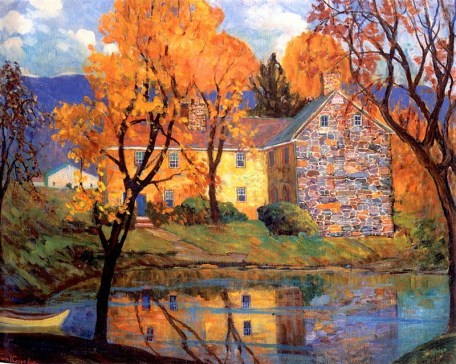
I traveled north several hours to my daughter’s for Thanksgiving last week, and home again three days later. Through rural areas mostly, my favorite views were of the forests and orchards, oaks and maples and almonds, many of the trees with their leaves glowing yellow and red as the light caught them just right, against a dark green conifer background. The sun was, as this poem says, the artist.

THE SUN

All colors come from the sun. And it does not have
Any particular color, for it contains them all.
And the whole Earth is like a poem
While the sun above represents the artist.

Whoever wants to paint the variegated world
Let him never look straight up at the sun
Or he will lose the memory of things he has seen.
Only burning tears will stay in his eyes.

Let him kneel down, lower his face to the grass,
And look at the light reflected by the ground.
There he will find everything we have lost:
The stars and the roses, the dusks and the dawns.

Warsaw, 1943

―Czesław Miłosz

Fern Coppedge, Autumn