Monthly Archives: November 2023

The kindness may be unpleasant.

“Why do men learn through pain and suffering, and not through pleasure and happiness? Very simply, because pleasure and happiness accustom one to satisfaction with the things given in this world, whereas pain and suffering drive one to seek a more profound happiness beyond the limitations of this world. I am at this moment in some pain, and I call on the Name of Jesus — not necessarily to relieve the pain, but that Jesus, in Whom alone we may transcend this world, may be with me during it, and His will be done in me.

“But in pleasure I do not call on Him; I am content then with what I have, and I think I need no more. And why is a philosophy of pleasure untenable? — because pleasure is impermanent and unreliable, and pain is inevitable. In pain and suffering Christ speaks to us, and thus God is kind to give them to us, yes, and evil too — for in all of these we glimpse something of what must lie beyond, if there really exists what our hearts most deeply desire.”

– Fr. Seraphim Rose

Weekday Vespers

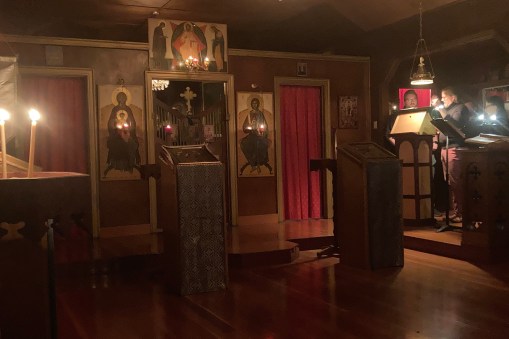
Vespers was in our little old church this evening, and very beautiful in every way. Beforehand a few of us read an akathist prayer to Mother Olga of Alaska by candlelight. I think the wood paneled walls of this church are infused with 80 years’ worth of incense; something makes it smell good even when no services have been held recently. But tonight we had fresh incense, as well as warm singing and earnest supplications.

In each minim mote.

OPENING WORDS

I believe the earth
exists, and
in each minim mote
of its dust the holy
glow of thy candle.
Thou
unknown I know,
thou spirit,
giver,
lover of making, of the
wrought letter,
wrought flower,
iron, deed, dream.
Dust of the earth,
help thou my
unbelief. Drift
gray become gold, in the beam of
vision. I believe with
doubt. I doubt and
interrupt my doubt with belief. Be,
beloved, threatened world.
Each minim
mote.
Not the poisonous
luminescence forced
out of its privacy,
The sacred lock of its cell
broken. No,
the ordinary glow
of common dust in ancient sunlight.
Be, that I may believe. Amen.

-Denise Levertov

You have to treat it as a living thing.

Tessa Carman was having a conversation with Paul Kingsnorth last year, on “Following Christ in the Machine Age.” This is an overarching theme of Kingsnorth’s thinking and writing. Their conversation was leisurely and ranged over many topics, everything from books they have been reading, to Kingsnorth’s conversion, to Hollywood, to being “cancelled.” Kingsnorth lives on a “smallholding” in Ireland, so naturally the conversation turned to how we humans treat the land. I liked the point that Carman brings up, about how farmers traditionally have not been sentimental about nature, but because they “have to do” the work of caring for the land day in and day out, they develop an intimate relationship with it:

“Christians were not untouched by modernity. Especially when there’s more uprootedness — I suspect it’s easier to treat things like machines if you are used to living amongst machines. And if you’re used to taking care of a piece of land, where you have to treat it as a living thing in some sense, even if you don’t think of it as a living thing, that’s just what you have to do, because there’s a living relationship amongst the animals and the land and the people. You see that and live that, and you see the reality of it— the cycle of life and death, how manure brings life.

“If you’re in the city, you can have your image of how the natural world is instead of the reality. And there’s the danger of sentimentality, when we have disconnected ourselves from the land such that we think we can decide what’s good for the land without even knowing it, without knowing the people, let alone this specific piece of land, these animals and these plants.”

Tessa Carman

Orange groves in Tulare County, California.