I don’t think I ever heard this carol until today. I was checking out the YouTube channel of Clamavi De Profundis, guessing that I might find good Christmas music there. I was happy to see that they have recorded several Christmas pieces, including this one: “See Amid the Winter’s Snow”:
Monthly Archives: December 2025
A most melancholy cry.
THE OWL
Downhill I came, hungry, and yet not starved;
Cold, yet had heat within me that was proof
Against the North wind; tired, yet so that rest
Had seemed the sweetest thing under a roof.
Then at the inn I had food, fire, and rest,
Knowing how hungry, cold, and tired was I.
All of the night was quite barred out except
An owl’s cry, a most melancholy cry
Shaken out long and clear upon the hill,
No merry note, nor cause of merriment,
But one telling me plain what I escaped
And others could not, that night, as in I went.
And salted was my food, and my repose,
Salted and sobered, too, by the bird’s voice
Speaking for all who lay under the stars,
Soldiers and poor, unable to rejoice.
-Edward Thomas
posted here https://nigeness.blogspot.com/ Aug 2025
The good giant lifts the world.

Malcolm Guite included this passage from “The Ballad of the White Horse” in his anthology of Advent and Christmas poems, Waiting on the Word. King Alfred the Great narrates:
And well may God with the serving-folk
Cast in His dreadful lot;
Is not He too a servant,
And is not He forgot?
For was not God my gardener
And silent like a slave;
That opened oaks on the uplands
Or thicket in graveyard gave?
And was not God my armourer,
All patient and unpaid,
That sealed my skull as a helmet,
And ribs for hauberk made?
Did not a great grey servant
Of all my sires and me,
Build this pavilion of the pines,
And herd the fowls and fill the vines,
And labour and pass and leave no signs
Save mercy and mystery?
For God is a great servant,
And rose before the day,
From some primordial slumber torn;
But all we living later born
Sleep on, and rise after the morn,
And the Lord has gone away.
On things half sprung from sleeping,
All sleeping suns have shone,
They stretch stiff arms, the yawning trees,
The beasts blink upon hands and knees,
Man is awake and does and sees-
But Heaven has done and gone.
For who shall guess the good riddle
Or speak of the Holiest,
Save in faint figures and failing words,
Who loves, yet laughs among the swords,
Labours, and is at rest?
But some see God like Guthrum,
Crowned, with a great beard curled,
But I see God like a good giant,
That, laboring, lifts the world.
-G.K. Chesterton, excerpt from “The Ballad of the White Horse.”
I like to listen to Fr. Guite read poems on his site. You can read and listen here, too: “The Good Riddle.”

A Psalm and a tree for Advent.
This is a re-post from only three years ago, but it’s meaningful to me in a fresh way this year because now, instead of teaching little ones at church, I’m back with the high schoolers, and our lesson on the Holy Forefathers will be presented differently.
Also, this week I meditated on Psalm 89/90, “A Prayer of Moses, a man of God,” and Moses is one of those Holy Forefathers we are remembering. Because of its repentant tone, it was an answer to my prayer for guidance in how better to prepare for the Feast of the Nativity of Christ, in the short time remaining.
It’s a morning prayer, to help us focus at the outset on God instead of on our sorrows, and to keep at bay the feeling of hopelessness that lies in wait at the door of our heart. The poetry conveys so well the patience of God, and the way our longings and heartaches coexist with thankfulness and repentance:
….Lord, Thou hast been our refuge in generation and generation.
….Before the mountains came to be and the earth was formed, and the world, even from everlasting to everlasting Thou art.
….
….As for the days of our years, in their span they be threescore years and ten.
….And if we be in strength, mayhap fourscore years; and what is more than these is toil and travail.
….For mildness has come upon us, and we shall be chastened.
….
….Return, O Lord; how long? And be Thou entreated concerning Thy servants.
….We were filled in the morning with Thy mercy, O Lord, and we rejoiced and were glad.
….In all our days let us be glad for the days wherein we saw evils.
….And look upon Thy servants, and upon Thy works, and do Thou guide their sons.
….And let the brightness of the Lord our God be upon us, and works of our hands do Thou guide aright upon us, yea, the works of our hands do Thou guide aright.

From 2022:
Today is the Sunday of the Forefathers of Christ, His ancestors according to the flesh. We remember these who lived “before the Law and under the Law,” especially the Patriarch Abraham, to whom God said, “In thy seed shall all of the nations of the earth be blessed” (Gen. 12:3, 22:18).
I brought an icon of the Prophet David to stand up on the table in my church school class, and we talked about David as a shepherd boy, his killing of a lion who was threatening the sheep, his composing songs, and his anointing by the Prophet Samuel. (But first, we must chat about St. Nicholas and Santa, because he was strongly on the minds of the four- and five-year-olds.)
When I took the icon out of my bag again at home, I set it up downstairs, and lit a candle to help me keep remembering for the remainder of today. Maybe I will leave it here through next Sunday, when we remember more of these saints; the next church school lesson will focus on the Hebrew Children in the Fiery Furnace.
One thing I didn’t discuss with the children, but would be fun to teach older students about, is the Tree of Jesse, a visual depiction of the genealogy of Jesus Christ. Jesse was the father of King David; his roots extend down and back to his own forefathers including Abraham, the Father of the Faithful; and Jesse was himself the root, or progenitor, of David’s line, which culminated in Christ the Messiah.
![]()
Jesse Tree icons must necessarily include so much information, they somewhat overwhelm me. When looking at them I tend to concentrate on Jesse himself, lying at the base of the tree, with its trunk growing out his very body.


Stained glass windows portraying the Jesse tree, which abound in Britain, are also a bit much for me to take in. Often they are in tall cathedrals and extend up a whole wall, the figures distant and their names unreadable. As I was looking at some online I was happy to find Val Stevens talking about the Jesse Window at Wells Cathedral, which window I no doubt saw when I visited there with daughter Pippin, but I don’t remember.
It’s a very short video (which ends with a request for contributions which are no longer needed, because the repairs have been completed), and she speaks for only two minutes, but she made me laugh with joy when she began to speak about the rare crucifixion scene that is in that window, which dates from the 14th century. The stem turns green, and takes the form of a cross, on which the Savior hangs. When she got to the part about the meaning of the green wood, or what it meant to the medieval mind, my heart leapt to hear it, and to see the change in her body language as she moved from purely artistic ideas, to the more compelling realities of the heart: Jesse Window of Wells Cathedral

Also I want to share a quote I have posted before, more than once, because it pulls together several of these images, metaphors, and real people in our salvation history, in our cultural tradition. This is about a different sort of tree, the more familiar and ubiquitous Christmas tree! From Metropolitan Hierotheos Vlachos:
“I suspect that the custom of decorating a tree at Christmas time is not simply a custom which came to us from the West and which we should replace with other more Orthodox customs. To be sure, I have not gone into the history of the Christmas tree and where it originated, but I think that it is connected with the Christmas feast and its true meaning.
“First, it is not unrelated to the prophecy of the Prophet Isaiah: ‘There shall come forth a Rod from the stem of Jesse, and a Branch shall grow out of his roots’ (Is. 11:1). St. Cosmas the poet had this prophecy in mind when he wrote of Christ as the blossom which rose up out of the Virgin stem from the stump of Jesse. The root is Jesse, David’s father, the rod is King David, the flower which came from the root and the rod is Theotokos. And the fruit which came forth from the flower of the Panagia is Christ. Holy Scripture presents this wonderfully.
“Thus the Christmas tree can remind us of the genealogical tree of Christ as Man, the love of God, but also the successive purifications of the Forefathers of Christ. At the top is the star which is the God-Man (Theanthropos) Christ. Then, the Christmas tree reminds us of the tree of knowledge as well as the tree of life, but especially the latter. It underlines clearly the truth that Christ is the tree of life and that we cannot live or fulfill the purpose of our existence unless we taste of this tree, ‘the producer of life.’
“Christmas cannot be conceived without Holy Communion. And of course as for Holy Communion it is not possible to partake of deification in Christ without having conquered the devil, when we found ourselves faced with temptation relative to the tree of the knowledge of good and evil, where our freedom is tried. We rejoice and celebrate, because ‘the tree of life blossomed from the Virgin in the cave’.”
-Excerpt from: “The Feasts of the Lord: An Introduction to the 12 Feasts and Orthodox Christology” by Metropolitan of Nafpatkos Hierotheos Vlachos – November 1993.
I’ve known families who used a Jesse Tree along with their Advent wreath as helps in Advent. But oh, my, out of curiosity I just looked at some current Pinterest-era examples, and had to abort that browsing quick; it was plenty for a Sunday afternoon to look at stained glass windows.
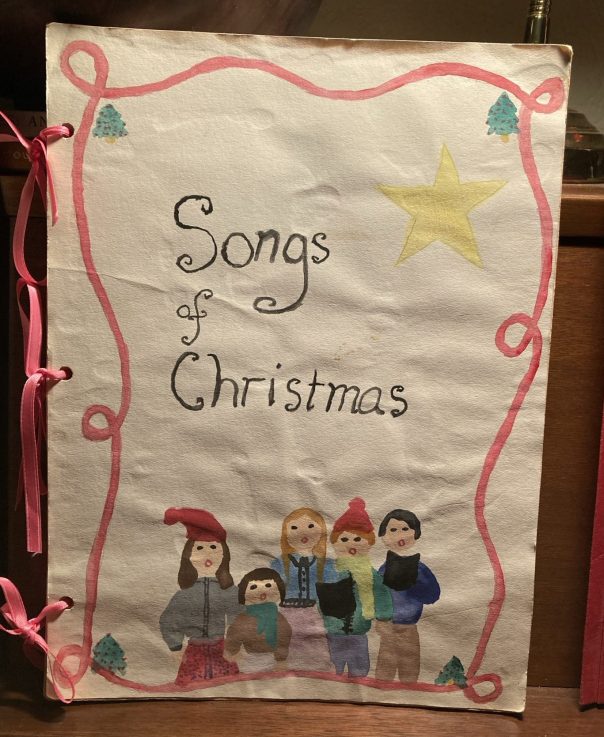
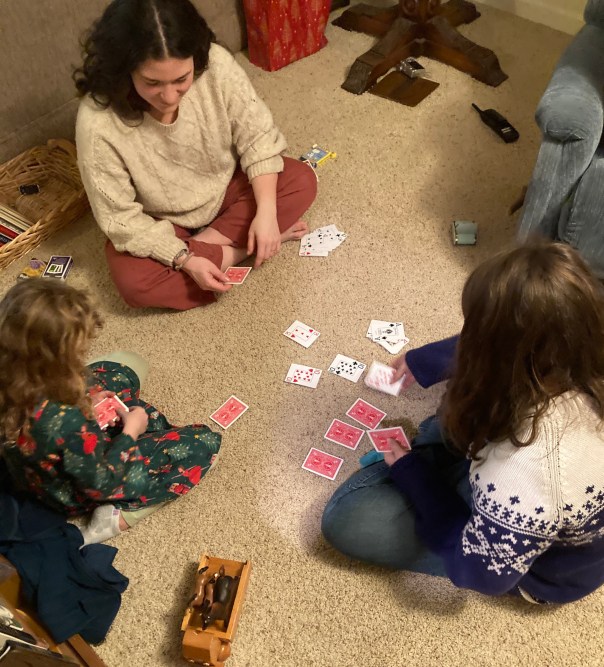
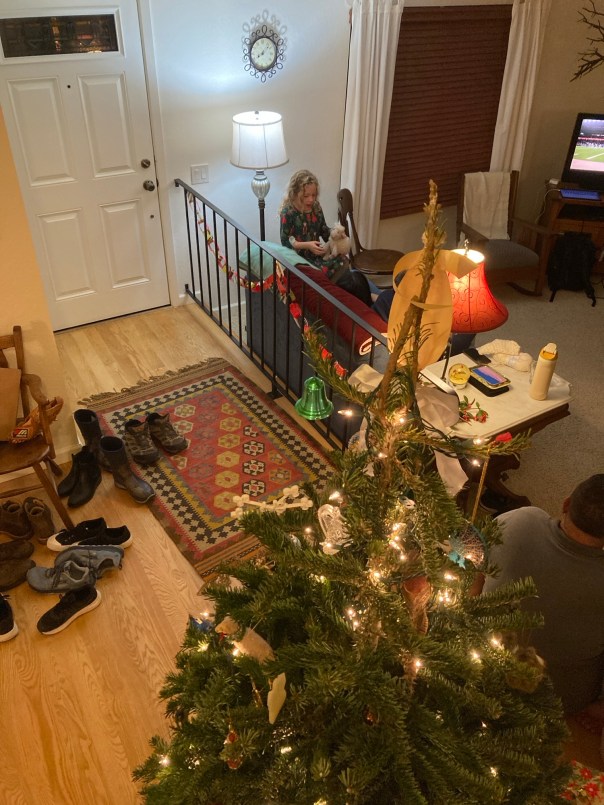
My daughters and I have been sharing memories this month, from our homes scattered across the country; posting photos of past and current Christmas trees, reminiscing about Christmas caroling, and recalling their father’s voice and his Christmas joy. This year I will have neither a Jesse nor a Christmas tree, but I feel rich with history and symbols and family. There’s my earthly family, and there is the heavenly family into which I’ve been adopted by the Father. Today I’m especially grateful for all those patriarchs and prophets who have gone before and who encourage me by their lives of faith.
By faith You justified the Forefathers,
when through them You betrothed Yourself beforehand
to the Church of the Gentiles.
The saints boast in glory,
that from their seed there is a glorious fruit:
she who bore You without seed.
By their prayers, O Christ God, save our souls.
-Hymn for the Feast