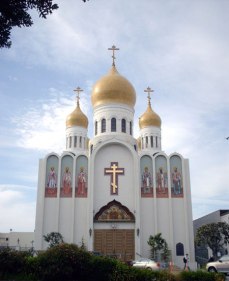
My godmother Charity and I took a trip to San Francisco yesterday, to the Orthodox cathedral affectionately called “Joy of All Who Sorrow.” I have mentioned visits to this holy place a couple of times before. The relics of St. John (Maximovitch) of Shanghai and San Francisco reside here, and draw pilgrims from around the world.
We wanted to present our petitions to the Lord with the help and intercession of St. John.

As many of my prayers have to do with my children and grandchildren, I was touched to see this icon near the front of the cathedral soon after I came in:

Being so large, the church has lots of space for iconography, an overwhelming number of images to take in, in one visit. This sweeping 360 degree tour of the cathedral might be interesting to give you an idea of the whole of the interior. It starts with the exterior and you have to click on the little square picture at the upper right of the frame to see the interior.
A photo of my companion hints at the feeling of being in the space:

Since my last visit here, I have become familiar with the traditional depictions of various saints and can recognize more of them, even if the names on them are in Cyrillic script. But I didn’t know this couple, whom Charity guessed to be Ss. Peter and Fevronia, and which the man at the candle desk in the narthex confirmed:

I have only recently learned about this royal couple, but they have long been famous in Russia, because:
“The Day of Saints Peter and Fevronia since the days of Kievan Rus and until 1917, was broadly celebrated in Russia because it is believed that the Saints Peter and Fevronia are the patrons of marriage and family, as well as the symbols of love and fidelity. On this day it was common to go to church, where the people asked for love and family grace.” (Wikipedia)
Their holiday has been revived in this century, now celebrated every July 8.
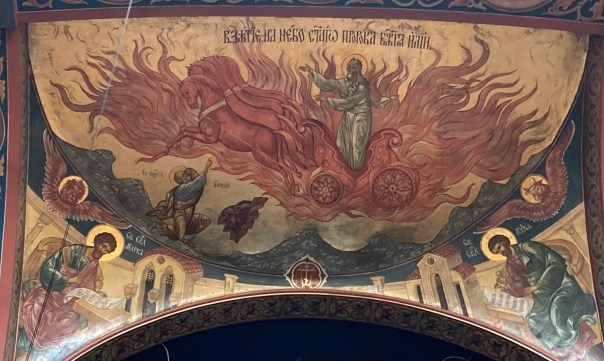
On the west wall I was surprised by a very large icon of Elijah in his chariot of fire:
One icon that blessed me very much was of the Holy Myrrhbearing Women. I am always especially interested in them because one is my patron saint, but this is the first time I have been so touched by their expressions, which seemed more emotional than is typical. (I really don’t know much about art, so take anything I say with a huge grain of salt!)

Just today I was reminded that icons are re-presentations of those depicted, an opportunity for us to engage further with the saints whom we know and love in the Lord. I offer one excerpt from an article by Fr. Lawrence Farley in which he explains why we ask saints to pray for us:
“If the living and departed are both united to Christ, they are by virtue of this union also united to one another. Even while on earth all Christians are united in a bond of mutual prayer and intercession (Ephesians 6:18)—how much more will our departed brethren pray for us when they are closer to Christ in heaven?”
In the huge Holy Virgin Cathedral full of saints re-presented to me, made present in a mysterious way, I experienced that reality which was also expressed by Bishop Dimitri (Royster) at the glorification of St. Herman of Alaska:
“The Church on earth lives in a loving fellowship with the saints who have already run their race, who have fought the good fight, and have received their crowns (2 Timothy 4:7) (James 1:12). This is what the Apostle means when he says that we are compassed about or surrounded by the witness-martyrs or saints. We are assured both of their presence and their interest in us. In fact, they are concerned about the whole world and its salvation, for ‘there is joy in heaven over the repentance of one sinner’ (Luke 15:7).”
It encouraged my heart to be with so many, many saints at the cathedral. I know that the ones presented in icons are only a few out of the great Cloud of Witnesses who are examples and friends for us, who love and pray for us. Their faith is like a magnet that draws me in to the Kingdom, and keeps me from getting discouraged. Their love is a comfort to my heart, and no wonder, for I was in the cathedral named for her whom we know to be the “Joy of All Who Sorrow.”


 Nothing could be more pleasing than to have rain in the night and morning, followed by sunshine and blue skies. The cold air smells delicious.
 Also, I gave up trying to find a picture of one of my family when a child, with a head that I would call bulbous. It might be that the word was more neutral in tone at the beginning of the last century. But I imagine that the poet and artist also delighted in how the toddler’s proportions were just the reverse of his, whose body was quite oversized relative to its head.


 Gladsome Lights