This is a post about bees. If you find them icky or boring and don’t care which bee is a robber, I understand! I put a pretty flower at the bottom for you to look at before you leave.
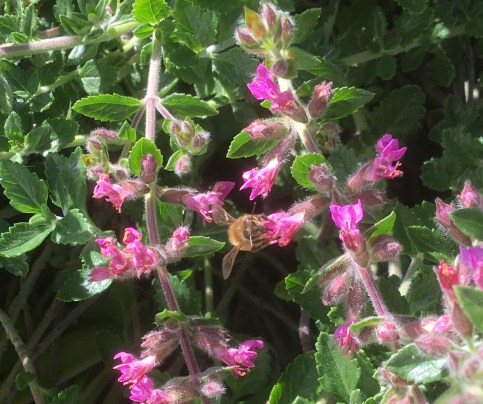
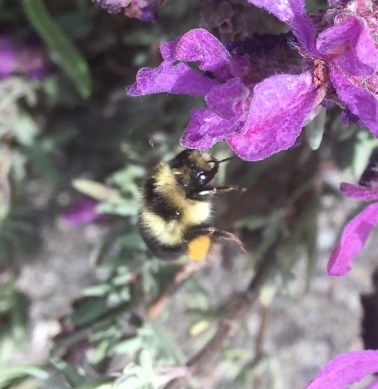
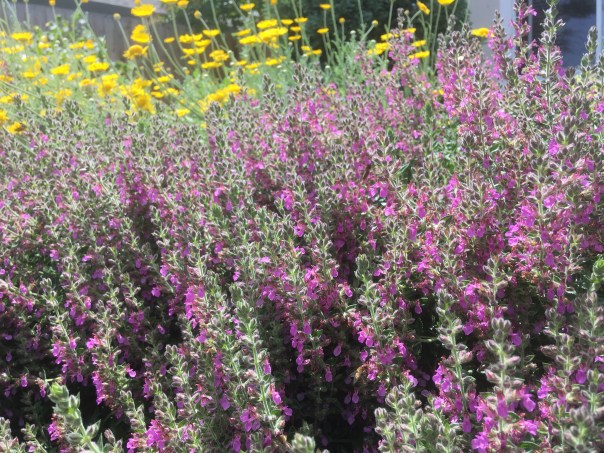
One morning this week I went back and forth along the front walk, for fifteen minutes or so, stooping over the germander hedges to watch a bumblebee. It caught my eye because of its yellow markings that were not what I’m used to seeing, and also because of its nectar-gathering style.
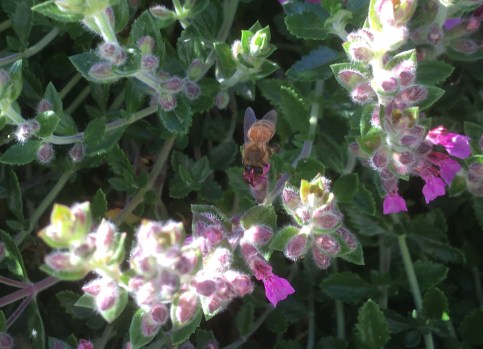
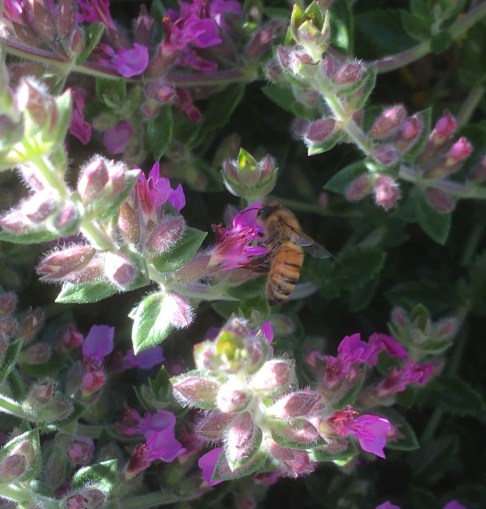
Was it because of its size and weight, that it couldn’t manage the flowers near the tops of the germander stems? It seemed to get lost in the understory of that purple forest, but would eventually resurface, tempting me to try again and again with my camera to fix his image (I can’t help switching male pronouns so I will just give in to my inclinations and be unscientific, because of course I have no idea of “his” sex.) so as to be able to see his markings better.
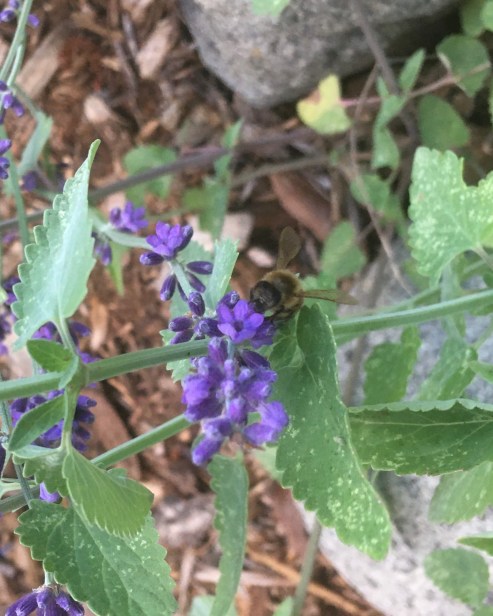
Here are the best pictures I got. Bees are buzzy and usually vibrating!
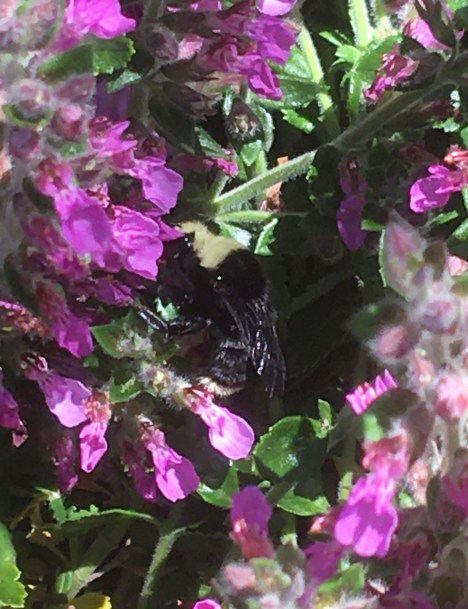
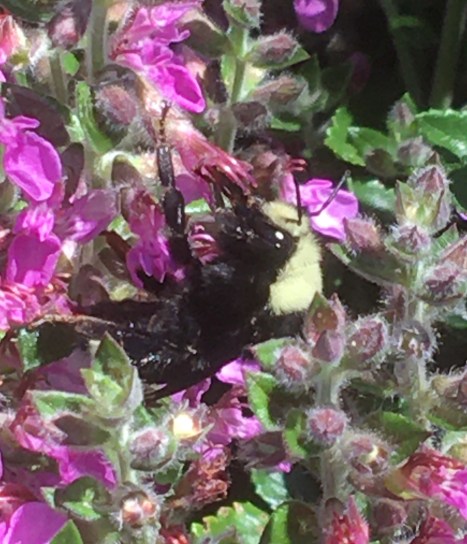

My Yellow-Faced Bumblebee is funny-looking! In that middle picture sprawled on his back like a suckling child, his yellow face is more like a yellow toupee. Here is a clearer, more classic image of the bee:

It is from the page Bumblebees of California, which is where I realized that what I thought for years was the primary bumblebee enjoying my pollinator garden is not a bumblebee at all.
It wasn’t until that same evening that I was set straight. As the sun was about to go down, I was snipping spent penstemon blooms in the back garden when I saw one of these “bumblebees” visiting the non-spent ones. He was not trying to go in at the door, so to speak, but was busy at the top. Did he have a short cut to the nectar? Was he making a short cut?

Back inside, when it began to dawn on me that he was not a bumblebee, I searched for “black bees that look like bumblebees,” and soon realized that he is a carpenter bee. And on the first site I found they described what I had seen a few minutes before: “On flowers such as salvias, penstemons, and other long, tubular flowers the carpenter bee, due to its large size, is unable to enter the flower opening. Instead they become nectar robbers. Using their mouthparts they cut a slit at the base of corolla and steal away with the nectar without having pollinated the flower.”
I learned that there are 500 species of carpenter bees! Most of them are all black and hard to tell one from another. The easiest way to tell them apart from bumblebees is by their abdomens: The bumblebees’ abdomens are covered with dense hair, while the carpenters’ are shiny. This last fact I was well aware of, because it has been the biggest hindrance to me getting a picture of these bees that usually show up as shiny black blobs. But now that I have identified two bees in one day, and have blurry pictures to refer to when I forget, I will relax and move on.
But — early this morning I went out looking for Yellow Face. I didn’t see him, but I did see the carpenter bees, and what were they doing? Stealing nectar from the tubular white salvia flowers!

I wasn’t shocked, but pleased. And I don’t see why this should be called “stealing.” Is there a law of nature that says a bee has a right to nectar only if he pollinates the flower at the same time? Have the tubular flowers filed a complaint about the theft?
Last year I was trying to identify a strange-looking wasp, and I browsed entomology sites to no avail. Entomologists can’t even keep the thousands of species straight, and we common people who deal with insects our whole lives have strong and conflicting beliefs about their names and identities. I realized back then that wasps were a low priority for me; I’m sorry to say that I even hate some of them. But I feel otherwise about bees. Here is a photo from the U.S. Forest Service showing the smallest bee with the largest bee:
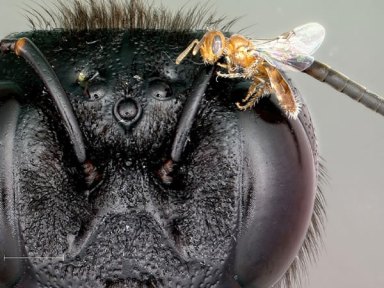
It is the Perdita minima on the head of a female carpenter bee. Wasps and bees, along with ants, are among the members of the Order Hymenoptera, but wasps are not bees any more than ants are bees. The first very readable paragraphs on this site I found helpful in refreshing my own memory on these creatures: Bees, Wasps, and Ants.
The tribe to which the 250 species of bumblebees belong is called Bombini. Isn’t that cute?
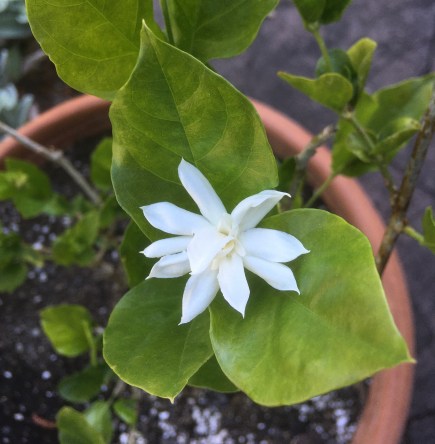
Okay, enough entomology for today. Here is that flower I promised you. It is my Belle of India jasmine that Soldier and Joy gave me for Christmas one year. It’s taken me a while to figure out how to make it happy, but now it is healthy and blooming and so sweet! I wonder if any Bombini will come by for a taste?
 Way back in October, I think, was the last time a certain one of my favorite plant nurseries was open — until Saturday, when I drove over for the reopening. The retail aspect is a small part of a larger sustainable agriculture/ecological/educational project, and is only open on weekends in the warmer months. Over the years I’ve bought lots of annual vegetables there, but lately they focus on perennial edibles and and medicinal plants.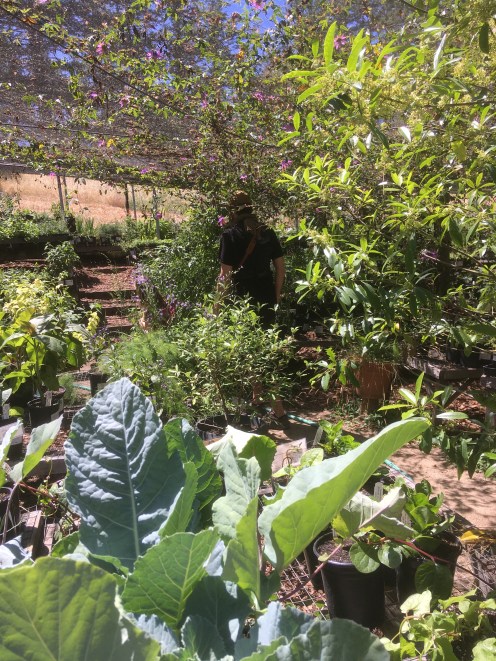







 After Myriah had gone home, she wrote to thank me, and to apologize for what she thought was her own “noise” as she “tried to make sense of everything.” She said, “I came home and planned to curl up and read the Bible.” But family demands prevented her. I realized that I had robbed her of what should have been a respite from confusion, talking as I had as though raging and clanging could be truly rational. Probably we should have spent some part of our two-day visit reading the Gospel together. (The garden did rescue us several times.)