
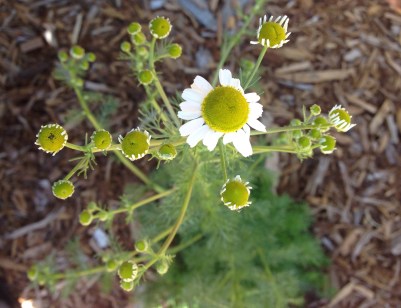
 I got confused about my chamomile. All I could remember was that one is perennial and the other annual. When I noticed that they are both starting to bloom now, I had to try to figure out which was which again. This is what I’ve found.
<< The annual German or Hungarian chamomile is the taller of the two, to 24″. From what I read it often self-sows, and I hope it will do that in my yard.
German: Chamomilla recutita syn Matricaria chamomilla
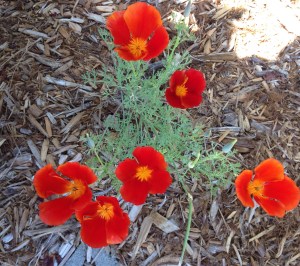
It’s growing near the red California poppy that I planted from a nursery pot, and whose flowers just opened this week. The white variety of this plant that I put in at the same time bloomed a couple of months ago, much less enthusiastically.
That makes me think about something I read in the Summer book I mentioned last week, a quote from Chesterton, from “A Piece of Chalk,” in which he gives an account of how he reluctantly tore himself away “from the task of doing nothing in particular,” and set off into “the great downs” of England with his brown paper and his brightly colored chalks, all on a summer’s day.
To his dismay he had neglected to bring any white chalk — and he begins to hold forth on how the color white, in art and in morals, is essential:
One of the wise and awful truths which this brown-paper art reveals is this, that white is a colour….a shining and affirmative thing, as fierce as red, as definite as black. When, so to speak, your pencil grows red-hot, it draws roses; when it grows white-hot, it draws stars….Virtue is not the absence of vices or the avoidance of moral dangers; virtue is a vivid and separate thing, like pain or a particular smell. Mercy does not mean not being cruel or sparing people revenge or punishment; it means a plain and positive thing like the sun, which one has either seen or not seen.
Perhaps my spindly white wildflowers, just starting out and blooming faintly without any other color around them to contrast with (even their foliage was already faded when the buds opened), do not provide a fitting metaphor to match this principle, but it did seem like a good place to tuck in that quote about something I do believe in.
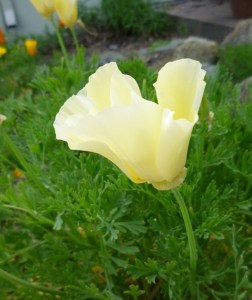 So far I haven’t sown any seed for the standard orange color of our state flower because I am a little afraid of them taking over. The other colors are not as vigorous, but some of them are really special in their rarity and subtlety, and when I have had one re-seed itself or, more often, go dormant and hidden for the winter only to surprise me the next spring, I am thrilled. This pale yellow one did just that for several years in my old garden, but could not be saved. >>
The red ones are my first variety that are both rare and bright. I hope they self-sow — but much of the garden is experimental. I’ll see over the next months what likes growing in this environment, and not fuss over the things that aren’t thriving.
Back to the chamomile… Just in case the Germans don’t bear children next year, I planted a perennial type, the Roman or Nobile. It grows half as tall and is sometimes used as a walkable ground cover, or part of an herbal lawn mix.

<< Roman: Chamaemelum nobile syn Anthemis nobilis
An hour after I took this picture, I strolled past again and noticed that ten more buds had swelled enough to be noticeable. History in the making!
I had a house guest for two nights and a day – we spent a nourishing and relaxing time, even though we did no artwork or gardening or poetry-reading. We did eat and shop and update our family birthday lists. But now I have lots of garden work that needs to be done, before I go to see brand-new Baby Brodie next week. Here’s a yarrow bloom for you to look at while I am out tending to my beds.

 , because they live on the earth with us and can be observed as they really are. But still….
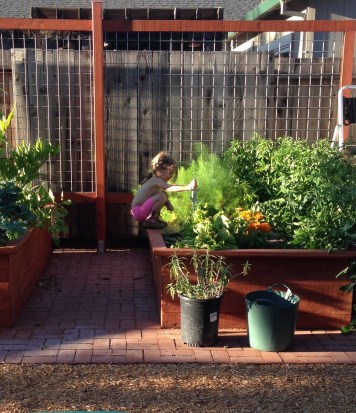


 be doing Special Things every week, in order to enjoy the season and the time off school and regular routines. People have jobs and housework, and the tomatoes need to be picked. Many of us like to be home washing the dishes these evenings when a breeze is blowing through the open window, and the sun sets late. And of course, working in the garden in the cool of the mornings, and sitting under a leafy arbor in the afternoons.

