12th century mosaic in St. Mark’s Basilica, Venice,
depicts the Holy Spirit descending on the apostles.

Iconreader article on this mosaic

12th century mosaic in St. Mark’s Basilica, Venice,
depicts the Holy Spirit descending on the apostles.
Iconreader article on this mosaic
… in grief nothing “stays put.” One keeps on emerging from a phase, but it always recurs. Round and round. Everything repeats. Am I going in circles, or dare I hope I am on a spiral? But if a spiral, am I going up or down it? How often — will it be for always? — how often will the vast emptiness astonish me like a complete novelty and make me say, “I never realized my loss till this moment”? The same leg is cut off time after time.
― C.S. Lewis, A Grief Observed
In reading quotes about grief, I notice that many of the ones that ring true are from Lewis’s book about his wife’s death. I downloaded it to my Kindle so I will start reading the whole thing tonight.
Many things keep me from writing about my own grief, but the biggest hindrance may be the strangeness of it. Every day I am startled and disturbed by a new discovery — of an ache or a gaping hole or a missing component of myself. I am helpless against the ambush of thoughts and emotions whether it comes just as it did yesterday, or by a fresh route.
That all sounds like grief is something outside of me, but of course it’s what is going on in my heart; it is Me. This Me is a woman I don’t really know; she is mystifying and unpredictable. I don’t know what else to write about her, but I pray for her.
This poem reminds me of the effect Annie Dillard’s An American Childhood had on me the first time I read it. Her noticing of so many details in the history and geography and biographies of her life made me realize that I’d had just as fascinating a childhood. From then on I began to look around with a new eye.
Looking Around, Believing
How strange that we can begin at any time.
With two feet we get down the street.
With a hand we undo the rose.
With an eye we lift up the peach tree
And hold it up to the wind — white blossoms
At our feet. Like today. I started
In the yard with my daughter,
With my wife poking at a potted geranium,
And now I am walking down the street,
Amazed that the sun is only so high,
Just over the roof, and a child
Is singing through a rolled newspaper
And a terrier is leaping like a flea
And at the bakery I pass, a palm,
Like a suctioning starfish, is pressed
To the window. We’re keeping busy —
This way, that way, we’re making shadows
Where sunlight was, making words
Where there was only noise in the trees.
by Gary Soto
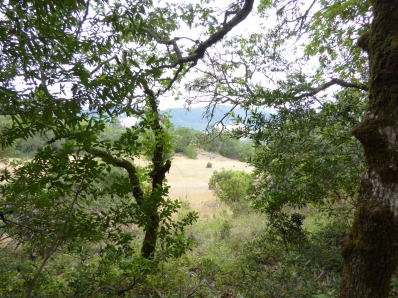
Thanks to the encouragement of my friend Eleanor, I went outside my usual walking realm this morning on a trail she suggested, and with her along to make sure I didn’t get lost.
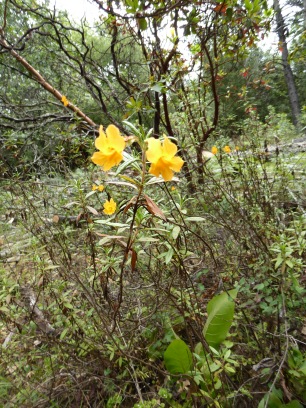
She and I had enjoyed walking together a couple of times, say, ten years ago? but then our lives got busy with expanding family. Now that I don’t have Mr. Glad for a walking companion, various friends with whom I’ve had ongoing and indefinite plans to walk or hike will find me easier to pin down to a date.
We went up into those hills from which streams run down – but we didn’t get near any wet areas this time. The hills had their typical summer parched look, but lots of wildflowers were scattered over the landscape, and the oaks and bay trees had green leaves. 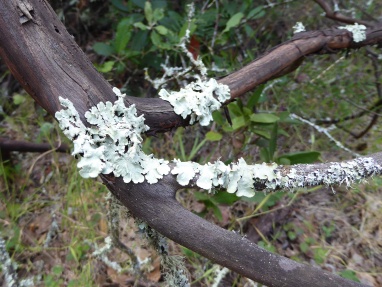

The poison oak was profuse. This picture shows the leaves with three leaflets of the toxic plant Toxicodendron diversilobum alongside some other oak sprout in the foreground, the “regular” oak having four leaves and a coarser form.
Poison oak is often, but not always, glossy, and it sometimes has these pretty colors, but the easiest way to identify it — except when is leafless in winter — is by the clusters of three oak leaves. 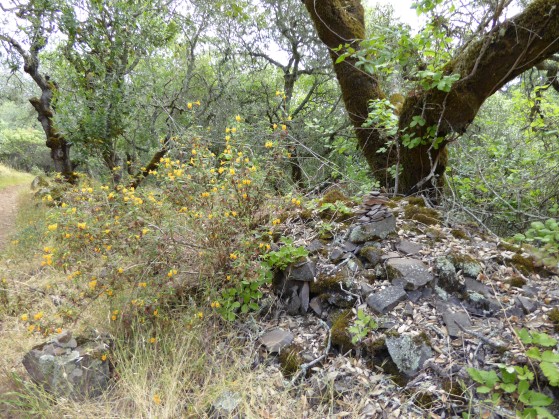

So strange and dramatic to see a densely bright, perfect bloom rising above the pale and crispy grass. Even its name is a contrast to the setting. 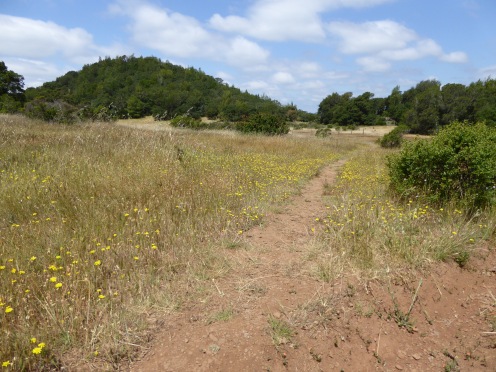 I was shocked when the names of three flowers came to my mind right while I was looking at them! I guess after dozens of instances of entering the same data into my brain, a synapse is finally ignited? I only had to think for half a minute to remember Mariposa Lily and Elegant Brodiaea when we came upon them.
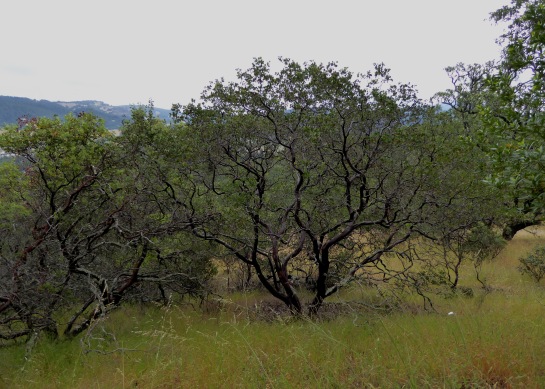
This is a park where I’ve hiked many times, but not much lately. Maybe now that I’ve been reintroduced to its system of trails I might return on my own.
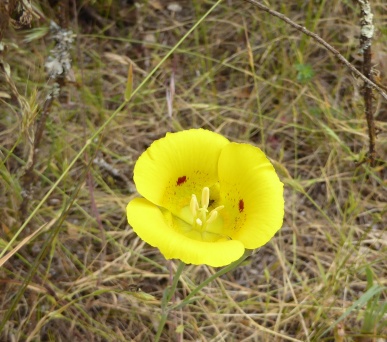
But I’m afraid this may be the last I’ll see of the spring wildflowers.

