My granddaughter whom I call Annie had recently taken a photography class with a few other homeschooling girls. The first day of my visit with her family we would go to the exhibit and reception in the evening, but we had a whole day to do “whatever” before that, and in addition to sitting around chatting and eating some meals that her mother graciously prepared, we took several walks.
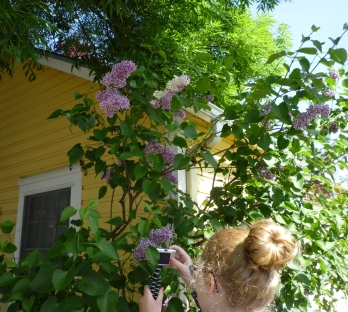
The first one suggested by Annie was to a nature trail on the other side of the small town they live in, and as the trailhead as it might be called was easily within walking distance, we set off on foot. It’s so scenic there in southern Oregon that we both found things to catch our attention within a block or two of their house.
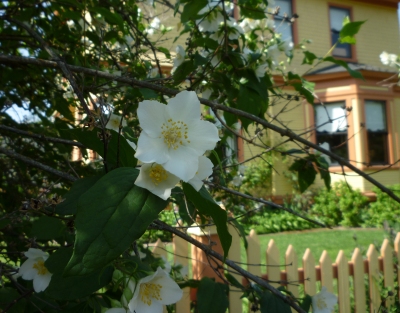
For example, a lilac whose every petal is bi-colored, but seems to have reverted to all white on one branch. I looked it up online when I got home and think it might be called “Sensation.”
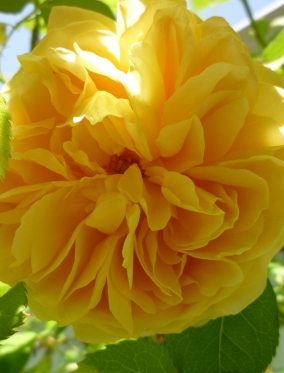
The sun was high in the sky, as it was mid-morning, so Annie showed me how to adjust the exposure on my camera to compensate. We talked about how it often happens that we take a picture of a beautiful flower and then when we get it home and see the enlargement on our computer screen, there is an ugly insect or a chewed-off flower petal spoiling the perfection. Occasionally I have found the bug to be cute, but only if he hasn’t already defaced the blossom or leaf.
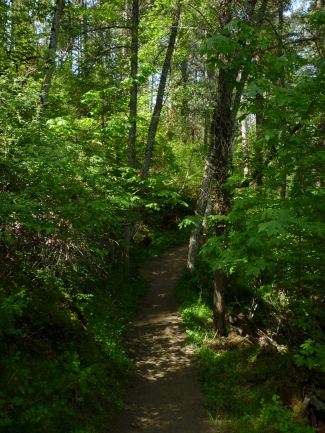
The woodsy path was just shady enough to make our flower photography easy. We took care to avoid the poison oak just off to the side.
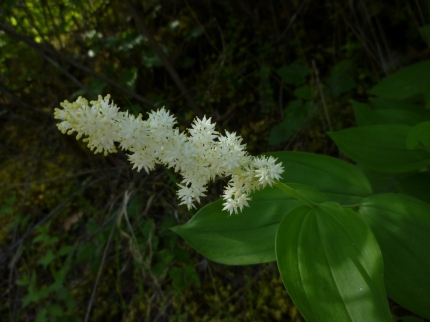
Annie will turn thirteen this month, and she had embarked on a project to take several photos of flowers each day to fill up an album for her birthday month. Her skill at composing her pictures was admirable, developed over six weekly sessions of three hours each, covering the techniques of portraiture, landscape, photo-journalism, macro, and animals. You can learn a lot in 18 solid hours.
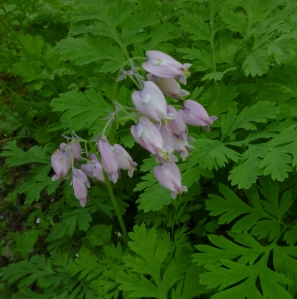
Later in the day we took three more walks, twice to the library to return books, and once to the post office. How many people can live such a life? For years the family also walked to church every Sunday. I often think that this kind of town life conducive to and convenient for walking would be really nice when I get 15 or 20 years older; I will need the walking and will likely be a more dangerous driver than I am now.
The photography exhibit was enjoyable; the girls were all country-bred-sweet and I loved seeing their unique collections showing their skill and perspective on the world. I’m looking forward to more outings with Annie; it’s always great to explore with someone who thinks dawdling along the trail to frame pictures is the most normal thing.
 In my last post I told you about Mr. Glad’s 40th day of repose in the Lord. On the 41st day I drove north in response to the invitation from a granddaughter to be present at the exhibit of her photography. If it hadn’t been for the request of my presence on a specific date, I’d probably have put off traveling a few weeks longer, but I took it as a gentle prod from Heaven.
 ch of recordings were produced between 2006 and 2008. For each one you get to hear some passages read from the book; background on the author or how the book came to be written, often from the author herself speaking; interesting music that seems to have been carefully chosen to go with the tone or setting; and many sound bites of other people’s responses to the story. Even if you have read the books — perhaps especially if you have read the books — it is very enriching to delve into them this way.
 t seem to engage with a whole novel in the deep way I am used to. I’m afraid I am somewhat apathetic right now about vicarious experiences and fictional characters, but I really enjoyed these Big Read introductions.
 ir parents, until they went under the bank and out of sight. Then I crossed the bridge with its watery blue-green glass bricks, to the path on the north shore. I bought a mango Italian ice, to lick as I walked briefly through an uninspired perennial garden, and then back to the bridge for a few more photos.
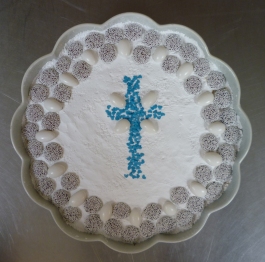 It is traditional in Orthodox churches to have a short memorial forty days after a death, and though my husband was not Orthodox, I am, and I am the one remembering and praying for him. Last week my priest generously held this service, called a panikhida, and I prepared the dish of boiled wheat called koliva for us all to eat together at the end of the service.
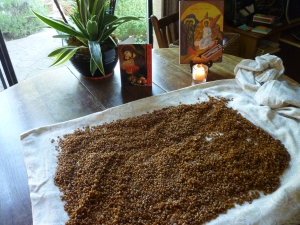 The essential ingredient is boiled wheat – but actually, even that is not essential, because sometimes it is rice, or lacking wheat, barley or another grain can be substituted. But the image of a kernel of grain being buried endures, as in the Gospel of John Christ speaks of His own coming death, “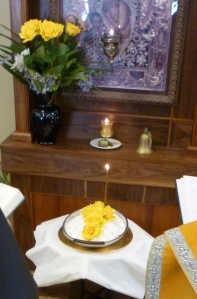
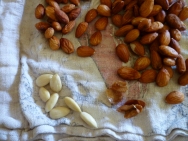
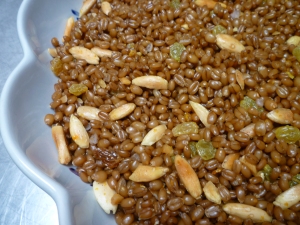
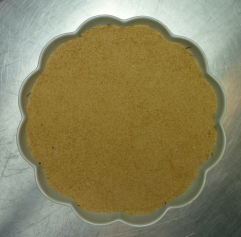 t I put the final layers of my dish together in the church kitchen where I could not find any waxed paper. My alternative method didn’t work so well, which is why the surface of my finished product has some flat areas, some imprints of my fingers, and some sugar untouched.
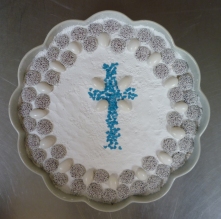 f chocolate or a candy. The koliva recipe was judged to be excellent.