All posts by GretchenJoanna

Unknown's avatar

About GretchenJoanna

Orthodox Christian, widowed in 2015; mother, grandmother. Love to read, garden, cook, write letters and a hundred other home-making activities.

The Music of My Life

The third chapter of The Hidden Art of Homemaking is the impetus for this post. It is titled simply “Music,” and continues the theme of how Christians might express their creativity in their varied and unique circumstances. I am participating in the discussion of the book on Cindy’s blog, Ordo Amoris. This is a long post and I apologize — you would be smart to skip it and go do something creative!

It might have been 30 years ago that I first read Hidden Art, and I wrote on the day of the author’s death how important it was in developing a vision for my life. At the time of its publication in 1971 I don’t think there was anything else like it, but feminists were writing plenty about the stifling life of the typical housewife. It was lovely to have laid out before me many concrete examples of interesting people and their home-enriching activities.

Just a couple of years later, Karen Mains wrote Open Heart, Open Home, which also contributed to my Christian vision, on the theme of hospitality. And I was married in the early 70’s, and enjoying keeping house and garden even before the children started arriving. When the house began to fill with kids, I never lacked for creative projects and plans.

But I hadn’t even read Schaeffer’s book yet. My young-married-childbearing years were overflowing with culture and creativity, and I could not relate to the reader Edith seemed to be writing for, someone who is frustrated, locked up, or unfulfilled (her words).

Only recently have I been able to look back over my life and see with more understanding (I hope) why the story reads the way it does. I needed time to think, and I needed to see more of the plot toward the end, before I could notice how the first chapters fit with middle parts of my saga.

Part I contained an excess of family drama, as we call it these days, emotional and psychological stress that I didn’t get any help dealing with. If you have a splitting headache it is hard to tap into your creativity. It’s the same with emotional pain, maybe more so when it isn’t diagnosed or even acknowledged, but stays like an always-freshening wound that makes you want to move as little as possible.

Me in Part II

What brought me into Part II was getting married to a good man and empowered to create my own story, free of distracting pain. The setting was calm and clear and full of the hope of the gospel. It was somewhat the opposite of what Schaeffer talks about, because being home was my obvious opportunity to do just about anything. I had had no lack of examples and ideas; actually, the hippie era for me segued into a homesteading spirit a la The Mother Earth News. And there were all the creative people I’d known growing up (just about everyone), while I was storing up tinder for my creative fires.

I see that I have mixed a few metaphors here trying to tell my story — or am I writing the score for the symphony that has been playing out? Though this chapter is about music, it seems as good a place as any to bring up what seem to me to be realities on which our artistic life is built. They apply to music, too.

I received little musical training as a child, and I had no career that I had to put on the back burner. But growing up in church was good ear-training, and even in the Girl Scouts and in public school we sang a lot. I was lucky to marry a musician, and by means of his guitar and my singing we filled the house and our children’s ears with music.

We sang in the car, using songbooks I wrote out by hand. We sang around the campfire. We parents sat on the bedroom floor and crooned lullabies to our children every night. And in church I helped the young readers to develop fluency while hymn-singing, running my finger along the page under the words while they looked on. But I don’t know how to read music.
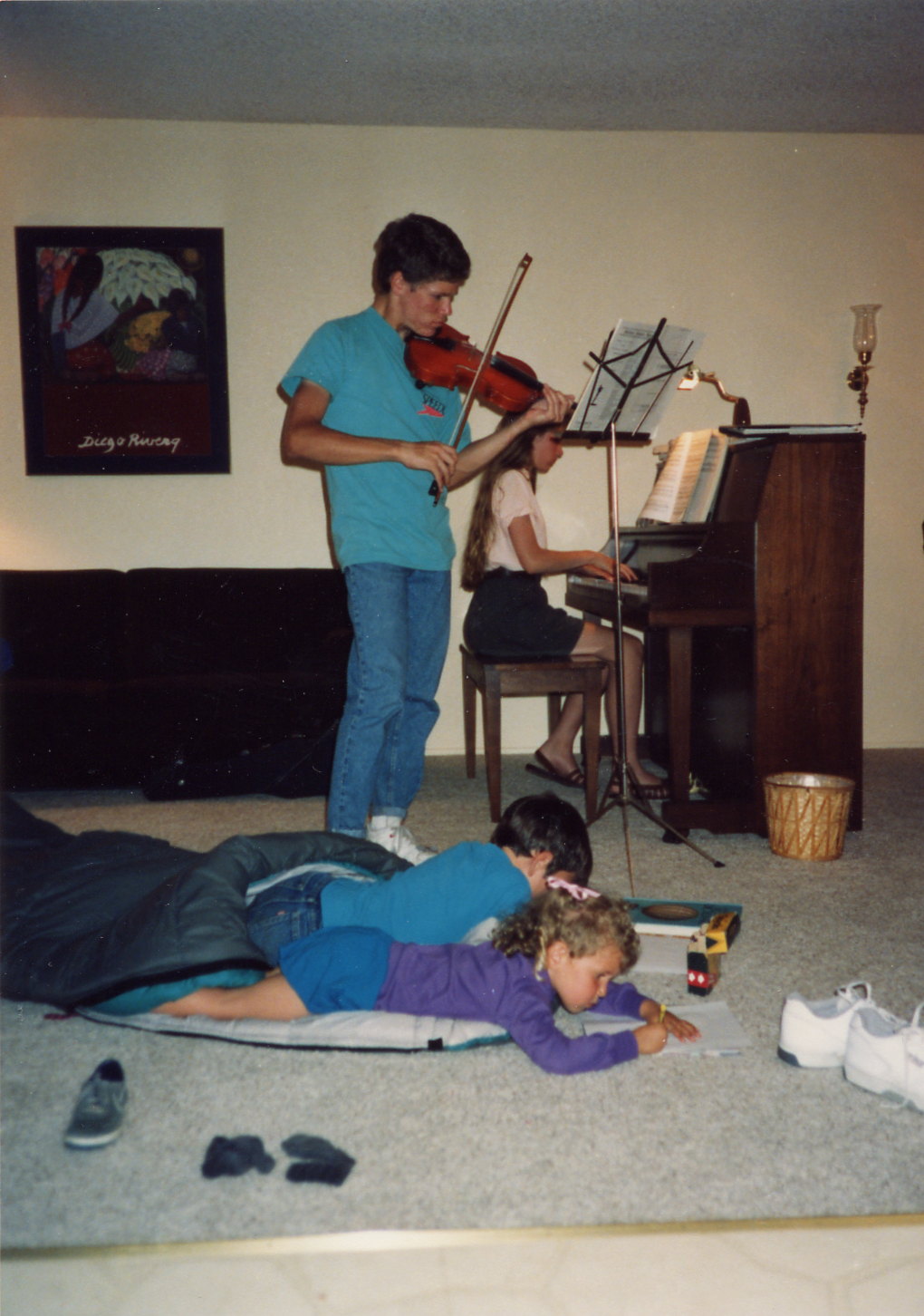
At first there wasn’t money for music lessons, and I wept over the injustice of a world in which my firstborn had no opportunity for a more structured musical education. Then grandparents and great-grandparents stepped in and God provided a generous piano teacher two blocks from our house. From that time forth the provisions continued in various ways, so that eventually all of our five children learned to play at least one instrument. The photos are of them and a grandson enjoying their music. Two of our daughters became piano teachers in their teens.

But for many families, music is not something they can really accomplish. My parents could not provide it for me, but it all worked out o.k. Some women find that their distracting drama only starts when they marry, or when a child falls ill. There are women for whom getting through the day is like climbing a steep mountain, and while they might be relieved to stop and smell the flowers, it’s asking a lot to tell them they ought to get out the seed catalog and develop a plan for further landscaping. But I suppose they aren’t the ones reading Hidden Art.

When Schaeffer says things like, “Christian homes should…be places where there is the greatest variety of good music,” I balk at the word should. I don’t know how she might otherwise have presented a picture of what she considers the ideal home, but every time she says we should do this or that to develop our creative side — and in the short Chapter 2 she used the word nine times — I get annoyed that she is telling me what my Christian duty is.

To me that’s backwards, because I can’t recall ever doing one creative homemaking thing out of a sense of duty, though I firmly believe we are all obligated to do our duty. To fear God and keep His commandments is the whole duty of man, according to Ecclesiastes (Not that we can even accomplish those basics on our own). It seems to me that the rest, the art and music and beauty, flow naturally from a human soul that is nurtured by God’s love — just as sap running up a tree trunk results in bright leaves and colorful fruit. The main thing is not to tell the tree to make fruit, but to keep the connection to the life-giving Fountain — Who is also the One who heals all those diseases of the heart that might hinder us.

What do you know — beauty in our life is one of the healing potions God provides. So if we start with small things that brighten our homes, say, singing a few lines from a hymn over the kitchen sink, or teaching a nursery rhyme to a toddler, just in response to the impulse, we are creating culture and feeding our own souls. It keeps the sap running, and the more the tree grows, the more sap and delicious fruit there will be.

Since Edith Schaeffer wrote this book and What is a Family, the only two of hers that I have read, thousands of families have discovered that homeschooling provides the opportunities to build the kind of family life and culture that the author presents a vision for. Just give us enough time with our children and all these good things are more likely to happen. The vision she sets forth was an ingredient in the soil that nourished my own heart and gave me the courage I needed. All the rest is in Part II, Part III, and still writing… Oh, and still singing new songs!


 

little goats now in the spring

The hymns of Pascha and Bright Monday are playing themselves in my mind every day, all day long, like heavenly prayers. Christ is risen indeed! And my house is filled with honeysuckle scent, as a consequence of a long gardening party I’ve been having with myself.

I’ve been on my hands and knees in the dirt quite a bit this week. Above you can see one perennial bed I’ve been thinning and re-planting. Eleven tomato plants have been tucked into various places all over the yard, and in order to make a sunny home for one of them it was necessary to severely prune the honeysuckle vine that was starting to bloom profusely. Beforehand, as I walked past it several times, the sweetness almost made me woozy, and reminded me of the lilies in church on Holy Friday, as at a funeral.

I couldn’t bear to throw all the prunings into the yard waste bin, so I cut carefully and put the trimmings in three vases to enjoy indoors. There were still so many left, I filled another jarful to give to a neighbor, but it’s still here, too. Even though the petals are drying and starting to fall on the table, all of this flowery flavor is still permeating my days.

A wonderful story was passed on to us on the blog Mystagogy, of the Athonite monk Elder Porphyrios (1906-1991) who on a Bright Tuesday visited his cardiologist, overflowing with Easter brightness and quoting a hymn:

What happiness is in the Resurrection! “And leaping for joy, we celebrate the Cause.” Have you ever seen the little goats now in the spring who jump on the grass? They eat a little from their mother and begin to jump again? This is what it means to leap – to jump. This is how we should also jump for unspeakable joy at the Resurrection of our Lord and our own.

It is a sweet and not long anecdote you can read here.

There is this lightness and heavenly singing, but pressing in on all sides, sorrow and pain. In the lives of extended family, and friends near and far, things happen even in Bright Week that reek of death. A husband commits suicide, a child dies suddenly and mysteriously, a sweet woman becomes incapacitated with irrational fears….

How to make sense of it all? How to carry the joy along with the burdens of the people you love? It probably requires a measure of the Holy Spirit I haven’t acquired in order to do a good job of it. My joy is often a shallow emotionality, and certainly my burden-bearing is hampered by laziness and the distraction of my own burdens that I needlessly carry.

Or is it needlessly? It was only a short time ago I was ruminating on the yoke of Christ — and He did say His burden is light. He was exhorting us to take up His yoke. I want to “be there” for people who are hurting, and often the only thing to do, and it’s not minor, is to bring them to God’s throne in my heart and prayers. If I will just stay there I should be able to hold on to this sweetness and Light as well. 

Christ is risen!

See and be His art.

The second chapter of The Hidden Art of Homemaking is short, and titled “What is Hidden Art?” I love reading all the many women’s thoughts on this topic, which [used to be found, but not these several years later] on Ordo Armoris where the discussion [was] taking place.

It’s a huge topic! Each human is a living and complex demonstration of creative powers, as is revealed by the uniqueness of each woman’s life as expressed in her contributions to these discussions. The stories, the photos on the Hidden Art Pinterest page, the glimpses into the families whose wives and mothers are taking time to share their creativity online in addition to the never-ending work they do in their homes….it’s all a glory to the Creator.

Obviously, art is hidden as long as you don’t see it. That seems a basic point of this discussion. For me, having children opened my eyes to the world in a new way, because I often thought of my babies as tiny foreigners who were themselves seeing things in this new “country” for the first time. It was fun being the tour guide, and it challenged me to look afresh at my environment.

Sometimes just pointing a camera at some everyday scene helps to reveal a pattern of beauty – or to preserve the art when there isn’t time for a quick sketch. My picture that I titled “Butter Art” so many years ago still makes me happy with its hominess, and it calls to mind the intangible kinds of creativity that I also brought to bear on the task of mothering my children, small “art” projects that took place in the kitchen, or the garden, or — the heart.

I’m still pondering the thoughts of my previous post on this inward kind of creativity, which the author I quoted says “begins with the ability to change — to change intentionally. Creativeness begins with the ability a being has…to become what he is not yet, to start at the point at which he was created and then grow into a fullness that he did not possess before…”

Might this not include the developing in us of the fruits of the Spirit, the love, joy, peace, kindness, longsuffering, etc. that are so essential to making a home? I know that Edith Schaeffer in the book under discussion is primarily dealing with outward, visual or sensory beauty. But what if we could “create” peace by our very presence, or transfer some of our own joy into our children’s hearts?

Mothers naturally do those kinds of things, and often it’s by the attitude they have while they are accomplishing practical works such as laundering the socks, changing them from stiff and smelly to soft and fresh. It all starts with something we are. The artistry of our God is not just something to imitate, but is His active work in us, with which we participate, and by which we become ourselves lights in the world.

It’s a joyful day, whatever day it is.

Pascha goes on and on! So we have Paschal Bright Week services, Monday, Tuesday, Wednesday….

Christ rose on the first day of the week, Sunday. The Church has always considered this to be be the eighth day as well, the beginning of a new order of things. I don’t really understand this. But our bishop mentioned it this morning, Bright Monday, when he talked about the grace that extends throughout the week hinting at the newness of life given us in Christ’s Resurrection.

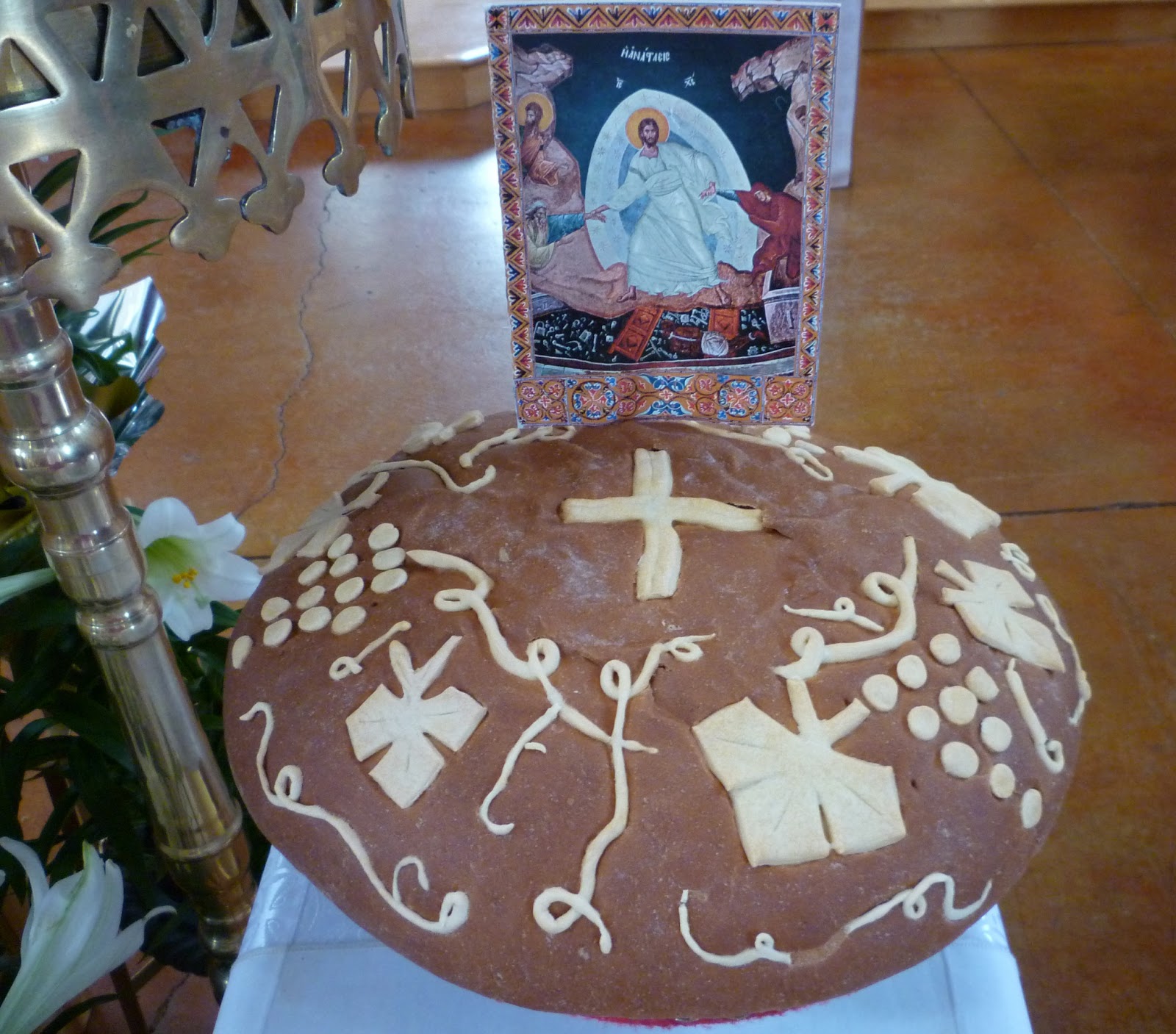
We all are feeling the newness. Today we lived in the joy of Christ’s presence and celebrated it in many ways, including a loaf of bread. This year it was baked by a young girl with the help of a more experienced baker. It must weigh over five pounds — I know, because I was honored to carry it in the procession around the church, and then standing on the porch as the gospel for the day was read.

This bread is called the Artos and “symbolizes the physical presence of the resurrected Christ among the disciples.” It will remain in the church all week and be carried in procession after Divine Liturgy those days; on Saturday it will be cut into pieces and distributed to the parishioners.

Below is a photo I found online of a Bright Week procession elsewhere.  It seems it might be the only photo available — maybe everyone wants to actively participate in these blessed processions and not stand apart to be a photographer.

On Pascha night I remembered that I have a piece of last year’s Artos in my refrigerator. I’m sure I was saving it for a time when I was ill or afflicted, and I must never have thought that I was terribly bad off at any time during the year. Praise God for that. So I’ll have to eat it for joy this week and put a new portion in reserve for any upcoming needs. Having been exposed to the air for a whole week it becomes dry and keeps very well!

The day of our Lord’s Resurrection is another case, it seems, of how we live in the present life and at the same time we live in the reality and anticipation of God’s coming Kingdom. St. Gregory Palamas wrote in a sermon “On the Sabbath & The Lord’s Day”:

Whatever is said in praise of the 7th day applies even more to the 8th, for the latter fulfills the former. It was Moses who unwittingly ascribed honor to the 8th day, the Lord’s Day. The Jubilee year (Leviticus 25:8ff), which Moses regarded as a year of forgiveness and named accordingly, was not counted among the ‘weeks of years’ under the law , but came after them all, and was an eighth year proclaimed after the last of these 7 year periods. Moses did the same with regards to periods of 7 weeks.

However, the lawgiver did not only introduce in this hidden way the dignity of the 8th day, which we call the Lord’s Day because it is dedicated to the Lord’s resurrection, but also on the feast called “Trumpets” referred to the 8th day as ‘the final solemn assembly’ (cf. Lev.23:36 LXX, Numbers 29:35) meaning the completion and fulfillment of all the feasts. At that point he clearly said that the 8th day would be holy for us, proclaiming in advance how divine, glorious, & august Sunday was to be after everything pertaining to the law had passed away.

But I see that Metropolitan Anthony in a passage I quoted just last week tells us that we are living this present life in the Seventh Day:

…the seventh day will be seen as all the span of time that extends from the last act of creation on the part of God to the last day, the eighth day, the coming of the Lord, when all things will be fulfilled, all things will come to an end, reach their goal, and blossom out in glory. It is within this seventh day, which is the whole span of history, that the creativeness of man is to find its scope and its place.

In this whole span of history we have much work to do, including our bread-baking and flower-arranging to celebrate Christ’s rising from the dead. St. Isaac of Syria tells a bit about how the fullness of our Eighth Day is yet to come, and seems to see things somewhat differently from Met. Anthony:

The Lord’s Day is a mystery of the knowledge of the truth that is not received by flesh and blood, and it transcends speculations. In this age there is no eighth day, nor is there a true Sabbath. For he who said that ‘God rested on the seventh day,’ signified the rest [of our nature] from the course of this life, since the grave is also of a bodily nature and belongs to this world. Six days are accomplished in the husbandry of life by means of keeping the commandments; the seventh is spent entirely in the grave; and the eighth is the departure from it.

It certainly is a mystery to my small mind, but I am always comforted by these realities of the faith that show how great is our God, and His plans for us, so high as the heavens are above the earth, that they are hard to grasp with our minds. And I’m full of that joy that is not received by flesh and blood, of the glorious risen Savior Christ. He is here every day.