All posts by GretchenJoanna

Unknown's avatar

About GretchenJoanna

Orthodox Christian, widowed in 2015; mother, grandmother. Love to read, garden, cook, write letters and a hundred other home-making activities.

Love Poem for Frances

Ogden Nash wrote so many loving letters and poems to and about his wife Frances. Here is one typically playful poem on a favorite subject:

FOR FRANCES

Geniuses of countless nations
Have told their love for generations
Till all their memorable phrases
Are common as goldenrod or daisies.
Their girls have glimmered like the moon,
Or shimmered like a summer noon,
Stood like lily, fled like fawn,
Now like sunset, now like dawn,
Here the princess in the tower,
There the sweet forbidden flower.
Darling, when I think of you
Every aged phrase is new,
And there are moments when it seems
I’ve married one of Shakespeare’s dreams.

-Ogden Nash

Paintings About Love
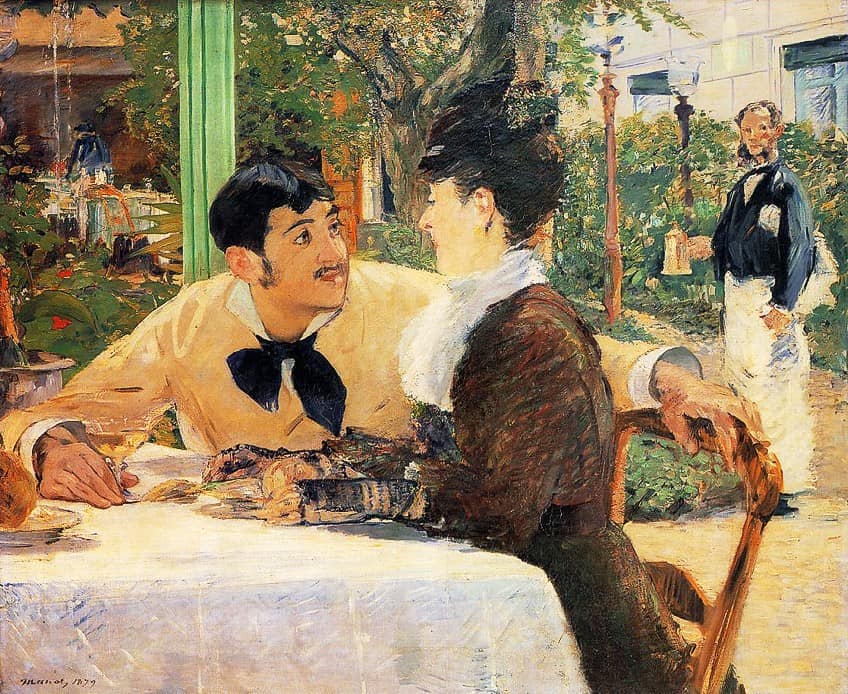
Chez le Père Lathuille by Édouard Manet

We must be indifferent.

A word from an Athonite elder:

The faithful are often scandalized by the prosperity of sinners. And it is true that if we look at things from a purely human perspective it can seem as if God has distributed His blessings unjustly. Here, where He should have given a measure of happiness, He has given only misfortune. And there, where He should have dispensed riches, He gave only poverty. And where poverty was in order, he lavished wealth. When we wait for a blessing, He often deals us a hard blow, while at the same time He maintains smiles on the faces of those around us.

In a way that echoes modern social concerns, we might say that God discriminates, and this is something that scandalizes us. Why does this scandalize us? The answer is simple. It is because our hearts are still attached to earthly things, still clinging to false “goods” that we continue to covet and crave. Thus the solution to our dilemma must be sought elsewhere, and this means that we should not be hasty in abolishing whatever strikes us as discrimination or injustice.

We live in a time of rapid change, when every innovation is presented to us as “progress,” but before real change, real progress, can take place, something must first change within us. And for this to happen we must become completely estranged to all things earthly and human, to all human logic, to all human ways of thinking, and to every so-called material good. We must be indifferent in the face of all things. And only then, when we have become strangers to all, can God become all things to us, as if there existed nothing else in the world for us except God.

It is this alone that can grant us true and lasting tranquility. Otherwise, if our heart is attached to anything earthly, no matter how small or insignificant it may seem to be, we can be sure that it will make us suffer.

—Elder Aimilianos of Athos

Women reading and laughing.

As soon as I got inspired by the 5×5 reading plan that I mentioned in my last post, I collected most of the books from around my two-storey house that were in stacks and not on shelves, and spread them on the dining table. I started to arrange the appropriate ones according to topics, and the two categories of “Women” and “Church History/Saints” were quite overloaded.
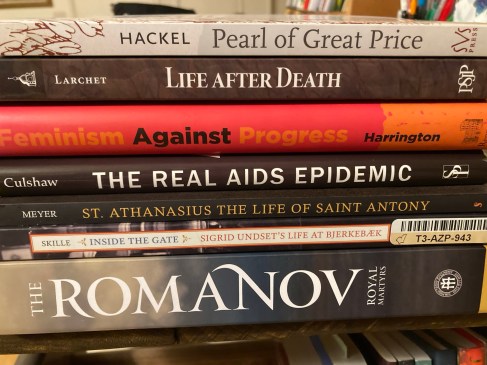

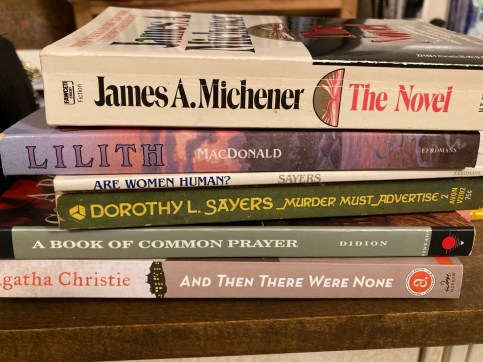
As I perused this scene, I recalled that in the last few years, many books I’ve read have been by audio — and few of those on the table were of the sort that are easy for me to attend to, by the “ear gate.” I wondered, “When will I sit and read all these books, most of which are too big to read in bed at night?” Quickly my mood also went into the Overloaded/Overwhelmed category and I climbed the stairs to bed.

Soon I decided the 5×5 plan is not for me. Clearly it wasn’t designed for me, but for young homeschooling mothers who need to read more books and look less at screens, who need to develop the habit of lifelong learning. I picked out several — not 25 — that I want to try extra hard to read in print this year.

Hmm… I almost forgot these I want to read after that first bunch. Altogether I see that they add up to about half of 25:

My two long-time friends Cori and Di came to visit for a couple of days last week, and because I planned for us to eat at the smaller table near the kitchen, I left my book mess as it was. They each brought dozens of titles for show-and-tell, give-or-lend. The warmth of the wood stove drew us to the nearby love seats, where we talked about all the volumes they brought out of their bags, a broad variety of genres and titles that would make the Scholé Sisters proud.

Many of Di’s offerings had Cori in mind, because she and her husband had lost their extensive library when their house burned down, in one of the many northern California fires of recent years. The only books I kept from this trading session were small paperbacks that I can easily read lying in bed, while my mind is turning off just before conking out for the night.

Our gathering was a festival, and a marathon
of talking and thinking, laughing and even weeping.
Now, it’s time for the reading to begin.

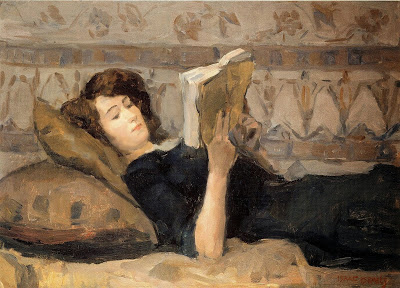
Isaac Lazarus Israëls

Joan was a perfectly practical person.

It’s been a long time since I read Mark Twain’s Personal Recollections of Joan of Arc. When I came across the quote below it made me want to read it again — though I can see the good in reading a different biographer.

The Scholé Sisters presented again their idea of the 5×5 reading plan. You pick five topics or genres of books and try to read five books in each category. Personally, I won’t be officially joining the group challenge, but this organizing of my stacks does sound appealing. Already “Women” was one of the categories that immediately came to my mind, and a book about Joan of Arc would fit very nicely. I wish Chesterton had written one; this is from his book Orthodoxy:

“Joan of Arc was not stuck at the Cross Roads either by rejecting all the paths like Tolstoy or by accepting them all like Nietzsche. She chose a path and went down it like a thunderbolt. Yet Joan, when I come to think of her, had in her all that was true either in Tolstoy or Nietzsche — all that was even tolerable in either of them.

“I thought of all that is noble in Tolstoy: the pleasure in plain things, especially in plain pity, the actualities of the earth, the reverence for the poor, the dignity of the bowed back. Joan of Arc had all that, and with this great addition: that she endured poverty while she admired it, whereas Tolstoy is only a typical aristocrat trying to find out its secret.

“And then I thought of all that was brave and proud and pathetic in poor Nietzsche and his mutiny against the emptiness and timidity of our time. I thought of his cry for the ecstatic equilibrium of danger, his hunger for the rush of great horses, his cry to arms. Well, Joan of Arc had all that and, again, with this difference, that she did not praise fighting, but fought. We know that she was not afraid of an army, while Nietzsche for all we know was afraid of a cow.

“Tolstoy only praised the peasant; she was the peasant. Nietzsche only praised the warrior; she was the warrior. She beat them both at their own antagonistic ideals; she was more gentle than the one, more violent than the other. Yet she was a perfectly practical person who did something, while they are wild speculators who do nothing.”

G.K. Chesterton, in Orthodoxy