Category Archives: agriculture

October on Central Valley farms.

glt-p1050721-bee-fairy-duster
bees on fairy duster – calliandra


For a long weekend I returned to the Central Valley (California) territory of my childhood as I had done in May. Both times were for nephews’ weddings, so I was there primarily to be with my family, but I also managed to visit with three dear friends before and after the festivities.


glt-sumo-ripening-10-16

Back in May, I didn’t get to see much of my childhood friend Dick’s garden or groves, but this time I asked for and was given a thorough tour, and I took so many pictures of his vast collection of plants, I will have to scatter them at random around this post and the next. I hung around with my farmer sister Nancy long enough to ask more questions, and hear stories about the trials and adventures of being a farmer in these times. Heat, drought, frost, and the hot pursuit of thieves are a few of them.

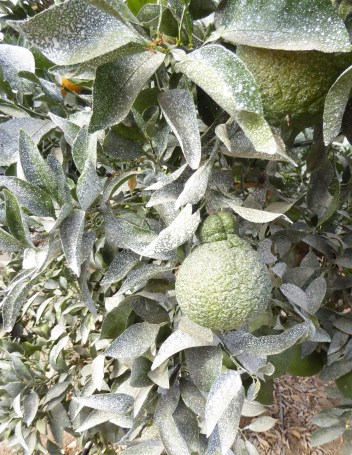
As I pulled into Nancy’s driveway I noticed that the Sumo mandarins were whiter than I remembered from May. Have you ever wondered why Sumos are so expensive? It might have something to do with the extra care they need to make it to harvest and on to market. Whitewash is used for several reasons, not least of which is as a sunscreen for the fruit. Whether it helps the leaves to withstand the withering rays, I don’t know. Citrus does like a warm summer, but the one that just ended featured 44 days over 100°, while the average would be 32 days. Some trees baked to death.glt-grove-dtRain was hoped for last week, even though an outdoor wedding was on the schedule. You can see how the sky was grey with clouds — but storms often come as far south as Fresno, and no further, which was the case again. A few sprinkles did fall as a happy gift at the wedding reception, just enough to feel like a blessing, and to create a rainbow!
glt-dog-beds
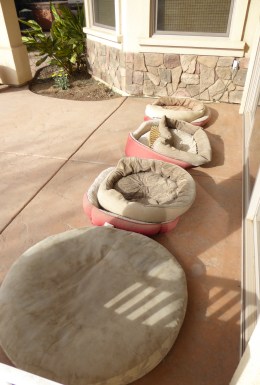
Beds for the essential watchdogs.


One topic of conversation as we sat around in various assortments of kinfolk over the days was the problem of thievery and vandalism in the citrus groves and around the farmers’ houses. People will steal copper irrigation valve fittings worth $2, and the damage requires the farmer to spend $200 in repairs. Next to one of Dick’s groves live some teenagers with nothing better to do than drive their cars into orange trees and stuff rags into pipes. This kind of thing adds up to a cost of $100-200 every month for just that few acres.

glt-grove-in-fall-prp
young grove against the Sierra foothills

Sometimes thieves will spread tarps on the ground under trees in the middle of a large orchard and pick fruit into them; then after dark they come back and haul it off. A woman rides her bicycle down a driveway to see if there might be something to pilfer, and when challenged by the dogs and/or the homeowner she makes up a story about being lost and needing directions. My sister is becoming famous for the many times she has jumped in her car to chase down such interlopers (some in cars) and take their pictures, or tell them to leave the neighborhood, because they aren’t fooling her.

October is the month when the citrus growers can breathe a sigh of relief that the hottest season of the year is past, and they begin to watch the sky for signs of rain. The oranges really need some rain in October if they are going to “size up” — no amount of irrigating will accomplish what atmospheric moisture does.

And in the coldest months the lemons and oranges have to be protected from hard frosts, nowadays usually by wind machines that make a breeze to keep the frigid air from settling on the trees and their ripening fruit. If you are growing one of the ultra-early varieties that now exist, which can be picked as early as October, you might have less to worry about come December and January.glt-grafting-lemons-on-to-oranges-10-16
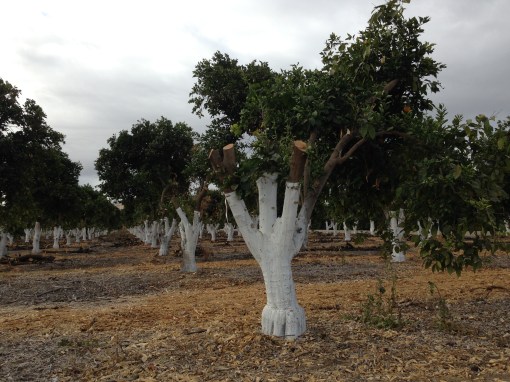
Just down the road from Nancy’s I saw this grafting project the likes of which I don’t remember seeing in all my years living in the citrus orchards and coming back to visit. I wondered what was going on that required such brutal cuts. It’s this: these are mature orange trees that are being changed into lemon trees.  All but one of the major branches have been cut off, and lemon wood was grafted in under the bark. (I wish I had been able to get over the ditch to get a closeup photo.) The one branch carries on photosynthesis while the lemon parts are growing, and eventually that remaining upper part of the orange tree will be pruned off, leaving a lemon tree with an orange rootstock.
glt-sorghum-silage-10-16-central-valley

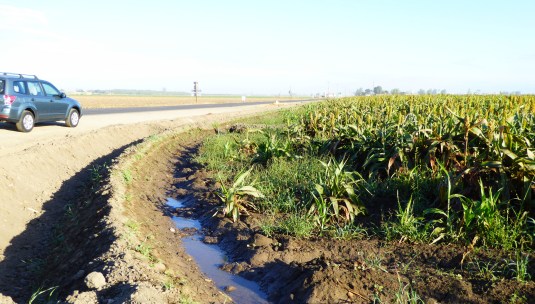
I drove past fields of something I didn’t recognize, so I took a picture and texted it to my sister, who told me it is silage for dairy cattle. When I researched it I found out that it is sorghum silage, and uses less water than corn silage. That feature is always a good thing in this thirsty land we live in.

Nearby, alfalfa covered fields with its sweet green blanket; cotton was drying and popping out of its bolls. Cotton is also a plant that can be grown in arid regions such as the Central Valley’s West Side. When I was a child my father grew cotton for a few years.

To complete the report of my fun trip, next time I’ll focus on the specific microclimate of my friend Dick’s place, and the lush gardens three generations have created on a hunk of granite. A lot is still blooming in October, but some of the harvest is just now coming in.


Cornfields and the heat of July – My Ántonia

Almost two years ago in this post I shared my love of Willa Cather’s My Ántonia. I hoped it would be the first of a few posts in which I would share a paragraph or so from the book. Following is the passage I’d planned to put up next; various events slowed down that project, not the least of which has been the disappearance of my copy. But I eventually borrowed one from the library. (Sad to say, my branch, though it is the most used in our whole county system, doesn’t own a hard copy. I’m sure they did at one time; it must have been someone who’d never read it who decided to discard it.)

I leafed through half the novel to find this part that I have been keeping in mind, and in many places I wanted to stop a while and visit with Ántonia and my other friends whom I seem to have been missing all these months. My sojourns with them are my only experience of Nebraska, and I don’t know much about corn otherwise, either.

July came on with that breathless, brilliant heat which makes the plains of Kansas and Nebraska the best corn country in the world. It seemed as if we could hear the corn growing in the night; under the stars one caught a faint crackling in the dewy, heavy-odored cornfields where the feathered stalks stood so juicy and green. If all the great plain from the Missouri to the Rocky Mountains had been under glass, and the heat regulated by a thermometer, it could not have been better for the yellow tassels that were ripening and fertilizing each other day by day.

The cornfields were far apart in those times, with miles of wild grazing land between. It took a clear, meditative eye like my grandfather’s to foresee that they would enlarge and multiply until they would be, not the Shimerdas’ cornfields, or Mr. Bushy’s, but the world’s cornfields; that their yield would be one of the great economic facts, like the wheat crop of Russia, which underlie all the activities of men, in peace or war.

-Willa Cather, in My ­Ántonia

I soak up homey and farmy vibes.

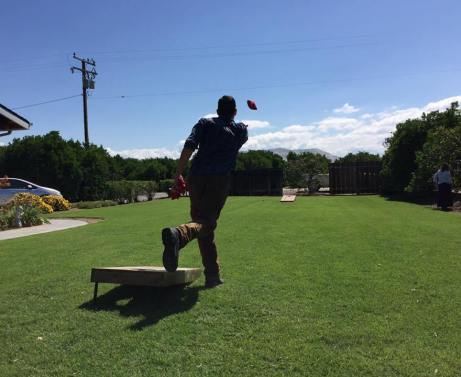
gl3 NL hat weddingMy travels over a long weekend were for the purpose of attending my nephew’s wedding, held very near my old high school and home in the agricultural middle of California, the Central Valley. If the event had begun any earlier than 4:00 in the afternoon, much sunburning would have occurred; as it was, the two sunhats I retrieved from my car were traded around for a few hours among several of our family group, of both sexes.
At the reception, descendants of my parents, with their spouses, were seated all together at one of the long tables on the grass, and my own clan took up two-thirds of those chairs. No seat assignments had been made beyond assigning us a table, and as I was the oldest — the matriarch? — I sat at one end, what might have been the head of the table. But truly I didn’t sit there very much. The three-year-olds Liam and Ivy kept me busy, fetching drinks or wedding cake, or taking them up front to dance in a circle with me. Do the books on how introverts can survive parties ever talk about the strategy of hanging out with the preschoolers?

It was fun to introduce those two to the aunts and uncles and cousins they hadn’t met since they were old enough to be introduced. “Ivy, this is your Aunt Cairenn. She is my sister; we used to be little girls like you….”  The children were all happy to shake hands and be cordial, though reserved. And my heart filled and was satisfied to see all the love shared among the younger generationsgl3 wedding trees and across generations, even though many of them rarely see each other.
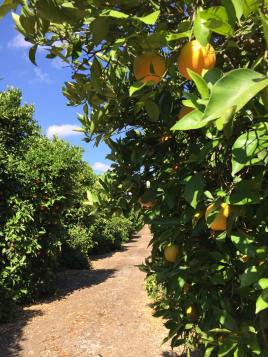
Over the two layover days I spent time at three houses, each situated in the middle of a different citrus grove. Two belonged to my siblings and one was the home of a man I grew up with in a bygone era that seems a short while ago; we used to ride our bicycles between the rows of orange trees and slide down the golden hills on pieces of cardboard. While I wasn’t paying attention, my brother and sister and my friend Dick were learning the art of farming, so that now they can carry on in their parents’  tradition and even in some of their groves.

I had the chance to play among the trees again, this time with Liam and Ivy and Scout, who in the absence of store-bought toys were making do with old oranges that had fallen off the trees, with snails among the dead leaves, and with a trowel in the dirt. The smell of the trees and of the Bermuda grass lawn, and of the soil, and the air that stayed warm into the evening when we watched the Black Phoebes swooping and scooping up insects… All of these sensations and moments added up to create in me a dreamily contented mood.

2016 wedding Soldier corn hole DL

mt view-by K crp

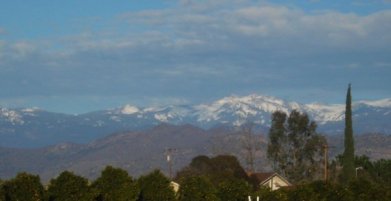
My nephew the groom partly grew up in the same house that I mostly grew up in, that his grandfather built. I stayed three nights with my sister who is another of his aunts; she and her husband farm mandarins and oranges for his mother and for themselves, and live in a house they designed to have a view of the Sierra Nevada much like this one from her neighborhood (taken by someone else).

It was fun to be with country people who are daily involved with plants and animals different from my usual. In addition to the snails and phoebes mentioned above, I learned about or interacted with:

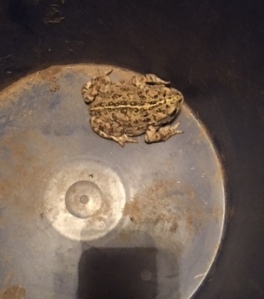
A frog that I met in the bathroom. It was at midnight and I didn’t want to frog in bucket at nancy's cropbother with him right then, so I went back to bed and he disappeared for two days, during which time everyone teased me about my tall tale. Then he was found in a different bathroom, and I was judged to be sane after all. Here he is in a bucket.
A house finch who flew down the chimney into the ashes; I helped Nancy use an old towel to surround and collect the tiny bird and carry him outdoors.

Gophers come down from the foothills in droves to feast on the roots of all the watered orange trees and vegetables, etc. that my friend Dick grows on 50 acres, and their tunnels contribute to the erosion of the sloping orchard land. His son explained all this to me and showed me the traps they put into the tunnels, trying to keep the population of pillagers at bay. It’s a constant and fairly hopeless battle that must be fought nonetheless.

More snails: Did you know that some snails are carnivorous and eat other species of snails? Yep. The brown snail is a pest in the orange groves, but the Decollate snail ignores the trees and goes after the brown snails. My brother is in the field of citrus research and one nephew is a farm advisor on such matters. I lured them into the grove with my questions and we scratched around under the trees trying to find some Decollate snails so I could remember how they look different. Later I did find an empty shell at my sister’s. You can see one on Wikipedia’s page about them.cara cara vs blood

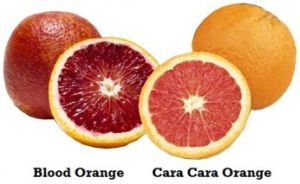
Pink oranges. Have you heard of Cara Cara oranges? I hadn’t; I must not have been spending enough time with all the citrus growers, because already Sunkist is selling lots of Cara Caras — they are mainstream. Friend Dick is growing them, as well as…

Berries: I had brought with me boxes of blueberries from Costco for a family breakfast, fruit that seems to have been grown in Salinas, California, not far from the coast. But even in the hot Central Valley they are growing blueberries now, more of them than are produced in any other area of the U.S. I learned about this from Dick as we stood on a patio overlooking his garden, and I could well imagine how the earlier spring might sweeten up the fruit. His son ran down and brought back some blackberries bigger than my thumb and mm-mm….yes. The flavor lingered on my tongue as I drove away.

Another nephew is marrying in October, so I will have a good reason to visit again and soak up the vibes of my childhood stomping grounds, and chat with farmers about their crops and the weather and the birds. I know that time will be here before I know it; I should read this post again about a week before my departure, to remind me of the joy I am likely to have once again.

They rise against their rootedness.

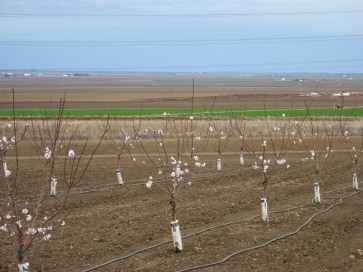
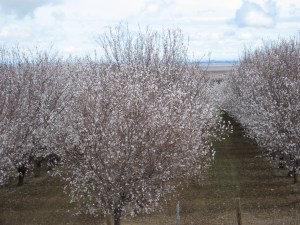
February is one of my favorite months for driving up and down the center of our very agricultural state. I won’t have that pleasure this year, but a few Februarys when I managed to visit family and the land where I grew up, the expanses of almond orchards were to be seen out my window for at least as many miles as it took me to drive one of the hours through what is called the West Side of the Central Valley. They are especially pretty on stormy days when the clouds are also playing their melodrama in the skies above.

The landscape along Highway 5 is never static, and not just because the seasons change. Our drought, and the loss of aquifer, mean that some farms will have to change what they grow, or downsize, or go out of business. One grower recently announced that they will be taking 10,000 acres of almonds out of production this year.

So I will enjoy the orchards I see, and not presume on their future. Richard Wilbur in this poem helps me to see aspects of fruit trees that I might not consider on my own, such as lifespans. Is it old orchards that are being “taken out,” or young trees that will never have the chance to be fully grown? What are the West Side bees meditating about this year?

gl w-side alm nurs closer

YOUNG ORCHARD

These trees came to stay. w-side alm med close
Planted at intervals of
Thirty feet each way,

Each one stands alone
Where it is to live and die.
Still, when they are grown

To full size, these trees
Will blend their crowns, and hum with
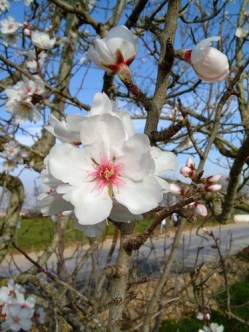
Meditating bees.almond-tree-flower

Meanwhile, see how they
Rise against their rootedness
On a gusty day,

Nodding one and all
To one another, as they
Rise again and fall,

Swept by flutterings
So that they appear a great
Consort of sweet strings.

~ Richard Wilbur

gl w-side alm orch clouds