Category Archives: architecture

The Library of Congress

p1050884
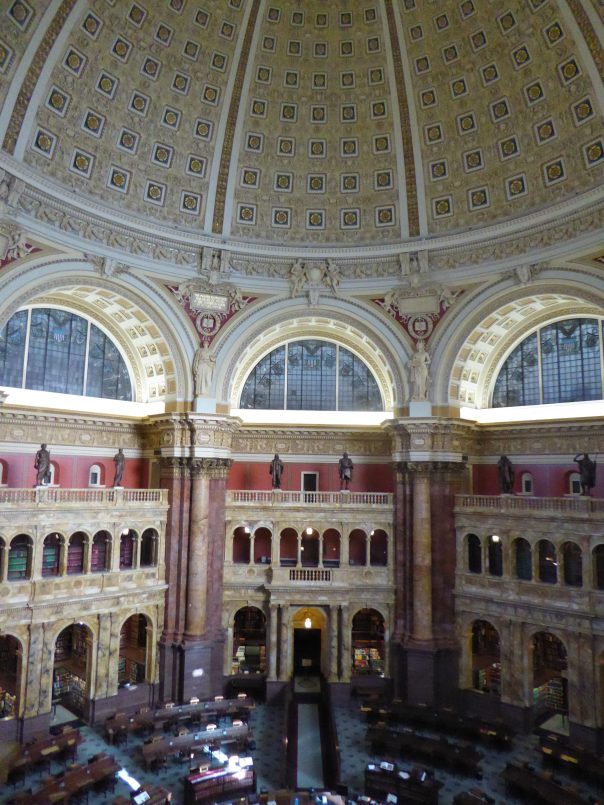
Ceiling of the Great Hall

The Library of Congress, the Thomas Jefferson Building, was a joy to visit, primarily for its architecture and design – which is not what I had anticipated. Before I had left home, when Kate suggested that we go there, I had naturally thought first of books, and exhibits about books.

We heard a story about how it ended up so beautiful: The first two construction attempts failed at the level of the foundation, and a third person was called in to complete the project. His son, who had recently graduated from the University ofย Beaux-Arts in Paris, took over the design and completion of the interior ornamentation. Or so our tour guide told us ๐Ÿ™‚

When I was trying to review these facts online for this post, I discovered another version of the story in a book about “German Achievements in America.” That story does not mention any failure on the part of the original (German) architects, but rather emphasizes that they spent twenty years perfecting the design and were never given adequate credit for it.
p1050894
Main Reading Room

This page on the LOC site gives broader detail about the drama of these events — involving “the selection of the proper cement for the foundation” — and eventual completion in 1897 of the main building of the library, which was not named for Jefferson until 1980.
p1050904

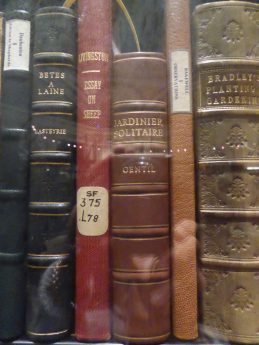
Thomas Jefferson deserved to be honored this way, because he offered to sell his whole personal library to Congress after their collection of books was destroyed by fire in the War of 1812; at that time the library was stored in the Capitol. He said he would accept whatever price they decided upon. Previously they had owned only law books, but Jefferson persuaded them that “…there is, in fact, no subject to which a Member of Congress may not have occasion to refer,” and they bought his 6,487 books for $23,950. That amount was based on the number and sizes of the books.

Jefferson’s generosity was not because he no longer needed what he named “unquestionably the choicest collection of books in the U.S.” He used the money gained to pay some of his debts, and began right away in a “frenzy” to assemble a replacement library for himself, saying, “I cannot live without books….”
gle-g-at-thomas-jefferson-library-exhibit-loc
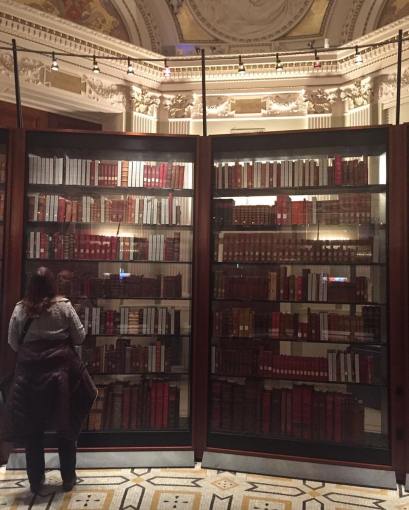
(A little part of) Thomas Jefferson’s Library exhibit

Two-thirds of the new Jefferson library was destroyed by another fire in the Capitol, in 1851. In the last decades efforts have been made to restore all the books that were in the original collection bought from Jefferson, and by 2008 replacements had been found for all but 300 of the original books; together with the volumes not destroyed by fire, these all comprise the exhibit of Thomas Jefferson’s Library which has been on display since then. Though we wandered through a couple of other exhibits in the building, this one is where Kate and I spent the most time. I had been to Jefferson’s home at Monticello ten years ago, but through this unhurried perusal of his books I felt more connection to him than ever before.
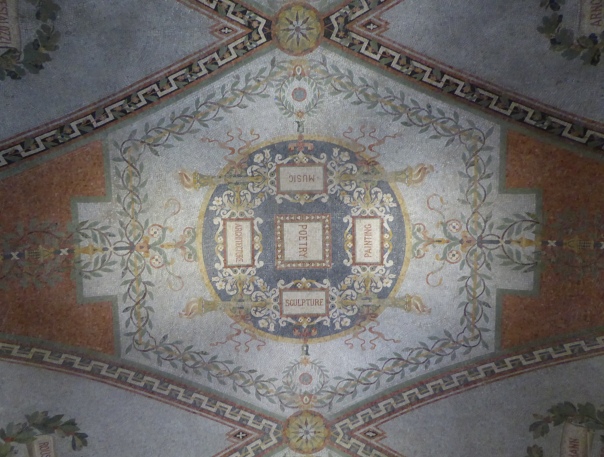
p1050890

Librarian of Congress Ainsworth Rand Spofford, an appointee of Abraham Lincoln, had wanted the Library of Congress to be not just a resource for legislators but a library for the whole nation, and he was responsible for the copyright law of 1870,ย  whichย required every author of any copyrighted map, book, piece of music, etc., to deposit two copies in the Library. This method of acquiring materials worked very well, and soon Spofford was pressuring Congress to approve a separate building dedicated to housing the collection, and to do it quickly, because books “were being piled on the floor” and he could see that his job would soon devolve into “presiding over the greatest chaos in America.” Though it took 25 more years before the new building was ready to store the books in a more orderly fashion, Librarian Spofford stayed on all that time, presumably presiding over chaos with hope.

In order to fully appreciate all of the art and architecture of the Library, someone who knows as little as I of fine arts and literature would need days of viewing and background studies. Many short quotes decorate the walls, without reference to the work quoted, and I was curious about these. I did look up this one that I liked (below), and found that it is from a Shakespeare play. Though it is a statement about what we can learn not from books but from nature, I will close with it, as I myself must leave the Library and go now to explore some other good things.

gle-quote-crop
Tongues in trees, books in the running brooks, sermons in stones,
and good in everything.

-William Shakespeare, “As You Like It”

Elegant Surprises

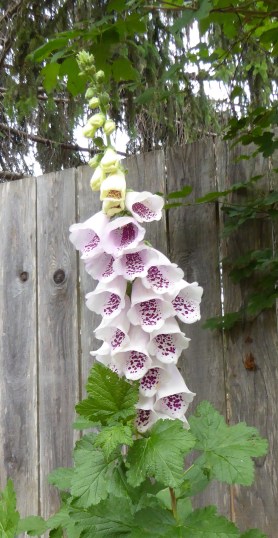
Over the years I’ve had happy surprises in the garden, and disappointing surprises. Today I have a composite. My initial puzzlement began when I saw this view from my kitchen window; back in the corner by the fence I could see two whitish flower stalks:

gl P1040703 foxglove view

I was confused, because they were of a kind I had not planted, so I went out to get a closer look, and it didn’t take many steps in that direction before I saw that yes, thegl P1040708 foxglove behind ribes 6-16y were lovely foxgloves!

I haven’t grown foxgloves for a good while, I did not save any foxgloves plants from my old garden, and in the past when I did grow them it was far from this area of the garden. However, close to this spot I had planted one of the Indigo Woodland Sage plants that I had carefully saved for months in an old watertrough. It was there a couple of months ago, and now it isย  nowhere. Did a bit of foxglove come with the mulch, as I assume was the case with my surprise horsetail grass on the other side of the garden?

You may also be confused, seeing a decidedly not-foxglove leaf form here.ย  That’s because the foxglove is emerging from behind a currant bush and hiding all its own leaves back there.

I’m sadly surprised that the salvia didn’t make it. It was a vigorous grower under what I considered less favorable conditions in the past; perhaps it didn’t like the shade from the snowball bush, nor the pushy calla lilies. But I know where to get another one if I want to try it somewhere else in the garden.

gl P1040717 3 sagesIn the meantime, across the way I have three salvias growing in a sort of triangle: Indigo Spires is huge, the Clary Sage is growing very close to the ground so far, and a little culinary sage plant lives modestly.
Today is windy and cool. I was wearing my flannel nightgown last night and I was still cold. The morning was overcast, though, and not so windy, and that’s perfect for picture-taking. I got a good photo of my acanthus.

gl acanthus 6-2015
acanthus mollis


“My acanthus” sounds odd, because I haven’t wanted to take ownership of that element of my new landscape that was suggested by the designer. When I had met acanthus in the past I always thought it scraggly and too like a thistle; one I particularly remember by someone’s front door was huge and full of spiderwebs and litter besides. But a year ago I greatly lacked confidence and creativity, so I didn’t know what to suggest otherwise. I let several plants go in and thought without energy about what I might replace them with next fall.

My attitude began to change when a friend told me that acanthus leaves as a decorative form were common in ancient Roman architecture. Before that I was trying think of the plant as a representative of a Scottish thistle, which is also not beautiful to me, but it is meaningful historically, in several ways. Soldier and Joy featured purple thistle flowers as boutineers at their wedding. But honestly, that wasn’t doing it for me.

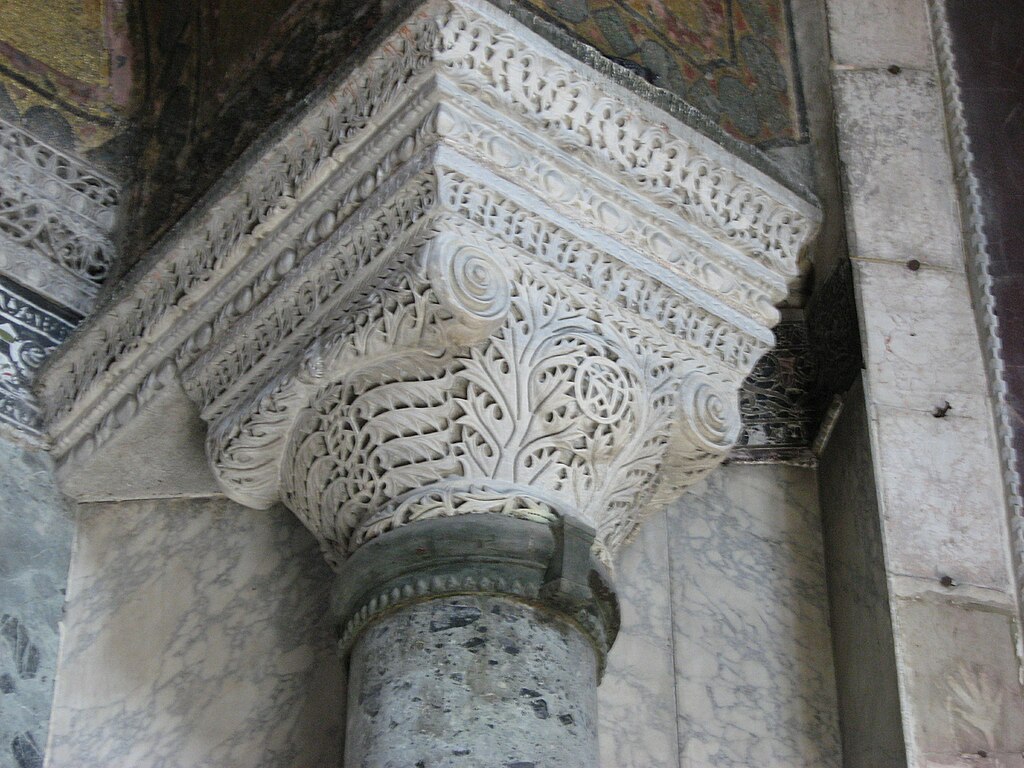
When the acanthus began to send up its elegant flower stalks, I softened. This morning after I took the picture, I looked on Wikipedia and found that the leaf form is ubiquitous in ancient architecture and popular in more modern art such as William Morris’s wallpaper designs.

And not only the Romans, but Byzantines and Greeks liked to use it.ย  Here is an example from the Hagia Sophia:

by Gryffindor, on Wikipedia Commons

gl Iceland poppy June 14 2016


So, I am surprised that I have changed my mind about acanthus. I’m glad I wasn’t in too big of a hurry to switch it out. I’m very pleased with my whole garden, actually, and I no longer feel that it belongs to someone else.

It doesn’t seem that most of it is taking three years to “leap,” and it really is full of delights every day. Those Iceland Poppies are certainly a wonder, how they keep blooming here in the middle of June! It’s strange to have the poppies right alongside echinacea; those two normally aren’t normally seen together.

gl P1040713 erigeron fleabane
erigeron

gl P1040712 bindweed on ribes


To my consternation, the bindweed is more prolific than ever. I seem to be constantly pulling it out, but it sneaked past me and climbed to the top of a currant branch before I noticed. Very inelegant behavior, that.


gl P1040699

The hydrangea I was gifted has nothing in common with this succulent except that they are both in pots on the patio.

gl P1040714 yarrow fields

There are yarrow fields, a variety of achillea called “terracotta.” Beyond it you can see that I have finally got the olives into their pots, and if one is not level it’s actually the one in the foreground — I guess that means the photo is not level. Anyway, the garden is in pretty good order now, and when you come for a tour you may be surprised to find, no thanks to me, patches of elegance.

Oh, Wind!

Right now the wind is blowing up a noisy gale outside.

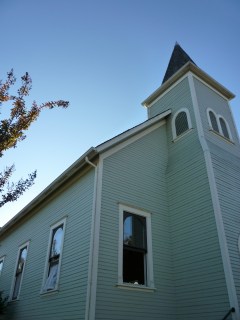
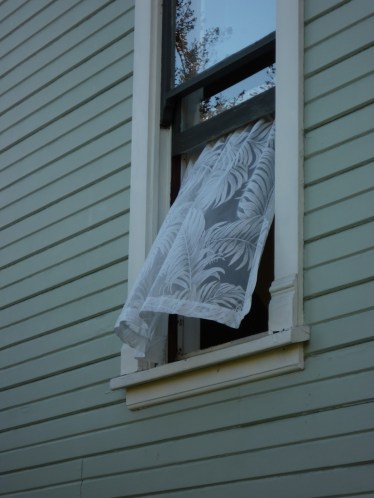
It was just getting going this afternoon when Mr. Glad and I were taking a walk in an old neighborhood in a nearby town.ย  We like to look at the gardens and the houses, like this one that seems to have been a church at one time.


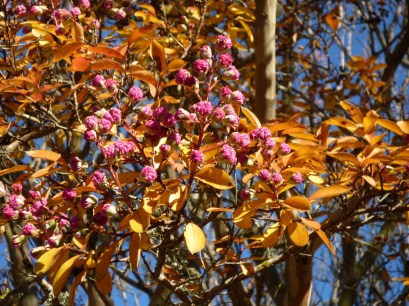
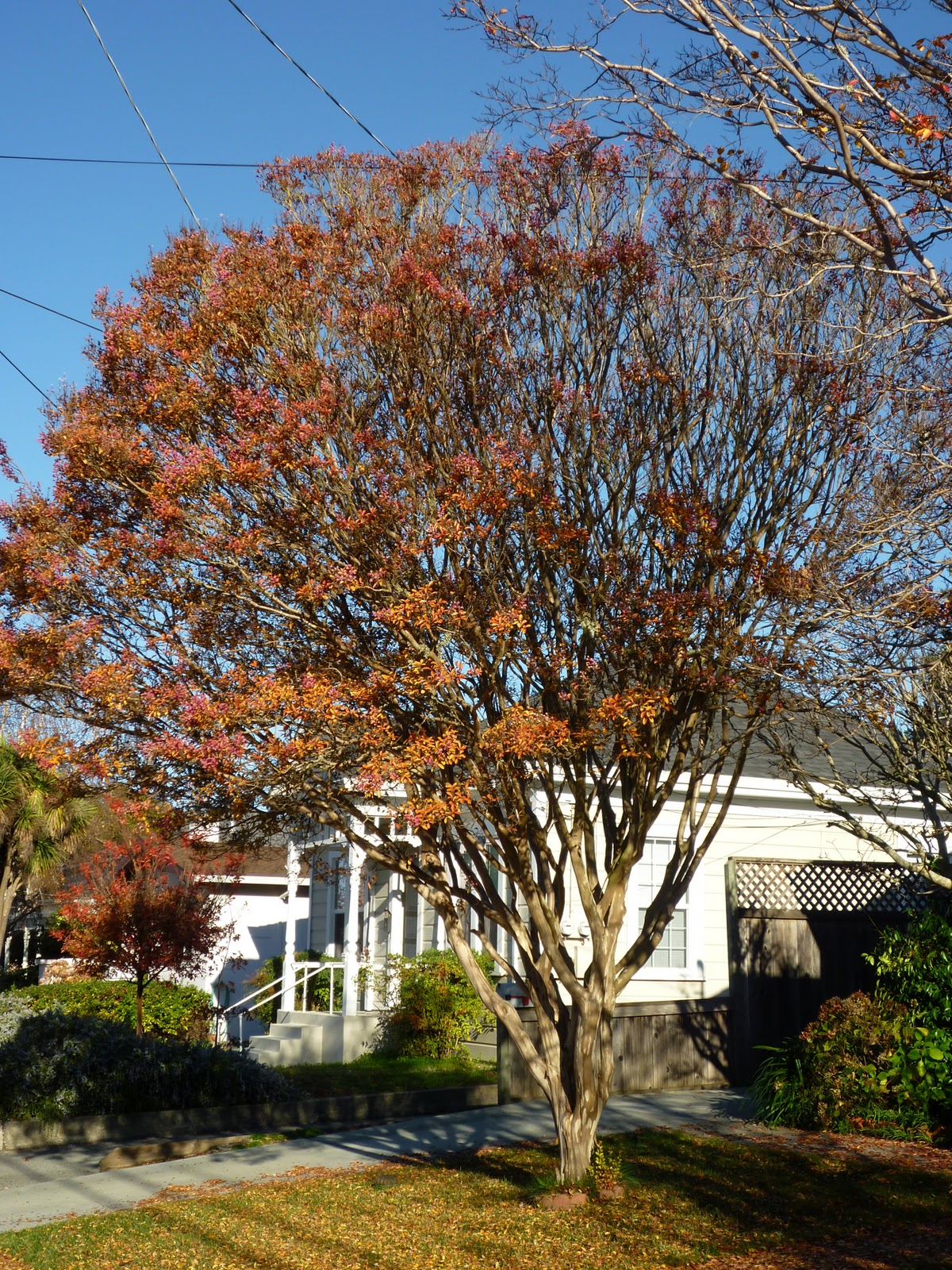
When we left the restaurant where we’d eaten a lunch of doner kebab and Turkish coffee, we crunched through leaves on the sidewalk, and took pictures of a tree we didn’t know.

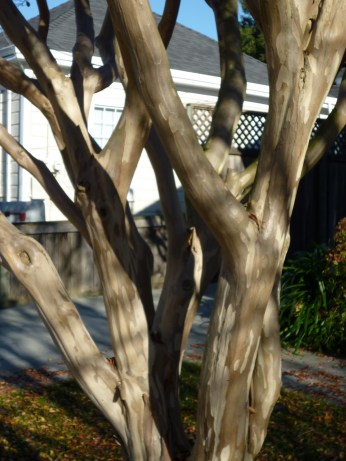
Its graceful branches and smooth bark, holding up bright yellow leaves and pink flowers, put on a multi-layered show for us.

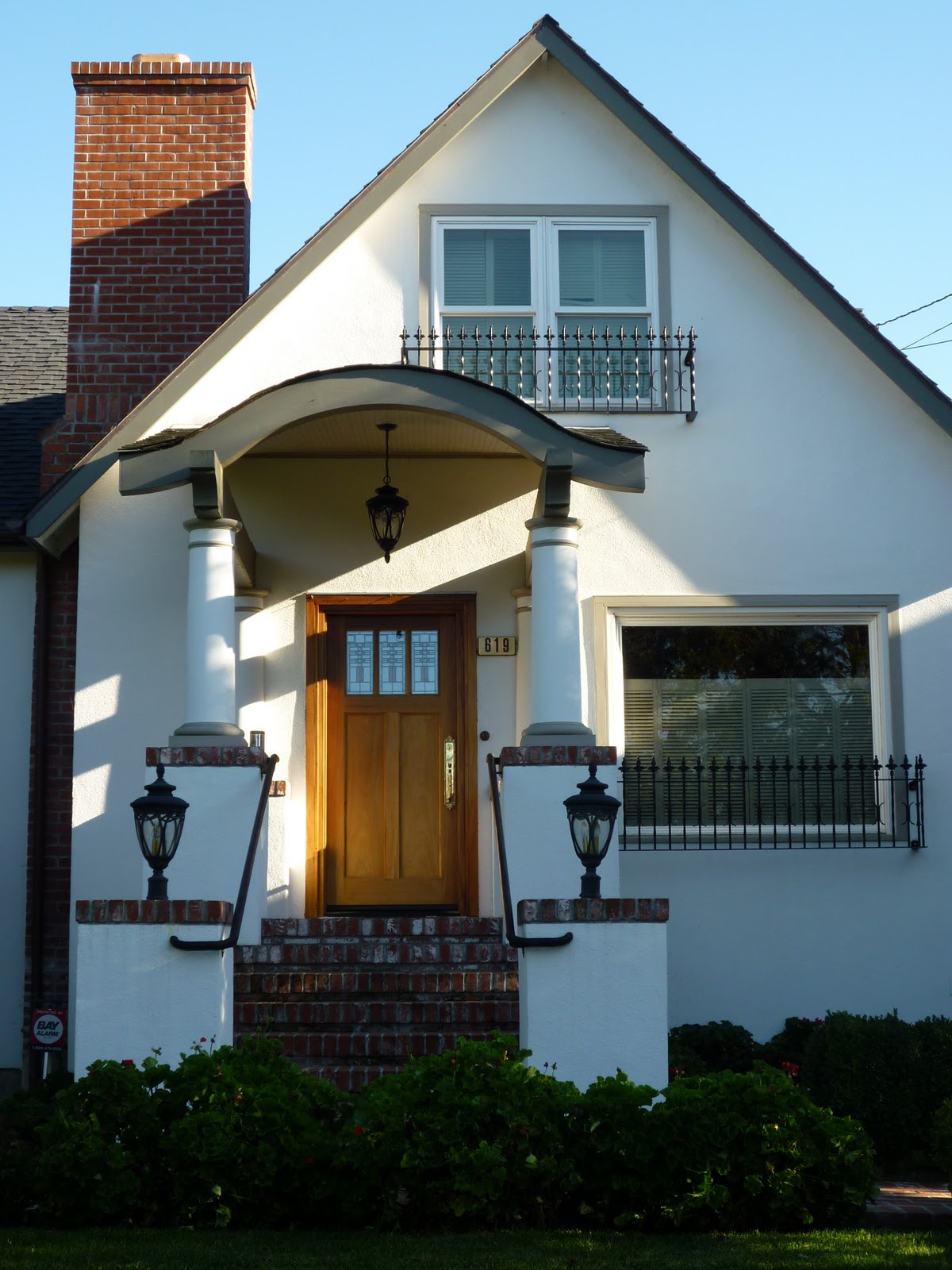
Mr. G. especially liked the door of this little white house…

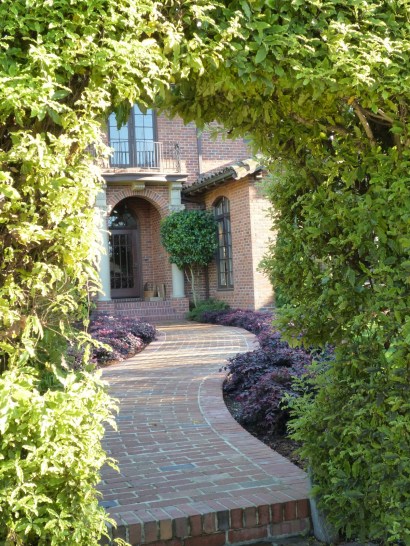
…and I liked the way the tall green hedge in front of a large brick house had been trimmed so neatly as to frame the entrance like a picture. So I took a picture.

And that purple plant bordering the sidewalk…I think we have that at church, but I can’t remember its name. It’s the perfect complementing color.

Leaves began loosening from branches overhead and falling down on us, as the wind lifted my hair and stirred it into the mix. I had to watch my steps as we picked our way over frequent humps in the sidewalk caused by roots of trees with giant trunks, maybe older than the old houses.

On the drive back to our town the thermometer in the car told us it was 71ยฐ! My husband stopped by a store for a few minutes and I stayed in the car. I pulled out an old Bible that I keep stuck between the seats for times like this, and opened randomly in the Psalms, where I read,

Tremble, thou earth, at the presence of the Lord, at the presence of the God of Jacob;
Which turned the rock into a standing water, the flint into a fountain of waters.

Return unto thy rest, O my soul: for the Lord hath dealt bountifully with thee.
For Thou hast delivered my soul from death, mine eyes from tears, and my feet from falling.

And it seemed that God was speaking from His written Word to elaborate on the exuberance of His presence in the wind and the trees, to remind me that the same Mover of winds is the keeper and Lover of my soul.

At least four poems, songs, and passages from books crowded all together in my mind, all about blowy days, leaves “falling down and down and down and down and down,” and Wind as a playmate.

That wasn’t the end of my windy mental explorations, but before I write any more on the subject I’ll make an effort to gather my thoughts from the corners of my mind and bookshelves and the winter skies.