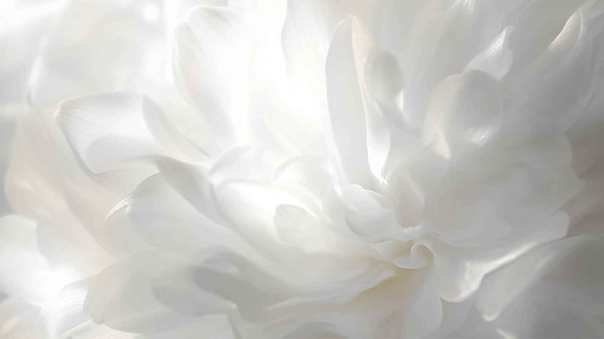
I ran across the news that Pantone’s choice for Color of the Year 2026 is WHITE! No, not just white, of course, but “Cloud Dancer” white. This is the first time they have chosen a shade of white as the color of the year. I’ve never heard about this practice before, in the 25 years that the company has done it, but that’s because the colors I am interested in are in my garden or my clothes closet, not in a lab.
I personally wouldn’t want to take too much time thinking about one shade of one color, because God has generously given us so many, all day every day, unless we are living in the Arctic. White is a color many of you are seeing a lot of already right now, and not on your walls. Have you thought about giving names to the different shades of snow you are shoveling, or watching fall outside your window?
It’s not because of my lack of snow that I take the trouble to post about this, but because of G.K. Chesterton. He probably wouldn’t think much of someone choosing a Color of the Year, but he did himself write about one color in particular, without regard to style or global trends. For him, it was not merely about things seen, but things unseen, the Cosmos and the Kingdom of God:
“White is a colour. It is not a mere absence of colour; it is a shining and affirmative thing, as fierce as red, as definite as black. When, so to speak, your pencil grows red-hot, it draws roses; when it grows white-hot, it draws stars.
“And one of the two or three defiant verities of the best religious morality, of real Christianity, for example, is exactly this same thing; the chief assertion of religious morality is that white is a colour. Virtue is not the absence of vices or the avoidance of moral dangers; virtue is a vivid and separate thing, like pain or a particular smell. Mercy does not mean not being cruel or sparing people revenge or punishment; it means a plain and positive thing like the sun, which one has either seen or not seen. Chastity does not mean abstention from sexual wrong; it means something flaming, like Joan of Arc.
“In a word, God paints in many colours; but He never paints so gorgeously, I had almost said so gaudily, as when He paints in white.”
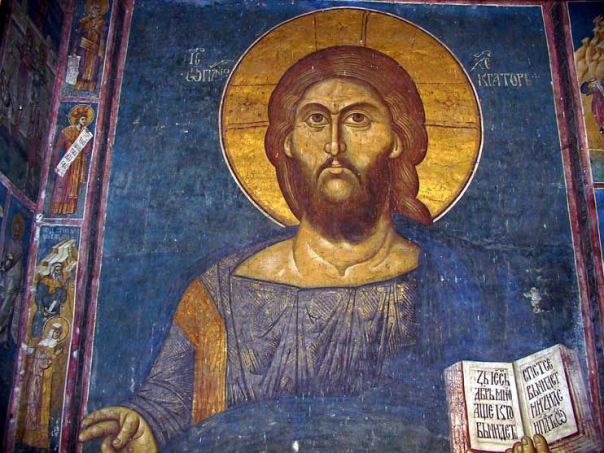
“The intimate darkness of our most precious cognitive organ constantly reminds us – whether we like it or not – that the “inner” content of any human is never absolutely available to our cognitive powers. The most powerful among the senses, thus, recognizes the deepest human cognitive powerlessness precisely during the encounter with the most powerful sense organ of another human being. However carefully we approach or analyze it, the unique personal existence of every human always stays partly hidden in the darkness of the unknowing.
“And this is most expressively manifested when we encounter the small black dot that is the pupil of the eye. At this place we truly do “enter into the human soul,” but at the same time –confusingly and paradoxically – we realize that we cannot enter it. In this kind of darkness, we can get lost and go crazy, or feel warm and safe – for the same reason: because we cannot possess what it reveals/hides. This darkness can be scary or the most welcoming place in the world for the very same reason: because, herein, we recognize the utmost freedom of the human being.
“Through the encounter with the pupil of another human being, we fall directly into the other’s personal infinity, which can never be fully attained – even if our faces are only a few centimeters from each other. Experiencing this kind of infinity, finally, becomes the cognition of the utmost human freedom – freedom that does not depend even on itself.”
I added paragraph breaks to this excerpt from an article by Todor Mitrović from the Orthodox Arts Journal, on “The Epiphany of the Eye.”
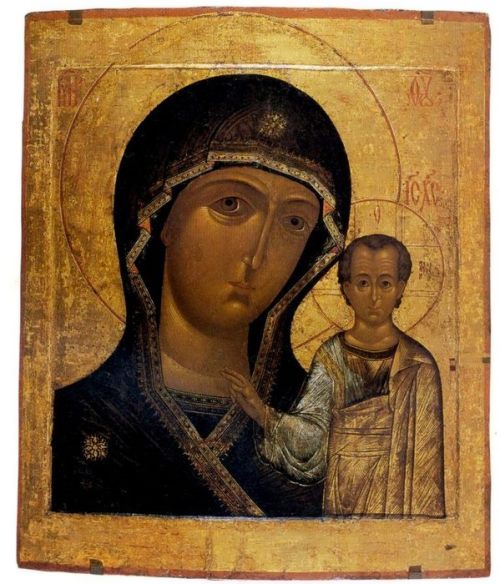
I found the author’s ideas fascinating, and convincing. I am not an artist, but I do gaze upon icons quite a bit. When I do, I am looking through the “window,” not caring to analyze what features of the image are having what effect on me. This article nonetheless does help me to better appreciate the whole phenomenon. The artistry of an icon is not the most important thing about it, but contributes to its beautiful effect on our souls, our deepening relationship to Christ through prayer.
You can’t walk very far in Thessaloniki without encountering antiquity as more than an idea; the present city layout incorporates reminders of previous communities and cultures, the oldest of which had been buried for thousands of years.
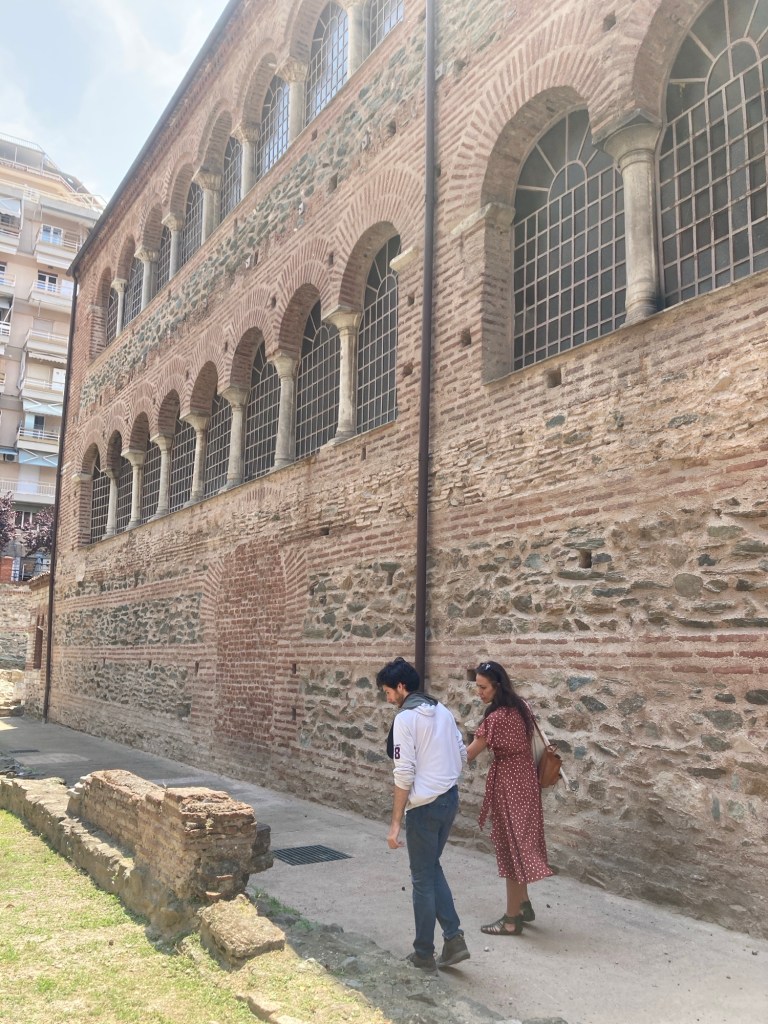
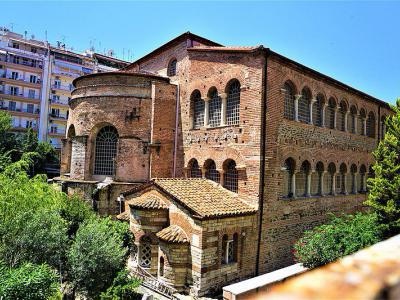
The Church of Panagia Archeiropoietos prompted me to think about this when I visited over the last week.
One has to descend a flight of steps in order to travel back in time to when Byzantine Christians first worshiped here.
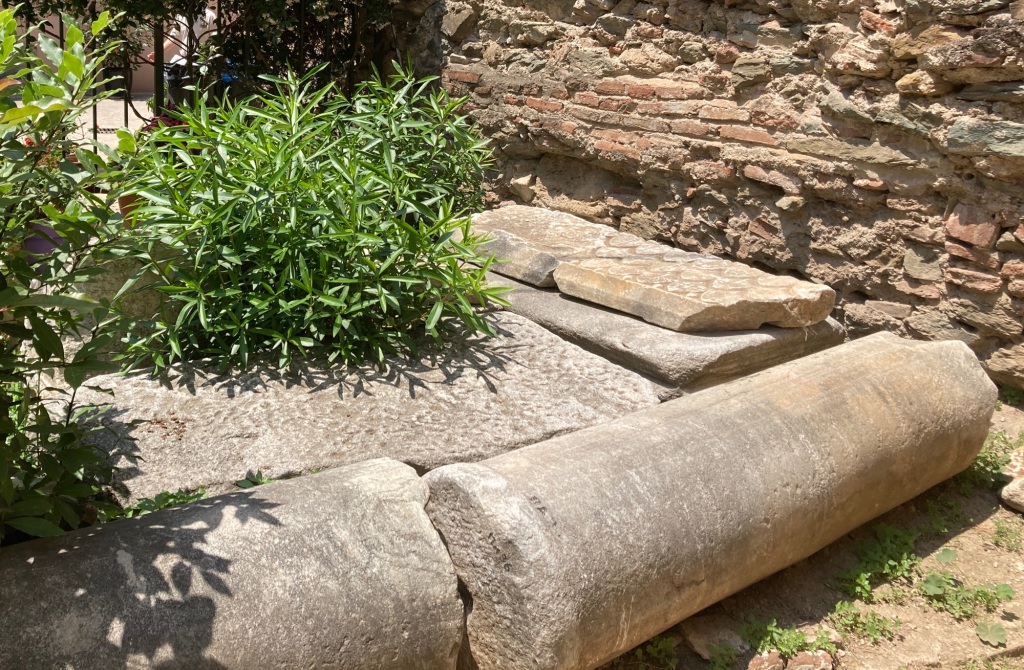
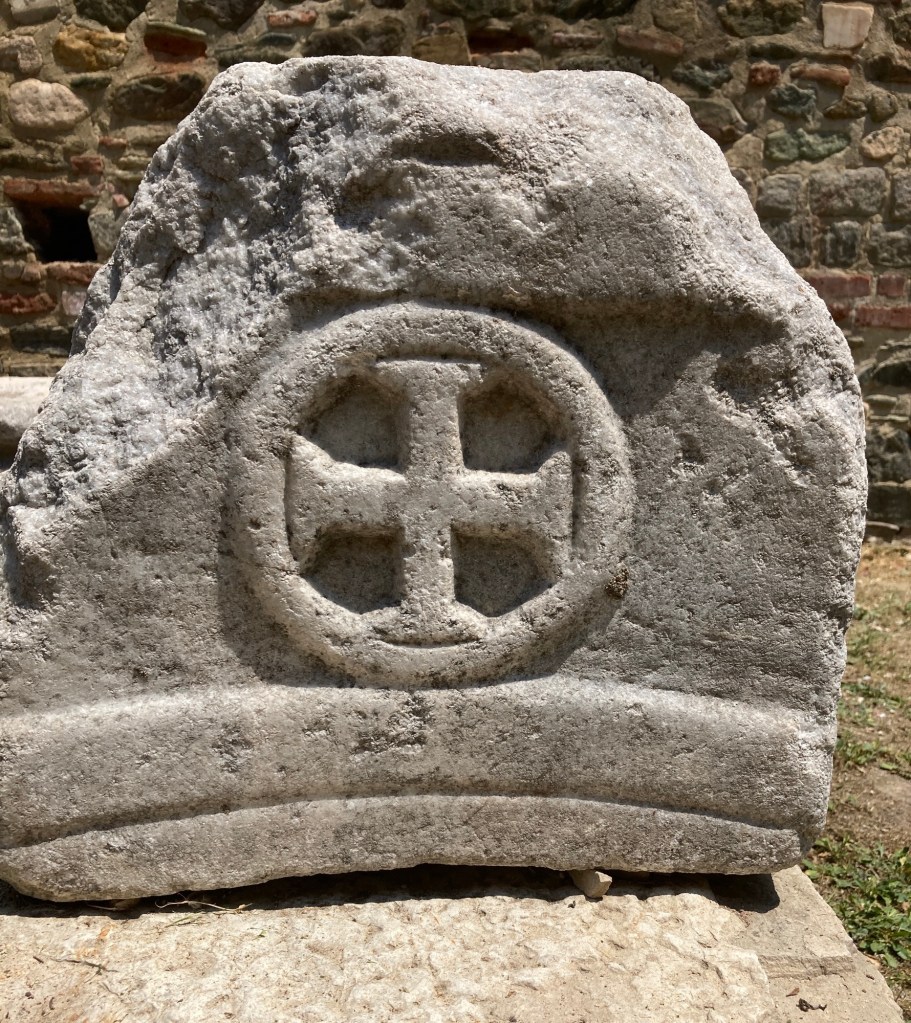
One afternoon my guide Maria and I found a university student at work behind the church, in a gated area where she had never been. The priest had given him two tasks: gardening, and also sorting and organizing stone and marble chunks of the church that had broken during earthquakes. He couldn’t have been more pleased.
“Would you like a piece of antiquity?” he asked me. “We have buckets of it!” And he handed me a few small souvenirs of my favorite type.
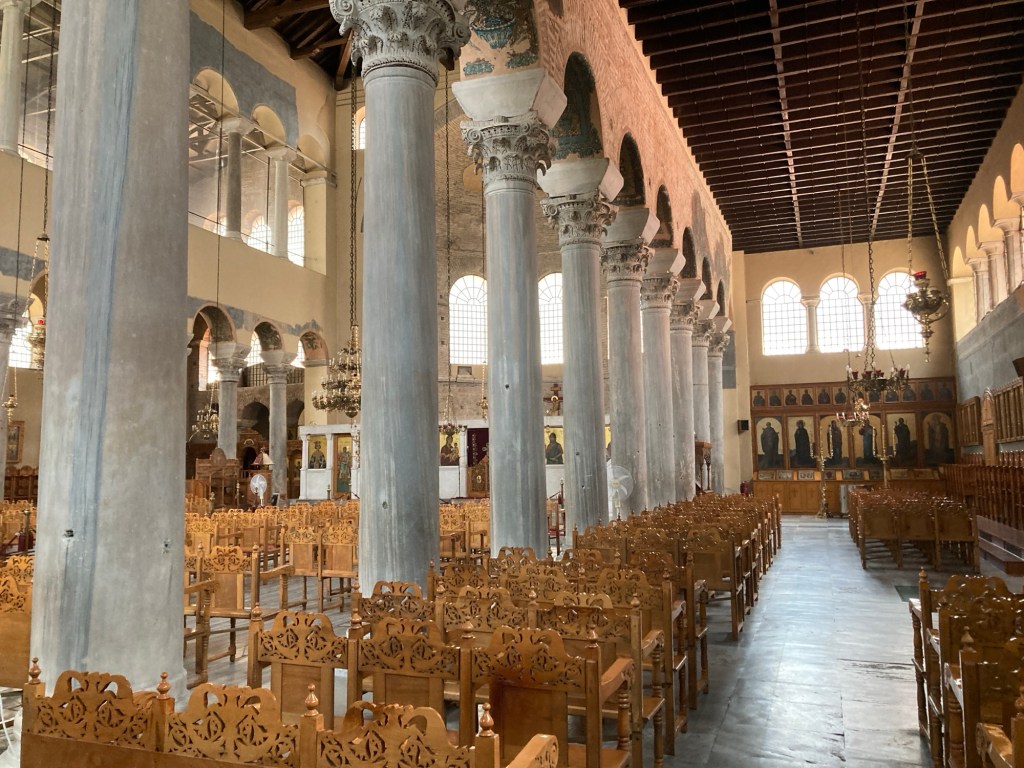
Inside the church, Maria pointed out to me distinctive features of this basilica style temple built in the 5th century.
It was the first church in Thessaloniki to be turned into a mosque when the Ottomans conquered the city in 1430, and Sultan Murad II inscribed his name and the date on a pillar.
Murad II’s insignia
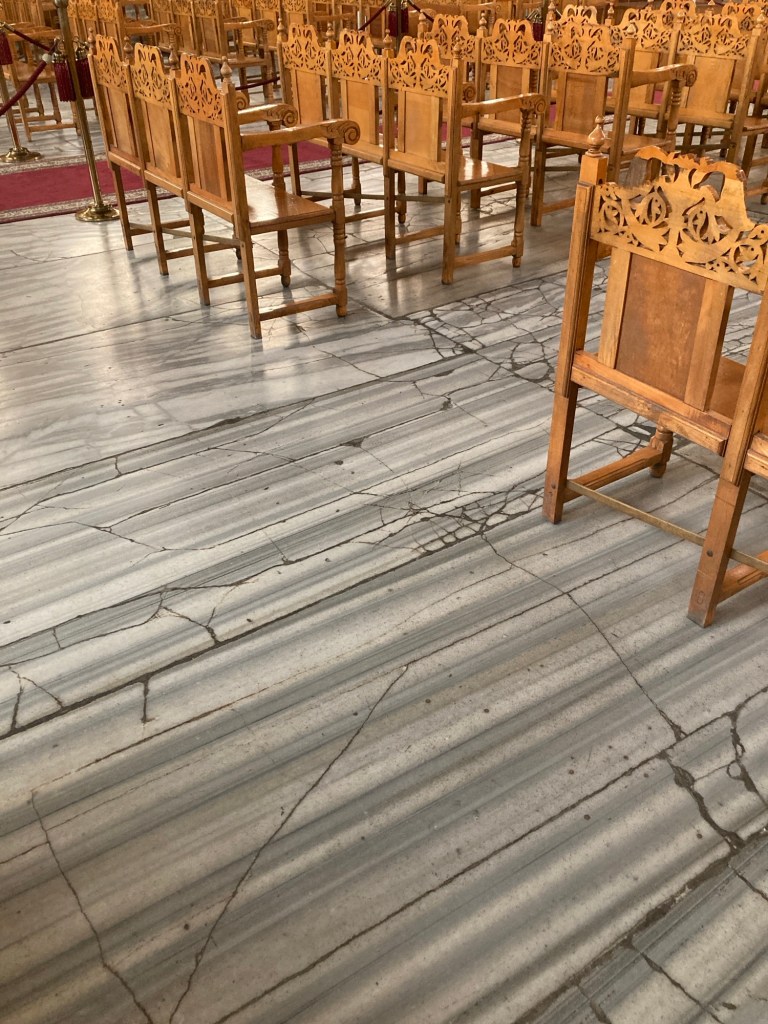
Historians say that the blue-veined marble in the floors and columns of this church was sourced from the island of Proconnesos in the Sea of Marmara. Before the custom of sitting on chairs in church was introduced in the last century, the pattern on the floor imitating rivers would have been more obvious. Near the altar the lines are wavier. The floor is still the most captivating feature of the space for me. How many people have stood, processed, knelt and prostrated on these smooth and cool floors over the centuries?
I joined the ranks of that company this morning, not just to stand but to kneel, because it is Pentecost Sunday, when Orthodox Christians around the world join in three long prayers, in the service of Kneeling Vespers.
The Byzantine Christians built this temple on top of a Roman bath complex. At places in the church see-through panels (easily ignored and walkable for regular parishioners) reveal below, farther down and further back, three previous layers of Roman floor mosaics from that earlier era.
Yesterday I walked a half hour to the northwest corner of what would have been the old walled city. That’s where the Church of the Twelve Apostles is, which I hadn’t seen yet. But I had forgotten some of the things Maria told me about the best time to go, in order to find it open during or just following a service, and it was closed.
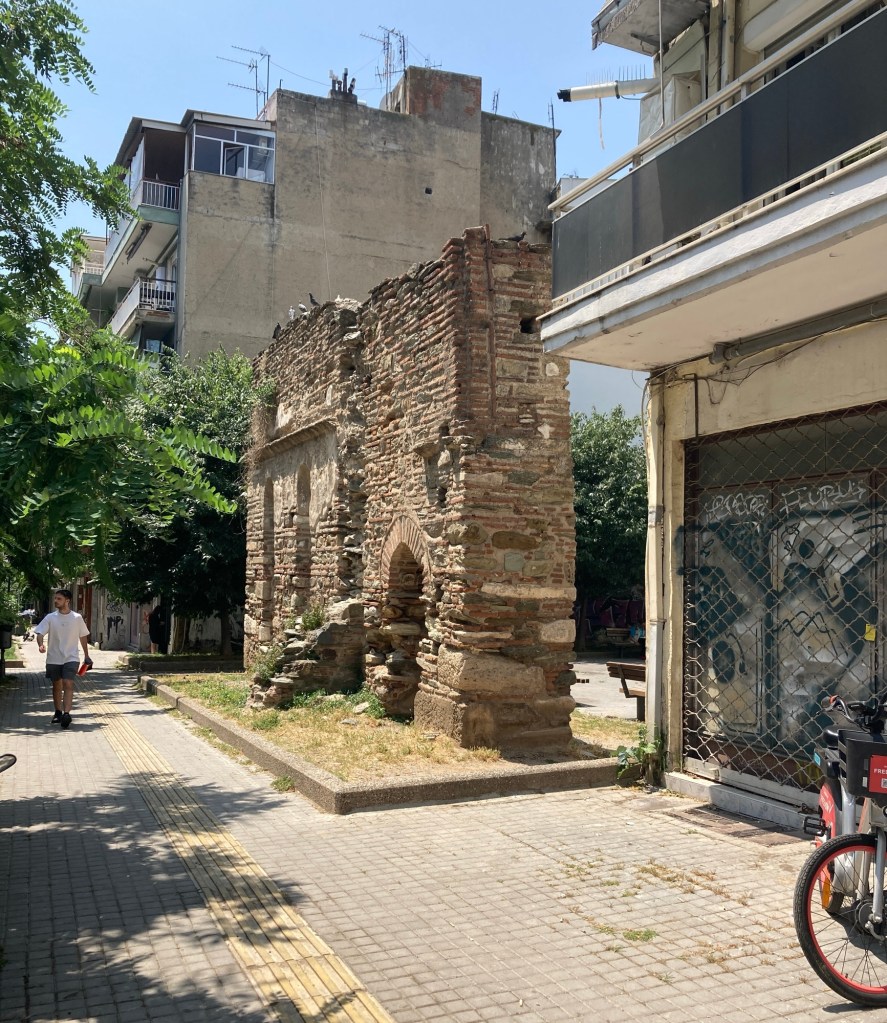
That was okay. I’m pretty much filled to the brim from all of the information and experiences of the last days, and was kind of happy just to have a walk in an area I hadn’t been yet. I came upon one wall portion…
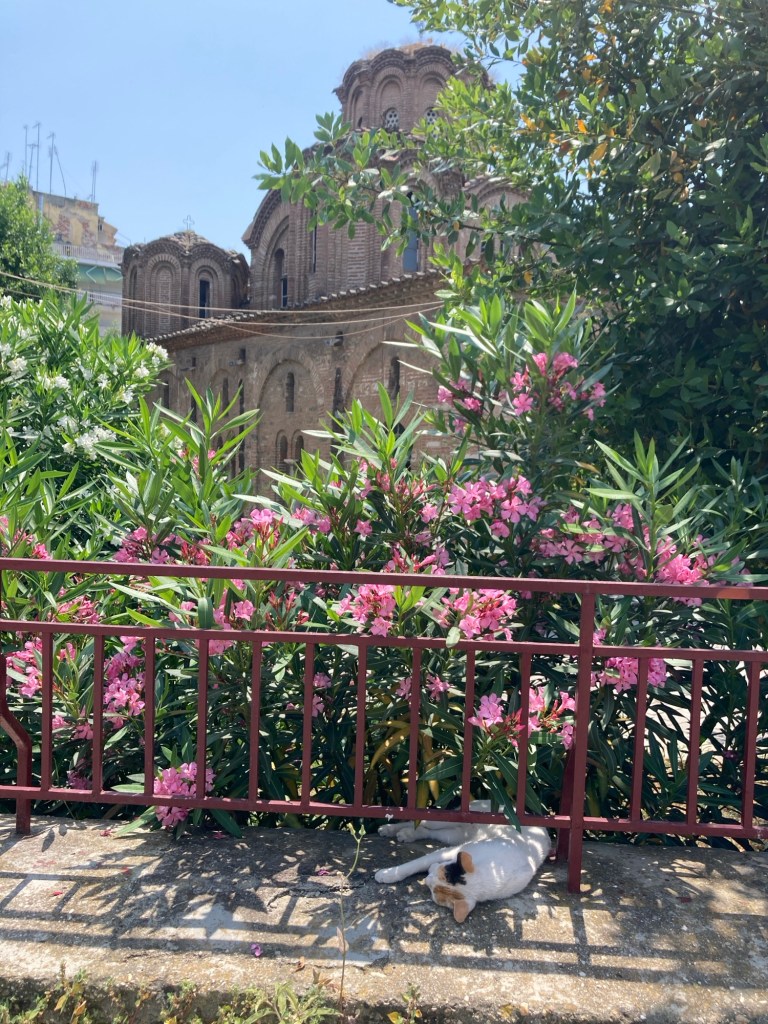
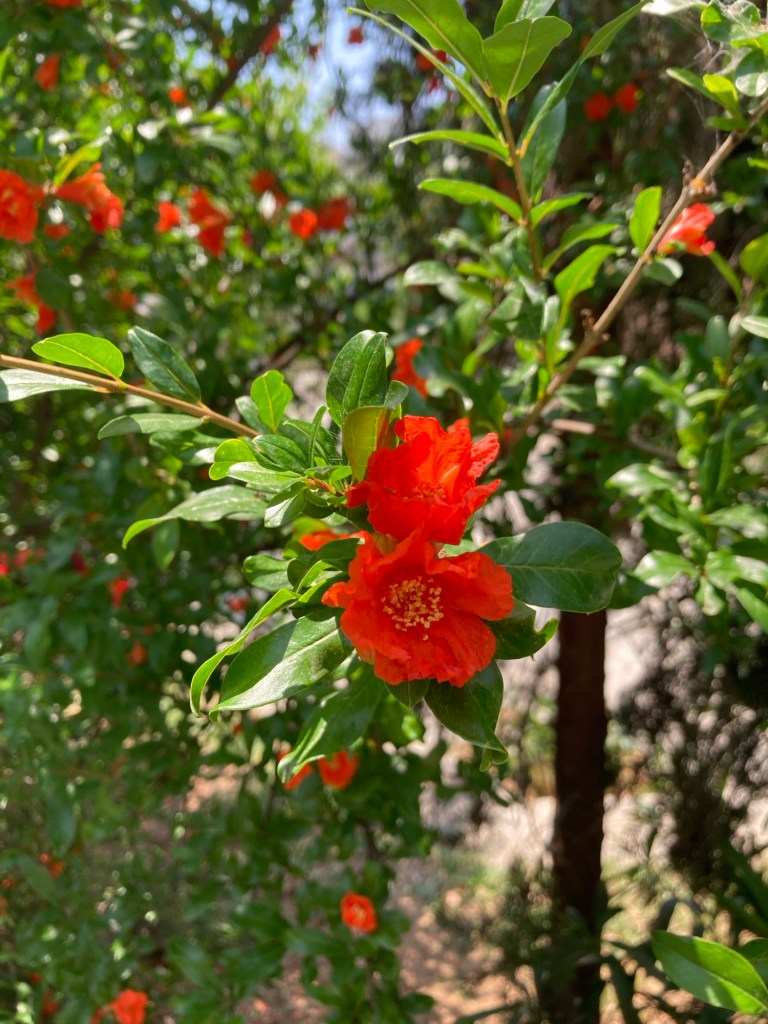
… and as I walked around the church, noting that every gate was locked, I saw a magpie in a tree, a cat trying to stay comfortable in the heat, and the most beautiful pomegranate tree.
The temperature has risen since my arrival in Thessaloniki, and the humidity increased, so that I have needed to walk less briskly, and to return to my hotel in the hottest part of the day to rest for a while before going out in the evening.
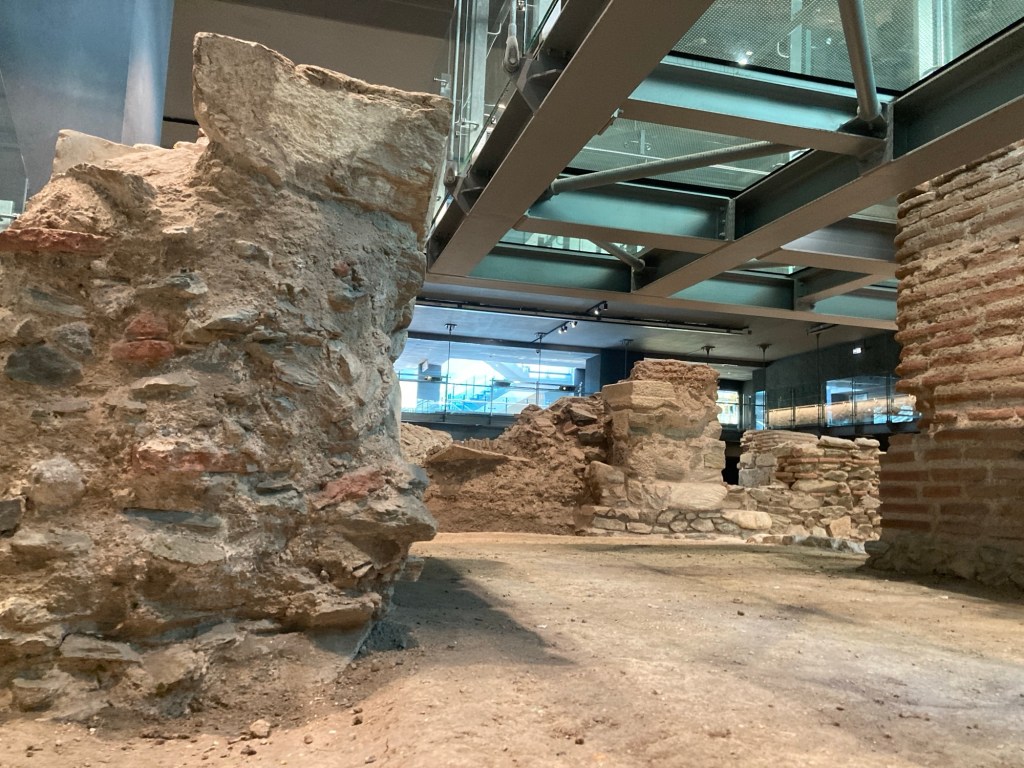
But I enjoyed strolling back through the center of the city, where the new Metro has also been built in such a way as to highlight the ancient civilizations that lie in its lower regions.
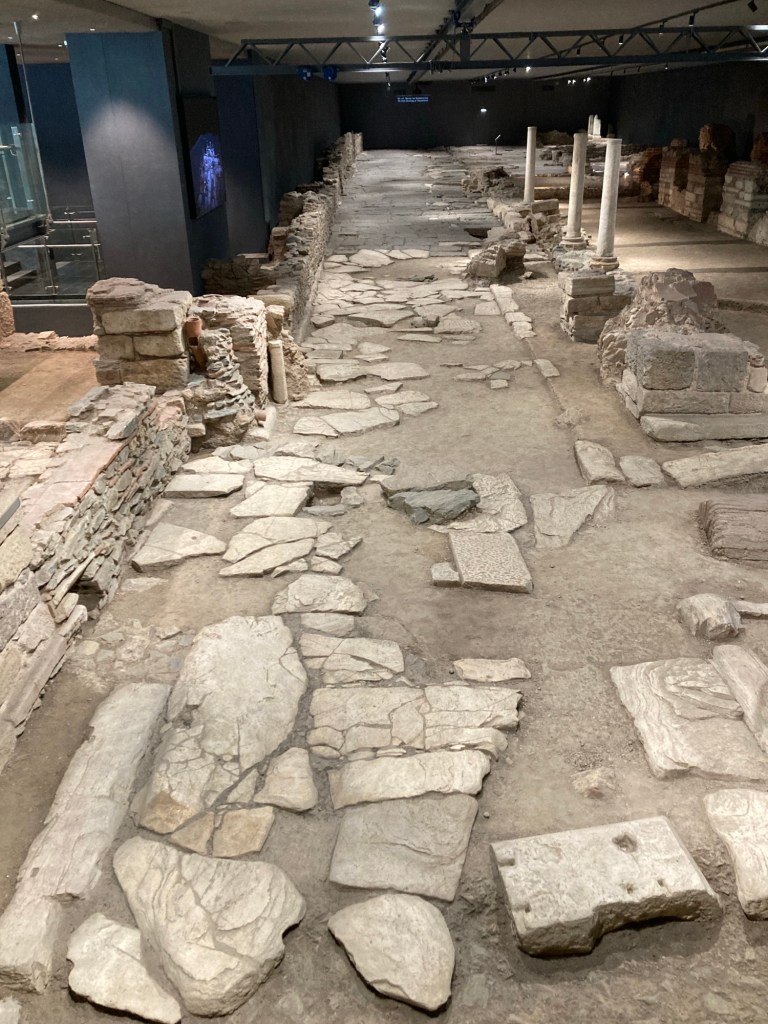
Maria gave me a tour of it also, and from all levels of that central station we got different views of the street scenes that have been preserved. It was the vastness of the archaeological discoveries, when excavation began for the project, that demanded a thorough and extended discussion about how to respect these artifacts.
The main road of the Roman city.
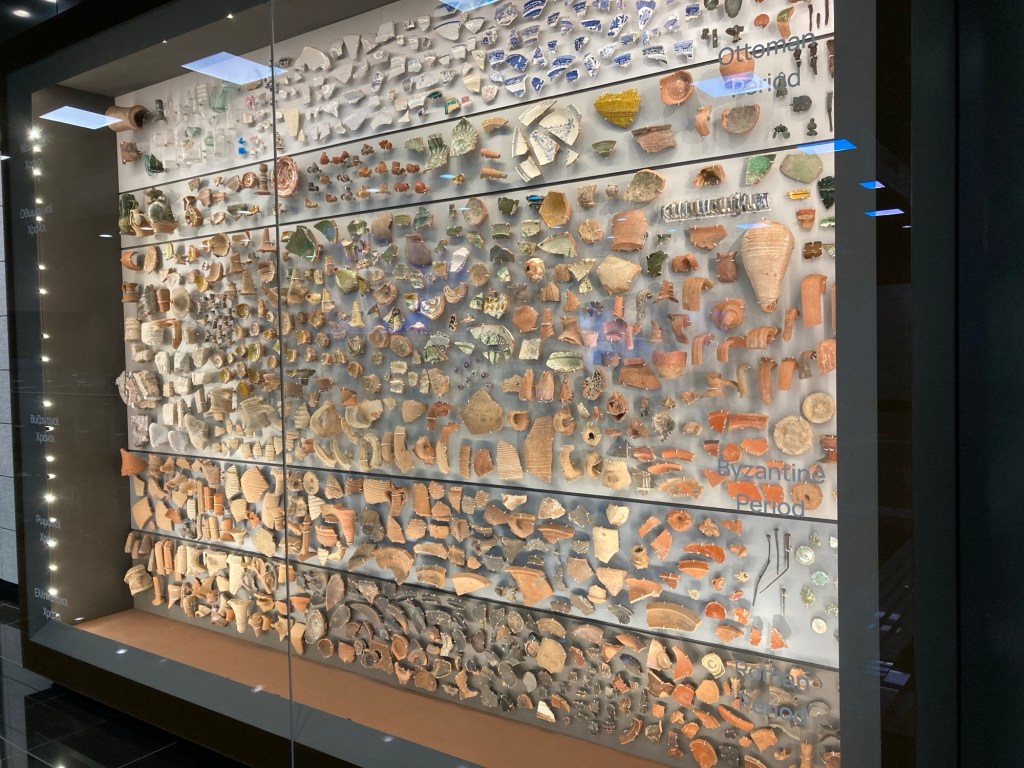
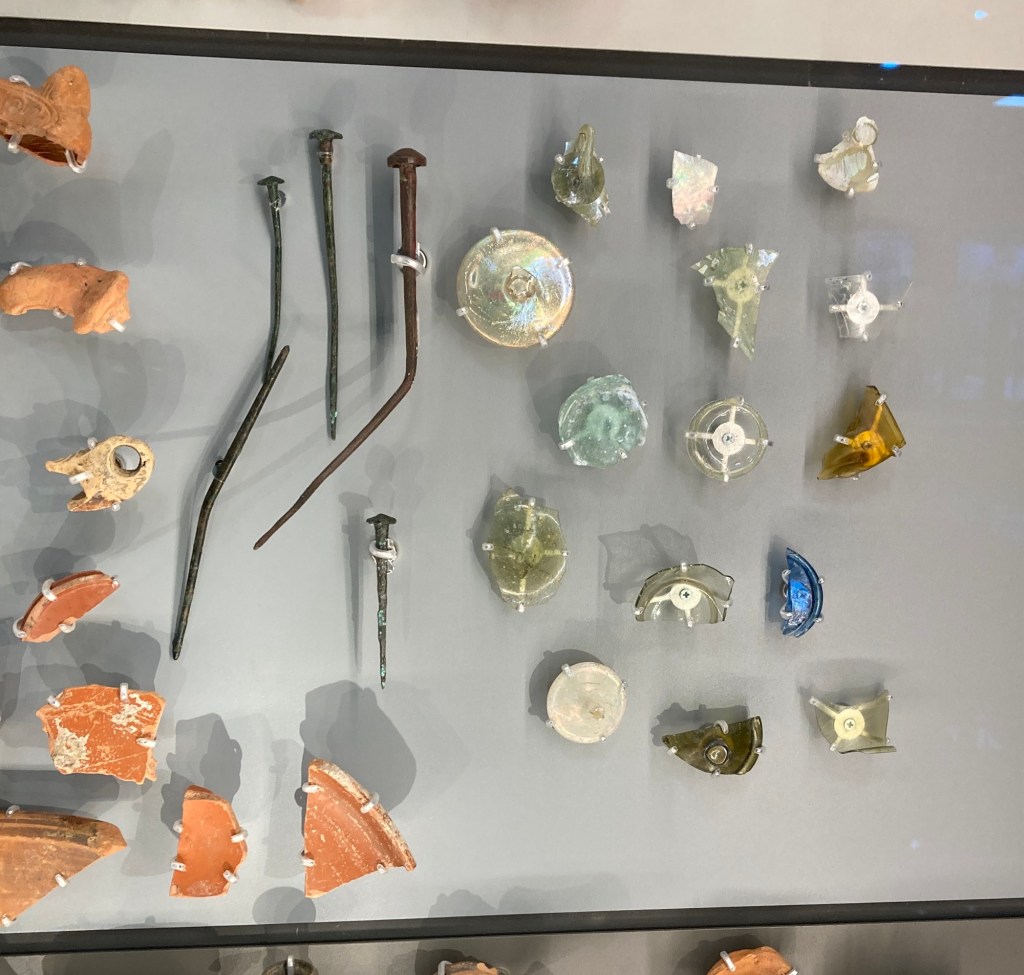
Layers representing Hellenistic, Roman, Byzantine and Ottoman societies were found, and the decision was made to display the Roman city. All of the artifacts will eventually be exhibited in a museum, a foretaste of which makes a wall display in the lower levels of the Metro station.
I am amazed at the vision and scope of this project. History is alive here.
Roman artifacts
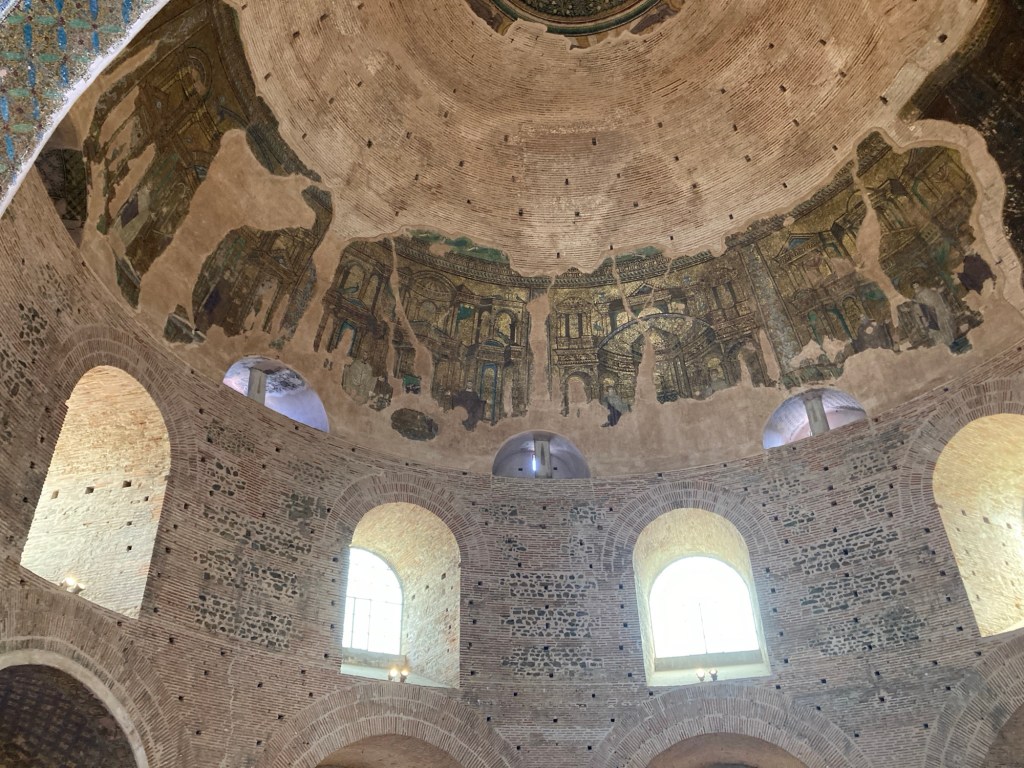
Because my time in Thessaloniki is running out, I need to tell you about the Rotonda now as well. It is the oldest of Thessaloniki’s churches.
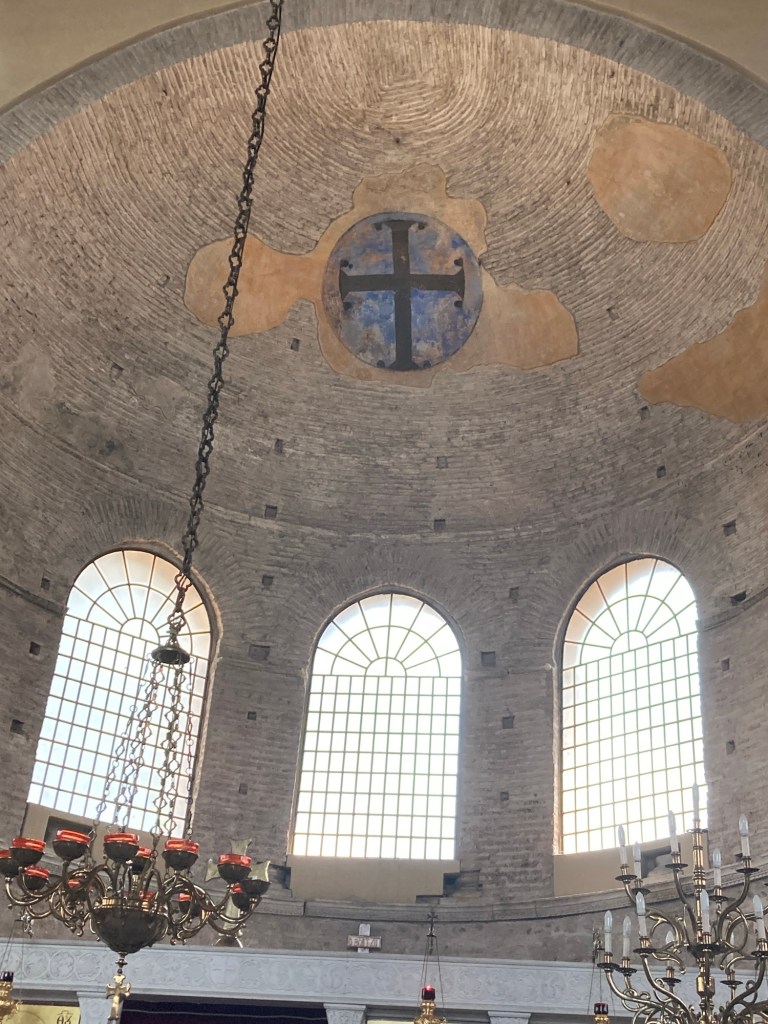
This edifice that was built in the early 4th century by the Emperor Galerius, possibly completed by Constantine when he lived here, has walls six metersthick. As soon as I was inside, I felt the immense presence of the place. The only visitor at that time besides us was a woman sitting on a folding chair and reading, and I knew it would be a blessed place just to sit. But I didn’t want it enough to go back and pay another ten euros to enter.
Some historians think that Galerius built it as a mausoleum, as part of the complex including the Arch of Galerius and the palace. But others think it was built as a temple to a god, possibly Zeus, who was Galerius’s patron god.
Galerius was buried in Serbia in any case, and a few decades later the Emperor Theodosius (probably) was the one who ordered the Rotonda to be made into a church dedicated to St. George.
In 1590 it was converted into a mosque for a few hundred years, and a minaret was added. It’s the only minaret that was not removed when the city was liberated from the Ottomans.
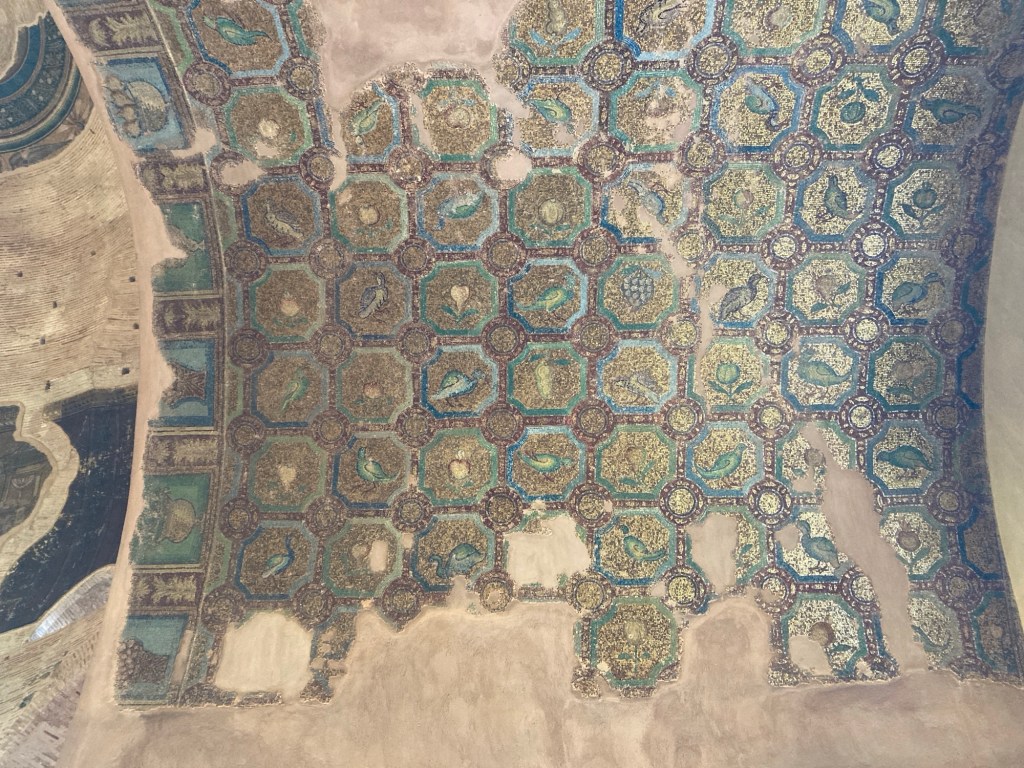
Along with the serenity and hugeness of the church, the remaining ancient mosaics impressed me, with their brilliance and detail. So, so lovely, the art that has survived nearly two thousand years and doesn’t show its age. If my neck were stronger, I’d have craned it longer to feast my eyes on the colors of the birds especially.
I think services are held there on the feast of St. George. One doesn’t have to go down to go back, when the Rotonda is taking you; it sits elevated above the city. You just walk up the hill, walk inside, and there you are.
One of the readings for Holy Monday is from Ezekiel, a description of what the prophet saw in his vision of creatures and wheels:
…a whirlwind was coming out of the north, a great cloud with raging fire engulfing itself; and brightness was all around it and radiating out of its midst like the color of amber, out of the midst of the fire. Also from within it came the likeness of four living creatures. And this was their appearance: they had the likeness of a man. Each one had four faces, and each one had four wings. Their legs were straight, and the soles of their feet were like the soles of calves’ feet. They sparkled like the color of burnished bronze. The hands of a man were under their wings on their four sides; and each of the four had faces and wings. Their wings touched one another.
The creatures did not turn when they went, but each one went straight forward. As for the likeness of their faces, each had the face of a man; each of the four had the face of a lion on the right side, each of the four had the face of an ox on the left side, and each of the four had the face of an eagle. Thus were their faces. Their wings stretched upward; two wings of each one touched one another, and two covered their bodies.
And each one went straight forward; they went wherever the spirit wanted to go, and they did not turn when they went. As for the likeness of the living creatures, their appearance was like burning coals of fire, like the appearance of torches going back and forth among the living creatures. The fire was bright, and out of the fire went lightning. And the living creatures ran back and forth, in appearance like a flash of lightning.
Now as I looked at the living creatures, behold, a wheel was on the earth beside each living creature with its four faces. The appearance of the wheels and their workings was like the color of beryl, and all four had the same likeness. The appearance of their workings was, as it were, a wheel in the middle of a wheel. When they moved, they went toward any one of four directions; they did not turn aside when they went.
As for their rims, they were so high they were awesome; and their rims were full of eyes, all around the four of them. When the living creatures went, the wheels went beside them; and when the living creatures were lifted up from the earth, the wheels were lifted up. Wherever the spirit wanted to go, they went, because there the spirit went; and the wheels were lifted together with them, for the spirit of the living creatures was in the wheels.
I was interested to see how artists might have rendered these images. Many of the pictures were quite psychedelic, and just as mind-boggling as the descriptions Ezekiel gave. My favorite was this quiet sculpture, detail of an Amiens Cathedral facade which shows only two wheels, and a prophet who might be seen as receiving his vision, or perhaps meditating on the whole of it — which would be impossible to render in stone. The complexity and drama are only hinted at by the way the wheels are interwoven or interweaving.
The church fathers have written that the four living creatures are the cherubim, the guardians of the throne of God. The burning coals are holy men, the lamps signify the light of the gospel, and the wheels signify Holy Scripture; St. Gregory the Great tells us that “the New Testament lay hidden by allegory in the letter of the Old Testament.”
Ezekiel closes his description (beyond this day’s reading) with the words,“This was the vision of the likeness of the Lord’s glory. I saw it, and I fell down on my face….”and God spoke to him, gave him an assignment, and gave him a scroll, saying:
“Son of man, eat this scroll, and go and speak to the children of Israel.” So I opened my mouth, and he fed me the scroll. Then he said to me, “Son of man, your mouth shall eat and your stomach will be filled with this scroll that is given you.” So I ate it, and it was in my mouth as sweet as honey.
My Bible footnotes remind me that the faithful can also know that sweetness that Ezekiel tasted, as the Psalmist sings:
How sweet to my taste are Your teachings. More than honey and the honeycomb in my mouth.
This probably works best when we love and obey those teachings… Lord, have mercy!
Heal me, O LORD, and I shall be healed; save me, and I shall be saved: for thou art my praise.










 One of the readings for Holy Monday is from Ezekiel, a description of what the prophet saw in his vision of creatures and wheels:


 Gladsome Lights