This afternoon I stood on a bridge overlooking the creek, and watched a Black Phoebe for about ten minutes. He would briefly perch on a branch near the surface of the water, and then fly up, do a quick whirl of an aerial pirouette, and come down on the same or a nearby twig. Over and over again… he must have been catching insects.
It took me a while to be sure that he was a phoebe. I had only seen those birds in my garden one other winter, some years ago. I tried taking pictures but that didn’t work out too well, as you can see.
Just down the path from the bridge, about half of the town’s wild turkey flock were grazing — eight of them to be exact. I took their picture, too, but they kept their heads down in the grass, and I really only got this presentable shot.
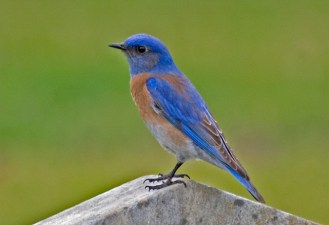
The birds that gave me a rush recently were bluebirds. Three of them were checking out my birdhouse several days in a row. First there was a pair: they flew back and forth from the trees to what was designed to be a Bluebird House, but which chickadees have used most often; they sat on top briefly, they flew back to the tree. The girl went in the house, then the boy. Then a second boy showed up! He also went in the house to look. I can see they have some decisions to make, about their relationships and about where the family will start out. They all three sat on the fence for a bit, but it didn’t seem long enough to have the necessary conversations.
Our Western Bluebird, from the Internet
I hope the girl makes her choices before the chickadees show up to take a tour of my lodgings, and most of all I hope she decides on my place, and that it’s not too late. Though, come to think of it, the other time bluebirds hatched in there it was midsummer. Anyway, I’d love to see something like this again:
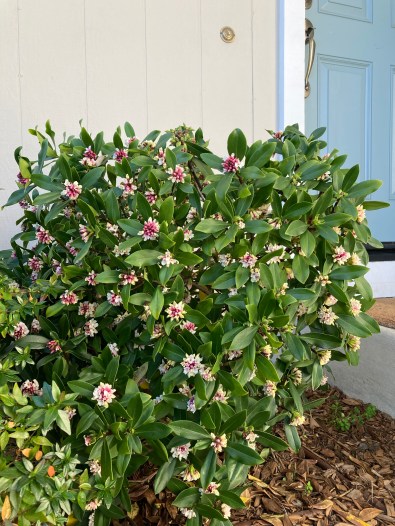
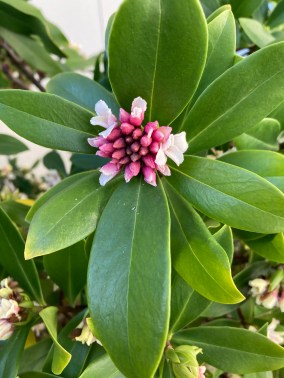
The daphne by my front door has been blooming like crazy this year; twice as big and flowery as last year, which means a double dose of its heady scent every time I come and go.
Tomorrow is the last day of January I will be doing that, but February is a good daphne month, too. It was in February many years ago now that my neighbor brought me daphne blooms at the birth of my dear Pippin. Who would have guessed that her bouquet back then would make me remember her so often, this far away in time, as I do nearly every day… The sweetness of the memory and the scent of the flowers by my door get mixed up together, and make winter delicious.
The hawk dropped down to the shoulder of the road just ahead of where I was driving down the mountain. It was at the elevation where you start to see the elderberries that don’t grow much higher, about 6,000 feet. He carried something in his talons that touched the ground just before he did.
I didn’t see any cars in my rear view mirror, so I slowed to a stop in the middle of the road and looked out the window at him, a few feet away on the other side of the road. He looked calmly at me. I should say, he looked in my direction, because I don’t know… what if I were the first human he had ever seen? Does a bird focus on another creature’s face and eyes, the way a human baby does? I stared and he looked a little bored, for ten long seconds, and then he flew into a tree nearby.
salsify
That meeting was one of the exciting events of my drive down from the mountains this week. I’d stayed at the cabin two more nights after my family departed, and had anticipated that when I finally left I would do my typical stop-and-go meandering for at least the first few thousand feet of descent, say, from 8,000 to 5,000 feet elevation. Because in July there are many more wildflowers than in September, the month in which I most often have visited this part of the High Sierra.
When the rain began to fall, and fell harder the morning I was to leave, it seemed my plans would have to change, and I might only be collecting rocks for my garden, instead of wildflower pictures. I always love rain at the cabin, so I did not complain at all. And it surely wouldn’t be a bad thing if I got home sooner rather than later. But — about the time I’d finished closing up the place and packing my car, the clouds began to break up, so that this was my last view of the lake:
The first wildflower I found, one I hadn’t seen for years, was Mountain Pride, bordering the road. It and Wavyleaf Paintbrush had few flowers remaining, but they provided a bright contrast to the sky, water and granite. This is a picture of them taken four years ago nearly to the day, in the same place. The snow melted earlier this year, as there was not much of it, so the bloom peaked before I got here.
I noticed or met for the first time no fewer than 18 different species of wildflowers that day, most of which I wrote down in a little notebook each time I got back into my car to drive further along the road, going slow and keeping my eyes open for spots of color, or whatever else might appear. Some of the flowers that I won’t show you were:
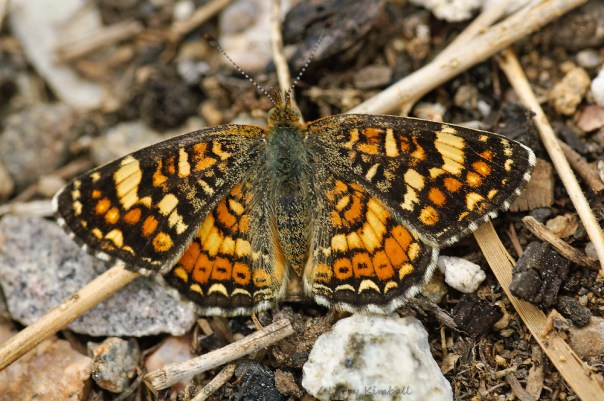
My favorite flower of the day by far was Bigelow’s Sneezeweed, a darling thing which I first saw in this area many years ago. I pulled over for it several times, and the last time was the best display, with bees and two kinds of butterflies drinking at the blooms.
One of them was the Field Crescent, of whom I didn’t get a good shot, but here is one I found online of this little insect:
Field Crescent Butterfly [Phyciodes campetris]Mormon Fritillary
Should Nature at times, on our awakening, propose to us The very thing to which we were disposed, Then praise at once swells in our throats. We feel we are in paradise.
-Francis Ponge
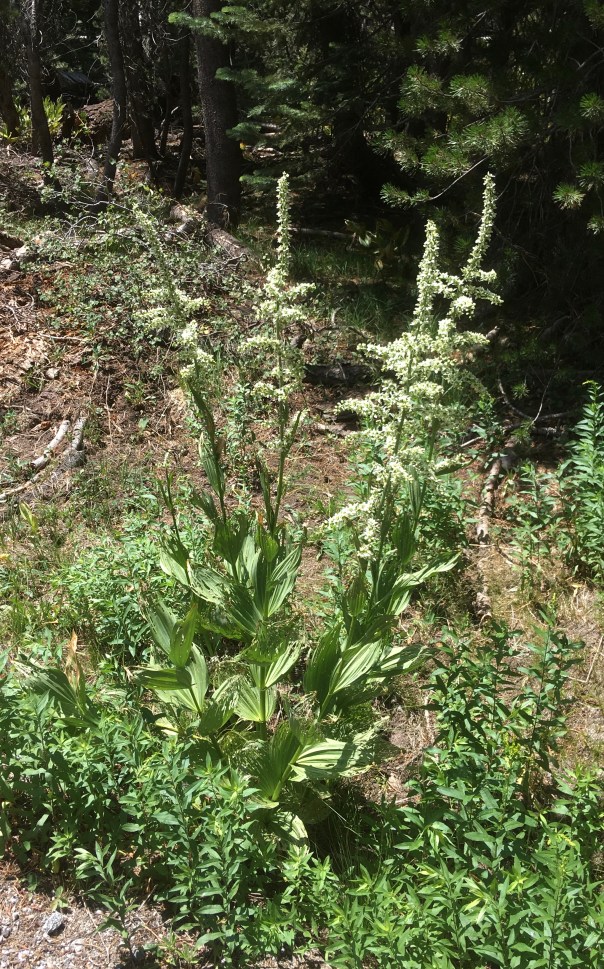
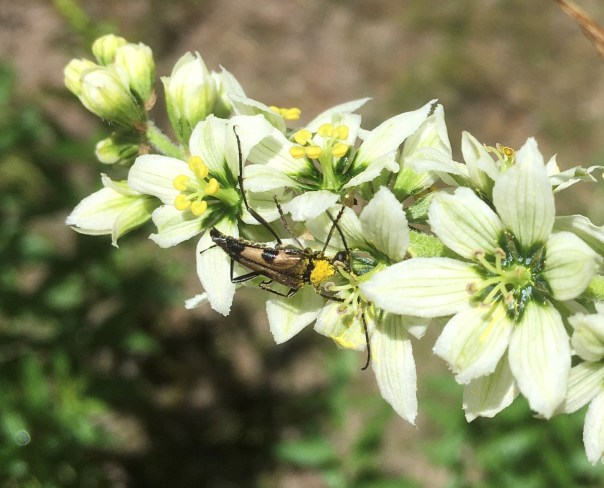
The corn lilies were blooming, and a beetle was on site for that glorious event, seeming to have lost its head over pollen:
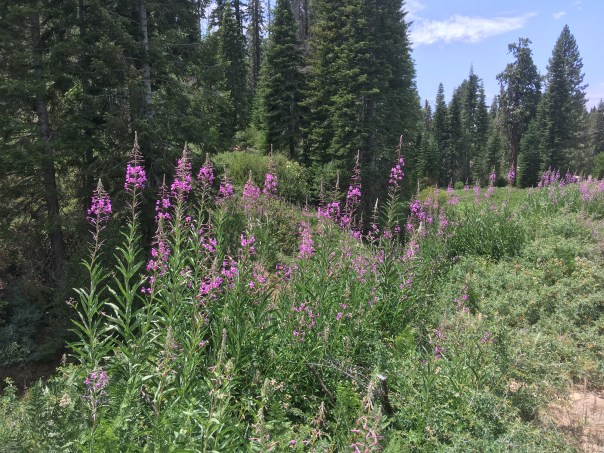
Fireweed waved its purple flowers in the breeze. “It earned its name because this plant is the first colonizer in the soil after forest fires.”
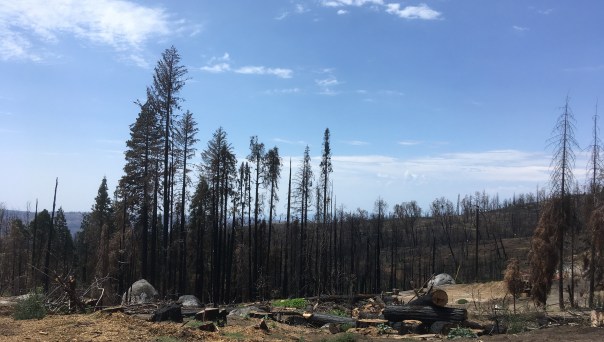
This next picture shows an area ripe and ready for some fireweed to sprout and grow; it is a landscape resulting from the Creek Fire last fall.
That was the huge fire that necessitated closing the highway that we use to get to our cabin, the same week that Soldier’s family and I had planned to be up there. We went to the beach and took smoky pictures instead.
Already I saw wild roses blooming among the stumps, and this healthy milkweed:
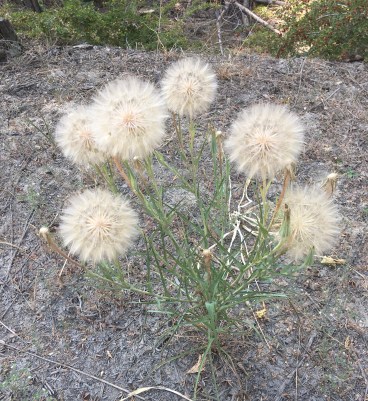
I often have run across wildflowers with buckwheat as part of their common name. This page shows you how vast is that family, called Polygonaceae, that includes mountain sorrel, curly dock — and rhubarb, of all things. But the strange species I saw a lot of on my drive was Naked Buckwheat.
It has strong, wire-like stems that are tall and bare for most of their length, with white puff-balls at the tip.
Bridges’ Penstemon
I wanted to get a nice picture of the elder bushes in flower, and when I squeezed in close this bright and rather large beetle got my attention:
I began to think of all the fascinating and complex creatures that live their (often short) lives in “obscurity.” I bet no one else had ever seen that bug. God lavishes the earth with life and beauty as an expression of His generosity and love.
As I went down the mountain, it was like an hours-long birthday party with Him saying, “Stop here. See that flower? It’s one of the special gifts I’m giving you today.” Then, “Look there! A red and black bug I chose just for you.”
He gave me sneezeweed because they are my old friends. He introduced me to a hawk for something new. Butterflies fluttered, proposing the very thing to which I was disposed. This place was not paradise, we can tell that by the fire damage, and many other aspects. But there was a little taste of Paradise in my soul, and praise swelling in my heart.
In my first view of the ocean upon arriving at the coast,
I could see whitecaps.
Velella velella
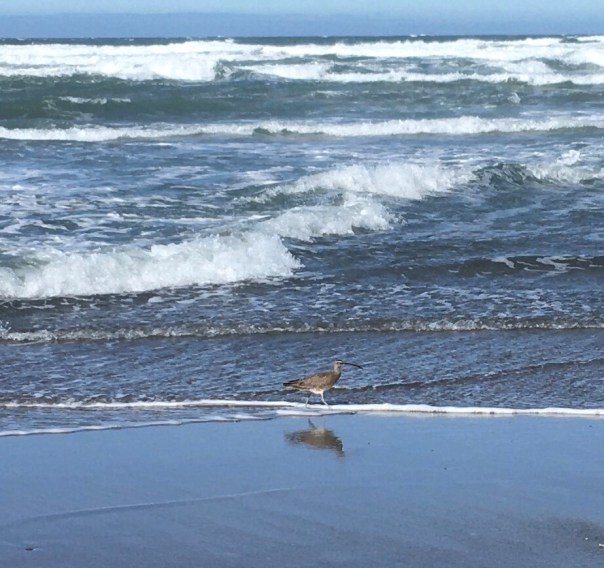
But the wind wasn’t too bad down on the beach, and I encountered new creatures: Long-billed Curlews and a By-the-wind Sailor (Velella velella). After I took a few blurry pictures of the wind-blown Sailor, a wave rushed up and snatched it back into the deep. Lucky for me I had seen a (much better) picture of that same species of “gelatinous animal” just last week. The one I saw in person was probably less than 2 cm. in diameter.
The curlews reminded me of the Godwits I’d seen last summer. But the bills of Godwits curve upward, and those of the Curlews curve downward. There are many other differences, I’m sure, such as, the Godwits seem smaller and leggier — but the bill was the thing that helped narrow my search. Here is a better photo from the internet.
Dozens of geese flew overhead in a ragged and strung out V. They were no doubt fighting the wind up there as I was doing below.
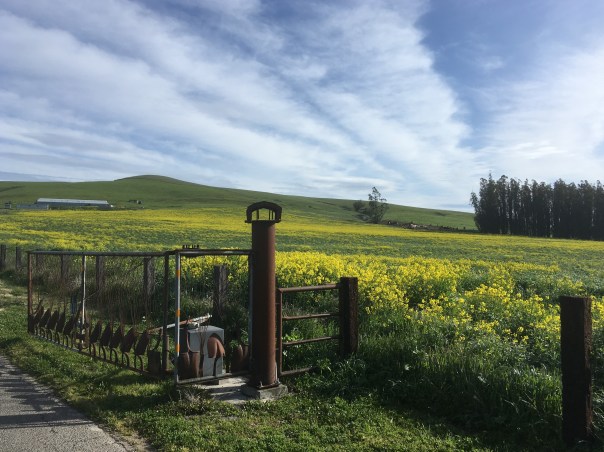
My drive to and from the coast was through lush farmland and pastures, with black-and-white cows grazing on green green grass. And mustard twice as tall as at my last viewing.
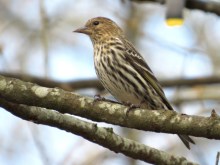
The local pine siskins are experiencing an epidemic, and I feel very bad about it for their sake and mine. Watching the birds at the feeders in my back yard, seeing the number of species increase every season, learning to identify and recognize most of them — it’s all been a steady comfort and joy. But now I need to encourage them to go elsewhere and find food in other, larger spaces.
It appears that in the case of the pine siskins, and in some places goldfinches, when they unnaturally congregate at feeders they keep spreading salmonella around. I’ve read news articles from British Columbia, Oregon, and California, all saying basically the same thing:
“Salmonellosis is an infection caused by bacteria of the genus Salmonella. These bacteria primarily attack the digestive system, notably the throat, making it difficult for the birds to feed. The symptoms are not always obvious in wild animals, but infected birds may appear thin, fluffed up, and lethargic.
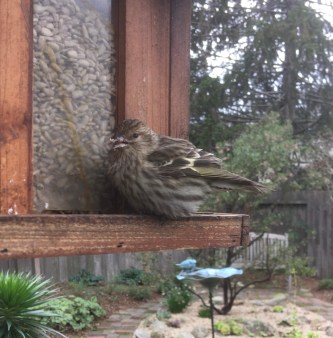
Pine Siskin at my feeder last week.
“How you can help birds avoid disease:
“Salmonellosis is primarily transmitted by fecal contamination of food and water by sick birds, although it can also be transmitted through bird-to-bird contact.
“High traffic spots, such as bird feeders, create a source point of transmission and can exacerbate the spread of this deadly disease. Removing the feeders completely is the best solution to encourage birds to disperse, thereby minimizing the potential for infection. If you choose to keep your feeders up, they must be properly maintained to foster a healthy bird environment.”
They make it sound as though the outbreak has developed this winter, but now that I’ve seen images and descriptions of sick birds compared with healthy, I’m pretty sure that last winter some of the pine siskins (which I thought then were sparrows) at my feeders were ill.
Just last week I encountered one at the tray feeder who I now understand was “lethargic.” At the time, and back in 2019, I only wondered at how calm and friendly they were. I also thought it strange that some of them would sit contemplatively on the hopper feeder, doing nothing. Now I get that they were too weak to fly away.
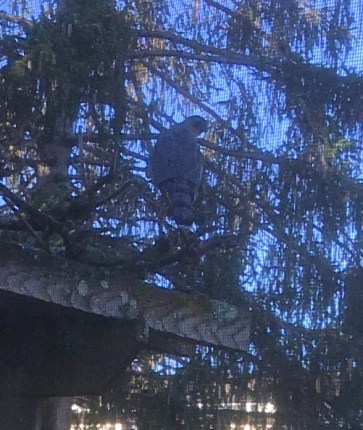
The Cooper’s Hawk that has been coming around more boldly all the time, taking advantage of the flocks of finches, will probably stop visiting. I plan to stop feeding the birds at least until next winter. I am not the tidiest housekeeper anywhere, and if I need to disinfect the birdbath, fountain and feeders regularly in order to be a good bird-feeding friend, I think it best to revert to nature.
How can I explain to these creatures about the changes? “This hurts me more than it does you!” I do have lots of plants with seeds or fruit that various birds can enjoy, and have been eating all along. Plus insects — yes, a good supply of those. Many birds pay little attention to my seed offerings.
And I still have the hummingbird feeder!
On another garden topic, the daphne by the front door is getting really big and is covered with blooms right now. When the sun shines on it in the morning the scent wafts up at me when I go in or out, and I swoon.
 This afternoon I stood on a bridge overlooking the creek, and watched a Black Phoebe for about ten minutes. He would briefly perch on a branch near the surface of the water, and then fly up, do a quick whirl of an aerial pirouette, and come down on the same or a nearby
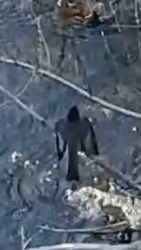 twig. Over and over again… he must have been catching insects.





 Spreading Dogbane