Category Archives: books

What makes Mrs. Quin happy.

gl-1-10-p1060501When Mrs. Quin was a wisp of a girl, the house called China Court was her favorite place to be, though she was only grudgingly allowed to cross the threshold, and that by the back stairs. She grows up and by strange twists and turns becomes the main character, an old lady who dies in her sleep in the first sentence of Rumer Godden’s novel China Court.

“Shouldn’ us pull the blinds down?” asked Mrs. Abel.

“She wouldn’t like it,” said Cecily. “She always says, ‘Don’t shut out the garden.'”

Soon begin flashes back to a younger  and younger Mrs. Quin at various stages of her life. We get to know her through the memories that play in the mind and heart of her in-laws and other people who held powerful positions in the family over the generations. Bits and pieces of stories of a score of relations, their suitors and servants are gradually revealed to the reader in a very realistic way. Haven’t we all had the experience of knowing someone personally for many years before we learn a surprising or even shocking fact about them?

In the case of this novel, we are taken back to the building of this granite house in the mid-19th century, and the first parents who birthed nine children there. Some of that first “Brood” marry unhappily, and some behave very badly, but by the end of the book you see them all, and the following generations peopled with similarly bumbling humans, with varying degrees of understanding. I think this is because of the example of Mrs. Quin, who has the ability to accept happiness when it comes to her, and to keep humble in the awareness of how little can be known, even of the ones we love and communicate with.

Homes must know a certain loneliness because all humans are lonely, shut away from one another, even in the act of talking, of loving. Adza cannot follow Eustace in his business deals and preoccupations….Mr. King Lee, kissing Damaris, has no inkling of the desolation he has brought her….Jared hides himself from Lady Patrick, and John Henry and Ripsie, in their long years together, are always separated by Borowis. The children especially are secret….It is better not to ask questions…. “Even if they told you,” says Mrs. Quin, “you would never really know.”

This kindness and compassion for her characters is one way in which Rumer Godden reminds me of author Elizabeth Goudge. Also, as with Goudge, there is the feeling that things will work out in the end, that in kairos, or God’s time, He will gather all the loose ends and broken parts together and even we will see the sense of them. For me, reading China Court was a chance to see a century’s worth of this household’s loves and sorrows with a fraction of that heavenly perspective.

Mrs. Quin had many years’ experience with being treated cruelly, and not getting what she so much wanted. But she early on seemed to learn the wisdom of seeing that she was quite content at present, so why make a fuss about all this water under the bridge? One of the things that always gave our protagonist great satisfaction and rest for her soul was the garden, so I can relate to that major aspect of her character.

A fact of history that didn’t seem to be fair, Mrs. Quin discusses with her daughter-in-law:

“I think that’s sad,” says Barbara.

“Sad and glad,” says Mrs. Quin.

How can something be sad and glad at the same time? For most of the Quin women, it has been like that. “All unhappiness,” says Mrs. Quin, “as you live with it, becomes shot through with happiness; it cannot help it; and all happiness, I suppose, is shot through with unhappiness. But I was usually happy….”

I enjoyed the descriptions of the girls’ Victorian party dresses, and of the old furniture that Mrs. Quin never bothered to re-upholster, and of the teatime ritual:

“Two teapots stood ready and warmed; the cups had to be warmed too for, ‘If the tea touches anything cold it loses the aroma.’ Mrs. Quin impresses Tracy with that. ‘Only vandals,’ says Mrs. Quin, ‘put the milk in first.'”

Towards the end of the book the serving of tea even brings a brief respite from squabbling among some relations whom Mrs. Quin would likely have relegated to the category of Vandals.

A thread that connects all the parts of the story, shown to us in Mrs. Quin’s bedroom in the first chapter and on the introductory page to each chapter after that, is a medieval Book of Hours. Other old and rare books and an old maid of the Brood who collects them come to play a crucial part in helping Mrs. Quin, in her death, to right many wrongly drifting tendencies in the family and to bring a very satisfying ending.


gl-1-10-p1060502

Taking the cure with Rumer.

Is it unnecessary and even unprofitable to analyze my reading habits? Why not just read what I like? Because I don’t seem to know what I like, or what I have the strength for. In times of stress, such as in my current bereavement and during my husband’s illness before that, the intellect still jumps at the chance to read books of theology or philosophy, so I have gone on acquiring stacks of them… only to find that my mind will not be engaged enough to get through the first chapter.

Or, I try a “good novel,” hoping to be pulled into the story and have some vicarious excitement. Aha – that is the problem, as I realized yesterday, sick and sitting by the fire with a quiet book. I need rest, not excitement. I need, as I wrote a few years ago about another novel, to embark on a reading journey “as one takes a needed vacation or The Cure at a sanatorium.”

Rumer Godden is a writer whose presence on the pages of her fiction or non-fiction is always strangely comforting and nourishing to me. I suppose my recent acceptance of weakness led me to take her China Court off the shelf, after passing over it for years. Lately it seems that I have almost daily been wandering among the four rooms that house parts of my library, as I look for the Right Book. As I held this one in my lap I mused about why it is that.

When you need to heal and build strength, where do you like to be? Me, I like to be either alone in an orderly and comfortable place, or with kind and gentle, competent people who take care of the place and might even cook for me. If there is a garden attached, and lovers of trees and flowers who might 27a16-p101064228129fruitstandgardenstroll its paths with me, all the better. I could sojourn in this place indefinitely, until I felt in my bones the renewed energy that would prompt me to go home and dig in my own garden or clean house.
Being in Rumer Godden’s books is like that. And China Court is especially so, because it is about a well-appointed house and the generations who have lived and worked and died there, servants making up beds with fresh, age-softened linens and a grandmother who secretly hand-picks little bouquets for her favorite people to find on their nightstands. It has the drama of stories going back a hundred years, if you want that, but it is mostly about being there with real humans, many of them quite sympathetic, and of course none of them requiring anything of me.

I haven’t read too far yet  🙂 but I was charmed by this one scene and wanted to share it:

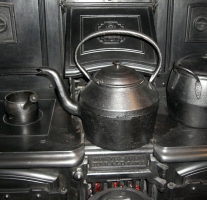
In the big house in Cornwall the large Quin Family gathers downstairs while breakfast is being cooked in the kitchen nearby. As the father Eustace reads from the Bible and prayer book… victorian-range

The smell of bacon drifts across the Lord’s Prayer — always for Eliza, the two are mingled, though she does not, at that age, get any of the bacon — and as the smell rises Eustace increases his pace….breakfast is waiting; the children, upstairs, have porridge and milk, white bread and the second best butter; but for Eustace and Adza the morning-room table is laid with porridge in blue and white plates, cream, brown bread, muffins, honey and rolls, while the bacon keeps in a silver dish over a flame, with another dish of kidneys or sausages or sometimes kedgeree.

-from China Court by Rumer Godden

Do you wonder what kedgeree is? I had never heard of it, but when I read on this page Kedgeree and saw the picture, it made me want to try making some myself. Sounds tasty!

Last week I was frying something using bacon fat left over from our Christmas feasting, and the smell of it warming in the pan brought back happy memories of my father and his mountain cabin, my grandma’s kitchen… it was curious how nourished I felt, before I had taken a bite.

I enjoyed reading about this Victorian Era breakfast and the well-supplied kitchen and staff that produced it. I sipped my tea before the fire, glad that I long ago graduated from the Porridge Upstairs stage of life, because I do like a little meat with my breakfast, though I haven’t tried kidneys yet. Winter days are cozy when taken with Rumer Godden, some bacon — and of course, prayer!

Mountain tea, rain, and a little book.

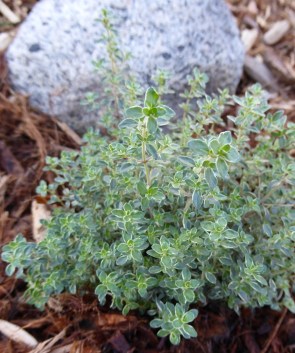
gl P1030396 thyme
thyme

It might seem to my friends to make perfect sense, that I would start the new year by reading a book that is about gardening. But I don’t normally enjoy such topics in print, preferring rather to have my own hands in the dirt and my eyes beholding whatever garden the whole of my body is present with. But Inheriting Paradise: Meditations on Gardening by Vigen Guroian drew me in for several reasons:

*It was a Christmas present from Pippin and the Professor, personally chosen for me, and not yet buried in stacks or lost in the large community of other yet-unread books on my shelves.

*Of the books I was gifted with, it is the smallest and shortest, fewer than 100 pages, which makes it easy to read while lying sick in bed (which I have been a little) or anytime before falling asleep in health. This minimalist aspect also leads me to hope that I might be able to stick with the author to the last page. It would be great to restart my Recently Completed list before January is gone.

*I’m familiar with Guroian and have heard him interviewed on the Mars Hill Audio Journal, as he walked around his garden talking about the various plants and about this book.

*I knew that his book was not about gardening as a thing that could be detached from the Giver of Life, but it would also be a book of philosophy and theology, and probably include some good quotes from world literature.

gl1-p1060466

Added to all these is a kind of fellowship with previous owners of this “used” book. On the title page an address label is glued on near the top, showing that Elizabeth A. Weber claimed the book at one time and was willing to leave her mailing address in it. On the next page are both the moving dedication of the author to his wife and a handwritten note from the year of the book’s publication.

Deeper inside were flowers folded in vintage Kleenex. But not too vintage – the book’s copyright is 1999.

I think I will want to share a few quotes from the book with you as I go along. Here is one:

“It is not the gardeners with their planting and watering who count,” writes St. Paul, “but God who makes it grow.” Indeed, we are not only “fellow-workers” in God’s great garden; we ourselves are God’s garden (1 Corinthians 3:7-9, REB). This is the ground of our humility as mere creatures among all other creatures loved by God.

It wasn’t a day to be a fellow-worker in my garden, even to clean up dead flower stalks. I was glad to be indoors, feeling loved by the rain’s healing and blessing. A brief hailstorm added excitement; immediately the nuggets of ice were melting away. I had just come inside from washing off that table when the shower began.

gl1-p1060472

The product of someone else’s gardening or farming efforts came in the form of Macedonian Mountain Tea this afternoon. Mr. and Mrs. Bread tended to me by bringing some to the house to speed my healing. I’m certain this is the same tea I drank cold from a tall glass when I was in Turkey long ago. That was also called mountain tea, or ihlamur.

There seems to be confusion or disagreement in some places (even in my Turkish dictionary) about what constitutes Mountain Tea, but everyone will tell you that it is very healthy. What I am drinking seems to be some kind of Sideritis, if you want to look it up. “Mountain Tea” sounds much more wholesome, though, don’t you think?

gl1-p1060478

To your health!

A certain reading skill is dwindling.

This year was not a good one for me sticking with books and completing them. I started reading at least three times as many as I finished. The likelihood of my getting to the end of a book in 2017 remains iffy, so to show that I had what it took at least a few times in 2016, I will list here (so you don’t have to click to the Books and Reviews page) my Books Read, most recent at the top. I wrote reviews for two of them — make that three, sort of — and you can use the links to those if you want.

At least I can say that most of these are worth reading again, and they are worthy of better reviews than I accomplished. I’m starting the new year with just one very small book in hopes of getting off to a good start!

Read in 2016

The Fellowship of the Ring by J.R.R. Tolkien
Acquiring the Mind of Christ by Archimandrite Sergius Bowyer
When Breath Becomes Air by Paul Kalanithi
Between You and Me by Mary Norris (audio)
Seventeenth Summer by Maureen Daly
The Year of Living Danishly by Helen Russell
Laurus by Eugene Vodolazkin
All the Light We Cannot See by Anthony Doerr
Babylon’s Ark by Lawrence Anthony (audio)
This House of Sky by Ivan Doig

Happy New Year! And may your own reading nourish your mind and heart!

books-too-many-nyt

Illustration from the NYT supplement “Holiday Books.”
Housemate Kit said it reminded her of me.