I miss spending time in the public library, not that I have had a great deal of that experience. In my youth the city library was not a convenient place to study, being ten miles from our house, and my elementary school had no library.
When I stayed with my grandma she would actually drop my sisters and me off at the branch library in Berkeley while she ran errands and we could roam at liberty for an hour. I’m sure none of us knew what a lavish gift that was, but from this vantage point I can appreciate the sublimity, and the mental picture of the room where I spent the most time is still there.
Back home in the country we depended on the bookmobile that every two weeks provided plenty of the sensory excitement that is the subject of the poem below. The visits were brief and fairly businesslike, as we had to jostle a bit with the other young patrons in that cramped space and there certainly was nowhere to sit and ponder. Mom was waiting outside in the car.
I paid no conscious attention to anything but the book titles, being mainly interested in getting my stash to take home and savor in a more purely intellectual fashion. But now, so long removed, if I think on that county van for only a minute, I can remember the clunking sounds of books being pulled off shelves and put back, and our tennis shoes scuffling around in the grit that we’d brought in from the gravelly parking lot. The librarian-driver would speak as few quiet words as possible as she stamped our cards. And the scent of the books — it’s still in me.
Library
by Valerie Worth
No need even
To take out
A book: only
Go inside
And savor
The heady
Dry breath of
Ink and paper,
Or stand and
Listen to the
Silent twitter
Of a billion
Tiny busy
Black words.
Of Cape Cod and summering there, one man generations ago said, “It is the dullest, flattest, stupidest, pleasantest, most restful place on the whole coast. Nothing to do and we do it all the time.”
Sometime back I succumbed to a book on a topic pretty far removed from my usual interests or experience: the life and history of a summer house on Cape Cod in Massachusetts. This book sat on the shelf for five years or so until for some reason I took it down and put it in my suitcase to read on a trip. How and why I ever came into possession of it, I couldn’t remember. Then inside the back cover I discovered a remainder sticker I had removed and put there, which showed that I had found it in the $1 bin at a local bookstore.
The author is George Howe Colt, who as I figured out after some chapters is married to Anne Fadiman, writer of essays I first read in her delightful book Ex Libris. As his story opens, he and Anne and their two children are opening up the eponymous Big House for the season, in what might be their last summer as its owners.
Colt writes richly about the history of Cape Cod and summer homes generally, and about his particular family’s particular house on the Cape. It hasn’t been that long, really, that people have lived this Cape-Cod-summer lifestyle that was already near to extinction when the author told his tale more than ten years ago. In the early 19th century Bostonians started building summer homes there where previously it was thought most unsuitable, as Thoreau wrote: “It is a wild, rank place, and there is no flattery in it.” In previous eras homes were built in more sheltered locations inland from the sea.
I learned that many of our forbears used to think of the ocean unkindly, as a symbol of spiritual barrenness, and they did not want to go into or live near it — and then over the course of a century they had changed, to the point where they thought that living close to the sea, swimming in it, and even drinking buckets of sea water the most healthful things they could do.
Aerial view of Cape Cod (from the www.)
I was interested in the architecture and construction of the Big House, so much larger than many summer houses that no way could it be called a cottage. Size is the only luxurious thing about it, though. Residents and guests must wash dishes by hand in a kitchen where crickets abound, sleep between old mismatched sheets, and prop open many of the sixty-seven windows with a wooden coat hanger or a copy of Greyfriars Bobby.
The whole phenomenon of Old Money and what Colt calls the Boston Brahmin is explained: “If one had old money, it followed that one had old things: the wealthier the Bostonian, it has been said, the more dents in his car and the more holes in his clothes.” I know this is common knowledge to many people but the concrete example of Cape Cod lifestyle brought it all home to me.
Of course, summer somehow relates to everyone’s childhood, too, and that keeps the traditions going: “We would never tolerate the Big House’s inconveniences in our winter homes, but this is different: we change in the winter, but during the summer — a season in which we regress to an innocent, Edenic state by replicating the experiences we had as children — change is heresy.”
For the author, the place was such a keystone of his youth that it seems reasonable to him to include in the book many stories and details about the family members who spent their summers there, information that seemed to me often inappropriate, and detracted from the book as a whole. When I read the subtitle, A Century in the Life of an American Summer Home, I did not anticipate hearing details about adolescent sexuality, Colt’s grandmother’s Alzheimer’s, and his uncle’s bunions. A little more focus would have been appreciated.
the author
He obviously cares very much for his whole family and wants to remember every detail for posterity — or is it for the sake of his own sentimentality that he cannot edit out anything? Seemingly no indescretion committed or indignity suffered by any relative can be omitted, and I was very uncomfortable reading much of this material. This kind of authorial behavior kept inserting Colt and his personality front-and-center for me, and I mused that he was really writing not merely The Big House but George’s Big Loss.
I admit that if Colt had strained out more stories not directly related to the house, I would have missed hearing the wonderful tale of how his father during the war was hidden from the Germans by a French family, whose daughters later made their wedding dresses out of his white silk parachute. That was one little part I really loved and had to mention!
And I kept reading because Colt is a very good writer and I was imagining myself there in those halcyon summer days the family spent recreating, whether they were washing dishes or playing outdoors. Fishing, sailing, and tennis each have a chapter dedicated to them. And in a chapter titled “Rain” we get a tour of many of the books that were available and savored, and not only on rainy days. After a mention of board games, Colt writes,
“Best of all, there were books. Although it didn’t take rain to get us reading in the Big House (in fact, reading inside on a sunny day gave us a deliciously guilty feeling), on an overcast afternoon people would be curled up with a book in almost every bedroom, with three or four of us draped over the sofas in the living room, physically proximate yet in separate worlds.”
It’s been almost two years since I finished reading The Big House, but as I worked on wrapping up this review that I began back then I am tempted to start reading it through from the beginning again — well, maybe I could skim over those indecorous parts. Because it is just that kind of book, to be read in summertime as a delicious seaside vacation.
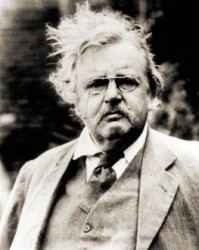
Today is the birthday of our dear friend G.K. Chesterton. He was born in 1874, which makes it 140 years since God gave him to the world. I’ve begun reading Chesterton’s autobiography two times, and it seems the least interesting of all his writings I’ve tried, because it doesn’t come naturally to the author to talk about himself. Much of what I read in the first chapters was about other people, perhaps well-known in his day but not to me.
Chesterton liked people, as this clip from The Daily Herald in 1913 attests:
“Quite a swamping majority of the men and women I have met in my life I have liked very much indeed. I have never met that Ordinary Man who seems to bore some people so much. All the men I have met have been the most extraordinary.”
It’s a good thing that the man’s own personality and character shine through his writings, so that we may know how extraordinary he was and is. He is for me a stellar example of the sort of writer with whom a reader can have a rich relationship. You might think from looking at my blog today that he is my literary Significant Other, being the author of my one current Bedside Book and my theme quote, and the subject of this post. He isn’t even my favorite author, but I happen to have put his birthday on my calendar.
A few years ago, for the July/August 2011 issue of Gilbert Magazine, the editors asked some Chesterton experts, “What is the most Chestertonian book you’ve ever read that was not by G.K. Chesterton?” A couple of them thought there was nothing else that could compare.
But James Woodruff named The Wind in the Willows, which happened to be published the same year as Chesterton’s Orthodoxy, because it is “a celebration of the primal things Chesterton loved — Home and Friendship and Adventure — all suffused with a sense of wonder and lived out by characters who write poetry and go forth to battle and who eat and drink with right good will…”
Nathan Allen named The Abolition of Man by C.S. Lewis, “…because he deals with a lot of the issues that Chesterton cared about: education, the loss of a sense of a common culture, and so forth.” Other titles suggested were That Hideous Strength, also by Lewis; The Phantom Tollbooth by Norton Juster; The Restoration of Property by Hilaire Belloc; The Restoration of Christian Culture by John Senior; and Pinocchio!
I wish I had a tidy way to take a few thoughts from and about this hero of mine and craft them into a fitting birthday tribute, but my skill and understanding don’t come near the level of my appreciation. [To demonstrate that fact: when I wrote that sentence I wasn’t yet aware that I had somehow moved his birthday forward 20 years. Ack! I think it’s fixed now.] Maybe after some more years — for his 150th? — I will do better than this mishmash. For today I will stop and let Chesterton’s own words from What is Right With the World convey the kind of attitude that has made him a favorite of mine and of ever-increasing numbers of readers:
“We are to regard existence as a raid or great adventure; it is to be judged, therefore, not by what calamities it encounters, but by what flag it follows and what high town it assaults. The most dangerous thing in the world is to be alive; one is always in danger of one’s life. But anyone who shrinks from that is a traitor to the great scheme and experiment of being.”
Every day a poem comes into my e-mail inbox from The Poetry Foundation. Even this solitary Poem-a-Day is often too much for me to handle, and I either let my supply build up for days and/or I delete some poems after a brief scan. But on the occasional day I take the bait and end up reading several poems and stories about the poets.
A couple of months ago there was a poem by X.J. Kennedy that got my attention, because although I knew his name from a poetry textbook I own, as he was co-editor with Dana Gioia of that book, I hadn’t seen any of his own poetry before. I was predisposed to like him because of his collaboration with Dana Gioia whom I greatly admire (As you will see if you check out tags with his name here on my blog).
Kennedy was born in 1929 and wrote science fiction in his youth. His poem-writing seems to have come a little later, along with journalism work during the war, and teaching English. Here is a short poem from 1985:
You Touch Me
You touch me.
One by one
In each cell of my body
A hearth comes on.
When I read that he had been writing a lot of poetry for children in recent years, I borrowed several books by him from the library to investigate. A book of nonsense poems wasn’t my style, but The Beasts of Bethlehem is quite wonderful, with short poems from the perspective not just of the usual farm animals, but some critters less famous for being near the Christ Child, such as a beetle, a bat, a worm, and this:
HAWK
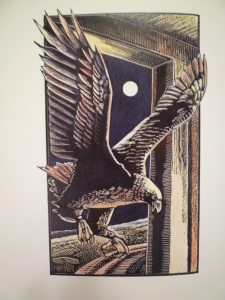
Before Christ, yesterday, From clouds I dived, gave chase, And fed. But in this place Of peace I shall not prey
On living things. Those six Young hares ripped from their burrow Were lovely, though. Tomorrow, Old plump hen, watch your chicks.
As you can see, the animals not only think to themselves about the Event, but are in conversation with each other. Many also convey Kennedy’s sense of humor that is not without reverence. I have already bought three copies of this book so that I’ll be ready for next Christmas.
The Owlstone Crown is a novel Kennedy wrote for middle-schoolers, I think. It features children who accidentally fall into an alternate world where they help to rescue their relatives from slave labor. I was first off charmed by the presence of a talking ladybug, but it turned out to be a man ladybug who was a wisecracking tough character, and I didn’t like him much even though he was the type who has a good heart. I did see the book through to the end, but can’t imagine anyone to whom I couldn’t recommend some much better story.
My favorite discovery from X.J. Kennedy (if you Google him you can find out how and why he got those initials) I have kept for last. It is his Child’s Introduction to Poetry titled Knock at a Star. I wish I could have read the whole thing with my children, but it was published a little late for most of them, in 1999. So I bought a few copies for grandchildren who are at the right age right now, or will eventually be.
The first section of the book is “What Do Poems Do?” and the answers are Make You Smile, Tell Stories, Send Messages, Share Feelings, Help You Understand People, and Start You Wondering. Each of those chapters includes ten or more poems, many by well-known poets and not specifically for children, which I appreciated. Too often I’ve seen collections that were so dumbed-down as to be insulting, and not a good kind of literary food for inculcating good taste.
Even the humorous poems include “Termite” by Ogden Nash. This one from the Understanding People section is by Valerie Worth
My Mother
My mother Wasn’t like Some others.
She didn’t Make cakes or Candied apples.
She sat down Beside her Sewing basket
And stayed Up late Reading poetry.
In Section 2 the question “What’s Inside a Poem?” is answered. Here a poem by Wallace Stevens illustrates that Images may be inside. And Word Music is shown through this poem by Emanuel diPasquale, “Rain”:
Like a drummer’s brush, the rain hushes the surfaces of tin porches.
Beats That Repeat are found in one of my favorite “Opposites” poems by Richard Wilbur, and in others by Robert Frost and Gertrude Stein. The descriptions of poetic technique are brief and helpful, so we can move on quickly to the poems themselves.
There are limericks, of course, and songs (“Blowin’ in the Wind” by Bob Dylan) and haiku. And a last section on writing your own poems. I just think this book has everything for the child of eight or ten and older, and if I’d read something like this when I was young I’d be even more like that mother in the poem. I wonder just how late she stayed up?


 Today is the birthday of our dear friend G.K. Chesterton. He was born in 1874, which makes it 140 years since God gave him to the world. I’ve begun reading Chesterton’s autobiography two times, and it seems the least interesting of all his writings I’ve tried, because it doesn’t come naturally to the author to talk about himself. Much of what I read in the first chapters was about other people, perhaps well-known in his day but not to me.
 ho eat and drink with right good will…”
 what flag it follows and what high town it assaults. The most dangerous thing in the world is to be alive; one is always in danger of one’s life. But anyone who shrinks from that is a traitor to the great scheme and experiment of being.”
 ago there was a poem by X.J. Kennedy that got my attention, because although I knew his name from a poetry textbook I own, as he was co-editor with Dana Gioia of that book, I hadn’t seen any of his own poetry before. I was predisposed to like him because of his collaboration with Dana Gioia whom I greatly admire (As you will see if you check out tags with his name here on my blog).
 , yesterday,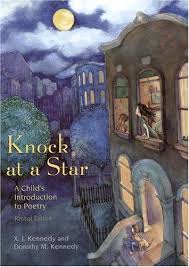
 Gladsome Lights