To prepare for a recent road trip, I visited the public library looking for a book on CD. I ended up with a whole stack of boxes to take along in the car later that morning and was very pleased with a few of them.
My car was also loaded down with a Thanksgiving turkey, baking pans and tablecloths and some already cooked food, things to contribute to a feast at Pippin’s house. I was taking myself early to help prepare, and Mr. Glad would follow later.
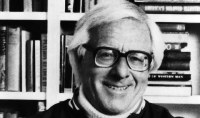 |
| Ray Bradbury |
Two slim library cases held one disk each of an introduction to a book in the Big Read program of the National Endowment for the Arts. I was only vaguely familiar with the list and the program, not having any family member that I know of participating. But of the offerings I browsed I was interested in A Wizard of Earthsea by Ursula K. LeGuin because of recent recommendations from someone, I can’t remember who. And Fahrenheit 451 by Ray Bradbury was a book my reading group discussed a decade or so ago. The recordings were about 30 minutes each.
When I slid the Wizard introduction into the player and the narrator’s voice came into my car, it took me a few seconds to realize that it was Dana Gioia, my favorite book reviewer, poetry critic, and literature teacher. His voice was recognizable, but his intonation was all jazzed up, brighter and more dramatic, I suppose to keep the average somewhat reluctant American reader listening.
His commentary was in brief snatches, and mostly introductory to several other authors who talked about the book, including LeGuin herself, and to short passages read from the text. None of the comments or readings was longer than a minute or so, and most were much briefer than that, which made it easy for me to pay attention; I’m sure this feature was also designed for listeners of diverse ages who are used to having their short attention spans catered to.
 The Big Read program is intended to reverse or at least slow the decline in the number of readers in our nation, and I haven’t heard if it is working. But this recording was a wonderful introduction to LeGuin. I enjoyed myself thoroughly while listening to what seemed like a sort of CliffsNotes in audio technicolor. There is music in the background that also adds to the drama.
CliffsNotes (Yes, they do squish the name together like that nowadays) seems to have some videos out, and digital flashcards, but for literature I think these NEA audio files would be much preferable, being a better bridge to visual and private reading activity than listening to a talking head, as I assume the CliffsNotes videos are.
The general plot and themes of the novel were discussed, and the particular skills of that writer. LeGuin talked about her background as a reader and writer and how she developed into the writer she is. Her childhood was spent in an intellectually rich household in Berkeley, where her father founded the anthropology department at the university and her mother wrote a book on Ishi.
There were many refugees from Europe in town then, such that “everyone had an accent.” It seems that her exposure to many cultures nourished her imagination to create new worlds and people groups. The Earthsea books do sound appealing to me now, and if I keep looking at that cover illustration I pasted here I’ll be bound to buy the first one soon.
But the first CD I took out of the box from my library stash was not from the NEA; it was a 2-disk collection of Popular Poetry, Popular Verse, Volume II from Naxos AudioBooks, a broad offering of everything from Shakespeare and Longfellow to Donne and Robert Herrick. It’s not surprising that I didn’t remember hearing most of the poems before — but I’d like to listen again. The many love poems made me miss my husband whom I had only seen a couple of hours before.
Quite a bit of music was interspersed between groupings of poems. I skipped most of this because I was impatient to hear more poems, and I had no idea how long I might have to wait through the instrumental portions. The poems were read by Tony and Jasper Britton, and by Emma Fielding, all of whose voices and reading were not over-dramatic or annoying in any way. Here are some of the rich words that fell upon my ears:
Prayer (I)
By George Herbert
Prayer the church’s banquet, angel’s age,
God’s breath in man returning to his birth,
The soul in paraphrase, heart in pilgrimage,
The Christian plummet sounding heav’n and earth
Engine against th’ Almighty, sinner’s tow’r,
Reversed thunder, Christ-side-piercing spear,
The six-days world transposing in an hour,
A kind of tune, which all things hear and fear;
Softness, and peace, and joy, and love, and bliss,
Exalted manna, gladness of the best,
Heaven in ordinary, man well drest,
The milky way, the bird of Paradise,
Church-bells beyond the stars heard, the soul’s blood,
The land of spices; something understood.
Out of the 5+ hours I was on the road on the way up the state, there were only 10 minutes or so that I didn’t need my windshield wipers. The rain was often drenching, so when I had to stop for refueling and resting I was back in the car lickety-split and pushing the Play button again.
I tried a speech by author David McCullough, his Jefferson Lecture in the Humanities from 2003, but he was very dry, in content and delivery. I have found from Mars Hill Audio Journals that some writers of the most fascinating books are not good at speaking even in interviews.
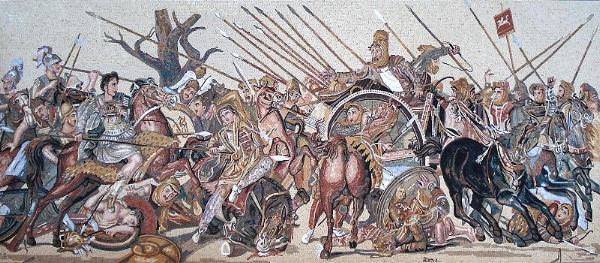
The last thing I was listening to when I arrived home again the day after Thanksgiving was Alexander the Great and His Time by Agnes Savill. It is nine CD’s and I only heard three of them, but it was the most detail I’ve ever read on Alexander, who is certainly a fascinating ancient man. The descriptions of battles sometimes were hard for me to follow, but overall it was an easy “read” and I’m trying to figure out when I might finish it.
I kept thinking about the great contrast between my comfortable life — just sitting in my heated car snacking on food that I had easily bought at the store — and that of the high-achieving, fighting, indomitable but gracious man who slogged all over his world under the harshest conditions and must have had comparatively little ease in his relatively short life.
 |
| Alexander in The Battle of Issus |
And the other Big Read disk? That was my favorite of the two I tried, because I still remembered Fahrenheit 451. It was wonderful to hear the author tell how he and his brother would run, not walk, to the library, and spend hours there every week. He started writing stories as a young child, and never stopped.
Here’s a list of books in the Big Read program. I’m planning to listen to more of the introductory recordings, which are lots of fun even if I never get around to reading the actual book.
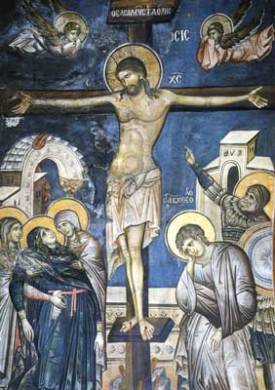 …the air is the sphere of the devil, and the enemy of our race, who, having fallen from heaven, endeavors with the other evil spirits who shared in his disobedience both to keep souls from the truth and to hinder the progress of those who are trying to follow it. The apostle refers to this when he says, “According to the prince of the power of the air, of the spirit that now worketh in the sons of disobedience.” But the Lord came to overthrow the devil and to purify the air and to make “a way” for us up to heaven, as the apostle says, “through the veil, that is to say, His flesh.” This had to be done through death, and by what other kind of death could it be done, save by a death in the air, that is, on the cross? Here, again, you see how right and natural it was that the Lord should suffer thus; for being thus “lifted up,” He cleansed the air from all the evil influences of the enemy. “I beheld Satan as lightning falling,” He says; and thus he re-opened the road to heaven, saying again, “Lift up your gates, O ye princes, and be ye lift up, ye everlasting doors.”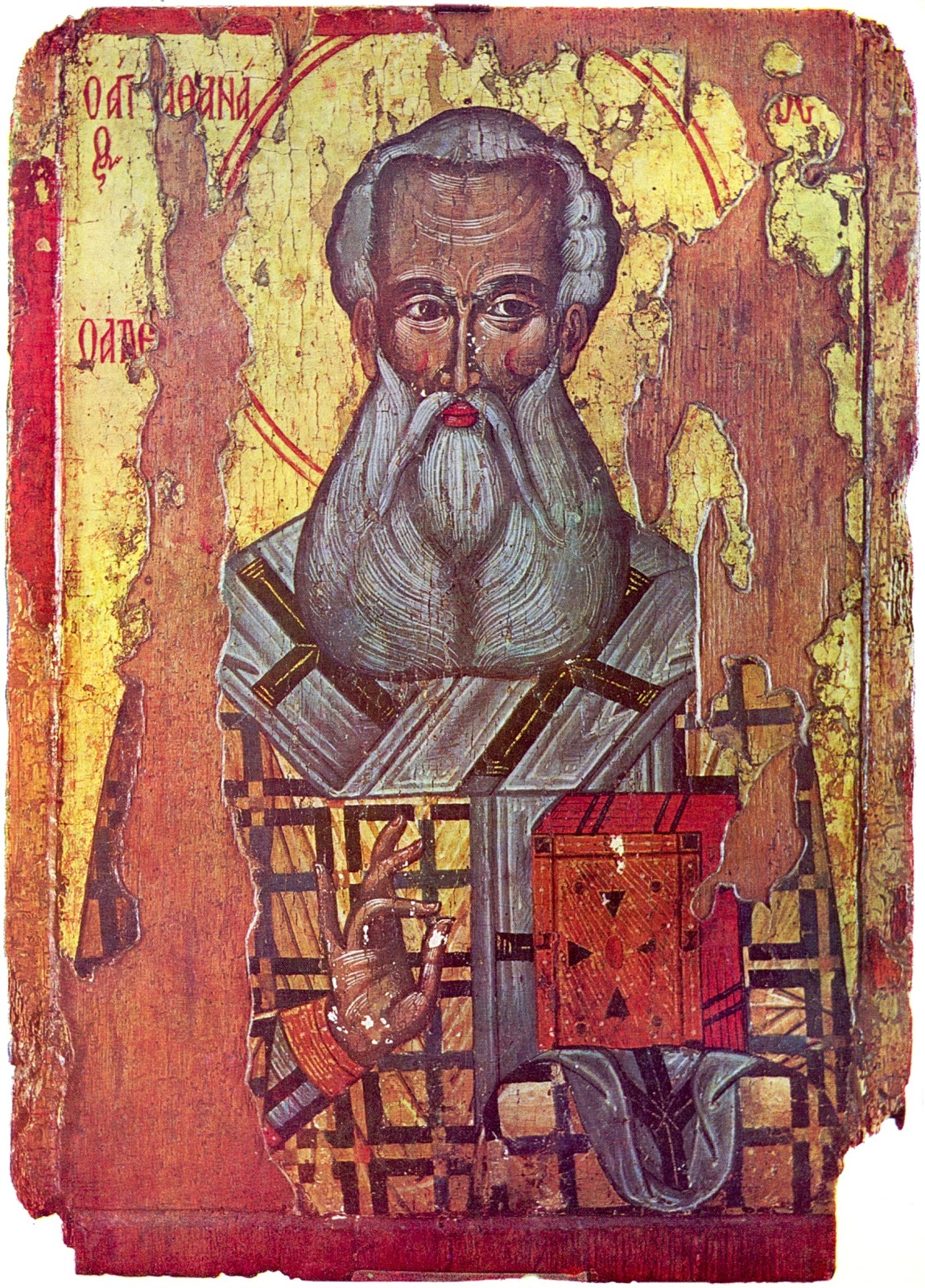

 Van Gogh was with his cypresses for quite a while, getting to know them. I have felt close to some particular trees over the course of my life, starting with a pear tree outside my back door, which for some reason made enough of an impression on my five-year-old mind that it remained the only thing I remember from that house’s yard.
 Gladsome Lights