Category Archives: books

Love and Language

Over my car’s radio yesterday morning I caught the end of an interview with an author talking about her husband’s aphasia and recovery from it. As I drove into the Target parking lot the women were still talking, and I hadn’t heard any names of books or people yet, so I sat in the car a little longer, digging around in my purse to find a tiny black notebook to write in.

Eventually the host mentioned that we were listening to Diane Ackerman talking about her book 100 Names for Love, which tells the story of her husband Paul West’s recovery from a stroke, and the ways in which she was able to help him in the process, though their relationship was challenged and changed. The 100 names were the new pet names he came up with for his wife, when he could not recover the old ones. One of them that she mentioned was My Bucket of Hair. (She has a good head of it.) Many of the nicknames were as unusual and poetic, like My Remains of the Day, and My Residue of the Night.

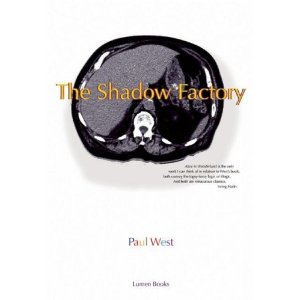
I have tried reading Ackerman before, and there is too much about her prose and perspective that makes her tedious, but the things she said on the radio about love and care-giving and language recovery made me think I really wanted to read this particular book. I came home and put it on my Amazon list, but then I went on to read about Paul West, and found an excerpt online from the book he himself wrote, The Shadow Factory.

In the interview Ackerman had shared that, when he was depressed about not being able to write — and writing had been his profession — she suggested that he write a book about his experience, and he agreed to dictate to her as he labored to find each word and phrase in the rubble that was his brain. The following day he would rework the text, and the whole project became a huge part of his rehabilitation both emotionally and mentally.

I heard Ackerman describe her husband’s book as a “free associative dream version” of how it felt to have a stroke and to heal from it. Those words gave me the impression of it as the type of writing that I find hard to endure. But now that I’ve read this small part, I’m not sure I agree with her description. Here are a couple of paragraphs from the article I link to:

There was a bewildering assortment of false starts and incomplete sentences for the mind only. I no sooner thought of something to say to myself than I forgot it, and I was lucky to get beyond the second or third imagined word. Of course no one in his right mind overheard any of this, the dumb speaking to the silent in a reverse image, so no one was upset. But if this happens 50 or 60 times, one wants a little revenge of some sort. Of course, one was in all probability speaking no kind of written English, so this meant that whatever you said was relevant and you could not say anything irrelevant.

Reading, at which I used to be no slouch, now gave me the most incredible, disheveled experiences of my print-bound life. Now print jigged toward me, then it hung back. The one part of it that was readable swam backward or forward to render the reading experience at best incomplete, or subject to the vilest, maddest vagaries of a proofreader’s nightmare.

So far I am thoroughly enjoying West’s post-stroke prose, and find it much more focused and readable than Ackerman’s, so perhaps I’ll be content with having heard her radio voice, which seems to absorb better, and in my Amazon shopping cart I’ll trade her book for The Shadow Factory.
Wait until after this date – Christmas

Tolkien’s Northern Lights

One of our children has a birthday on Pearl Harbor Day, which is today. So as not to take away from the specialness of that child’s celebrations, in the past we didn’t get into the swing of Christmas until the 8th, and even St. Nicholas Day passed without any notice, because in that era even I wasn’t cued in to feast days.

Now I’m thankful for that habit of delaying, which makes it easier to practice my present Orthodox unwillingness to jump ahead too much. And every day, every week in the church calendar holds a rich and festive remembrance of a person of faith or an event in our salvation history, so that the Waiting for Christmas period is full of bright days that make the time pass quickly. St. Nicholas, for example. But that holy man was at the center of much childlike fun yesterday, and we are moving on already!

Following our family traditions, then, Mr. Glad and I give ourselves permission to get and decorate a tree as early as tomorrow. Still I drag my feet, so as to nudge the bulk of merrymaking toward the Twelve Days of Christmas, the old-fashioned time to rejoice and feast. Our son-in-law fondly remembers Christmas in Ireland when for two weeks after Christmas many people were on vacation, and shops were closed. So much for the cash-register noise.

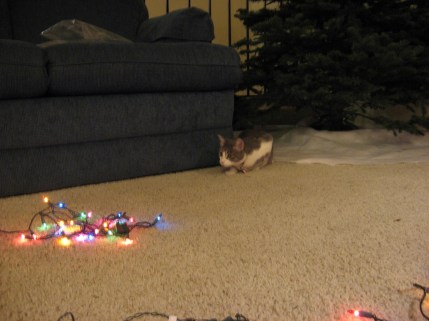
As we decorate the house, there are a dozen childlike joys to partake of, often involving memories of Christmases of 20 or even 50 years ago. And some of those are bittersweet, as memories can be. When Gus the Cat was still alive he made us laugh, the way he stalked the tree lights. This picture is a little bit sad for me, because we don’t have him anymore.
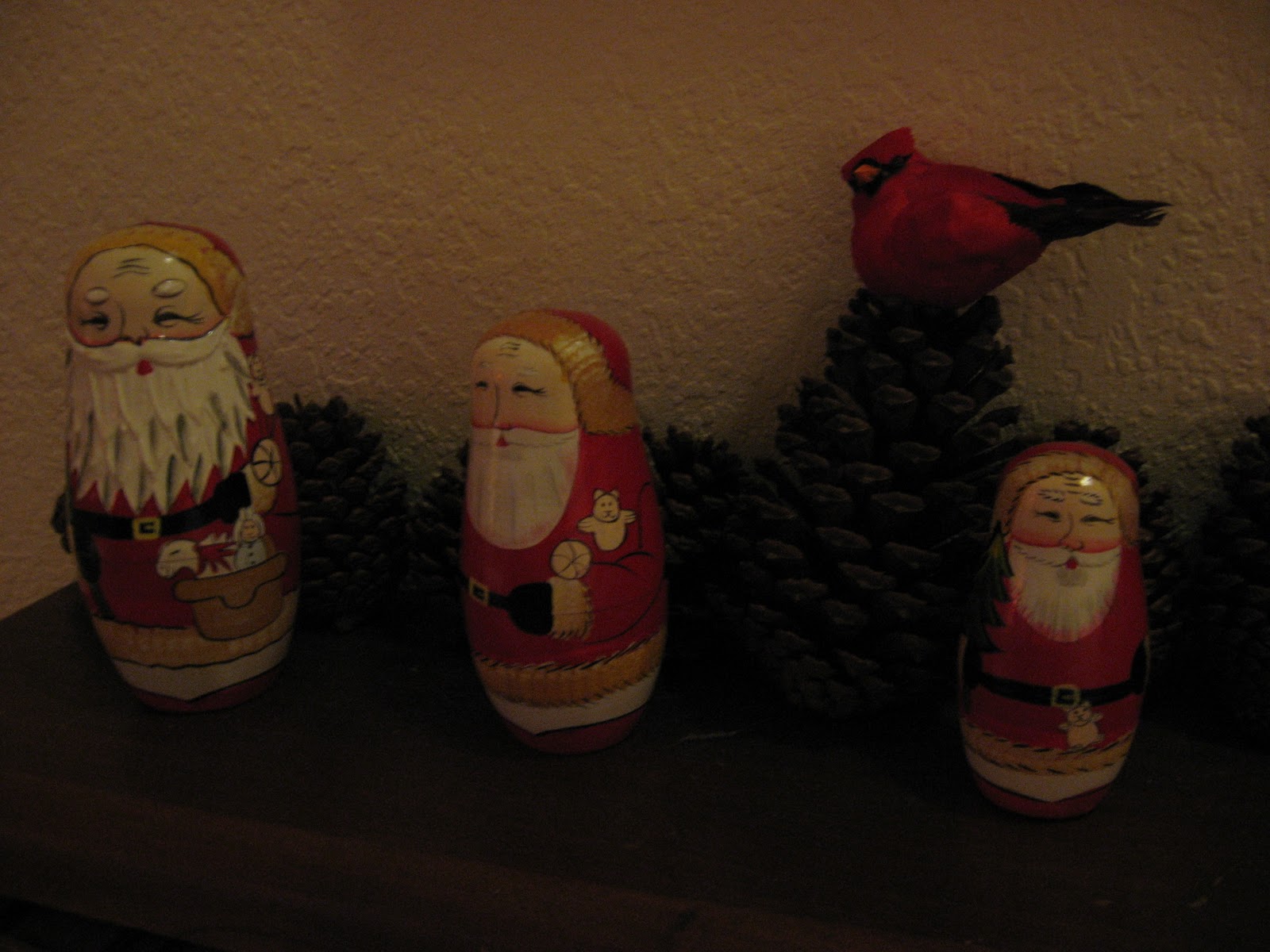
I like the tradition of keeping back the Baby Jesus from the crèche until Christmas Day; the manger waits empty until then. But in my Nativity set, the baby is glued to the manger, so He is forced to “arrive” way early. At least, these Santas are alone and in this photo they are sort of in the dark so far. Their situation changes when the Light of the World comes to earth.

Some of the participants in Pom Pom‘s Childlike Christmas party have written about their own memories of Christmas when they were children. Though it didn’t occur to my philosophical mind at first, it seems obvious now that what each of us retains with fondness of our own most distant Christmases Past will influence the definition of childlike for us.

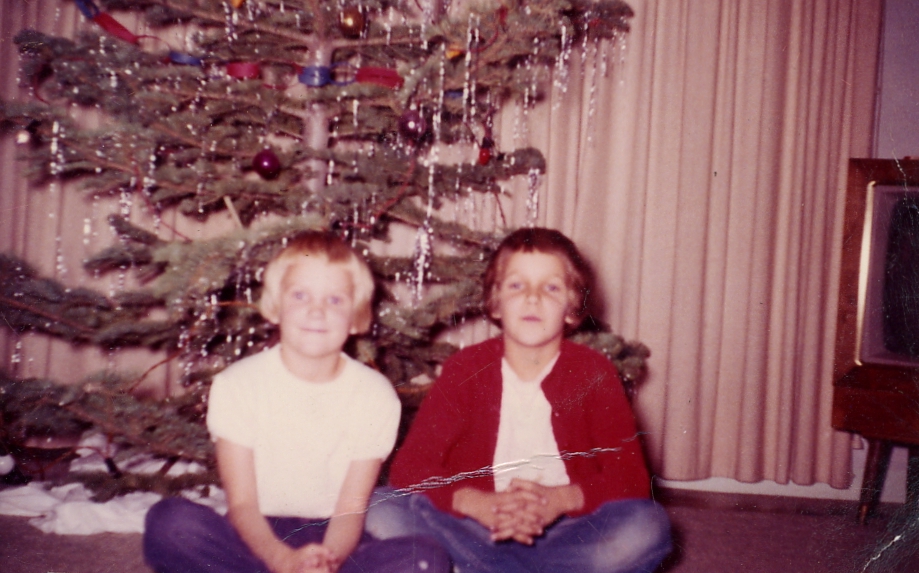
Waiting for Christmas – GJ on the right.

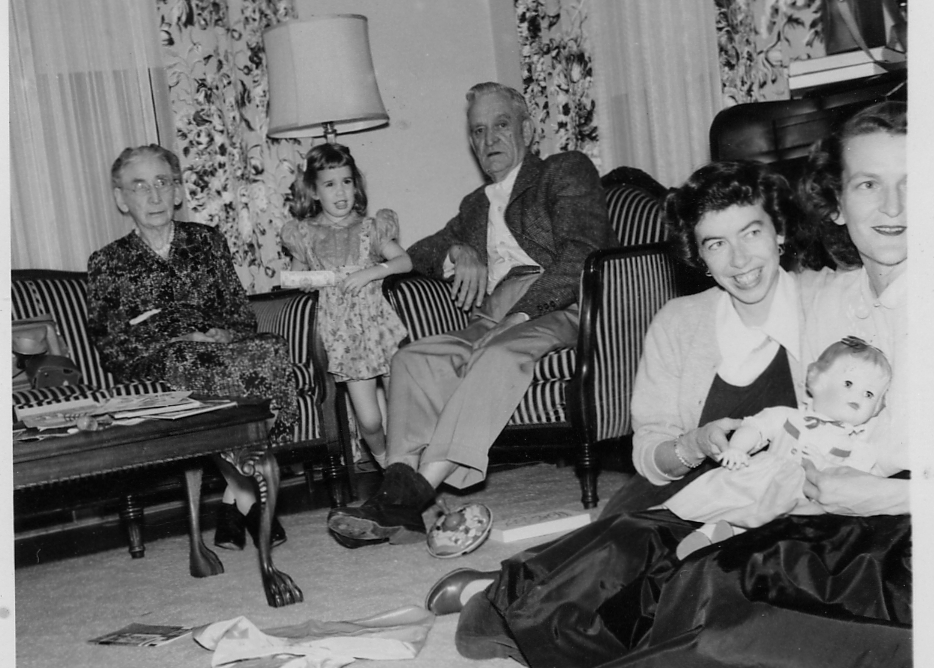
The black-and-white photo below shows a glimpse of Christmas as it was for me before I can remember, and it was taken at my grandma’s house in Berkeley, where we never gathered for Christmas the years that I can remember.

The important thing is that the picture is connected to my maternal grandma, and without fail we knew that Christmas had arrived when my grandma and grandpa’s car announced their coming by the crunching of the driveway gravel, and the trunk was opened to reveal its overfull load of wrapped presents, pies and sweet rolls. My siblings and I helped carry all the gifts from that bottomless hole into the house, and we piled them under the tree, from which they spread outward like an extravagant wave across the living room rug.

The pies and breakfast goodies were set out on the service porch where the temperature was cool enough to keep them for a day or two; after Christmas Eve dinner a slice of pie would always be set on the hearth so that Santa could have a snack that night when he stopped by.

My grandma and I are not in this photo.

The photo shows my mother at right, holding a doll that I imagine was given to me that year, when I was only two. I like seeing that my grandpa, my cousins and my spinster aunt were there with us. And my grandma’s beautiful furniture that I loved!

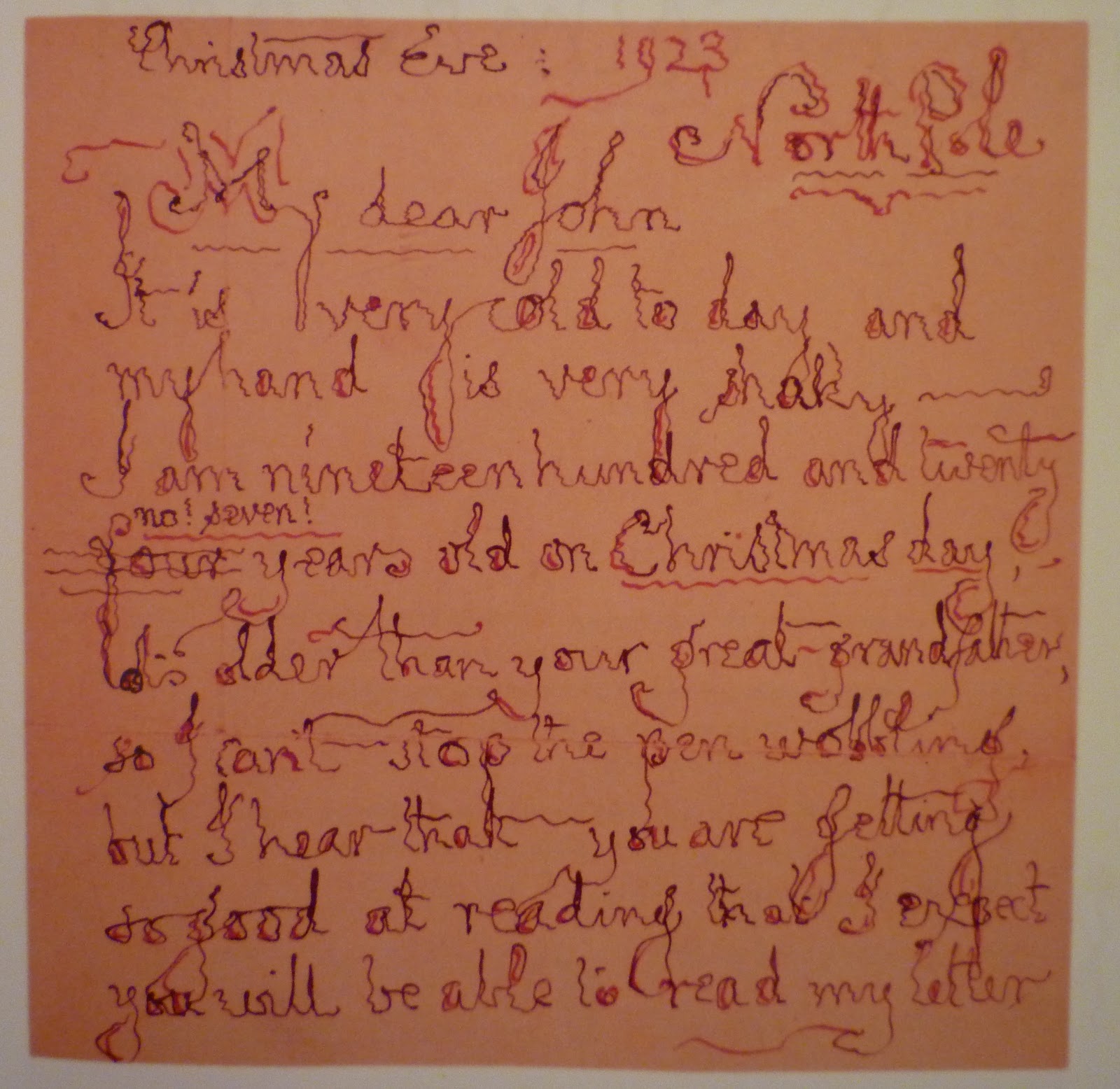
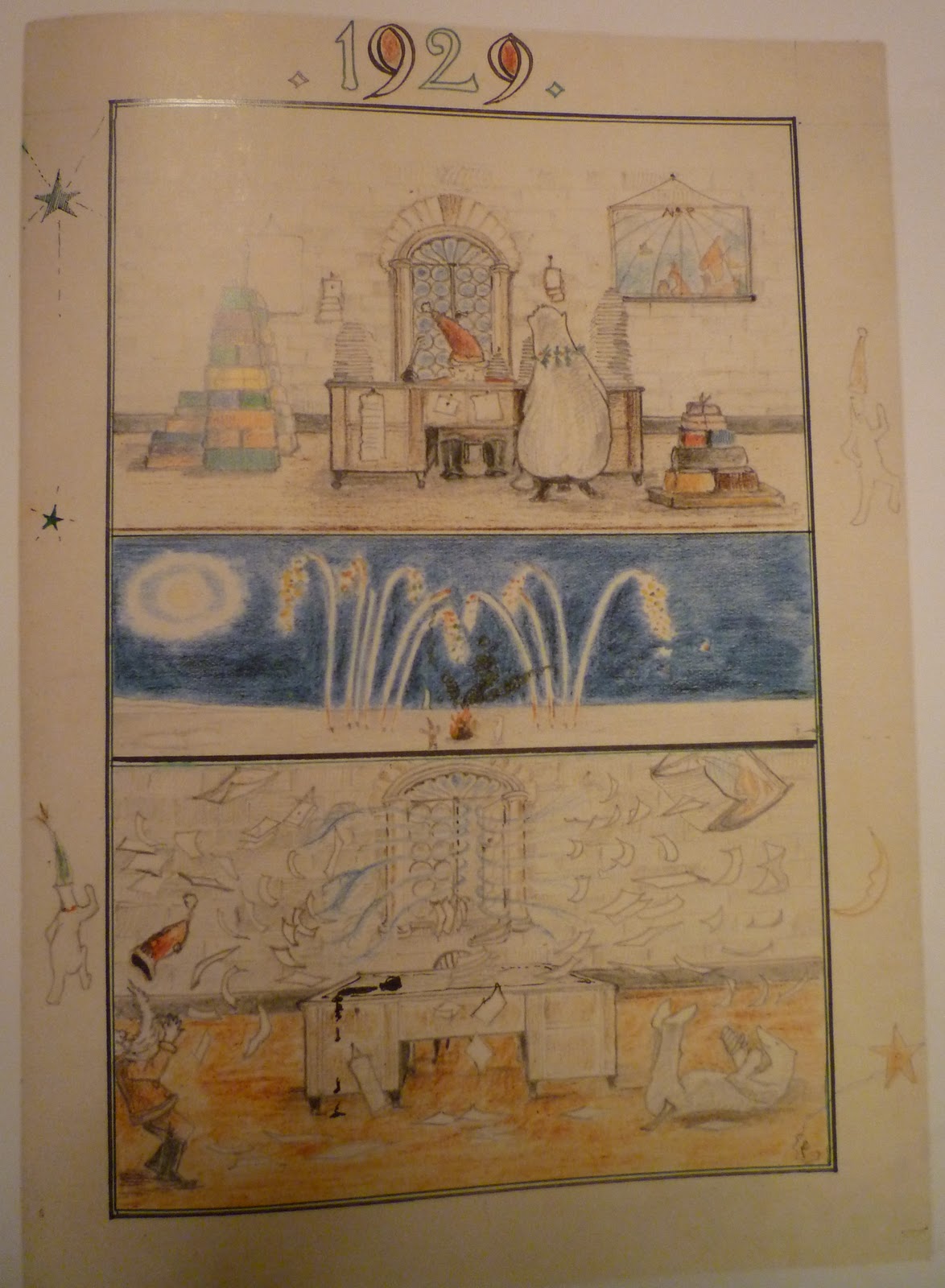
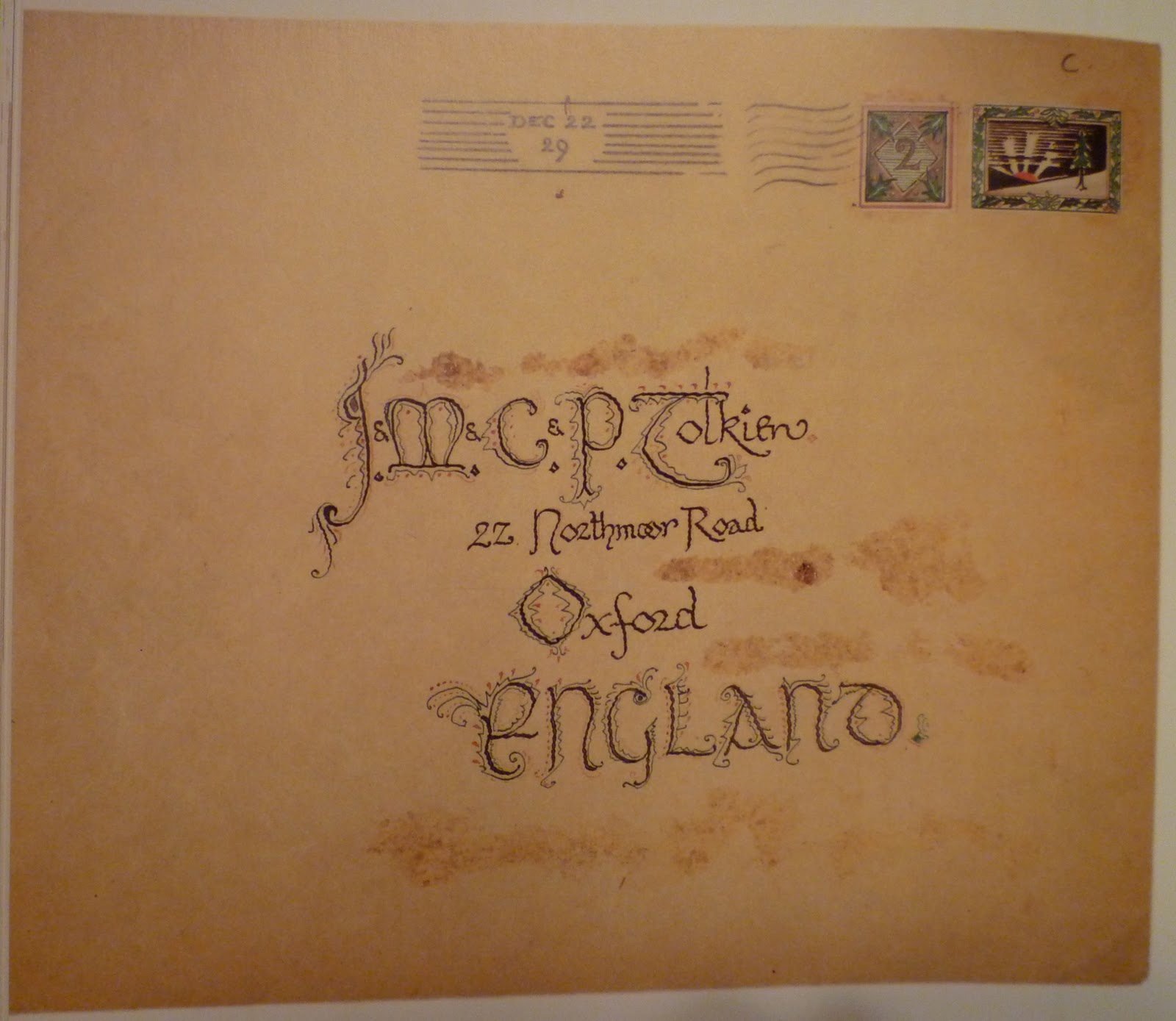
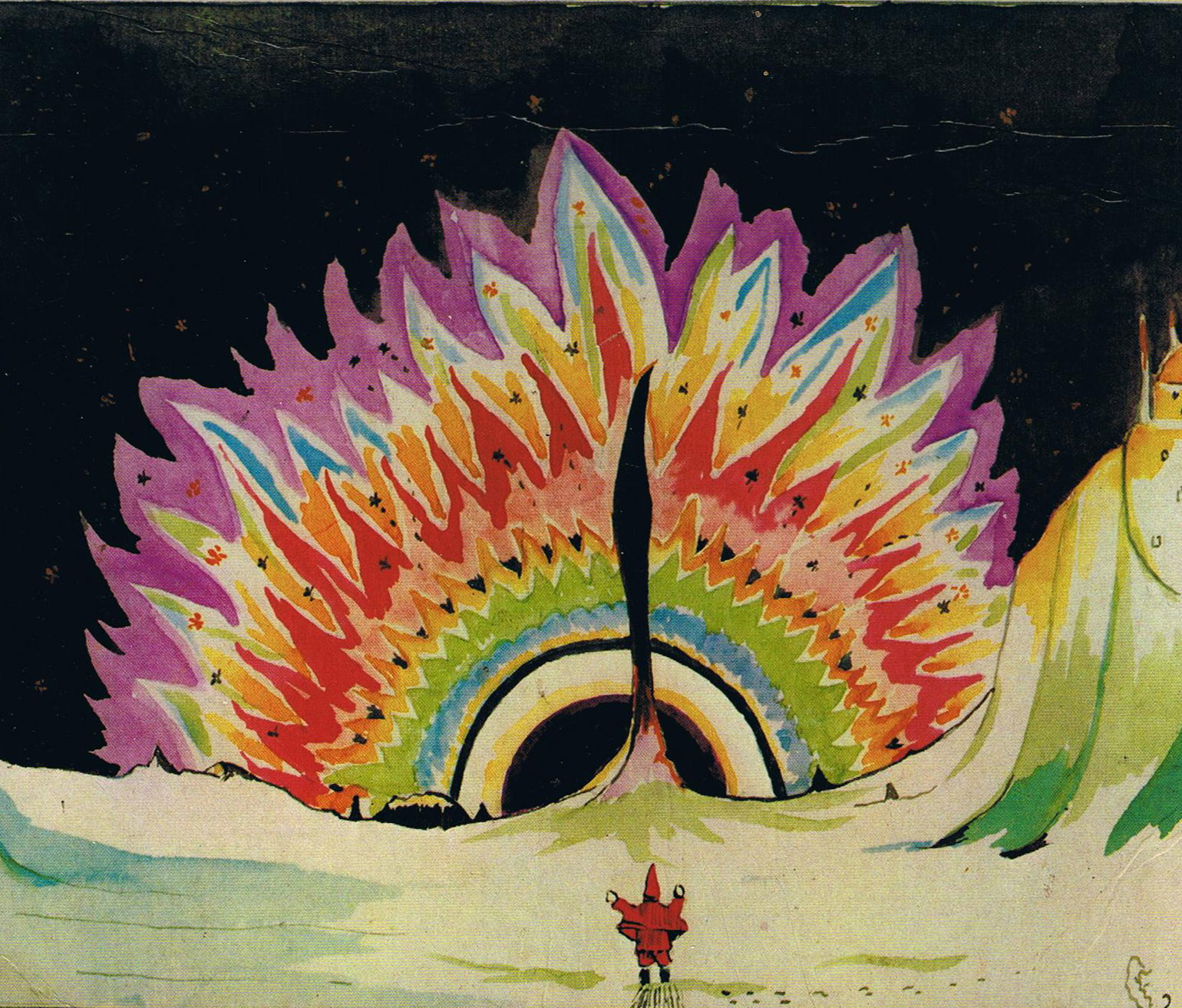
Now about the colorful picture at the top of this page: I have an edition (Houghton Mifflin, 1999) of the collected illustrated letters that J.R.R. Tolkien wrote to his children from Father Christmas, and I’d like to tell about them even though I haven’t even read them all myself yet, much less to any children or grandchildren.

For over 20 years the Tolkien children received letters from Father Nicholas Christmas, often near to Christmas Day, but sometimes as early as October 31st. For all the ice and snow pictured, the drawings give the impression of a very cozy group at the North Pole, including Polar Bear and other helpers.

illustration including Polar Bear

This year, several of my grandchildren will be around in advance of Christmas Day and for a full week ! so perhaps we can read a few together. Or perhaps not, as I already have a long mental list of all the lovely things I can do with the children whom I haven’t had with me at Christmas for so many years.

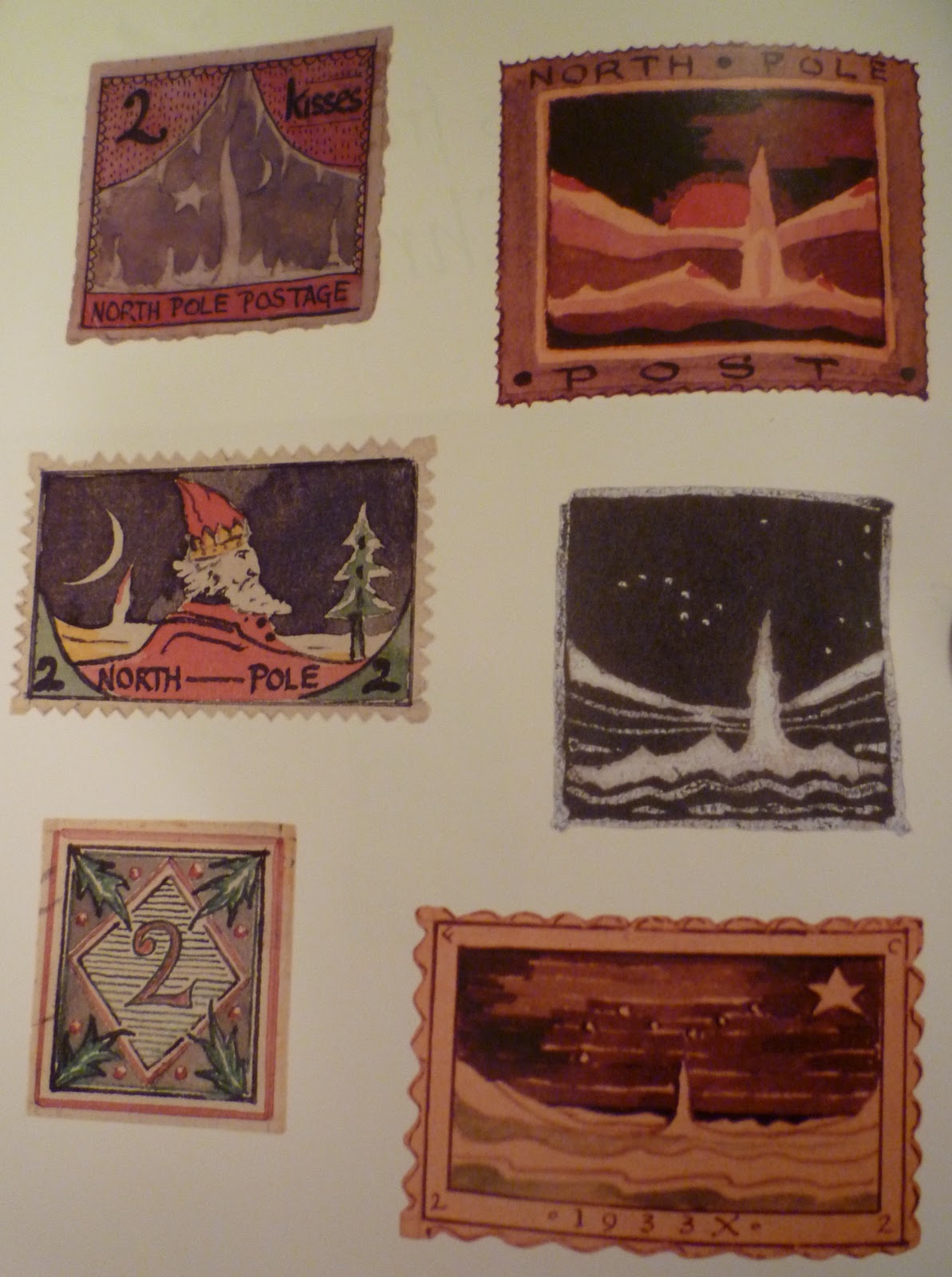
Some of the pretty stamps

I’m looking forward to an abundance of time to “waste” just being together for the Blessed Feast of the Nativity of our Lord and Savior Jesus Christ. This year I don’t have to have a long-distance Christmas relationship such as Father Nicholas Christmas had with the Tolkien children. But I bet I am just as busy as he before The Event as I scurry with my ribbons and lists around my cozy winter house.


Librarian of Antiquities

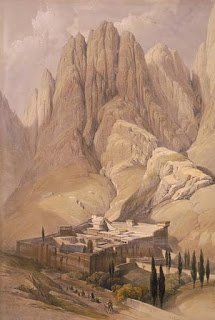
Last night Mr. Glad and I traveled with some friends to Berkeley where we heard a lecture by Father Justin Sinaites, who is the librarian for Saint Catherine’s Monastery in Sinai. Those few words that name his job send me into a realm of thoughts which tumble over each other and in their layering seem too high for me. The history, the theology, the parchments…the prayers in the desert….

St. Catherine’s was founded in the sixth century by the Byzantine emperor Justinian and is the oldest Christian monastery in continual existence in the world. The collection of ancient manuscripts there is surpassed only by that of the Vatican.

Currently Fr. Justin is in charge of the project of digitizing all of these documents and illuminations, including the famous Codex Sinaiticus, written in the 4th Century and considered to be one of the best Greek texts of the New Testament. The monastery’s goal is to eventually make everything available in very high resolution, using such tools as one we heard about at the lecture, a donated camera that is “the size of a small room.” This kind of sharing will also protect the valuables by minimizing the handling of the originals.

The librarian is a native Texan and the first American to be a resident monk at St. Catherine’s, where he has lived since 1994. Before that he was a monk at a monastery in Massachusetts for 20 years. But in spite of his age, experience and technical modernity, he seemed to have a childlike joy about him when speaking about the history of God’s dealings with men, and on the focus of the talk, the typology of the Bible and the Tabernacle in particular.

During his lecture he showed us slides from the 6th-century work  Christian Topography, which is full of illuminations of the tent that Moses was instructed to build according to strict instructions from God. Cosmas Indicopleustes, a man who had done quite a bit of traveling compared to most people of that time, wrote the book, and he included all these pictures of the tabernacle and its parts and contents because he was trying to conceptualize the world and was convinced that the Tabernacle was the key to understanding the whole universe.

I’ve heard about the symbolism of the Tabernacle in Bible studies and sermons throughout my adult life. Books have been written on all the meanings of the type of wood used, the colors, the candlestick, the carvings and the cherubim, the mercy seat. In the New Testament it is hinted that there is so much to be said about all of it that the apostle in his letter to the faithful doesn’t have the time even to begin. We do know that it speaks to us of God.

Orthodox tradition sees the Virgin Mary as prefigured in the Tabernacle, because she mystically contained the Son of God, “Light of Light, True God of True God…of one essence with the Father.” And Fr. Justin clarified, “The tabernacle did not confine God, but it was the dwelling place of God as an icon.” So, too, we are all “called to be priests and to offer ourselves as vessels and lamp stands.”

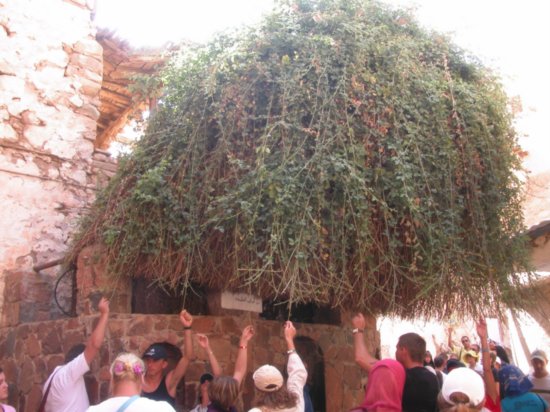
The bush at St. Catherine’s

A few years ago there was an article in Parade magazine about Father Justin and the monastery, in which the burning bush is discussed. St. Catherine’s is believed to be the site where Moses beheld the glory of God in what some prefer to call the Unburnt Bush. Last night one of my former fellow gardeners at church took the opportunity to ask the monk what is the binomial, meaning the two-part botanical name, of the bush, of which we have a descendant living on our parish grounds; Fr. Justin said it is rare to have success rooting cuttings from the one at St. Catherine’s.

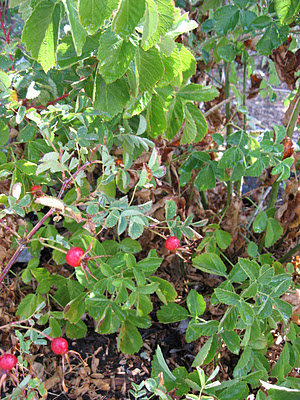
Below is a photo I took of our burning bush. Its leaves are the larger ones in the picture, and the smaller grayish leaves and hips are of the Nootka rose that grows in a planter with it.

rubus sanctus with Nootka rose

The monks are happy at the potential for more widely sharing the manuscripts with scholars everywhere. And nowadays they welcome numerous tourists and pilgrims to the holy place itself, knowing that the God who has blessed it and them is the spiritual food people need. In fact, in the the last 50 years, as our lecturer put it, “The whole world has come rushing in.” Especially in the winter months the monastery has as many as 1,000 visitors a day. The challenge is “to keep a spiritual tradition that was born in isolation when that isolation has come to an end.”

If I ever journey to Egypt, I hope to join the masses thronging to that place.

Long and Boring Road

Our family loves the books by Byron Barton, like Trains and Machines at Work. Plenty of everyday and exciting things happen in these books, and the stories are told with few enough words that toddlers end up memorizing the text and can “read” the book to themselves or to others.
  
Along a Long Road seems like it is trying to be such a book, but I think it fails miserably. Unfortunately I don’t have a toddler to try it out on. On second thought, I wouldn’t try it out on anyone, because I don’t do that. I have to preview a book and make sure that I like it before I will read it to a child, and I could barely get through this book by Frank Viva.

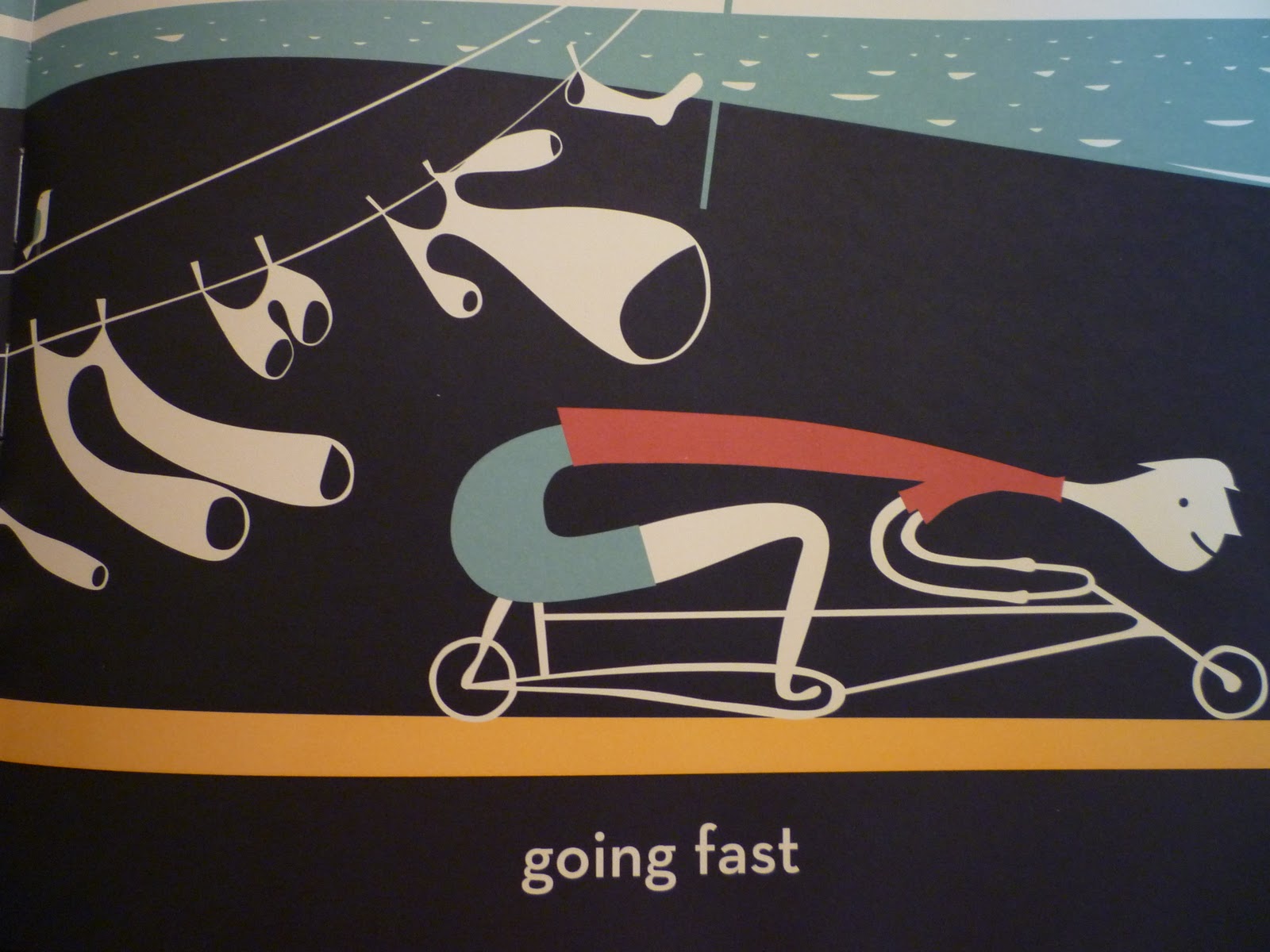
The picture book features stylistic pictures of the long road, made shiny by some plastic coating, and a very long man riding his long and stretchy bicycle. According to the text he rides and rides, “again and again.”

I haven’t known small children to be very interested in bicycles. They like their trikes, and boys especially seem to love heavy road equipment, trains, and motorcycles. One more reason to pass on this book.

About the only thing both my husband and I liked was the picture of a pregnant woman whom the cycling man passes. I suppose there are plenty of items along the road that one could talk about with a child, but no story to keep the long road from getting tedious.

I quickly got tired of the man and his weirdly shaped vehicle, expressed in only three colors, plus black. The artwork reminds me a little of an odd and favorite book of ours, The Clock, by Esphyr Slobodkina of the abstract expressionist movement. Slobodkina is better known for her picture book Caps for Sale, but long ago I found a beat-up copy of The Clock, which is a captivating story.

Maybe Along a Long Road would be pleasing to a very early reader, or a delayed reader, who might be able to relate to the sign for lottery tickets or a distant view of a carnival, and who would find satisfaction in reading the words “again and again” again and again. Not that I can imagine a child like that. If anyone out there has had another experience with Viva’s arty book, I would like to hear about it, even though I will soon take it back to the library for good. Give me Barton any day.