Category Archives: books

I consider my difficulties.

My current difficulties stem from these realities:

1) The world is so full of a number of things
    I’m sure we should all be as happy as kings.

This rhyme has played in my head a million times since I learned it as a little girl. Maybe even then I suspected in my childish way the layers of truth in the sing-song, the irony of too-muchness.

2) I have been traveling a lot, and that brings me into contact with even more numbers of “things,” like real people, people in books, ideas in books, and new places I’ve visited. This summer, for example, I sat on airplanes for more than ten hours, and many of those hours were spent in the company of Alain de Botton as I read his book The Art of Travel. As I drifted off to sleep at night in a house not my own, I was soaking up the coastal delights of George Howe Colt’s childhood summer place, The Big House.

In the spaces between these literary adventures my more physical self was learning to reach right instead of left for a stirring spoon, and to relax in the hot tub of the Eastern summer atmosphere.

3) I need — o.k., I feel the need! — to write about at least some of the experiences in order to process the information and be restored from the overload/exhaustion of so much excitement. As Alain and I were musing together over the meaning of our travels, I scribbled notes in the margins and made a list in the back of the book of all the blog post ideas that were generated from our “discussion.” Every night for a week or two I have spent at least fifteen minutes writing and rewriting in my mind, in the dark, my review of the Colt book.

Even Archimandrite Sophrony is reported to have said, “Arrange whatever pieces come your way.” [update: It seems to be Virginia Woolf who said that.] I don’t know what the context of this quote was, but the urge is a basic, human, compelling one, and applies to just about everything I know.

4) When I am on the trip, just returned from a trip, or packing my bags and boxes to set off again, there is less time than ever for this kind of writing, and also less mental energy. When I hear Thomas Mann say, “A writer is somebody for whom writing is more difficult than it is for other people,” I feel that I am certainly one of those. I could coin my own saying: “A homemaker-writer with a large family is somebody for whom writing is even more more more difficult than it is for other people.”

I hope I am not complaining, by using the word difficulties. I could say challenges, or pieces. Or thoughts, as in “Bring every thought captive to Christ.” In my mind I have more challenging pieces of thoughts and prayers and connections to be made than there are dust bunnies floating up and down the stairs.

This morning it all seemed too much, as I add another item to the list of things that make us happy as kings: We are going to the cabin! There will be stimulating conversation on the way, as our numbers will be doubled by the presence of our dear Art and Di. (That will add pieces, to be sure.)

Stars will shine crisply in the black sky at night, and in the mornings chipmunks will scurry in the brush below the house. Humans will eat cookies and bacon and drink coffee on the deck while we watch the hummingbirds squabble, and we’ll paddle our canoe quietly over the lake.

(Past posts about our Sierra cabin: 2009  2010  and  2011 )

Though I have picked up only a few pieces here to tie in my bundle, it’s been quite comforting. Now I can face my lists of more practical things like dinner menus, shopping needs, and what to put in my book bag. That won’t be too difficult.

Elder Zosima and his brother

In my reading of The Brothers Karamazov, I came this morning, Monday of Holy Week, to the part “From the Life of the Elder Zosima.” The elder first relates about his older brother, who only at the age of seventeen and sick unto death, turned from anger and scoffing toward a path that might lead to repentance, and seemingly only to please his mother. But that is not an entirely bad reason.

…on Tuesday morning my brother started keeping the fast and going to church. “I’m doing it only for your sake, mother, to give you joy and peace,” he said to her….But he did not go to church for long, he took to his bed, so that he had to confess and receive communion at home. The days grew bright, clear, fragrant — Easter was late that year. All night, I remember, he used to cough, slept badly, but in the morning he would always get dressed and try to sit in an armchair. So I remember him: he sits, quiet and meek, he smiles, he is sick but his countenance is glad, joyful. He was utterly changed in spirit — such a wondrous change had suddenly begun in him!

The young man asked forgiveness of everyone and talked about his great sin, but at the same time was so happy and full of thankfulness and exhortations, that people thought he was going mad.

Thus he awoke every day with more and more tenderness, rejoicing and all atremble with love. The doctor would come — the old German Eisenschmidt used to come to us: “Well, what do you think, doctor, shall I live one more day in the world?” he would joke with him. “Not just one day, you will live many days,” the doctor would answer, “you will live months and years, too.” “But what are years, what are months!” he would exclaim. “Why count the days, when even one day is enough for a man to know all happiness. My dears, why do we quarrel, boast before each other, remember each other’s offenses? Let us go into the garden, let us walk and play and love and praise and kiss each other, and bless our life.”

This older brother died a few weeks after Easter, when the teller of the story, the elder Zosima, was only eight years old. He talks, now near death himself, more about his childhood, and how it was also during Holy Week that he began to see more when he went to church.

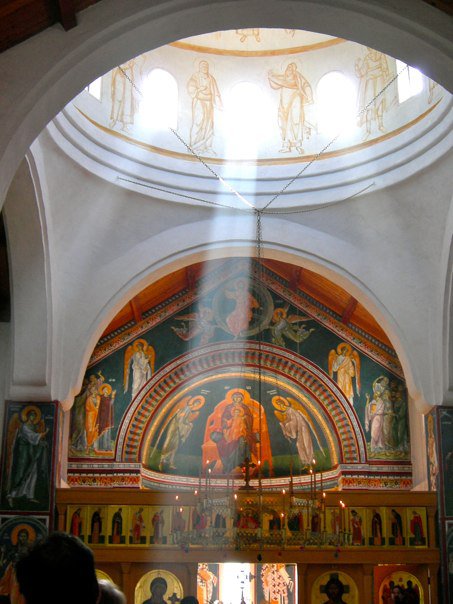
But I remember how, even before I learned to read, a certain spiritual perception visited me for the first time, when I was just eight years old. Mother took me to church by myself (I do not remember where my brother was then), during Holy Week, to the Monday liturgy. It was a clear day, and, remembering it now, I seem to see again the incense rising from the censer and quietly ascending upwards, and from above, through a narrow window in the cupola, God’s rays pouring down upon us in the church, and the incense rising up to them in waves, as if dissolving into them. I looked with deep tenderness, and for the first time in my life I consciously received the first seed of the word of God in my soul. A young man walked out into the middle of the church with a big book, so big that it seemed to me he even had difficulty in carrying it, and he placed it on the analogion [lectern], opened it, and began to read, and suddenly, then, for the first time I understood something, for the first time in my life I understood what was read in God’s church.

The reading was from the book of Job. And tonight I myself plan to attend this liturgy, and though I haven’t seen the program for the service, I now have confidence that I will hear this same reading. How many times have I also watched the beams of light shining down when I stood in church, and even felt their heat on my face, like the warmth of God’s Holy Spirit?

The Elder Zosima is a fictional character, but he is believed to be based on a real-life monk in old Russia. In the novel, where I am reading, Zosima goes on in his very moving fashion to tell his life’s story: “– and over all is God’s truth, moving, reconciling, all-forgiving!”

Isn’t it sweet that God should arrange for me to read this passage this morning, to help me in an unusual way to become even more receptive to His being with us tonight by means of hymns such as, “Let my prayer arise in Thy sight as incense….,” and the Psalms of Ascent — and the Holy Mysteries!

Last week our bishop was present with us, and he gave us a good word about the last days of Lent — well, technically Lent has come to an end, but we are still in the anticipation and preparation that is Holy Week. He said that Lent is not about finding every bit of dirt in our souls, but about the bridal chamber, about discovering the great love that our Lord Jesus has for us.

Perhaps Zosima’s brother went to a Bridegroom Matins service on Tuesday; we have three of them this week, and tomorrow I hope to attend at 6:30 in the morning. The Lord Himself has been filling my lamp with the oil of His Holy Spirit!

Looking isn’t always seeing.

St. Symeon the New Theologian

“How can one be fit to handle the divine teachings of our Lord if he or she has not first submitted to them and been transformed by them?”

In Orthodoxy faith is activity, not passivity.”

“The Orthodox find sin to be a much more serious problem than just personal guilt….there is also decay. It is not enough to treat sin as a category that Christ saves from; sin is a power that kills spiritually.”

These quotes are from Benjamin Harju’s blog series of reviews on Robert Koester’s book A Lutheran Looks at … Eastern Orthodoxy, in which Harju does a useful work in explaining Orthodox life and practice, as a response to a book written from one Lutheran’s point of view.   Read the first of five parts here.

Anastasia posted about this offering from her godson, a writer who is respectful and careful in his discussion and clear in his use of the language, all of which endear me to him. The review can be found in its entirety on the March 5-7 posts of his blog.

Comparing and contrasting one thing with another is an excellent way to refine one’s understanding of any subject, and the method works for me in this case, as Subdeacon Benjamin compares the East with the West, the truth of Orthodoxy with some misconceptions, and scholarly writing with propaganda.

All in all, Harju has to conclude that Koester did not “look well into the matter,” (my quotes). The reviewer himself, one can learn on his blog, converted from the Lutheran church to Orthodoxy, so he is familiar with both traditions, and points out on this post the context and starting point of Lutheran theology, that it “arose by seeking to reform Western, medieval, scholastic theology,” unlike the Orthodox tradition which is continuous from the apostles, and that he “learned to love Orthodoxy as the fulfillment of my Lutheran goal.”


Love and Language

Over my car’s radio yesterday morning I caught the end of an interview with an author talking about her husband’s aphasia and recovery from it. As I drove into the Target parking lot the women were still talking, and I hadn’t heard any names of books or people yet, so I sat in the car a little longer, digging around in my purse to find a tiny black notebook to write in.

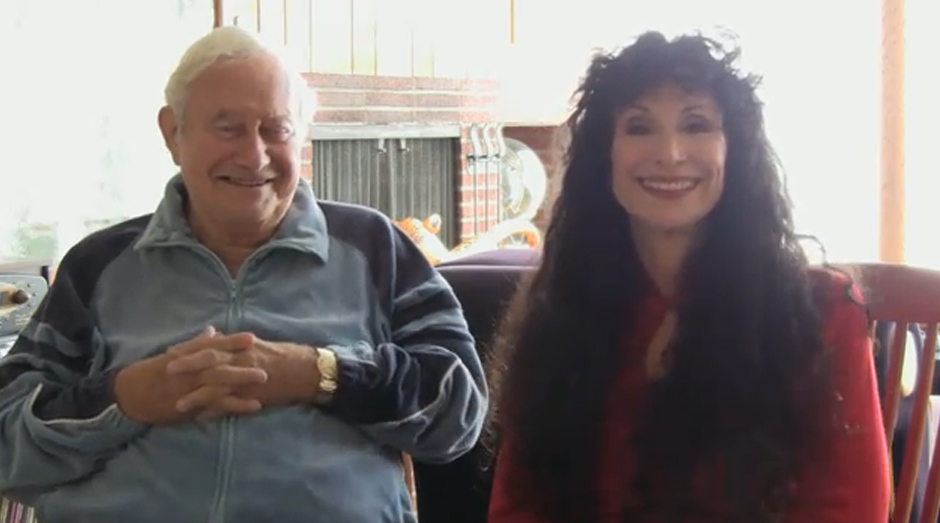
Eventually the host mentioned that we were listening to Diane Ackerman talking about her book 100 Names for Love, which tells the story of her husband Paul West’s recovery from a stroke, and the ways in which she was able to help him in the process, though their relationship was challenged and changed. The 100 names were the new pet names he came up with for his wife, when he could not recover the old ones. One of them that she mentioned was My Bucket of Hair. (She has a good head of it.) Many of the nicknames were as unusual and poetic, like My Remains of the Day, and My Residue of the Night.

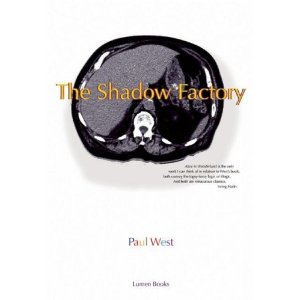
I have tried reading Ackerman before, and there is too much about her prose and perspective that makes her tedious, but the things she said on the radio about love and care-giving and language recovery made me think I really wanted to read this particular book. I came home and put it on my Amazon list, but then I went on to read about Paul West, and found an excerpt online from the book he himself wrote, The Shadow Factory.

In the interview Ackerman had shared that, when he was depressed about not being able to write — and writing had been his profession — she suggested that he write a book about his experience, and he agreed to dictate to her as he labored to find each word and phrase in the rubble that was his brain. The following day he would rework the text, and the whole project became a huge part of his rehabilitation both emotionally and mentally.

I heard Ackerman describe her husband’s book as a “free associative dream version” of how it felt to have a stroke and to heal from it. Those words gave me the impression of it as the type of writing that I find hard to endure. But now that I’ve read this small part, I’m not sure I agree with her description. Here are a couple of paragraphs from the article I link to:

There was a bewildering assortment of false starts and incomplete sentences for the mind only. I no sooner thought of something to say to myself than I forgot it, and I was lucky to get beyond the second or third imagined word. Of course no one in his right mind overheard any of this, the dumb speaking to the silent in a reverse image, so no one was upset. But if this happens 50 or 60 times, one wants a little revenge of some sort. Of course, one was in all probability speaking no kind of written English, so this meant that whatever you said was relevant and you could not say anything irrelevant.

Reading, at which I used to be no slouch, now gave me the most incredible, disheveled experiences of my print-bound life. Now print jigged toward me, then it hung back. The one part of it that was readable swam backward or forward to render the reading experience at best incomplete, or subject to the vilest, maddest vagaries of a proofreader’s nightmare.

So far I am thoroughly enjoying West’s post-stroke prose, and find it much more focused and readable than Ackerman’s, so perhaps I’ll be content with having heard her radio voice, which seems to absorb better, and in my Amazon shopping cart I’ll trade her book for The Shadow Factory.