Category Archives: books

Apples I Have Known – in a book

Janet blogged recently about an apple-picking expedition, with photos that reminded me of excursions to the apple orchard that has been our family’s favorite vender for decades. We didn’t make it out there this year — yet.

The number of munching, saucing and pie-baking kids and grandkids that we had around here at times could consume quite a few bags and boxes of fruit during apple season, and our grower friend featured almost 30 varieties of apples, which kept his barn open to customers for a deliciously long time.

My daughter whom I call by the name of a favorite apple gave me a small book that is fun to peruse when the apple farm closes, or when there isn’t enough demand for fresh fruit in the house. It is all about various kinds of apples, with bright watercolors of those featured. Some old varieties, some newer.

Above is the Cortland that Janet is enjoying. If you want to read the text in any photo just click on the picture to enlarge it.

The Arkansas Black is one of that large selection on the local apple farm, and I have cooked with it many times.

Another friend and neighbor grew an orchard full of Criterions and sold gallons of the fresh juice out of his barn. Our older kids helped on the ranch, thinning the crop and such like, and no doubt these extra sweet and crisp fruits contributed to their good health.

Jonathans were a favorite of my father, as I discovered late in his life when I was given a boxful of runts. Late in the mountain season I sat in his cabin cutting up the fruit for applesauce, and he ate a dozen while youthful memories flooded his head.


And the Gravenstein — it’s got such a tang that as I write about it I start salivating. Its season is short, but there are plenty of orchards in our part of the country, and it adds the most appley flavor to whatever you cook with it. I have made many a curried apple turkey loaf with Gravenstein sauce.

I like the pictures of all the odd apples that I’ve never encountered, especially the sort of ugly knobby ones, or those with russeting or bumps, or elliptical shapes.

But my favorite apple of all, and naturally the best-for-me entry in this book, is one that was more available in stores when I first learned to bake pies. After using the same apples for many years, I have to admit that only Pippins make a pie that with my whole being I can rejoice in as Apple Pie. To prove my love, I am feeling a need to make a trip to Our Orchard this week and get a boxful.

Swan Lake stories


I really got into the Swan Lake story last Spring. It all started with an Amazon.com recommendation, from which I learned that Mark Helprin had written a book-length adaptation of the tale that was most famously told by Tchaikovsky’s ballet. There were surprisingly few reader reviews of his book given that they were nearly all gushingly positive, some saying it was the best book they had ever read.

I’ve long been curious about Helprin and the many books he’s written. Some of my family and friends have read his novels, stories, and non-fiction pieces. I had a feeling that I should appreciate him more than I did, and I planned to try again to read his fiction. I was sure his Swan Lake would be good, and I nearly ordered it without previewing it. But then I saw that it was first of a trilogy, and people were less thrilled with the sequels, so I got it from the library instead to see for myself before investing on behalf of a grandchild.

While I was at it, I borrowed three other juvenile versions of the story, so I would have something to compare with. On the first day of Lent I read all four of the books — I know, it was an odd thing to do that day — and scratched out some thoughts. After returning the books to the library in the interest of focusing on more appropriate matters, I forgot all about the subject, until today, when I decided I should gather everything up finally.

Helprin’s version (©1989) would have to be counted my least favorite of the four. It’s the length of a short novel, and his story is fleshed out with several characters who don’t appear in the more common tellings. It’s the most changed, interesting and complex story, but maybe too complicated. The story’s flow is interrupted with goofy details and sidetracks that detract from the moral weight. The narrator’s voice is not that of a believable old man, not that of the man who has enough wits about him to accomplish what he does. Yet he’s supposedly a sage.

I also did not like the loose morals of the characters, who literally “shack up” together and have a child, who figures in the politics of the realm in the sequels, as I understand. The prince never does behave in a very noble fashion that I can see. And what’s the good of a fairy tale if the prince is at best only a foolish boy?

I’m really not competent to even know what it is about Helprin’s fictional style that puts me off. Probably it’s only a personal preference or lack of foundation that makes it hard for me to enjoy him. But I think that I’m through trying.

My next-least favorite of the bunch of Swan Lake tales that I read was Swan Lake, retold by Anthea Bell, illustrated by Chihiro Iwasaki (©1984). I liked the watercolors, but there weren’t enough pictures of swans for my taste. And the story line was thin.

Swan Lake, adapted and illustrated by Donna Diamond (©1980) was second-best of my stack. It was thorough story-telling, including more motives and complications, with nice black and white, dreamy paintings.
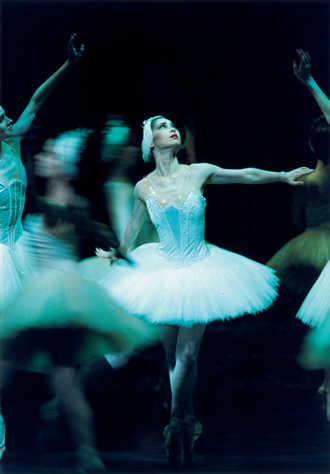
My favorite was Swan Lake, retold and illustrated by Lisbeth Zwerger (©2002). The illustrations were pleasing to me, and after mentioning several versions of the ending, the author makes it into a happily-ever-after story.

After all my literary wanderings, I’m left wondering if perhaps this tale is best told through a ballet performance. I know that even in that form there have been widely divergent versions of the story, but I can’t help thinking that the rich visual and musical elements would make the whole experience more satisfying than did any of these books.

Heavy or Lightweight Books

The other night when I came to the last page of The Fountain Overflows, I turned right back to the beginning and started it all over again. I couldn’t bear to leave the Aubrey Family, or Rebecca West’s lovely writing. I kept my pen in hand so that I could note even more phrases or passages that were notable examples of her masterful style, or of the psychology of children. And this time through I mean to circle words I don’t know from the very start, to look up in the dictionary sometime — maybe. Most of the time I forget to do that.

I don’t research those words as I go along because I am usually lying in bed and can’t handle something as heavy as a dictionary; most books I buy these days I get in paperback so that I can read them while curled up or generally horizontal under the blankets. Sometimes, though, I fail to notice that a particular book in the catalog has 800 or 1000 pages between its paper covers, and when it arrives at my door I realize that it can’t be accommodated at bedtime.

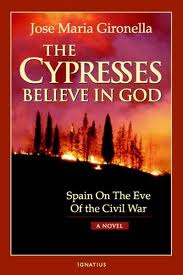
Vacations don’t seem to include the long afternoons I’d require to enjoy the big books in a lawn chair next to a lake or under a tree. That’s what I thought I would need if I were ever going to start The Cypresses Believe in God: Spain on the Eve of the Civil War (806 pages), by Jose Maria Gironella.

But last week, after leaving the library, of all places, my foot folded over at a curb and my ankle was sprained — voilà! Here was my chance! — and for three days I’ve been living in the world of Spanish culture and politics in the 1930’s, at the same time I am lying in the recliner with my foot up.

I was going to tell also about the paperback copy of The Brothers Karamozov, and Stephen Lawhead’s Hood (first book in the King Raven Trilogy about Robin Hood), who are both waiting on the shelf, but as I look at them more closely I notice that they are not at all in the same weight category as Cypresses. They are smaller in cubic inches, nearly the same size as each other, though Hood is under 500 pages and Brothers K about 700. Dostoyevsky is much heavier physically — the book, I’m talking about now — and I am confident in other ways, too. No taking that one to bed.

c. 1923

But maybe when I finish Fountain I could manage to heft Hood or at least have it lying next to my pillow. Unless I feel the need to read Rebecca West’s The Birds Fall Down again. When I came to the end of that novel I also had that urge to read it again soon, for somewhat different reasons.

The first time I heard of this author it was for her book Black Lamb and Grey Falcon. That title captivated me right off, but I thought the subject of her famous book would be helpful to me in understanding Balkan history and culture.

I borrowed it from the library, a hardback and huge book with small print, when I still had plenty of teaching and childraising to do, and I don’t think I ever got through one chapter. But now that I’ve read two other compelling books by her, and see that these three I’ve encountered are completely different from one another….I wonder if I can get Black Lamb and Grey Falcon in paperback?

[Update: more posts have been written about The Fountain Overflows,

The opposite of not getting in trouble. and

The endless troubles of everyday life.  ]


Bog Cotton and Other Book Encounters

It’s been a long time since I’ve posted a real book review. I read, but never feel that I can do justice to any book. If it’s bad, just what makes it bad? If it’s at all good, how do I assess it thoroughly and convey the worth of it? I don’t, obviously, do any of that lately.

Still, it is no fun keeping all the books to myself. So I’m going to try brief mentions of a stack of them, and tell only a little bit of what got my attention. So as to Get Something Done.

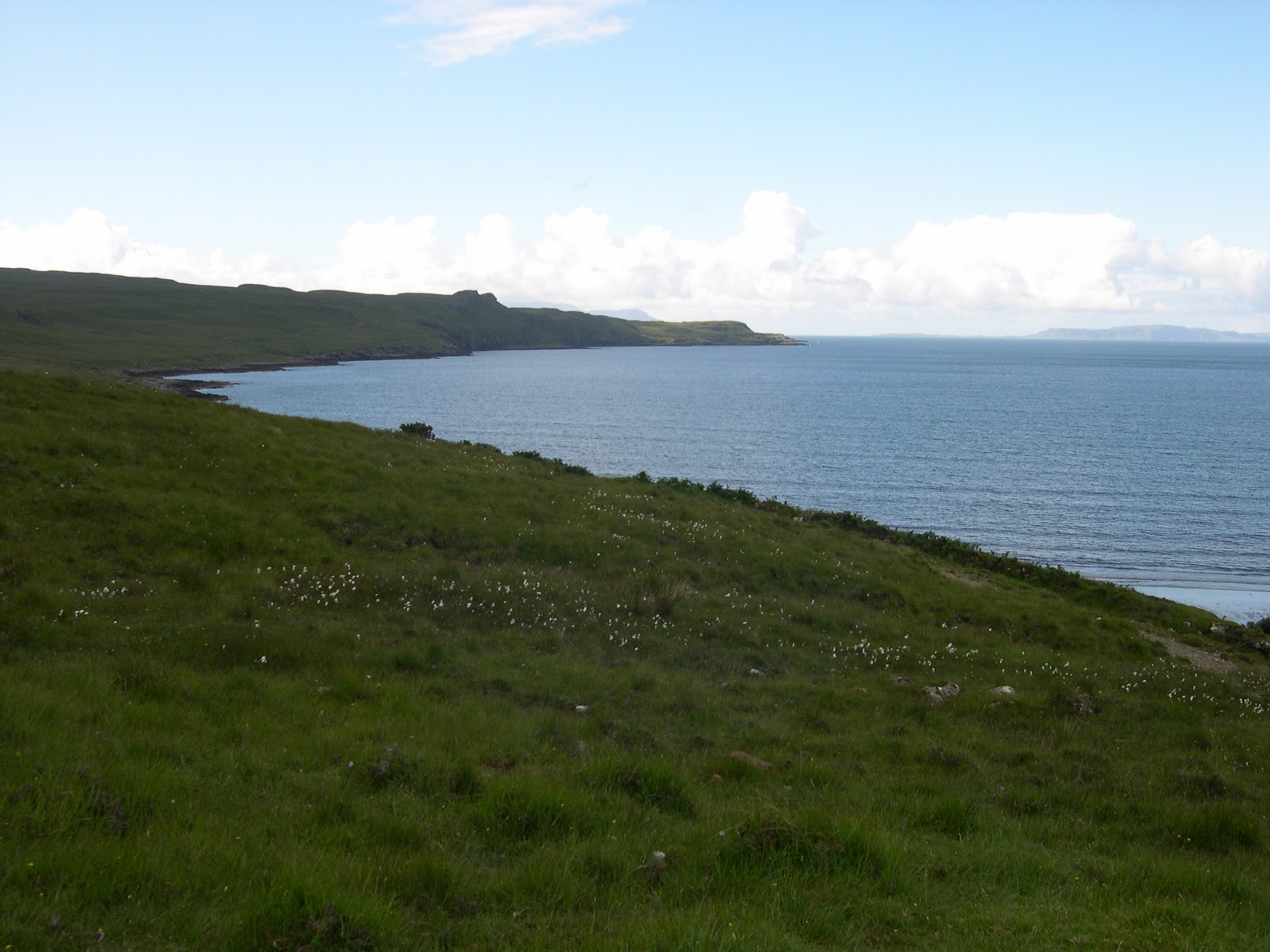
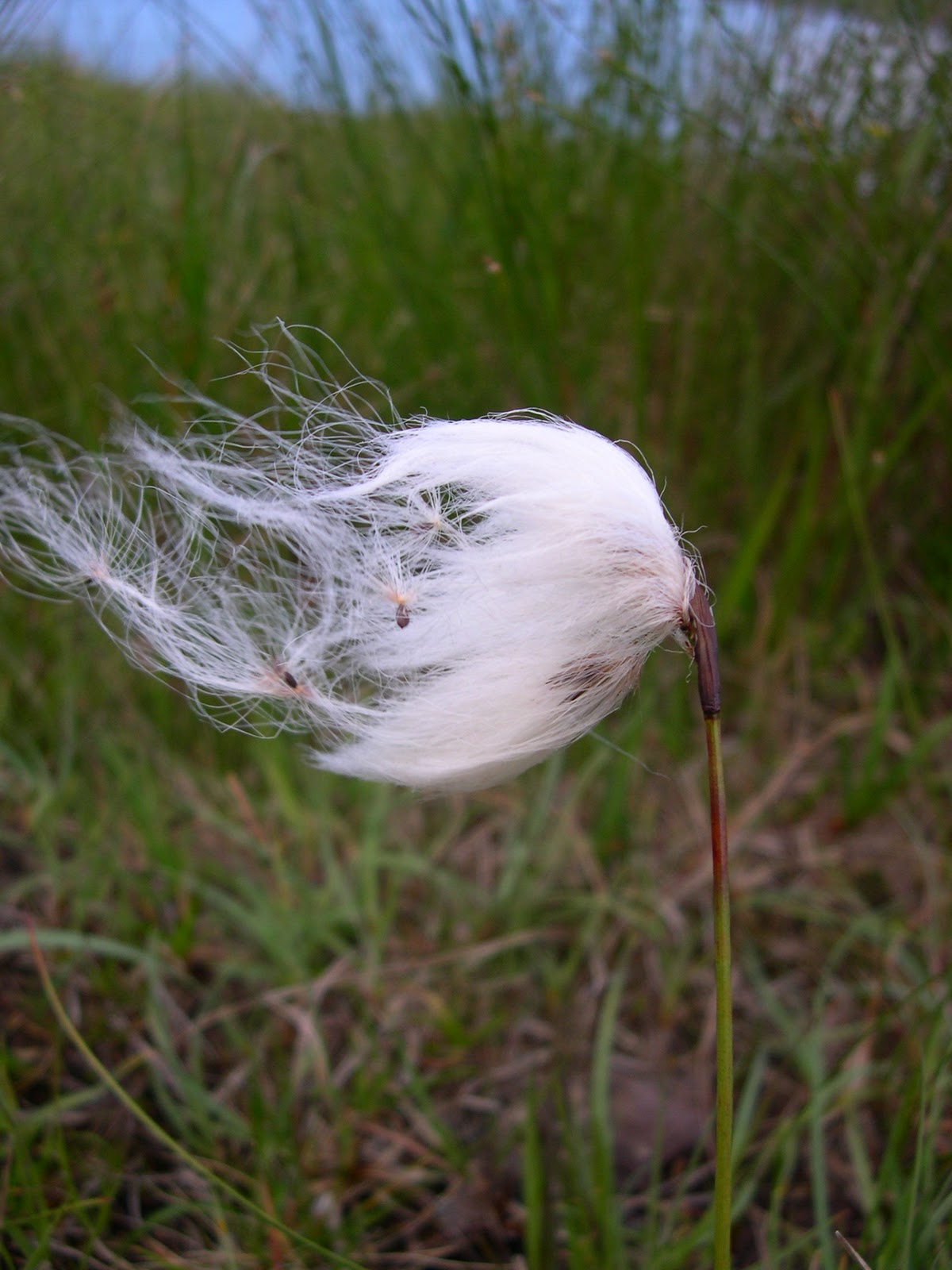
Bog cotton by Loch Glenbrittle
A Shine of Rainbows is one of many enjoyable books by Lillian Beckwith. Everything I’ve read by her has been set in the Hebrides Islands of Scotland, and most of her writing is light and humorous. This one was more serious, about an orphan who finds a good home, and the unwilling adoptive father who is eventually greatly helped by having a son. The thing I liked best about the story, which was fairly predictable and mostly an aid to falling asleep at night, was the mention of “bog cotton.”

When I read that name immediately a picture came to my mind of the plant that Pippin and I saw in Scotland years ago. I scribbled the name on a post-it note next to my bed and months later got around to looking it up; indeed, it is the very plant, a fairytale sort we encountered on the Isle of Skye as we began to hike up from Loch Glenbrittle into the Cuillin Mountains.

It’s also called Common Cottongrass: Eriophorum angustifolium. This plant is in the sedge family and is said to grow all over North America, but I’ve never encountered it before or since. These photos are by Pippin, from way back then.

Nothing to Do But Stay: My Pioneer Mother is by Carrie Young, the author of a book possibly more famous, The Wedding Dress. It’s a small book about growing up in a community of Norwegian immigrants in the Dakotas. The pioneer mother, Carrine Berg, grew up in the last decades of the 19th Century; the author graduated from college in 1944. Carrine was a plucky lady who homesteaded on the plains as a single woman, then when she was in her mid-30’s married another homesteader and managed to bear six children, of whom the author was the last.

All the stories of these hardworking people were well-told, but perhaps my favorite, that made me laugh out loud, was about when Carrine decided to raise turkeys as a moneymaking enterprise, in spite of the fact that her husband did not like the meat. The author and her sister were to “keep track of the turkeys” all summer long for four years, until their mother quit the business. “We soon learned that turkeys are congenitally indisposed to the principle of herding. Neither are they compatible with chasing, shooing, or rounding up.”

I also enjoyed reading about the way this extended family celebrated July 4th, as a children’s holiday focused on churning and eating as much ice cream as they could all day long. The vicarious experience of their family life makes me want to read The Wedding Dress, too.

Dust to Dust or Ashes to Ashes by Alvin Schmidt is a historical critique of the practice of cremation. This is likely the most poorly written book I’ve read in my life. The main points were well taken, but repeated over and over, with whole passages quoted almost verbatim from one chapter to another. The author has decent credentials, and I wonder why the publisher did not insist on some editing. Even the syntax is convoluted and confusing, and though Schmidt mentions the Orthodox view on cremation and the book is (I was ashamed to see) published by an Orthodox publishing company, he is not Orthodox himself and fails to convey the Orthodox understanding of burial.

Since I read that book, I bought another, newer book that promises to be a better treatment of the important subject: A Christian Ending: A Handbook for Burial in the Ancient Christian Tradition, by J. Mark and Elizabeth J. Barna. I also attended a lecture and discussion of the subject at a nearby monastery, which included the reading of many Bible passages that lament the breaking and grinding of human bones. One of the unchristian things about modern cremation is that it includes the grinding up of the bones. I still hope that some day I will find the time to organize all my thoughts on this subject.

Mrs. Mike by Benedict and Nancy Freedman I had read about 20 years ago, a public library copy. This time I ordered my own book online and got around to reading it when my brain was too tired for anything more strenuous. “Mr. Mike” is a Canadian mountie who takes his very young city-raised bride to the northern reaches of America, where they live through a lot of adventure and suffering along with the natives whom they often serve. It seems to be based on the life of a real woman, whose story is told honestly enough to be believable and to keep me turning the pages. I was glad to read it a second time but probably won’t again.

Echoes of a Native Land by Serge Schmemann: I picked up this book because it’s written by the son of Fr. Alexander Schmemann, one of my favorite authors. Serge was able to spend a decade living in the land of his forefathers and even in the very village where his mother’s people lived before the Russian Revolution, and this is the fascinating account of the genealogical history and the current residents, against the backdrop of 200 years of Russian politics and culture. Schmemann was a journalist for the New York Times who won a Pulitzer Prize for his coverage of the reunification of Germany. He’s always very readable and fair in this very personal history, which I liked very much.

I will let myself off the hook for a while, having mentioned a handful-sized stack of recent reads. Now turn aside from these brief and dull accounts to hear George Orwell on the subject of book reviews, even if it might be hard to connect what he says to my particular assemblage:

Prolonged, indiscriminate reviewing of books is a quite exceptionally thankless, irritating and exhausting job. It not only involves praising trash but constantly inventing reactions towards books about which one has no spontaneous feeling whatever.