Category Archives: books

Ordinary Grace–and Two Books

I should have taken warning from these lines on the third page:

“Ordinary life does not interest me. I seek only the high moments. I am in accord with the surrealists, searching for the marvelous….But I am not always in what I call a state of grace. I have days of illuminations and fevers. I have days when the music in my head stops. Then I mend socks, prune trees, can fruits, polish furniture. But while I am doing this I feel I am not living.”

So writes Anaïs Nin in her Diary from the 1930’s. Hers was a name I had often run across, perhaps because she seems to show up a lot in collections of quotes. I didn’t know anything about her, so I bought this used paperback book last month. It’s yet another that I will stop reading now. Why did I go on as far as I did, to read such lines as, “To be fully alive is to live unconsciously and instinctively in all directions….”? I don’t know.

But I know that I find this self-absorption and drama almost laughable, and definitely boring, in its gushing descriptions of feelings. Her prose is good; it’s the content that is lacking in concreteness and pervaded by an avoidance of reality; even the erotica she is known for is infused with her self-psychoanalysis and psychobabble.

Then there are the dreaded “ordinary” activities. If Nin can’t find her “state of grace” in the concrete here and now of Everyday, in nature and housework, I would give her condition a different name.

I should start doing a little more research on authors before I take time and/or money to learn about them the old-fashioned way. Wikipedia is easy. I could have found several reasons not to read her.

Annie Dillard is the opposite of Nin in some ways. She finds God, or at least looks for Him, in every rock and cloud and human she meets. When I threw For the Time Being into my sewing basket to take to the hospital for the waiting and laboring, I didn’t know that scenes from the hospital OB ward figure heavily in the book. I read a few passages to Pippin before her labor got very laborious.

“These times of ours are ordinary times, a slice of life like any other. Who can bear to hear this? Or who will consider it?” Dillard asks, as she, like Nin, considers the ordinary, but as a member of the human community, struggling with many questions that concern us all and sharing her ruminations with the reader.

She includes categories and section headers with labels such as Now, China, Sand, and Clouds, and cycles back to the topics again and again through the book. I skipped around and read a few of the Birth paragraphs aloud, and I haven’t yet read from the beginning to see how the author ties all these parts together, but I know from her other writings that she sees the philosophical interrelatedness of everything.

I recall words from G.K. Chesterton about how it is really the common everyday occurrences such as the sun rising or the train running on time that should astound us. But the best version of his thought I can find at the moment is: “The whole order of things is as outrageous as any miracle which could presume to violate it. This is how Dillard thinks.

Of the OB ward, she writes,

“There might well be a rough angel guarding this ward, or a dragon, or an upwelling current that dashes boats on rocks. There might well be an old stone cairn in the hall by the elevators, or a well, or a ruined shrine wall where people still hear bells. Should we not remove our shoes, drink potions, take baths? For this is surely the wildest deep-sea vent on earth. This is where the people come out.”

Her appreciation of the Numinous pervading our existence brings to mind another quote from Chesterton that will be my wrap-up:

There is no such thing on earth as an uninteresting subject;
the only thing that can exist is an uninterested person.

Book Stacks


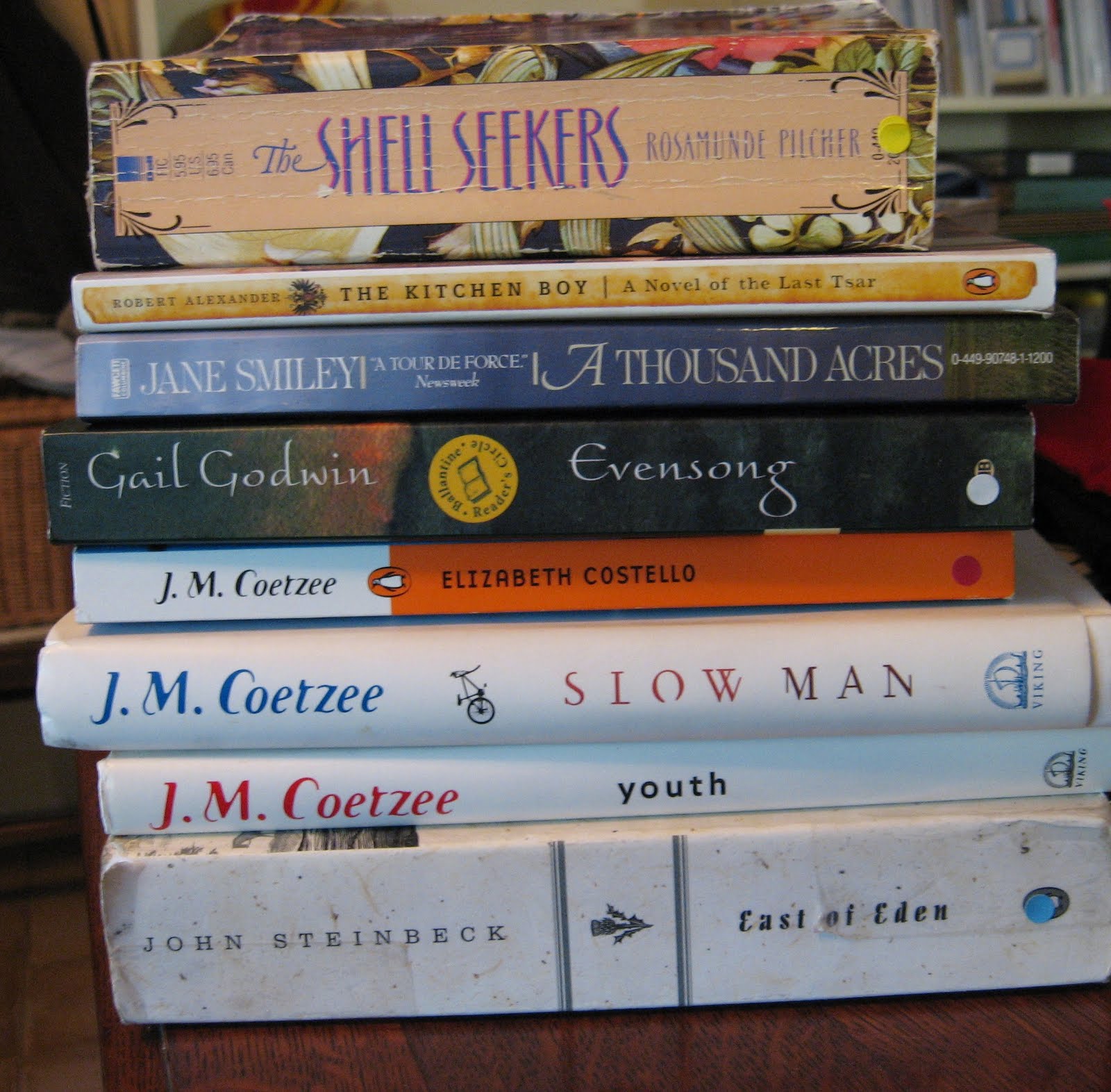
One of my blogger friends posted a picture of her book piles today. I realized that I love this sort of picture because it is a quick version of a browse over more extensive book shelves. It reminded me that I have similar piles around here. This first pile is the books I gave up on this summer, and will be shipping out. I’m still trying to find time to write about why I didn’t finish them. Several of them are by writers I know are good, but I am not equal to them, or I don’t have time for them, or something.

The second stack I just purchased at the library used bookstore yesterday. I went in with my eyes narrowed to paperbacks or very small hardcovers, because that is the category of book I am mostly limited to these days, as I read while lying in bed under the covers. There are already plenty of heavy hardcovers waiting on the shelves for me for those times when I am on vacation or sick or on a long car trip.

So I managed to find quite a range of authors and genres. My California is subtitled Journeys by Great Writers, but the only names I recognize are John Steinbeck and Dana Gioia. The Churchill book is a short biography published by The New York Times at his death in 1965. One of my teachers in junior high recommended the Thomas Wolfe book to me, and Annie Dillard is a longtime favorite. Perhaps some of these will end up starting a new reject stack, but in the meantime I feel prepared for some cozy times this fall.

Fewer Read Books at All


Is it still Banned Books Week? I might not have thought twice about it but for a couple of bloggers I check in on, each of whom sheds a ray of light from a different direction than the typical articles on the subject.

Semicolon writes briefly about how librarians complain about parents “censoring” reading material, while they quietly skew the contents of the library collections.

And Orrologion explains how the mainstream press is ignoring their own reluctance to publish a certain strain of unpopular works.

The most disturbing thing in my mind is that more and more people probably don’t care whether books are banned or censored or whatever, because fewer and fewer people in our country read books at all.

When Dana Gioia was still Chairman of the National Endowment for the Arts, the agency undertook an extensive study of the reading habits of the nation, which I heard him speak about recently. It’s a topic that is always current with me, and I hope to post here later about some of the interesting things I learned.

But for now, I must get back to my books….

Three Truthful Fictions

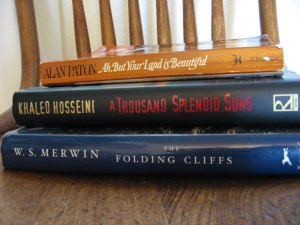
In early summer I read three works of fiction in a short space of time:

Ah, But Your Land is Beautiful by Alan Paton

A Thousand Splendid Suns by Khaled Hosseini

The Folding Cliffs by W.S. Merwin

These were all pretty dramatic stories of historical fiction. Paton’s book follows closely the events in South Africa mid-20th century. Hosseini writes about Afghanistan in the last 30 years, and Merwin’s book is an epic poem about Hawaii, mostly in the 19th century.

I was sitting around after surgery with my foot up, and that was what had made it possible for me spend more time reading and thinking. Some things I thought about: How funny that the settings of these three books were at three corners of the globe. Obviously they were not part of any theme. So were there some ways they were alike? What made them all worth reading to the end, when so many books I’ve tried lately were not?

Suffering was a large part of all the stories. The Afrikaners in Ah, But Your Land is Beautiful were treating all people of color unjustly and inhumanely. Whites who did otherwise suffered along with the oppressed, and often sacrificed their careers, homes, and reputations.

All the women suffer miserably in A Thousand Splendid Suns. War and famine, selfish and sinful men and women supported by bad cultural traditions, all combine to keep the women trapped in complicated and painful predicaments. Factions of Muslims hate one another.

The Folding Cliffs makes vivid the way conquering peoples oppress the vanquished, all the while thinking it is “for their own good.”

What benefit is there in dwelling on Man’s Inhumanity to Man? Don’t we already know how wretched we are? If that were all one gets from these stories, I don’t think they would be worth reading, but there is another bigger part to all of them, and that is Man’s Love. Just as Christ gave His life in love for us suffering humans, so He gives grace to men to rise above their suffering, show compassion to their fellow man, and do deeds of mercy.

“Courage is not simply one of the virtues but the form of every virtue at the testing point, which means at the point of highest reality,” said C.S. Lewis, and it is this courage that is shown by the young parents in Cliffs who flee to the hills and fight off government agents with guns rather than have their family torn apart by the health officials who are shipping off lepers to Molokai like so many unclean animals. Their love is demonstrated in the test of courage.

In Land, the author and his companions find joy and fellowship in realizing the sacrificial, mercy-giving aspect of their humanity as they fight what seems to be a losing battle against political power. Perhaps they were living what Winston Churchill was talking about when he said, “We shall draw from the heart of suffering itself the means of inspiration and survival.”

Alan Paton in his autobiography Towards the Mountain writes of the experience:

“…the inhumanity of man to man could be made endurable for us only when we manifested in our lives the humanity of man to man….there is a wound in the creation and…the greatest use we could make of our lives was to ask to be made a healer of it.”

I haven’t lived with the kinds of suffering I read about, and that is partly why I think these writings are valuable, for as we read we take as our companions in mind and heart characters who are historically real or fictionally true, who can train us in Christian virtue.

Khaled Hosseini has given his countrymen and all of us a wonderful gift in the two books of his I am familiar with. In Kite Runner and in A Thousand Splendid Suns he paints a backdrop of horror, including much personal moral failure. Kite Runner exposed my own innate cowardice as I empathized with the protagonist, and as he was able to find healing and hope after repentance, I was also comforted.

In Suns the author gives a tender role model to women everywhere who are beaten down by life. The character of Miriam is the ultimate in misery, as she has no friends and no family who care about her, and she is barren, so her husband hates her. Then a young woman comes into her life, a woman who could easily slide into being another tormentor. But instead she shows kindness and becomes a true friend, and Miriam finds hope and courage, as well as other parts of her humanity and womanhood that had been obscured. She is transformed from a passive recipient of abuse into a woman who can return love, and she is happy, even in the face of continued abuse.

These stories have the potential to become part of the collective consciousness of a people, and help us to live more humanly, more humanely. I hope that Suns in particular can give vision to the women of Afghanistan, a vision of themselves as able to rise above their circumstances by means of love toward others.

We won’t eliminate the oppressors; our hope does not consist of that, as Father Alexander Schmemann has summarized:

“The fundamental Christian eschatology has been destroyed by either the optimism leading to the Utopia, or by the pessimism leading to the Escape. If there are two heretical words in the Christian vocabulary, they would be ‘optimism’ and ‘pessimism.’ These two things are utterly anti-biblical and anti-Christian….It is for us, Christians, to reconstruct this unique faith, in which there are no illusions, no illusions at all, about the evil.”

Keeping with the theme of inspiring fiction, I’ll end with a quote by Whittaker Chambers from Witness (which book I love, but it is not fiction) about a novel that was formative for him. I haven’t read Les Miserables, but I noticed a few years ago that at least three important writers I knew of had mentioned they read it more than once as children. Sorry, I can’t remember who the others were. Chambers describes what can happen when a good writer connects with the reader:

“I read and reread Les Miserables many times in its entirety. It taught me two seemingly irreconcilable things–Christianity and revolution. It taught me first of all that the basic virtue of life is humility, that before humility, ambition, arrogance, pride and power are seen for what they are, the stigmata of littleness, the betrayal by the mind of the soul, a betrayal which continually fails against a humility that is authentic and consistent. It taught me justice and compassion, not a justice of the law, or as we say, human justice, but a justice that transcends human justice whenever humanity transcends itself to reach that summit where justice and compassion are one….”


Note in 2019: If you are reading this ten years later and feel like commenting, please do. The subject matter is never out of date and I’d be glad to renew the discussion.