Category Archives: books

Fewer Read Books at All


Is it still Banned Books Week? I might not have thought twice about it but for a couple of bloggers I check in on, each of whom sheds a ray of light from a different direction than the typical articles on the subject.

Semicolon writes briefly about how librarians complain about parents “censoring” reading material, while they quietly skew the contents of the library collections.

And Orrologion explains how the mainstream press is ignoring their own reluctance to publish a certain strain of unpopular works.

The most disturbing thing in my mind is that more and more people probably don’t care whether books are banned or censored or whatever, because fewer and fewer people in our country read books at all.

When Dana Gioia was still Chairman of the National Endowment for the Arts, the agency undertook an extensive study of the reading habits of the nation, which I heard him speak about recently. It’s a topic that is always current with me, and I hope to post here later about some of the interesting things I learned.

But for now, I must get back to my books….

Three Truthful Fictions

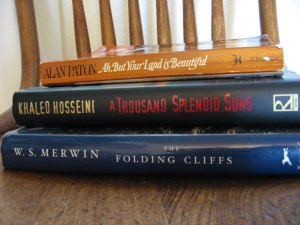
In early summer I read three works of fiction in a short space of time:

Ah, But Your Land is Beautiful by Alan Paton

A Thousand Splendid Suns by Khaled Hosseini

The Folding Cliffs by W.S. Merwin

These were all pretty dramatic stories of historical fiction. Paton’s book follows closely the events in South Africa mid-20th century. Hosseini writes about Afghanistan in the last 30 years, and Merwin’s book is an epic poem about Hawaii, mostly in the 19th century.

I was sitting around after surgery with my foot up, and that was what had made it possible for me spend more time reading and thinking. Some things I thought about: How funny that the settings of these three books were at three corners of the globe. Obviously they were not part of any theme. So were there some ways they were alike? What made them all worth reading to the end, when so many books I’ve tried lately were not?

Suffering was a large part of all the stories. The Afrikaners in Ah, But Your Land is Beautiful were treating all people of color unjustly and inhumanely. Whites who did otherwise suffered along with the oppressed, and often sacrificed their careers, homes, and reputations.

All the women suffer miserably in A Thousand Splendid Suns. War and famine, selfish and sinful men and women supported by bad cultural traditions, all combine to keep the women trapped in complicated and painful predicaments. Factions of Muslims hate one another.

The Folding Cliffs makes vivid the way conquering peoples oppress the vanquished, all the while thinking it is “for their own good.”

What benefit is there in dwelling on Man’s Inhumanity to Man? Don’t we already know how wretched we are? If that were all one gets from these stories, I don’t think they would be worth reading, but there is another bigger part to all of them, and that is Man’s Love. Just as Christ gave His life in love for us suffering humans, so He gives grace to men to rise above their suffering, show compassion to their fellow man, and do deeds of mercy.

“Courage is not simply one of the virtues but the form of every virtue at the testing point, which means at the point of highest reality,” said C.S. Lewis, and it is this courage that is shown by the young parents in Cliffs who flee to the hills and fight off government agents with guns rather than have their family torn apart by the health officials who are shipping off lepers to Molokai like so many unclean animals. Their love is demonstrated in the test of courage.

In Land, the author and his companions find joy and fellowship in realizing the sacrificial, mercy-giving aspect of their humanity as they fight what seems to be a losing battle against political power. Perhaps they were living what Winston Churchill was talking about when he said, “We shall draw from the heart of suffering itself the means of inspiration and survival.”

Alan Paton in his autobiography Towards the Mountain writes of the experience:

“…the inhumanity of man to man could be made endurable for us only when we manifested in our lives the humanity of man to man….there is a wound in the creation and…the greatest use we could make of our lives was to ask to be made a healer of it.”

I haven’t lived with the kinds of suffering I read about, and that is partly why I think these writings are valuable, for as we read we take as our companions in mind and heart characters who are historically real or fictionally true, who can train us in Christian virtue.

Khaled Hosseini has given his countrymen and all of us a wonderful gift in the two books of his I am familiar with. In Kite Runner and in A Thousand Splendid Suns he paints a backdrop of horror, including much personal moral failure. Kite Runner exposed my own innate cowardice as I empathized with the protagonist, and as he was able to find healing and hope after repentance, I was also comforted.

In Suns the author gives a tender role model to women everywhere who are beaten down by life. The character of Miriam is the ultimate in misery, as she has no friends and no family who care about her, and she is barren, so her husband hates her. Then a young woman comes into her life, a woman who could easily slide into being another tormentor. But instead she shows kindness and becomes a true friend, and Miriam finds hope and courage, as well as other parts of her humanity and womanhood that had been obscured. She is transformed from a passive recipient of abuse into a woman who can return love, and she is happy, even in the face of continued abuse.

These stories have the potential to become part of the collective consciousness of a people, and help us to live more humanly, more humanely. I hope that Suns in particular can give vision to the women of Afghanistan, a vision of themselves as able to rise above their circumstances by means of love toward others.

We won’t eliminate the oppressors; our hope does not consist of that, as Father Alexander Schmemann has summarized:

“The fundamental Christian eschatology has been destroyed by either the optimism leading to the Utopia, or by the pessimism leading to the Escape. If there are two heretical words in the Christian vocabulary, they would be ‘optimism’ and ‘pessimism.’ These two things are utterly anti-biblical and anti-Christian….It is for us, Christians, to reconstruct this unique faith, in which there are no illusions, no illusions at all, about the evil.”

Keeping with the theme of inspiring fiction, I’ll end with a quote by Whittaker Chambers from Witness (which book I love, but it is not fiction) about a novel that was formative for him. I haven’t read Les Miserables, but I noticed a few years ago that at least three important writers I knew of had mentioned they read it more than once as children. Sorry, I can’t remember who the others were. Chambers describes what can happen when a good writer connects with the reader:

“I read and reread Les Miserables many times in its entirety. It taught me two seemingly irreconcilable things–Christianity and revolution. It taught me first of all that the basic virtue of life is humility, that before humility, ambition, arrogance, pride and power are seen for what they are, the stigmata of littleness, the betrayal by the mind of the soul, a betrayal which continually fails against a humility that is authentic and consistent. It taught me justice and compassion, not a justice of the law, or as we say, human justice, but a justice that transcends human justice whenever humanity transcends itself to reach that summit where justice and compassion are one….”


Note in 2019: If you are reading this ten years later and feel like commenting, please do. The subject matter is never out of date and I’d be glad to renew the discussion.
Mountain Retreat Complete


As I wrote in my last post, I was departing for a mountain retreat. And I made such a big deal of my delight in anticipating it, I also promised a report.

It takes a full six hours to cover the 300 miles to my destination, and most of that time I listened to various things on tape or CD. As the library didn’t have anything promising on my last-minute visit there, I was forced to remember that we had taped readings of the New Testament in the cupboard. As with books, I took way more CD’s and tapes than I could possibly use….

On the trip down I listened to the latest Mars Hill Audio tape. Please ask them for a free sample if you’ve never heard their interviews with various authors, teachers, musicians. It’s like an audio magazine where you eavesdrop on discussions between thoughtful people. And I heard the whole Gospel of Matthew on tape–what a perfect intro to a prayerful couple of days!

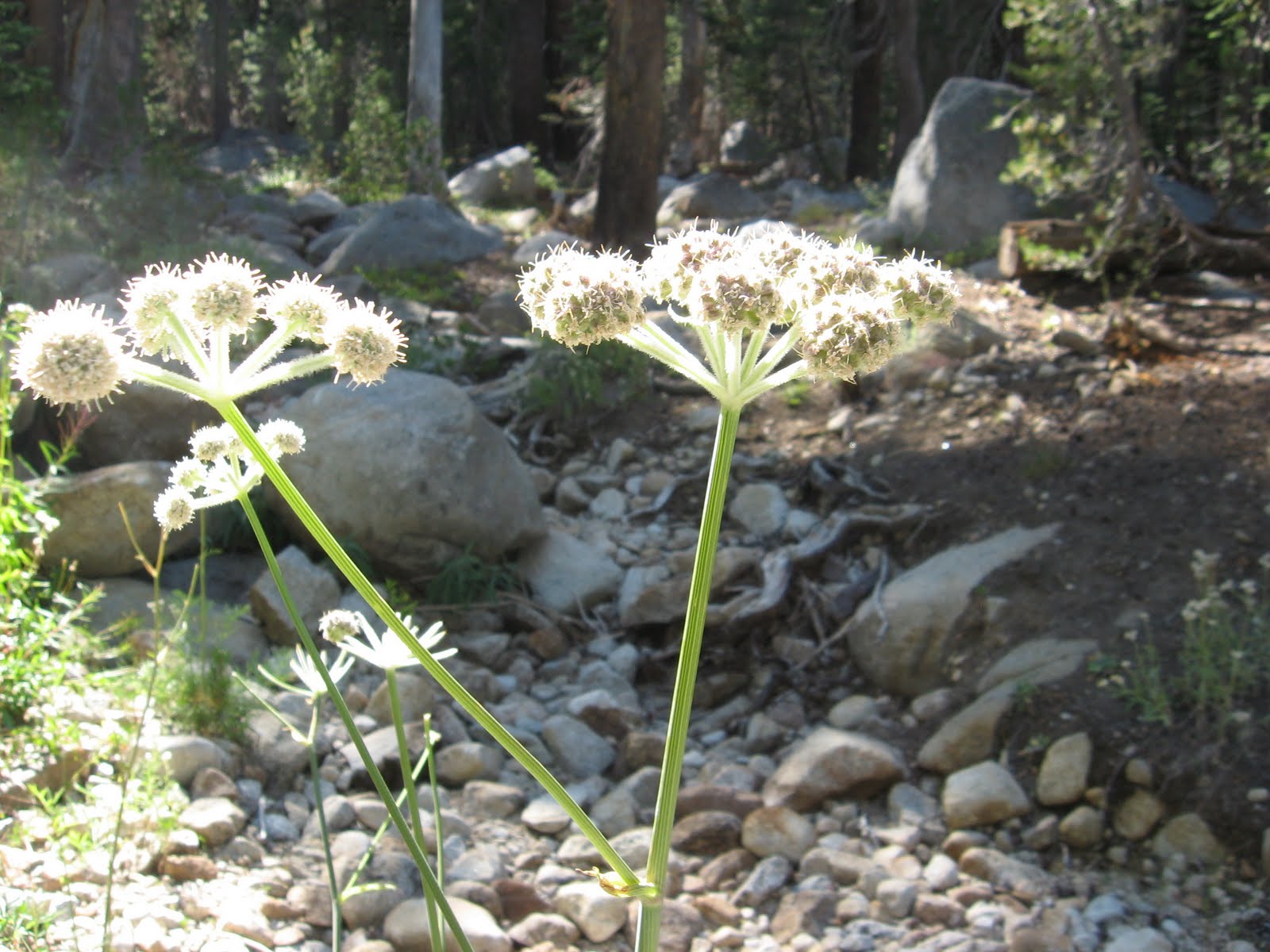
Sierra vinegarweed

My least beautiful photo, but the best of my attempts to capture this flower that graces the roadway, around 5,000 to 6,000 ft elevation, with a misty lavender haze. When you get close, the effect is spoiled as the plants are revealed as dry and stickery, puny individuals. (That sounds like a description of us Christians relative to the whole Church.) I don’t know what it might be, do you? It was the first of my pictures on this expedition.

It’s about this point on the driving, an hour and 3,000 ft down the mountain from Our Lake, I always have to turn off all recordings or radio and have quiet, so I can focus on the smells of the trees and hear the quiet of the forest.

Incense Cedars contribute one of the aromas. As a child with my family, on trips up the mountain it was filling my senses about the time I got carsick, and it took me most of my adult life to get over this association and develop an appreciation for the tree. But I haven’t known just what they looked like, so I found this photo on the Net.

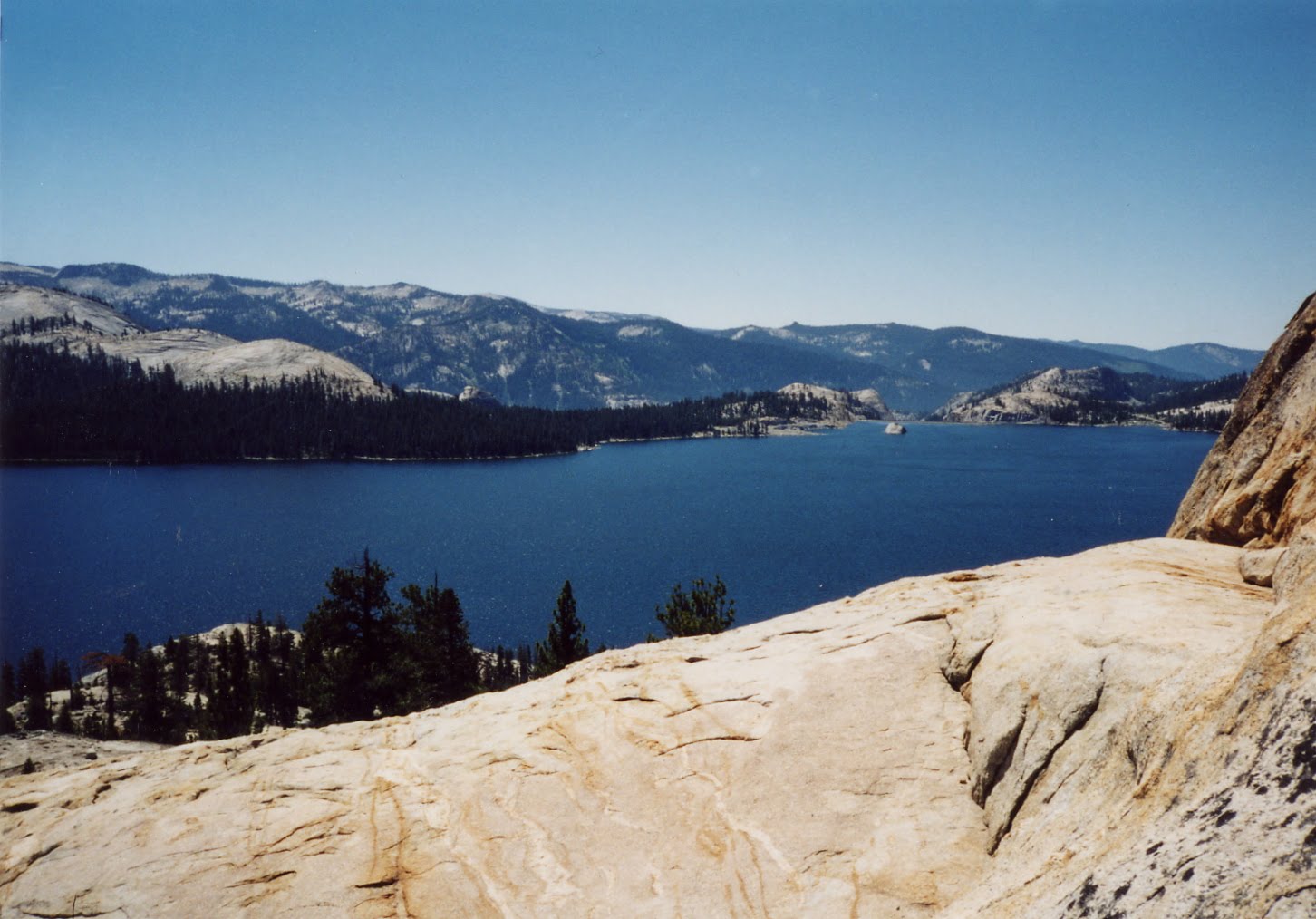
Far in the distance at left you can see a lake that is not our lake. But this photo was mostly for the sake of the manzanita that I love, and in the absence of the wildflowers that catch your eye earlier in the summer, it takes center stage for me, so I made it fill the foreground here.
Ah…the first view of Our Lake. Other than that purple haze, all the wildflowers I saw at high elevations were white. Like this Pearly Everlasting. I just looked up its name this morning.
Ranger’s Buttons along the road going in. I picked up some granite rocks near here for the garden at home.

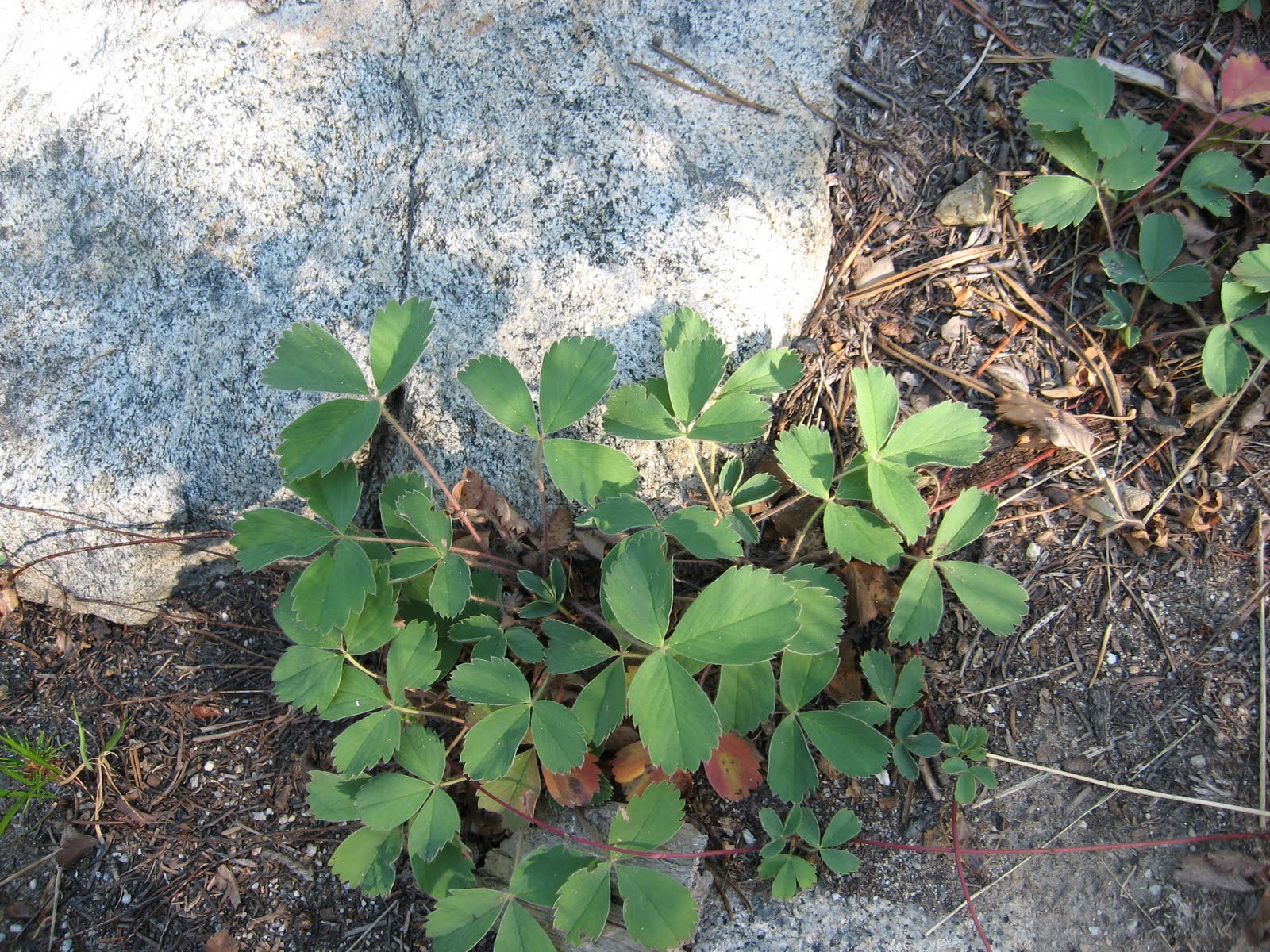
Yarrow was growing next to the cabin. I saw it when I was turning on the water down the hill. There are various things to do when you first arrive: turn on the water, turn on the solar, turn on the water heater. Bring your stuff in from the car. My legs were so heavy and I felt generally exhausted, so much that I wondered if I could resist falling on a bed and sleeping immediately. It must be the altitude. All evening my brain was slow, and I was so sl-e-e-py.

yarrow

For that reason I didn’t start right in on heavy reading, but took advantage of the magazines my sister had left. When my father’s mark was more on the place, you would find old issues of California Farmer, National Geographic and Sunset piled up everywhere. Now I find the New Yorker! Well, as I haven’t been on the treadmill for some time, where I used to read New Yorker, it was a welcome change, and just the thing for an oxygen-deprived brain. The most interesting article I read was in two parts, on Siberia, by Ian Frazier. His book on the subject is due to come out next year, and it looks to be worth reading.

This old coffee table caught my eye when I walked through the cabin door, the only furniture from our childhood home that never varied or wore out, and the only piece that we have (just since my last visit) installed in the cabin. Either my father or another ancestor built this table, I’m pretty sure, but none of my siblings can remember, so I guess we will never know its origins.

I brought some candles for indoor prayer times, and then was pleased to discover I had a little icon card of Christ the Shepherd in my purse to display with them. I prayed He would shepherd me through my weekend in the way of the 23rd Psalm, and give me light, and Himself as Light.

Speaking of light, I did lie out under the stars in my sleeping bag the first night, for a couple of hours, until my narrow bed (a lounge chair cushion) made it impossible to sleep. The stars and night sky were comforting, like an angelic blanket. This time little wisps of clouds were decorating the constellations; I could smell the trees, sweet and dry and piney-sharp, with a bit of wood smoke from the campground down the hill in the mix.

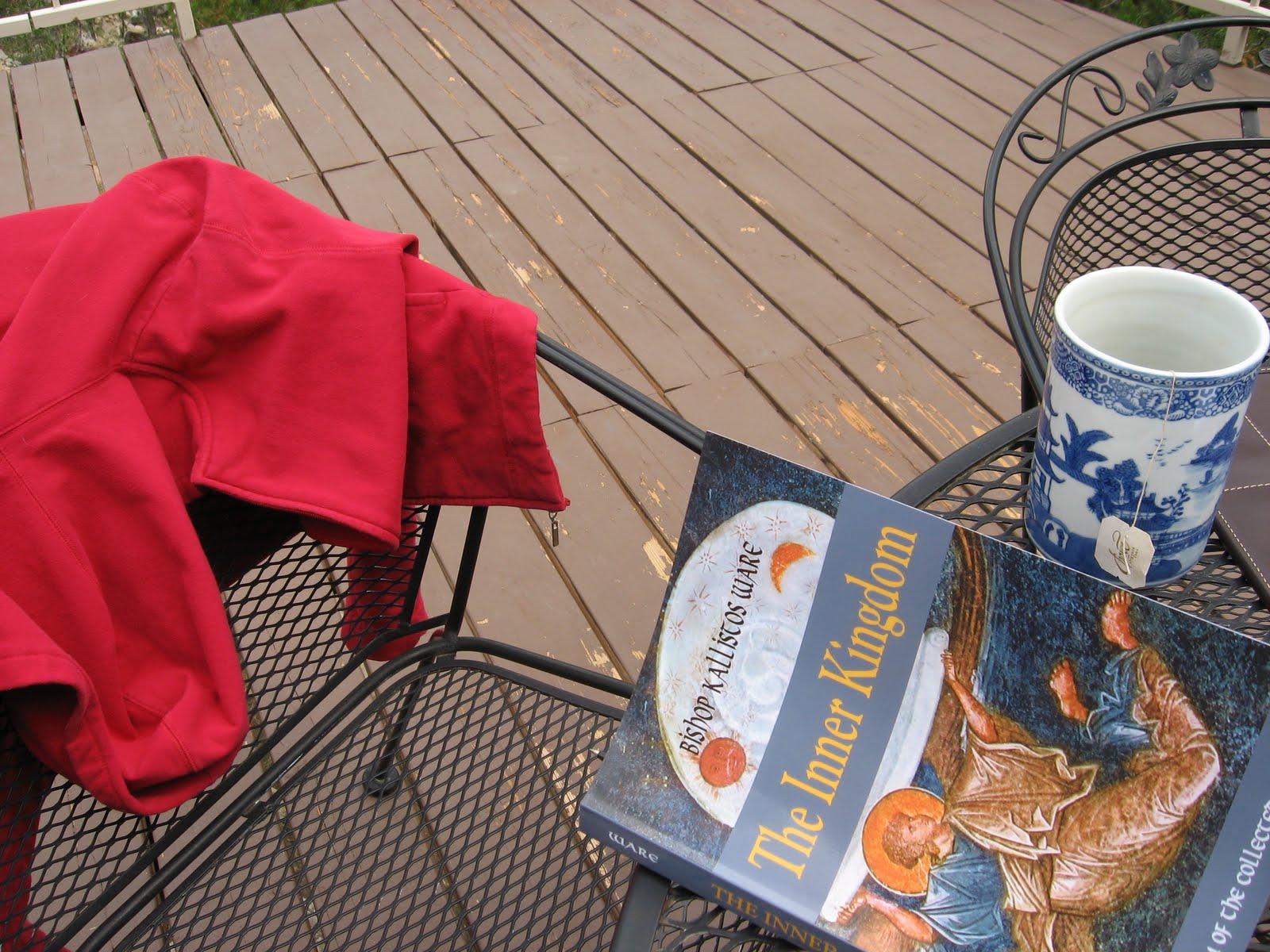
Much of the time I spent on the deck, reading this book, drinking tea, and watching the hummingbirds battle over the feeder. If the sun goes behind a cloud, or a breeze comes up, the temperature drops, so you find yourself putting on and taking off your sweater, moving under the umbrella and then back out in the sunshine again.

When I was wearing my red sweatshirt the hummingbirds would buzz threateningly behind my head as long as it took them to figure out that I wasn’t a giant flower.

The Inner Kingdom had been on my shelf for a year; I’m so glad I threw it in the box to take up! The author Kallistos Ware was a convert to the Orthodox Church as a young man in Britain and was a lecturer at Oxford for a long time. I have read other books by him, as a catechumen and since, and was able to hear him speak in 2008, which was pure pleasure.

This one is first in a planned six-volume collection of his works. He is a wonderful writer–so scholarly yet easy to read. I’d say he is more teacherly than devotional in his style, and he treats the subject matter so thoroughly that most every intellectual question I might have was answered; I was spurred on to love the God he so lovingly describes. I finished the whole book! What a satisfaction to finish something so nourishing.

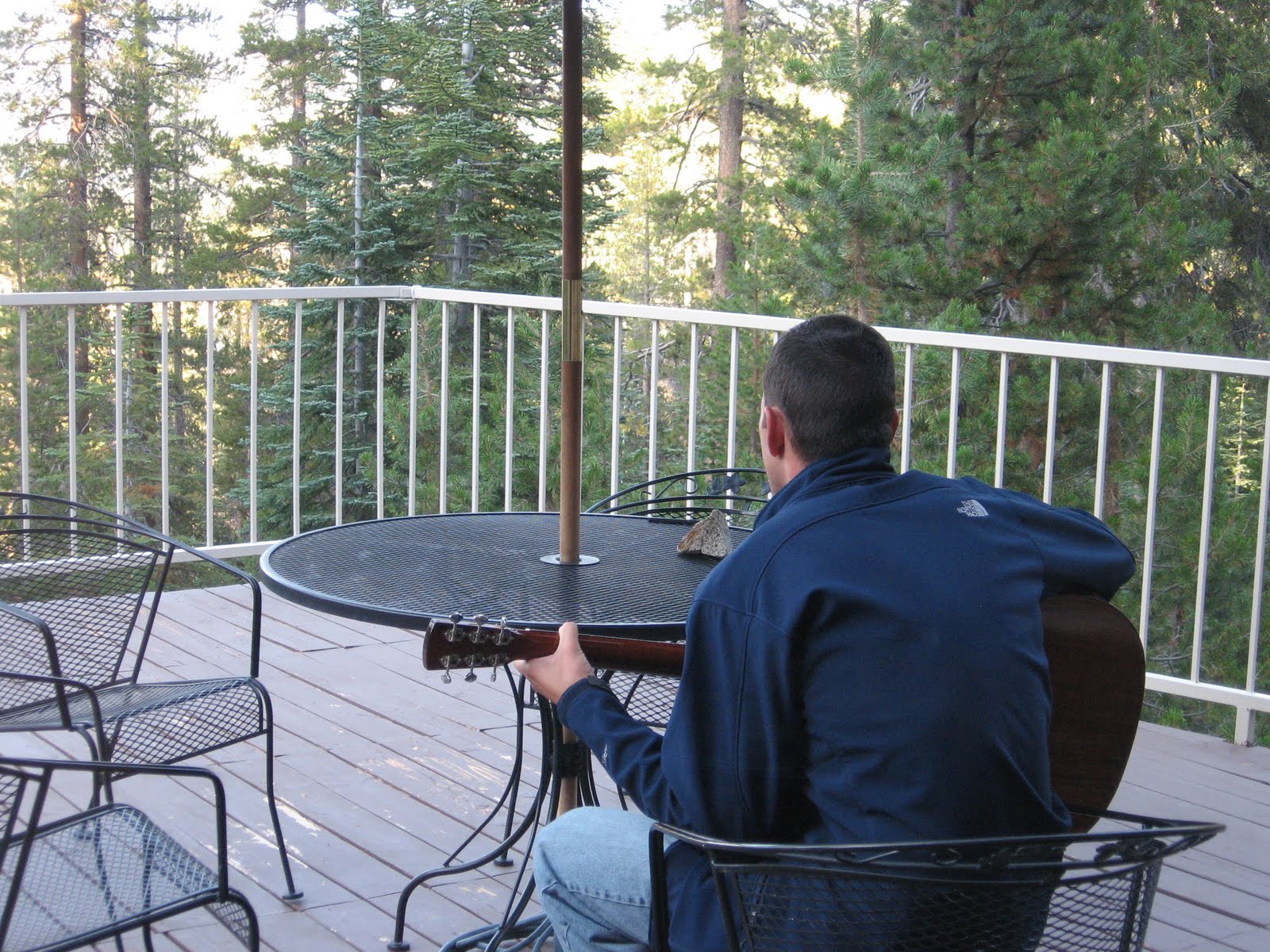
Soldier came up to be with me for part of the time. He also read a lot, and hiked, and played his guitar, everything from Dylan to gospel. It was a rare treat to be just the two of us together.

Here are the books all packed up and ready to carry home again. I only used about half of them, and there is an extra in the box going home, the novel by Jane Smiley that my sister had left in the cabin and that I am borrowing. It looks small enough for reading in bed, but I didn’t take the time to dip into it yet.
On the way down the mountain I had to stop and try once more to capture the beauty of the manzanita. I couldn’t, of course. And those tree smells wouldn’t be bottled up. I could never get a picture of the night sky that would make you feel the weighty silence of the Holy Spirit in it. But you know how it is–I had to try!

Mountain Retreat

I’m off to the mountains again this week. Two years ago I made my first solitary retreat in this remote destination, with some fear at the outset about being alone where there is no phone, and few people around. But the fear was gone the moment I walked through the cabin door and the reality of God’s presence came freshly on me. Why had I been talking about being alone up there, when it was really God and I together for a few days? And it did end up being best kind of retreat and rejuvenation of the spirit, by the Holy Spirit.

Perhaps this time I will spend more time at night looking at the stars. That other outing it was late September and almost too cold for it at that high elevation. There are none of men’s lights to interfere; I’ll put on my glasses and lie on my back on the deck. I remember how the sight of those uncountable stars filled me with awe for God, and with God Himself, so much that I couldn’t bear it for long.

Maybe I was unconsciously “thinking” ahead when I posted that poem and thoughts about night recently. I’ve been looking forward to the time for reading and prayer, and now that I start writing I’m reminded to anticipate the joy of the dark and starry night as well.

Our civilization has fallen out of touch with night.
With lights, we drive the holiness and beauty of night back to the forests and the sea;
the little villages, the crossroads even, will have none of it.
Are modern folk, perhaps, afraid of night?
Do they fear that vast serenity, the mystery of infinite space,
the austerity of stars?
–Henry Beston


But back to the bookish part of the opportunity. The process of preparing for the trip by choosing my reading material (and even the food to bring, I might add) is a sort of pre-retreat. I know I won’t be able to fully mine any of the treasure-troves that this list represents, but if I left one at home, it would surely be the one I’d want to dip into, right? In addition to a couple of the history or literature books from on my sidebar list, I’m taking these spiritually meaty ones.

Books for a Mountain Getaway:
Orthodox Dogmatic Theology by Michael Pomazansky
The Inner Kingdom by Kallistos Ware
Little Russian Philokalia Vol. 1 by St. Seraphim
Courage to Pray by Anthony Bloom
On Prayer by Archimandrite Sophrony

Well, I’m going on my adventure, and pray God will bring me home to tell about it. If not, you’ll all know that it really was unbearably glorious!