 Today I read the early reader Mouse Soup to the grandchildren. In the first pages a mouse is caught by a badger who is planning to make soup out of him. But the mouse thinks fast and tells the badger, “This soup will not taste good. It has no stories in it. Mouse soup must be mixed with stories to make it taste really good.”
Stories do make life tasty. I wish I had the skill to share the many humorous and heartwarming stories that have filled my days this week while I am at Pippin’s in the northern reaches of our fair state. Many people who haven’t been to California have the impression that there is not much northward beyond the San Francisco Bay Area, but I live beyond that, and I still have to drive six hours to get to Oregon. It’s about five hours to Pippin’s.
The weather has been a constant source of interest and conversation, of course, being the thing we live in, assaulting or caressing or charming my senses by turn. There was the melting day of my arrival when it was 105°, all the way to refreshing thundershowers that started a cooling trend, so that this week the highs have been in the 80’s and 90’s.

The cats are draped all over the house because it’s a bit cooler indoors. Duncan considers Jamie his special responsibility and often sleeps on the changing table. If Jamie were comfortable lying on such a lump, the cat would be content to stay in place while I change the baby. But Jamie complained, so I shoved Duncan to the side.
When I step outdoors at night I start to imagine that it is 30 years ago and our family is camping in the mountains, because in the warmth the trees are expressing their individual and familiar flavors, taking me back. The stars are just as bright, too — and I don’t even have to sleep in a tent.
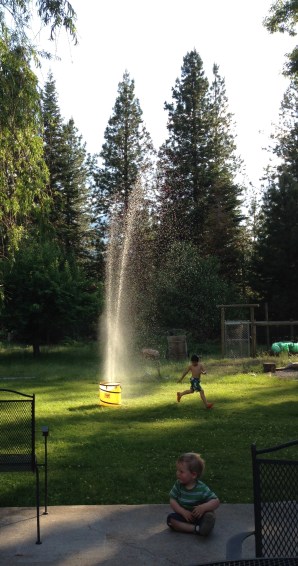 It was Sunday upon returning from Oregon and Pathfinders’ family that the thunder and lightning foretold the dumping of rain. It splashed down just after we got the sleepy children in the door. That gave Pippin some help in keeping the zinnia seedlings watered.
I might yet do that job, but for several days I’ve been barely keeping up with my main reason for being here, to mind the children ages 6, 3, and 1. Today was my last day of being the only adult on duty for twelve hours at a time.
The six-year-old is the sort of person A.A. Milne was writing about in the poem in Now We Are Six: “Now that I’m six, I’m as clever as clever. I think I’ll be six now for ever and ever.” I could see that if I didn’t want to be constantly on the receiving end of his management, carrying out his ideas, I had to have a plan of my own.
So I told Scout we were going to have Grandma Camp for three days. He insisted on changing the name of the program, to something like Grandma Half-Camp, and I conceded that it was not what one normally thinks of as camp, given that activities have to accommodate the shifting needs and schedule of a toddler.
I stayed up late the night before Day 1 planning our activities: periods of quiet, such as me reading to the children, or them playing with play dough, alternating with dancing or jumping on the trampoline. We would take walks, maybe two a day, for Grandma’s sake mostly.

Scout does not enjoy Alone Time, though his home here in the forest and his liberty to explore would be any boy’s dream. Even jumping on the trampoline is only fun if someone is throwing balls at you or providing a listening ear to the expounding of your thoughts. It’s a challenge to meet the needs of other members of the family when someone like that is sucking all the attention and airspace.
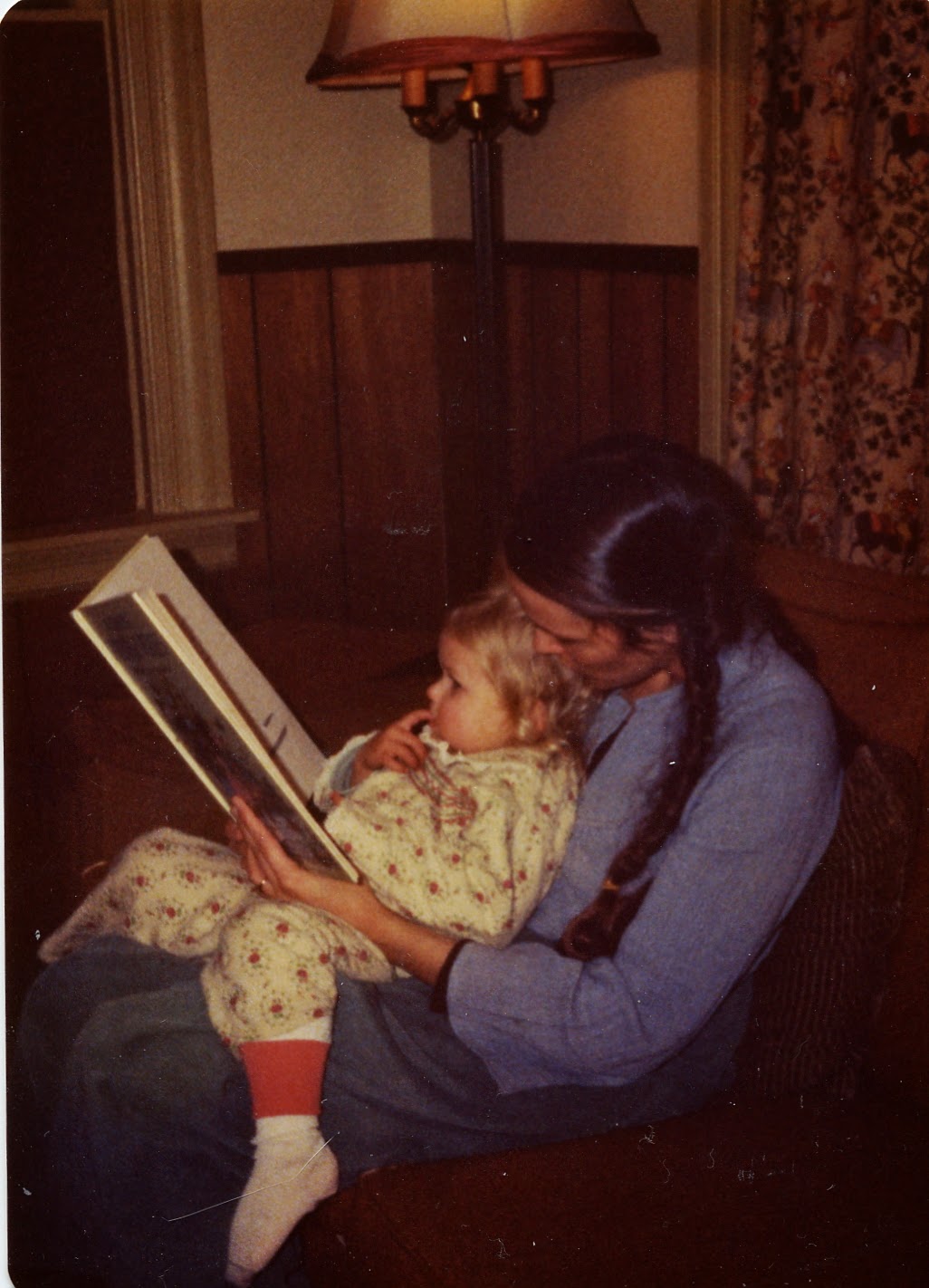
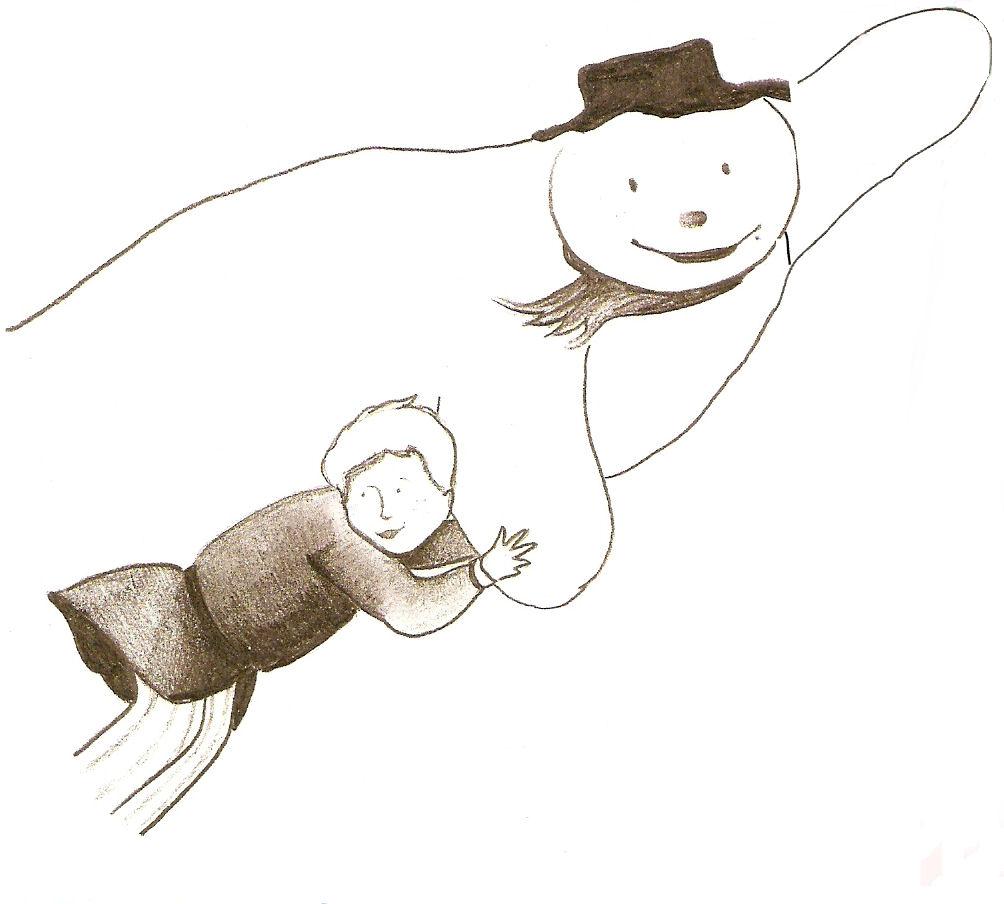
One of my favorite things to do with children is to read aloud, so I made sure to schedule in lots of time for that. This week we have read dozens of books, including many fairy tales, some of which were not very familiar to me, like a lovely version of The Snow Queen by Susan Jeffers, Sir Gawain and the Green Knight, and Bearskin by Howard Pyle.
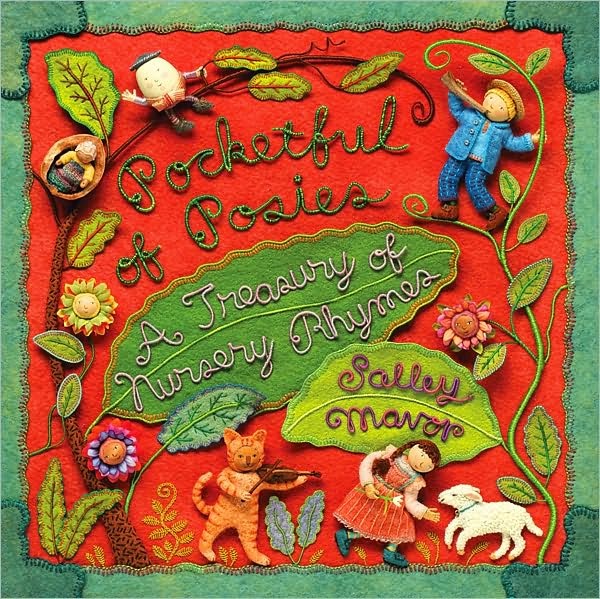 Ivy loves the book of nursery rhymes Pocketful of Posies, illustrated by the amazing Sally Mavor, and we like to examine the details of the pictures, like the flower petals and leaves that make up skirts of many of the ladies, especially Mary, Mary’s “pretty maids all in a row.” It was the selection for our Poetry Time one morning, which followed Prayer and Bible and me trying to teach them the simple song, “Isaiah Heard the Voice of the Lord.”
 A Far-Fetched Story by Karin Cates is a favorite of mine since I gave it to this family four years ago. It’s actually more appropriate to read in the fall, because the story revolves around the gathering of firewood in preparation for winter. But it’s a lot of fun, and if my husband had read it he’d have said I am like the woman of whom we hear in the first paragraph:
“Early one autumn, long ago and far away, the woodpile was higher than the windowsills. But even so, there was not enough firewood to suit Grandmother.” When one after another of her family sent to get a few more pieces for the wood box come back with nothing more than a tall tale, she says, “Well, that’s a far-fetched story!” Now Ivy has taken to trying out this comment in various conversations.
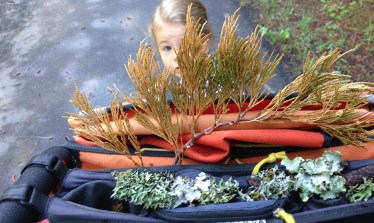
We only took one walk — so far. It was too hot much of the time, and at other times it seemed that either Ivy or Jamie was napping. But on that walk Scout found lots of lichens that he laid in a row on the back of the stroller along with a branch that Ivy said looked like a seahorse.
I danced most days with the children to some rousing instrumental music from the 50’s, 60’s and 70’s, as is their routine. Their style is quite untaught and hyperkinetic, involving lots of running around the perimeter of a rug in the living room.
But this evening they were dancing without me, and after a while Scout came proudly into the kitchen where I was making dinner, wanting to show me the results of his efforts. “Grandma, feel the back of my head!” I felt his damp hair. “Does it feel wet? That’s just my sweat, from dancing! It’s Swinging Man Sweat!” And off he went to swing some more.
My pace of life of late, combined with my inability to understand my various mobile devices, have frustrated my documentarian desires, and I had to stay up till midnight, after both parents returned, to get this post done. I may have some more “stories” to tell before I go home, and I hope they will be good food for our souls.
 ago there was a poem by X.J. Kennedy that got my attention, because although I knew his name from a poetry textbook I own, as he was co-editor with Dana Gioia of that book, I hadn’t seen any of his own poetry before. I was predisposed to like him because of his collaboration with Dana Gioia whom I greatly admire (As you will see if you check out tags with his name here on my blog).
 , yesterday,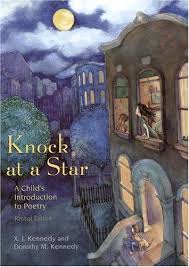


 Gladsome Lights
