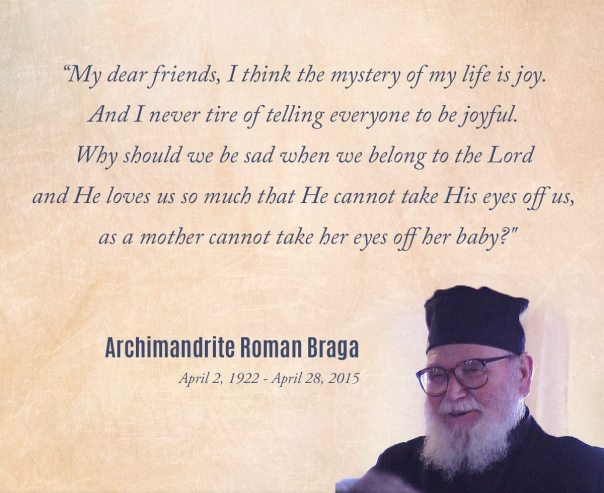
“My dear friends, I think the mystery of my life is joy, and I never tire of telling everyone
to be joyful. Why should we be sad when we belong to the Lord and He love us so much
that He cannot take His eyes off us, as a mother cannot take her eyes off her baby?”
About ten years ago, James Kushiner interviewed Father Roman Braga for Salvo magazine, and the interview was published in this article: “Solitary Refinement.”
Not long afterward, following Fr. Roman’s repose in death, Kushiner wrote again, in a 2015 Touchstone magazine newsletter:
Prisoner of the Redeemer
Early this morning, about a four-hour drive east of Chicago’s Holy Name Cathedral, a new and much smaller church in the Michigan countryside sheltered the body of a recently departed priest-monk of the Orthodox Church, Fr. Roman Braga. His funeral was scheduled to begin at 9:30 AM.
While Fr. Roman held no office as elevated as the Archbishop of Chicago, it would not surprise me if in some ways he influenced nearly as many people over the years through his counsel, prayers, and service to the church–to all who spoke with him.
Fr. Roman moved to Michigan from Brazil the same year I moved from Michigan to Chicago (1972). Twenty-five years later, on October 7, 1997, I met him for the first time at Holy Dormition Orthodox Monastery in Michigan. I was privileged to have a several conversations with him over the years, including an interview published in Salvo Magazine (Solitary Refinement: How One Man Found Freedom Inside a Communist Prison. A former high school teacher, he *loved* Salvo and young people.) His counsel helped me in many ways.
Fr. Roman was expelled from his native Romania in 1968, where he had served as a priest of the Romanian Orthodox Church. He had spent 5 years in a labor camp digging the Black Sea Canal, and later served 6 years of a new 18-year sentence, including time in solitary confinement, before being released under a general amnesty in 1964. He began his priestly ministry, watched carefully by the secret police, who came one night in 1968 with a Brazilian passport in hand and expelled him.

Fr. Roman said he discovered Jesus Christ more deeply in the depths of his being in prison, especially in solitary confinement, where he came to experience true spiritual freedom. He spoke of prison with nostalgia.
The New Testament has many scenes in prison: John and Peter, then Peter, Paul and Silas, then Paul. How many of Paul’s epistles were written from prison?
Didn’t the new church of God began in a prison (phulake), with the first sermon preached (ekeruxen) to its prisoners by Pilate’s former Prisoner (1 Peter 3:19)? Here the “gates of hell” did not prevail against Christ and his new church as he burst those gates and led the captives free.
I could sense from the way Fr. Roman prayed and chanted the “Akathist Hymn to Jesus Christ” on Sundays before Divine Liturgy that I was witnessing a loving communion between the Lord and his servant. One stanza is an icon of his faith:
Jesus, true God.
Jesus, Son of David.
Jesus, glorious King.
Jesus, innocent Lamb.
Jesus, Shepherd most marvellous.
Jesus, Protector of mine infancy.
Jesus, Guide of my youth.
Jesus, Boast of mine old age.
Jesus, my Hope at death.
Jesus, my Life after death.
Jesus, my Comfort at Your judgment.
Jesus, my Desire, let me not then be ashamed.
He also praised Jesus Christ, “Redeemer of those below” and “Vanquisher of the nethermost powers.” Fr. Roman was singing a song to his Paschal Liberator. I will always think of him with a captivating twinkle in his eye, revealing an inner joy forged in the crucible of prison. He was, with St. Paul, a “prisoner of the Lord” and true servant.
Father Roman, I trust, beholds the face of his Beloved Savior in the mansions of the righteous. Christ is risen! Memory eternal!
Yours for Christ, Creed & Culture,
James M. Kushiner
Executive Director, The Fellowship of St. James



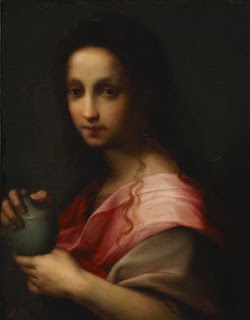 And when Jesus was in Bethany at the house of Simon the leper, a woman came to Him having an alabaster flask of very costly fragrant oil, and she poured it on His head as He sat at the table. But when His disciples saw it, they were indignant, saying, “Why this waste? For this fragrant oil might have been sold for much and given to the poor.”
  Gladsome Lights