Category Archives: church

Eating food that is not dead.

“Prepare yourself, my soul! Be courageous like Abraham, Isaac and Jacob, that acquiring diligence and wisdom you too may meet your God. Through contemplation may you reach the awesome depths in which He dwells and in so doing become a good steward of the Lord.”

-Canon of St. Andrew

For the Orthodox, it is the first week of Great Lent, which is called Clean Week. We began the fast on Monday, after the Vespers of Forgiveness on Sunday. This year in my parish we were thankful for good weather that day, as our long line of people bowing to each other in their masks, and mostly not hugging, stretched in a long loop that went out the side door of the church and wrapped loosely around the front. We were saying, “Forgive me,” to each one, and replying “God forgives.” Many of us had not seen each other in person for months or even the whole year.
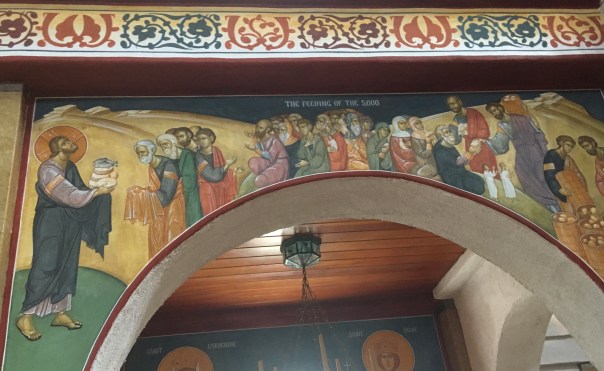
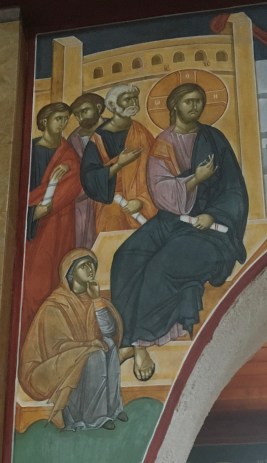
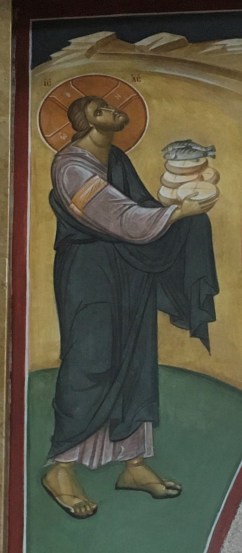
Two new frescoes had been completed just in time to take down the scaffolding and make room for Lenten services. As I took pictures of them on Sunday I realized how each of them draws me into an aspect of the season.

Christ in the House of Mary and Martha in Bethany (on the other side of the arch, not pictured, is Martha scowling) makes me want to imitate Mary and sit at Jesus’s feet. And The Feeding of the Five Thousand reminds me of various levels of meaning in the lines of the Lord’s Prayer, “Give us this day our daily bread.” As we are going without physical food in various ways during this season, that part of our prayer is extra meaningful. The most striking words I ever read on the relation of earthly and heavenly food were in For the Life of the World by Fr. Alexander Schmemann:
“The natural dependence of man upon the world was intended to be transformed constantly into communion with God in whom is all life. …He still loves, he is still hungry. He knows he is dependent on that which is beyond him. But his love and his dependence refer only to the world in itself. He does not know that breathing can be communion with God. He does not realize that to eat can be to receive life from God in more than its physical sense. He forgets that the world, its air or its food cannot by themselves bring life, but only as they are received and accepted for God’s sake, in God and as bearers of the divine gift of life. By themselves they can produce only the appearance of life.
“…Things treated merely as things in themselves destroy themselves because only in God have they any life. The world of nature, cut off from the source of life, is a dying world. For one who thinks food in itself is the source of life, eating is communion with the dying world, it is communion with death. Food itself is dead, it is a life that has died and it must be kept in refrigerators like a corpse.”

The most prominent reading during the first week of Lent is The Great Canon of St. Andrew of Crete, which is typically divided into four parts sung during services of that week. This year our women’s book group also chose a book on the Canon to read during this season.

I’ve noticed that during the Compline service when the Canon is being read, year by year, there are so many Scripture passages and characters referred to, that I can’t absorb half of it in my mind. Being at the service and participating with my whole body, soul and spirit is the way to do it — we humans are so much more than our thoughts! This week the Compline hymns have been the sweetest part for me, and as usual, a phrase or two from the Canon about a particular sin or person in the Bible will also grab my mind and stick. I seem to have the opportunity for more contemplation generally these days, which is why the lines at top made their impression.

Psalm 69/70 is part of Compline, also, and a few lines from it will help me end this ramble.

“Let all those that seek thee
rejoice and be glad in thee:
and let such as love thy salvation say continually,
Let God be magnified.

“But I am poor and needy:
make haste unto me, O God:
thou art my help and my deliverer;
O Lord, make no tarrying.”

You will be their terror.

Met. Anthony Bloom

“Beginning [this week], Orthodox Christians abstain from meat; has it any meaning apart from the ascetic, the disciplinary? Yes, it has, I think. There is a frightening passage in the ninth chapter of Genesis. After the flood, when mankind has become even weaker than before, less rooted in God, more tragically alone, more tragically dependent upon the created because it has lost communion with the uncreated, God says to Noah and his people:

“‘From now on all living creatures are delivered unto you as food; they will be your meat, and you will be their terror….’ That is the relationship which human sin, the loss of God in our lives, has established between us and all the created world, but particularly, in a particularly painful, monstrous way with the animal world. And our abstention from meat in the time of Lent is our act of recognition; it is also — oh, to such a small extent! — an act of reparation. We are the terror of the created world, we are those who destroy it, we are those who mar and pollute it, yet we are called originally to be its guide into eternity, into God’s glory, into the perfect beauty which God has intended for it.

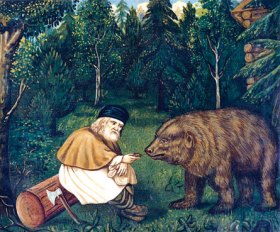
Saint Seraphim of Sarov

“We were called to make of this world of ours God’s own world, God’s own Kingdom — in the sense that it is His family, the place where He lives among His creatures, and where the creatures of God can rejoice in Him and in one another. Let us therefore, to the extent to which we are faithful to the call of the Church, remember that apart from being an act by which we try to free ourselves from slavery to the material world, our fasting is an act of recognition of our sin against the world and, however small, a real attempt to make reparation for it, bring a testimony that we understand, that we are heartbroken, and that even if we cannot live otherwise, we live with a pain and a shame, and turn to God and to the world, which we treat so atrociously, with a broken and contrite heart. Amen.”

-Metropolitan Anthony of London, reposed 2003

See more of the icon here.

All human conventions are destroyed.

Seeing posts of those who are at the beginning of Lent prompts mixed feelings in me. Orthodox Easter, or Pascha, does not come to us until May 2 this year, and our Great Lent begins March 15th, by which time western Christians will be halfway to their April 4th Easter.
Part of me is envious, and wishes we were already there, in that blessed season of “bright sadness.” But probably the greater part says, “Thank God we have a few more weeks!”

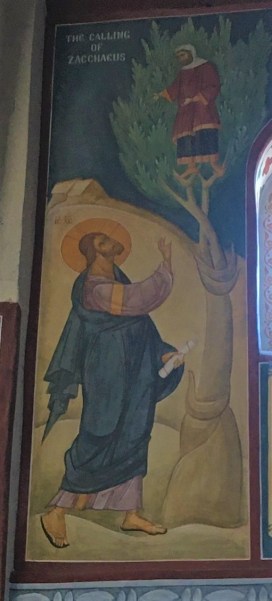
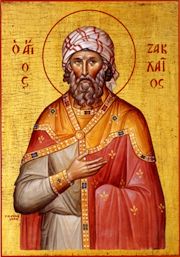
Yes… and I do want to take advantage of that time so that Lent itself won’t fly past without any effect on me. The Orthodox Church gives us five Sundays of preparation, and last Sunday was the first of those, Zacchaeus Sunday. Our rector emphasized to us that Zacchaeus climbed to a good vantage point because he wanted to see who Jesus was.

I appreciated Patriarch Kirill’s homily for the day in which he explained how Zacchaeus “…received his post from the hands of the Romans, the people who captured Israel, who enslaved the Jewish people. In modern terms, Zacchaeus worked in favor of the occupation power. And the freedom-loving Israelites, who painfully experienced everything that had happened to them – the fact that pagans seized power over the chosen people and over the holy places – treated those who voluntarily served the Roman authorities, collecting taxes from their own people, with contempt and indignation. That is why, in the minds of the Israelites of that time, the publicans were equal to the greatest sinners.

“But one of these tax collectors, Zacchaeus, was so eager to see the Savior that, being short, he climbed up a tree to see Him from there. The act itself is out of the ordinary, because Zacchaeus was one of those who had power, and adults who have power usually do not climb trees. If they need to see something, they have the opportunity to come closer: to push through the crowd, to make people part. But Zacchaeus climbed a tree, humiliating himself, only to see the Savior.”

And oh, my, wasn’t he rewarded! He did see Jesus, and apparently not just superficially. His humble act led eventually to true repentance and salvation; can you imagine how the whole town must have been astounded? As another has put it, “He lived in luxury from what he stole in the name of a hated foreign power.” It likely was not an easy process to make restitution to all the people through whom he had made himself rich, and to disentangle himself from the corruption of the political system, but however it happened, he went on to become one of the Seventy Apostles described in Luke Chapter 10.

Patriarch Kirill goes on to say, “Everything in this story is so simple and so unexpected. All human conventions are destroyed by the power of humility.” If we also can act in such a way that we begin to see Jesus more clearly, there is no telling what huge changes might begin in any of us, for the glory of God and our full salvation.

Father George exhorts us.

“In you the Church of Christ is alive and free. In her, we move and live through Christ, Who is her Head, and have full freedom, because we learn the Truth and the Truth makes us free. You are in Christ’s Church whenever you uplift someone bent down in sorrow, when you help someone elderly walk more easily, or when you give alms to the poor and visit the sick.

“You are in Christ’s Church when you cry out, ‘Lord, help me.’ You are in Christ’s Church when you are patient and good, when you refuse to get angry with your brother, even if he has wounded your feelings. You are in Christ’s Church when you pray, ‘Lord, forgive him.’ When you work honestly at your job, returning home weary in the evenings but with a smile upon your lips, bringing with you a warm and kind light; when you repay evil with love—you are in Christ’s Church.
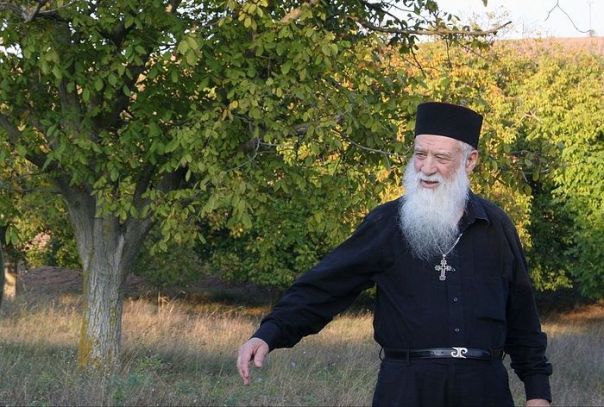
“Do you not see, therefore, my friend, how close the Church of Christ is? You are Peter and God is building His Church upon you. You are the rock of His Church against which no one and nothing can prevail, because you are a liberated rock—a soul that is fulfilled within His Church… Let us build churches, my friend. Let us build churches from the depths of our hearts ablaze with the light of the Sun of Righteousness, Who is Christ Himself, Who has told us that by faith we are free from sin. Let us build the churches of our faith which no human power can pull down, because the ultimate power of the Church is Christ Himself.”

+Father George Calciu, confessor of the Romanian Church; from Interviews, Homilies, and Talks