Category Archives: church

He lived daily with the Lord.

St. Nicholas is one of the “favoritest” saints in the Orthodox Church. I have read about him many times and don’t usually remember much. I didn’t grow up hearing about him as the real historical not-Santa-Claus person that he is, or knowing that there was such a thing as St. Nicholas Day, and since I became Orthodox I haven’t succeeded in implanting him in my heart in any satisfying way.
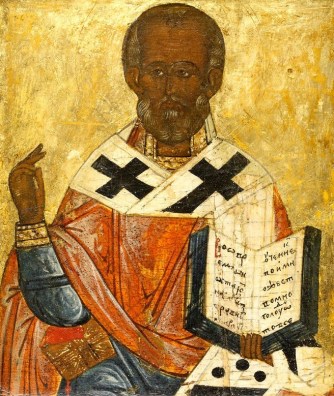
But we both live by and in the love of Christ, so he must be in my heart in spite of my neglect. I will pass on to you (again) what blessed me some years ago, from The Winter Pascha:

The extraordinary thing about the image of St. Nicholas in the Church is that he is not known for anything extraordinary. He was not a theologian and never wrote a word, yet he is famous in the memory of believers as a zealot for orthodoxy, allegedly accosting the heretic Arius at the first ecumenical council in Nicaea for denying the divinity of God’s son.

He was not an ascetic and did no outstanding feats of fasting and vigils, yet he is praised for his possession of the “fruit of the Holy Spirit…love, joy, peace, patience, kindness, goodness, faithfulness, gentleness, self-control” (Gal. 5:22-23). He was not a mystic in our present meaning of the term but he lived daily with the Lord and was godly in all his words and deeds. He was not a prophet in the technical sense, yet he proclaimed the Word of God, exposed the sins of the wicked, defended the rights of the oppressed and afflicted, and battled against every form of injustice with supernatural compassion and mercy.

In a word, he was a good pastor, father, and bishop to his flock, known especially for his love and care for the poor. Most simply put, he was a divinely good person.

-Fr. Thomas Hopko
Red for the Word made flesh.

When the doorbell rang one evening after dark, dark coming so early this season, Susan and I were both on our guard, because we are two vulnerable women and we weren’t expecting anyone.

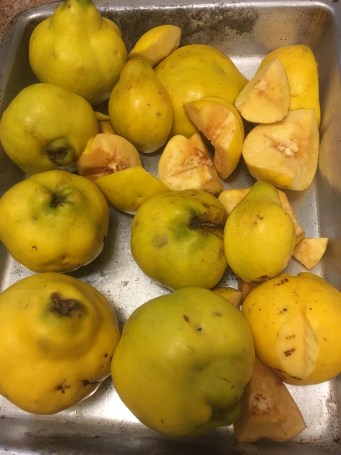
I have a peephole in my door, and I peeped, and saw that it was a human shape and not a package on the step, but I had to turn on the porch light to see if it was someone I recognized. It was Linda! Linda is  my friend who took me to the Heirloom Festival recently. She has been gifting me with garden things for four decades, and she’d mentioned last month that her neighbor — they live fifteen miles from here! — had some quinces she would try to bring me. Here she stood at my door with a dozen in the bottom of a shopping bag. I kissed her.

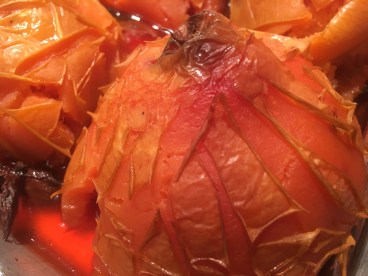
She’d heard about the puny and rock-hard fruits I’d gathered and tried to use, but this will be my last mention of that batch, because these were perfect. For a couple of days I let the good quinces perfume the kitchen, and then I faced the challenge of making use of them for food, when I didn’t have time to peel them. I took time instead to find a recipe for oven-poaching whole quinces with star anise, lemon, honey and cinnamon. As they baked, the whole house filled with an even complex and delicious aroma.

It is worth cooking quinces just to see how the fruit changes to this beautiful orange-pink color. I found it festive in Christmasy way, partly because I had that morning heard a talk that our rector gave the children after Liturgy, about the sequence and meaning of the layers of vestments that he puts on for the services, and he started out telling what the different colors symbolize.

Liturgical churches do not all use the same colors for various seasons or feasts on the calendar, and there are numerous options and meanings. But during Advent in our tradition, the vestments and altar cloths are red, as we are anticipating the birth of the Savior born to a human mother, who gave him human flesh and blood. Red for blood. To remind us of that tenet of our Christology.

In the beginning was the Word, and the Word was with God, and the Word was God.  He was with God in the beginning.  Through him all things were made; without him nothing was made that has been made.  In him was life, and that life was the light of all mankind. The light shines in the darkness, and the darkness has not overcome it.

The Word became flesh and made his dwelling among us. We have seen his glory, the glory of the one and only Son, who came from the Father, full of grace and truth.

-The Gospel of John

More than the rhythm of our breathing.

Remember God more often than you breathe, says St Gregory of Nazianzus (d. 389). Prayer is more essential to us, more an integral part of ourselves, than the rhythm of our breathing or the beating of our heart. Without prayer there is no life. Prayer is our nature. As human persons we are created for prayer just as we are created to speak and to think. The human animal is best defined, not as a logical or tool-making animal or an animal that laughs, but rather as an animal that prays, a eucharistic animal, capable of offering the world back to God in thanksgiving and intercession.

Bishop Kallistos of Diokleia

Love stands weakly at the border.

It is said by some that God has no boundaries regarding us, that He is God and may do with us (and to us) whatever He wills. This, of course, is true in an abstract sense. However, it is not true of God as He has made Himself known in Christ. Christ is a God who “asks.” He is the God who allows a freedom so great that it can kill Him. 
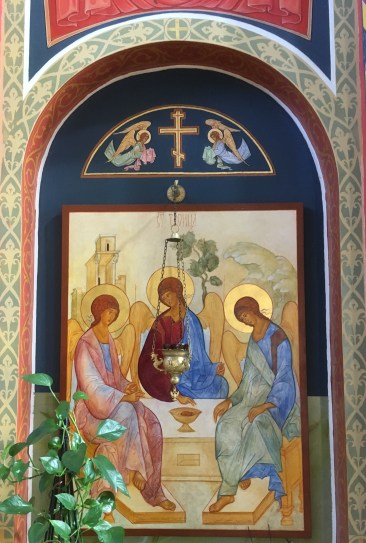
-Fr. Stephen Freeman in “Love and Freedom.”

I had just returned from a talk on the Holy Trinity when I read Fr. Stephen’s article quoted above. Our lecturer told us that the Cappadocian fathers of the 4th century, St. Basil the Great, St. Gregory the Theologian, and St. Gregory of Nyssa, developed the Trinitarian theology of the church from their answers to questions raised by their knowledge of Greek and Hebrew ideas of God. One idea, from the Greeks, was that God is forced by overflowing love to create man, and they did not believe that God is forced to do anything.IMG_0083

So why did He? Because He wanted to give humans the opportunity, the freedom to respond to His love, and by communion with the Holy Spirit to be transformed into true persons .

In another article Fr. Stephen wrote: The knowledge that comes through communion is not a fact to be considered, rather, it is a knowledge that in the very act of knowing becomes part of you. The knower and the known share some manner of common existence.

A last snippet from Love and Freedom: When I have written that Pascha is at the heart of everything (and I believe this faithfully represents the teaching of the Church) this weakness born of love is its consequence. It is the love of God that surrounds us and calls us to be His friends. It seeks us, face to face, even searching for us when we hide. But it is a love that stands weakly at the border of our freedom, and waits for our invitation.