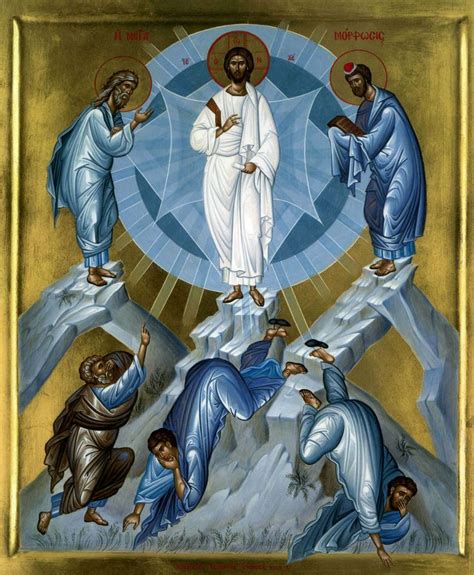
You were transfigured upon Mt. Tabor, O Jesus,
And a shining cloud, spread out like a tent,
Covered the apostles with Your glory.
Whereupon their gaze fell to the ground,
For they could not bear to look upon the brightness
Of the unapproachable glory of Your face,
O Savior Christ,
our God Who are without beginning.
You Who have shone upon them with Your Light,
Give light now to our souls.
I was a gardener long before I had a blog — still, it’s surprising I didn’t tell my magic bean story here before. [Hmm… well, I did tell it, as the “related article” boxes below just revealed to me!] It started with friend Elsie… A Long Long Time Ago she and I used to share garden lore and harvest, and mysteries. The biggest mystery was how the special bean ever came to be growing in her vegetable plot.
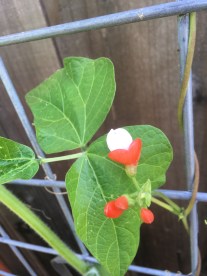
It must have been in 2006 at her house that she led me to a bed of earth next to a fence, to show me runner beans with big pods and pretty flowers. “Maybe you can tell me what this bean is,” she hoped. She always thought I might have the answers to any garden question. She hadn’t planted it, and her neighbors had no garden. I was clueless, but I went home and tried to find its picture online. It didn’t take long, even though at the time you could not easily find the seeds to buy. I read that only one runner bean has a bicolor flower, and this definitely matched the pictures of that variety called “Painted Lady.” Baker Creek Seeds in 2018 has this to say about it:
Traditional English bi-color grown since 1596! The name had mention to Queen Elizabeth I, ‘who was heavily made up with rouge and white chalk.’ The gorgeous flowers of red and white are among the most beautiful of flowering beans. The large beans are also good as snaps, freshly shelled or as dry beans, which are chocolate and tan mottled in color.
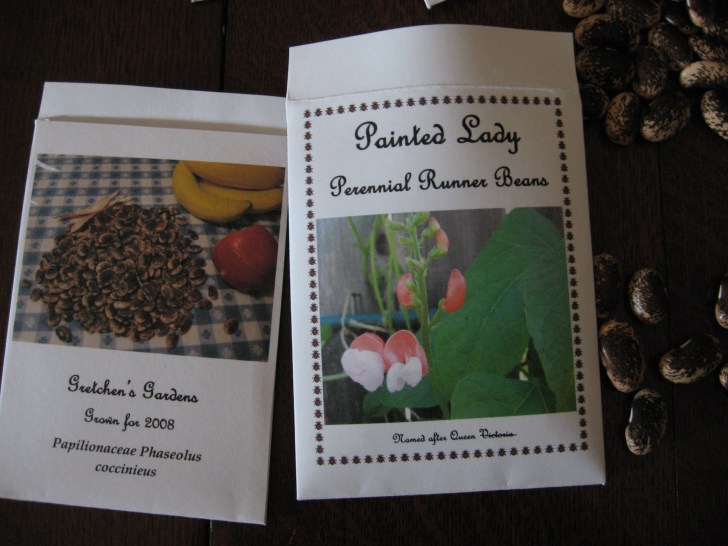
Just today I read on Wikipedia that this is a cultivar of the plain old Scarlet Runner Bean. They are all perennial, which is a great boon for someone like me who takes forever to get around to planting in the spring. The beans are pretty large, not the sort of seed you would imagine a bird dropping into the soil… Its appearance in our neighborhood and these other special features of the plant made it seem magic indeed, admittedly in a different way from those in the story “Jack and the Beanstalk;” but Elsie gave me seeds that fall, I planted them the following spring, and in a few months I had lots to give to friends in these packets I made, with an error in the name of the associated queen. Oops.
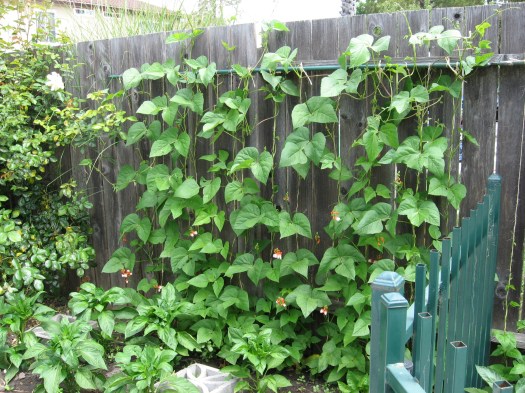
2007butternut,basil, and pole beans right now2018
It’s been many years since these beans have been given a spot in my garden, but I found a handful of seeds of uncertain age to try training along with the butternut squash on my sturdy trellis — and they sprouted!
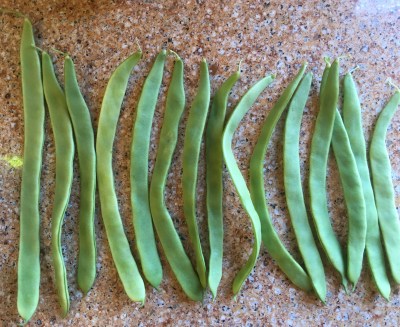
Nearby, the green beans named Blue Lake and Spanish Musica are reaching for the sky. I was lying in bed last night letting the poetry of bean names evoke images of Spanish ladies swimming in blue lakes, and composing a blog post about my wealth of beans. I had already made three pickings of the Spanish Musica, and Soldier came by to eat them with me — after I’d taken a picture of the last bunch, one of which was 11 inches long! They were very good eating, and their being stringless made them quick to prepare for the pot.
This morning at church the Gospel was the story of the Feeding of the Five Thousand. Father James’s homily ranged over the whole Bible and the goodness of God to feed us: The manna in the wilderness was a type of Christ, as He explained to His disciples at the Last Supper when they said,
Our fathers did eat manna in the desert; as it is written, He gave them bread from heaven to eat.
Then Jesus said unto them, Verily, verily, I say unto you, Moses gave you not that bread from heaven; but my Father gives you the true bread from heaven. For the bread of God is he which comes down from heaven, and gives life unto the world.
Then said they unto him, Lord, evermore give us this bread.
And Jesus said unto them, I am the bread of life: he that comes to me shall never hunger; and he that believes on me shall never thirst….Verily, verily, I say unto you, He that believes on me has everlasting life. I am that bread of life. Your fathers did eat manna in the wilderness, and are dead. This is the bread which comes down from heaven, that a man may eat thereof, and not die. I am the living bread which came down from heaven: if any man eat of this bread, he shall live for ever: and the bread that I will give is my flesh, which I will give for the life of the world.
Now we have the body and blood of Christ in the Eucharist week by week, imparting Christ the Bread of Life to us. Our homilist reminded us of the prayers that many people pray at meals, including those going back many millennia such as Jewish prayers like “Blessed art thou, O Lord our God, King of the universe, who bringest forth bread from the earth,” and “Blessed art Thou, O Lord, who feeds the world.”
When the theme of bread was added to the swirl in my head, a song popped up (naturally, because of Musica!) and joined in, one that our family used to sing as a grace before meals, part of Johnny Appleseed’s song adapted to the theme of dinner:
The Lord is good to me
and so I thank the Lord
for giving me the things I need:
the bread and the milk
and the bowl of beans;
the Lord is good to me!
It just so happens that I made bread last week, too, part of my ongoing project of combining “artisan no-knead” technique with my sourdough starter and experience. This latest effort was very satisfying, and makes me want to get another batch going tomorrow.
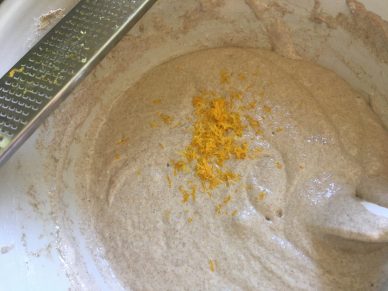
I assembled the ingredients for the Swedish Sourdough Rye on Tuesday…
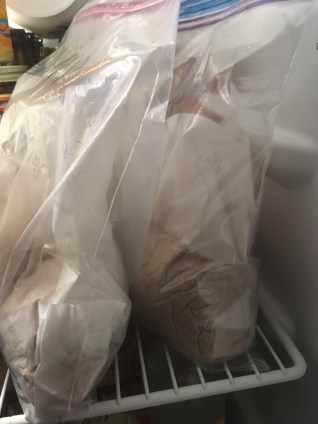
…and put two lumps of wet dough in the fridge in plastic bags.
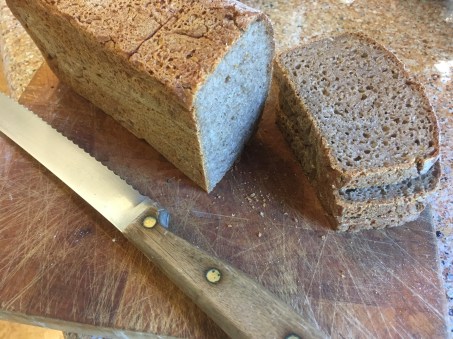
On Friday I baked one as a boule in the Dutch oven, and Saturday I baked the other in a bread pan, resulting in this 2-pound loaf:
It is incredibly moist, what they call a custardy crumb, and nice and sour, with the anise and caraway and orange peel I got the idea for from Mabel last fall in Tucson. I sort of forgot to put any white flour in this batch, though it has whole wheat flour with the rye, and it is therefore dense, but it’s not doughy or heavy.
I bought the book at right but have read only a couple of pages. Before it arrived I had perused many recipes online but was too intimidated by all the details to follow any of them. After you’ve baked bread in a rather relaxed (a.k.a. sloppy) fashion for 40+ years the idea of completely starting over step-by-step was paralyzing. So I picked up some general principles and hoped that I might learn by experimentation; I’ve been keeping notes on my own trials and results. But I don’t know if I will ever have a real recipe to share with you all. I do know what is working for me currently:
1) Keep the dough wet and loose, more runny than biscuit dough.
2) Let it spend a good amount of time in the refrigerator.
3) When you take a lump out to bake it, handle it gently and don’t knead.
4) Bake it hot, at 450° or 500°F, and for longer than seems reasonable.
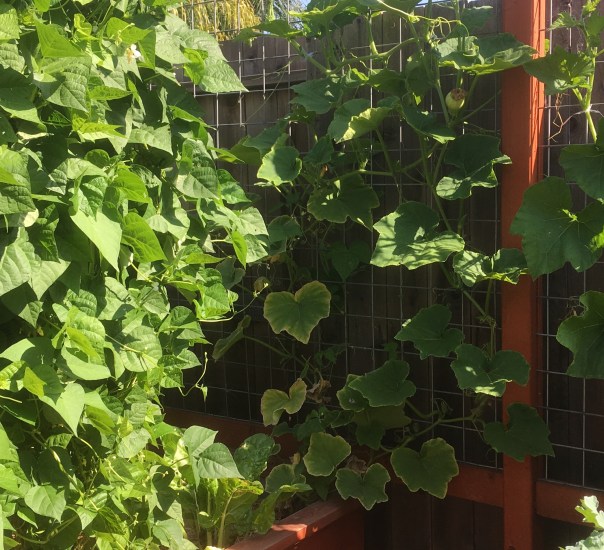
It’s not easy to see, but in the center of the photo below the Spanish Musicas are reaching across the space to hold hands with the trellis climbers. The poem that is being played out in my garden is too elaborate a ballad for me to follow easily (though Albert will likely jump at the chance to translate it), but tomorrow I’ll go out in the garden and try to soak up a few more lines.
This sign on the wall in our church kitchen shows evidence of its location above the coffee maker. I was looking at it as though for the first time this morning as I prepared the agape meal at church. It was my fourth time cooking for 100-120 people; I don’t know exactly how many ate today, but the important thing is we didn’t run out of food. 🙂
I went back and forth from the kitchen to the church as needed to put things in the oven to warm, and to worship. Before Divine Liturgy there was a glorious baptism, and I was surprised to miss the actual immersion of the baby, but I came in to the heady scent of Holy Chrism as he was being lifted out of the font, which in an Orthodox baptism is no more than halfway through, so there was plenty of praying left to do, and rejoicing in the love and joy that filled the place.
The next time I had to leave and come back, I entered when Father Peter was giving the homily. I’d never heard him preach before, and his words were full of warm encouragement. Near the end he recited the whole poem below, with a fitting and enlivening amount of expression.
It was a great honor to be the one serving and feeding my fellow worshipers a few minutes later. All week I’ve been grousing and anxious about the upcoming event, even though I had planned and organized well and had young and competent helpers, an easy menu, etc. As has been the case before, I began to relax on Saturday when we did the first steps of cooking. I was so grateful for my assistants who are my friends and love me.
Today, even more people helped, were thankful, told me that they loved the food — all the hugs and kind words I could want, to make me feel what a gift it is to be part of this parish and of Christ’s Church, and to work with people on a worthy project.
When I heard Herbert’s poem, I immediately thought, “I must share that on my blog!” I forgot to take any pictures of the food to share, but I think you can envision a hefty chunk of cheesy polenta with a scoop of the meatiest possible red sauce ladled over, plus a dollop of pesto on top. Mixed greens on the side, and ice cream for dessert. I might do this same menu again sometime, it was so relatively easy and successful.
For the good of our souls, it was not worth much, though, compared to the Love that Father Peter talked about, and George Herbert sang of, and which we had tasted in the Holy Mysteries that morning.
But it was an echo and a reminder, and gave us sustenance so that we could sit around basking in our family happiness for a while. “O taste and see that the LORD is good!”
I’ve been thinking a lot lately about the human will to live, and how it is a gift of God, and not a mere “survival instinct,” as scientific materialists might term it. We do not bring ourselves into being, and we can’t keep ourselves alive; and yet, most of the time we try to survive. It’s because God has given us LIFE. I also think about trees most days 🙂 so these words of Fr. Stephen Freeman are a joy to me, as we prepare for the Feast of Pentecost.
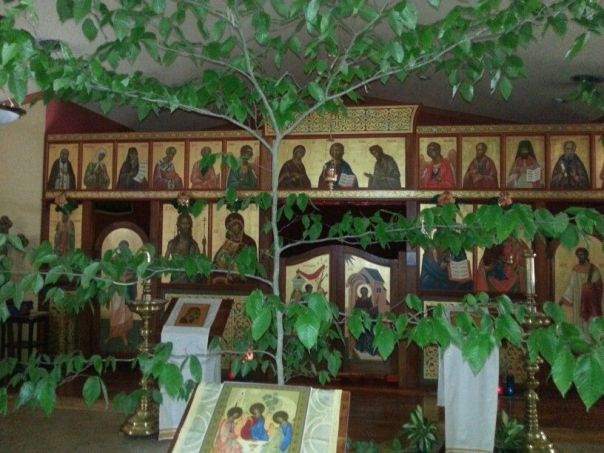
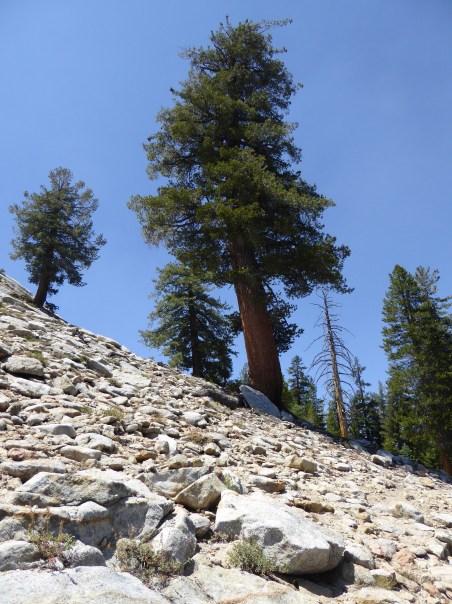
I had fun searching for photos of trees in church. The first photo I believe is from the author’s own parish church in Tennessee. The snippets below, which were included in our church bulletin this week, are from his blog post several years ago on Pentecost and Creation.
PENTECOST and CREATION
There is something about life, at least in our earthly experience, that is inexorable. Any individual case of life may be fragile, but life itself endures. In the Genesis account we are told that God blessed this planet and said:
Let the earth bring forth grass, the herb that yields seed, and the fruit tree that yields fruit according to its kind, whose seed is in itself, on the earth; and it was so. And the earth brought forth grass, the herb that yields seed according to its kind, and the tree that yields fruit, whose seed is in itself according to its kind. And God saw that it was good. (Genesis 1:11-12 NKJ)
The Feast of Pentecost…focuses as much on the Holy Spirit’s work in Creation as it does on the Spirit’s work in the Church. The Church is decorated in green. In Russian tradition, branches of birch are brought into the Church; fresh green grass is placed on the floor; flowers are everywhere. In Soviet times a secular version of the festival remained, called the Day of Trees.
The outpouring of the Holy Spirit on the Church is not something separate from Creation—nor are the trees a distraction from the Church. They are, together, a proper reminder of the role God’s Spirit plays always, everywhere. He is the “Lord and Giver of Life.” Just as the Spirit moved over the face of the waters in the beginning of creation, so He moves over the face of all things at all times, bringing forth life and all good things.
Though I am frequently assaulted with bouts of pessimism, despairing over various aspects of our distorted civilization, the truth is that like the planet itself, civilization with its drive for beauty and order seem inexorable. The history of humanity is not the story of a fall from a great civilization with increasing instances of barbarism and cave dwelling. Great civilizations have risen and fallen, but civilizations continue to occur. Some may already have begun in the ruins that surround us now. The story told in Scripture is not the story of collapse and decay. There are certainly dire warnings of terrible trials and great catastrophes. But these things do not reveal the mystery of God’s will. These things are cracks in the pavement while life continues to burst forth:
God has made known to us the mystery of His will, according to His good pleasure which He purposed in Himself, that in the dispensation of the fullness of the times He might gather together in one all things in Christ, both which are in heaven and which are on earth—in Him (Ephesians 1:9-10).
What appeared as tongues of flame upon the heads of the disciples at Pentecost was a manifestation of this Divine Purpose at work. With the sound of a mighty rushing wind, the Holy Spirit filled the room. The fullness of the Church burst into the streets proclaiming the Gospel in a multitude of languages. Being birthed in Jerusalem was the New Jerusalem, where there is neither slave nor free, Jew nor Greek, male nor female. Instead there is the fullness that fills all things bringing forth all things in one—in the One Christ Himself. The voice of Pentecost is the voice of creation’s groans being transformed into the “glorious liberty of the children of God.” Stones cry out, trees clap their hands and the song of creation rejoices in the One Christ.

 The Lord is good to me