Several articles I’ve read lately strike me as worth sharing.
Boredom is a topic that comes up a lot, maybe more so in summertime, when some people have more time to be bored. In “The Quiet Alarm” Andreas Elpidorou explains why “Boredom is precious, but there’s nothing particularly good about being bored. Its unpleasantness is no illusion, its subjective character no taste worth acquiring. We should give thanks for it – and avoid it like the plague.” 
I’m not sure what I think about all of this; perhaps Boredom is so related to Time that it’s one of those realities that I could muse on for a long time and get more and more confused – but never bored! Read the whole article here.
The threat of boredom comes to mind when I think of cocktail parties, but David Brooks uses them as a metaphor for the exciting “online life” in his article “Building Attention Span”: “Being online is like being a part of the greatest cocktail party ever and it is going on all the time….” He says that “This mode of interaction nurtures mental agility,” or what he calls “fluid intelligence.”
He contrasts that with “crystallized intelligence,” which is what we get more of in offline learning, “…the ability to use experience, knowledge and the products of lifelong education that have been stored in long-term memory.” This kind of learning leads to wisdom, and goodness knows we need that. Read the whole article here.
Fr. Stephen Freeman’s re cent article “Why the Orthodox Honor Mary” begins a discussion that continues in the resulting comments, contrasting the humility and submission of Mary as something to recognize and emulate, with the actual veneration of her as an aspect of our worship of God.
A fascinating bit of Bible exposition is in the comments where Fr. Stephen explains Jesus’s words to Mary at the marriage of Cana, and the meaning that becomes clear when you see that they hearken back to the story in I Kings of Elijah and the widow of Zarephath. Read it all here.
 To end on a lighter note, how about some coconut cake to have with your iced tea on a summer afternoon? (If you are in the Southern Hemisphere, even better – just make that hot tea.) This picture of Emily Dickinson’s Handwritten Coconut Cake recipe, and the accompanying text, do encourage me that if I get back into the kitchen more, it won’t necessarily mean a lessening of my writing output. I do wonder what the form of the coconut ingredient is intended to be, but it would be fun to experiment with one of my favorite foods.
As I write, the sun has yet to emerge in my cool corner of California, but by mid-afternoon the situation will probably have changed enough that I could sit outdoors with some tea and some more reading material from which to glean. Happy reading to you, too!
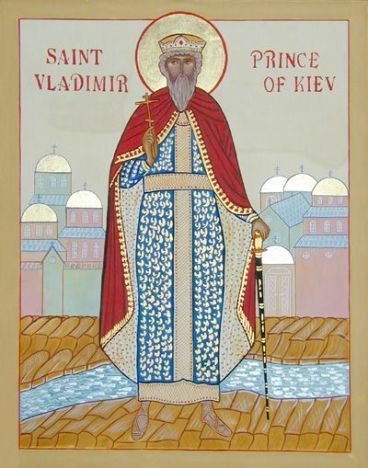 moration of the repose of St. Vladimir, Enlightener of Russia. He was the emperor whose decision to convert to Orthodox Byzantine Christianity transformed Russia and turned its history in a new direction, in about 988. I was lucky enough to attend Liturgy today, in a parish with Russian roots, and to hear a homily on St. Vladimir from a priest who had graduated from St. Vladimir’s Seminary. The Orthodox Church in America has posted online a long and rich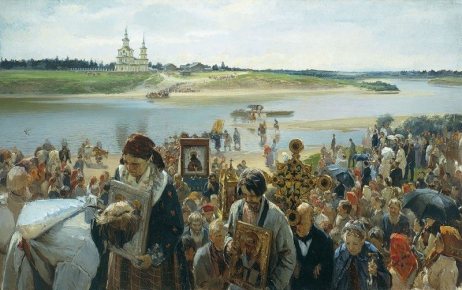
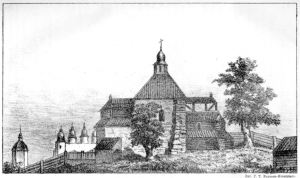 Christian culture. He built monasteries and many and magnificent churches; hospitals, schools and orphanages. The capital city during this era was Kiev, and these first years of Christianity in Russia were a time of growth and prosperity and art. The hundreds of churches in Kiev were renowned for their beauty, for example, the fascinating
  is under discussion again at this time.
 in the Orthodox Church a memorial service is often held at three months (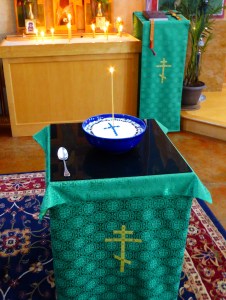

 Gladsome Lights