Today is the 1,000-year comme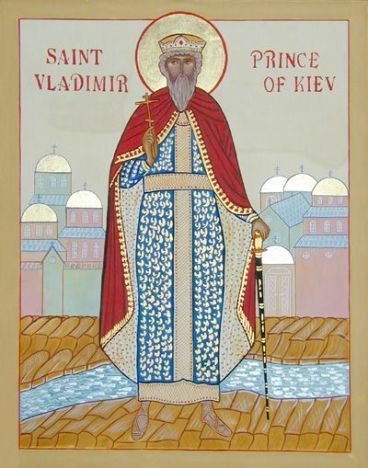 moration of the repose of St. Vladimir, Enlightener of Russia. He was the emperor whose decision to convert to Orthodox Byzantine Christianity transformed Russia and turned its history in a new direction, in about 988. I was lucky enough to attend Liturgy today, in a parish with Russian roots, and to hear a homily on St. Vladimir from a priest who had graduated from St. Vladimir’s Seminary. The Orthodox Church in America has posted online a long and rich story of the saint if you would like to read more of his exploits than I can tell here.
The most famous story among the faithful is an account found in the Primary Chronicle of Russia, written about this time, of how Vladimir, when he was still a confirmed pagan, sent emissaries to check out the churches and faiths of his neighboring lands.
They were completely unimpressed with the Muslim Bulgars, partly because of the ban on alcoholic beverages; of the German churches they reported, “We beheld no glory there.”
But in Constantinople at Hagia Sophia: “…they led us to the place where they worship their God, and we knew not whether we were in heaven or earth, for on earth there is no such vision nor beauty, and we do not know how to describe it; we only know that God dwells among men. We cannot forget that beauty.”
This has been the experience of so many of us converts to Orthodoxy, that we can well believe the story, which is not held to be as certain as the facts about the politics of the time and how Prince Vladimir made an arranged marriage with the daughter of the Byzantine Emperor, and was baptized before the marriage. However it came about, his conversion was providential and has had tremendous ramifications for the last 1000+ years.
He ordered the baptism of all his subjects, who dutifully went down to the River Dneipr en masse the next morning. Here I want to quote from the OCA article about how this event resulted in the continuing celebration of another meaningful church feast day:
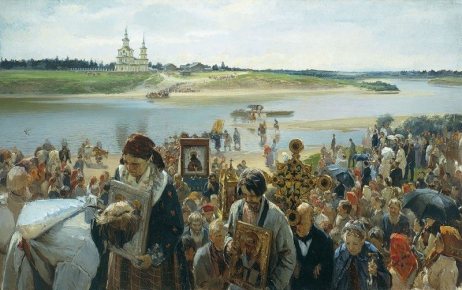
It is difficult to overestimate the deep spiritual transformation of the Russian people effected by the prayers of St Vladimir, in every aspect of its life and world-view. In the pure Kievan waters, as in a “bath of regeneration,” there was realized a sacramental transfiguration of the Russian spiritual element, the spiritual birth of the nation, called by God to unforeseen deeds of Christian service to mankind.
“Then did the darkness of the idols begin to lift from us, and the dawn of Orthodoxy appear, and the Sun of the Gospel illumined our land.” In memory of this sacred event, the regeneration of Rus by water and the Spirit, the Russian Church established the custom of an annual church procession “to the water” on August 1. Later, the Feast of the Procession of the Honorable Wood of the Life-Creating Cross of the Lord, which Russia celebrated with the Greek Church, was combined with the Feast of the All-Merciful Savior and the Most Holy Theotokos (established by St Andrew Bogoliubsky in the year 1164). In this combination of feasts there is found a precise expression of the Russian theological consciousness, for which both Baptism and the Cross are inseparable.
Prince Vladimir soon started to destroy pagan idols, some of which he had commissioned himself, and began serious reforms that would create a new  Christian culture. He built monasteries and many and magnificent churches; hospitals, schools and orphanages. The capital city during this era was Kiev, and these first years of Christianity in Russia were a time of growth and prosperity and art. The hundreds of churches in Kiev were renowned for their beauty, for example, the fascinating Church of the Tithes, which has been destroyed many times and whose rebuilding
 is under discussion again at this time.
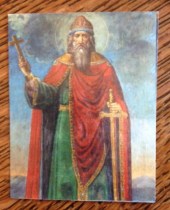
My own first experiences of Orthodox worship were not outwardly as splendorous as Hagia Sophia, but like those emissaries I felt the splendor of Heaven coming down on me. (Just this week I added to my page newly renamed “Orthodoxy and Me,” to tell much more of my story as a story and not just scattered parts.) In my parish we have a man who was born a Jew and took the name of Vladimir at his baptism somewhat late in life. This morning he joyfully passed out these little icon cards as gifts, and we were all glad that he was there so we could say, “Happy Name’s Day!”
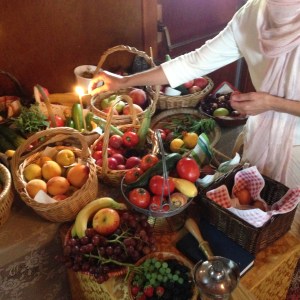
 tion of Christ on Mt. Tabor. Two years ago I wrote about honey and how it figures in this feast – if you’d like to think on that sweet subject for a few minutes and see lovely photos check it out again.
 cent article
  To end on a lighter note, how about some coconut cake to have with your iced tea on a summer afternoon? (If you are in the Southern Hemisphere, even better – just make that hot tea.) This picture of
  in the Orthodox Church a memorial service is often held at three months (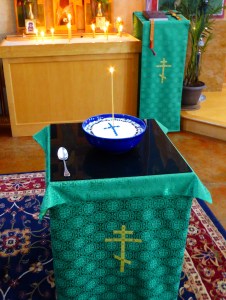
 Gladsome Lights