The second Tuesday after Pascha it is common for Orthodox to visit cemeteries to share the joy of Easter with the departed, just as Christ must have done when he “descended into Hades” first thing after His Resurrection. In our area it is a strong tradition among parishes and monasteries, and I learned to love this trip to the cemeteries early in my life as an Orthodox Christian.
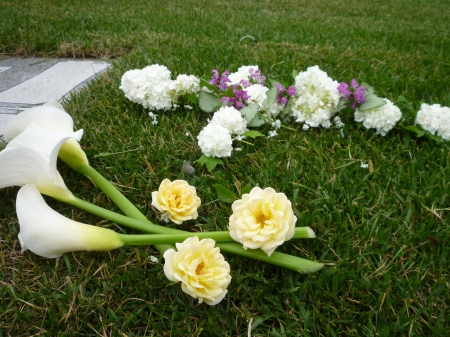
Until this year I had only visited one of the many cemeteries that are included on this day, but now that my own husband lies “newly reposed” in different one, I wanted to go and sing “Christ is risen!” by his grave as well. Priests from two Orthodox churches arrived unintentionally at the same time and led the service right next to the yet unmarked grave of Mr. Glad. You can see the long rectangle where turf was replaced, in the center of this picture.
The cemetery where his body was laid is of the modern “endowed” sort. All of the grounds are kept up by the owners, paid for by the burial fees. This is the same cemetery that I first visited in 2012 and afterward wrote about in A Sleeping Place Is Blessed. Not two years later Mr. Glad realized it would be prudent to buy plots for us there.

Up the road a few miles at the next stop, we were met by Nina who was waiting by the graves of both of her husbands. I saw on the marker that her first husband died when I was still a child. Through the oaks down the hill we could see a third priest praying with two women at one gravesite.
This cemetery is of the old and non-endowed sort, where you are lucky if once a year some community organization chops down the larger weeds. And there is concrete, lots of it, in big broken squares and rectangles of curbs and cracked slabs over and around family groupings. I had forgotten about the hilliness, and about this difficulty of standing and walking on uneven concrete surfaces, an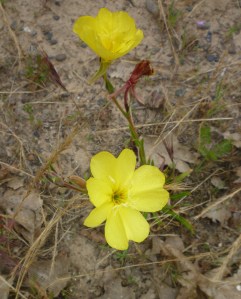 d my ankles began to hurt. Note to self: No Danskos next time.
Besides the concrete, in the unpaved areas there are often foxtails and dust. But flowers grow in the cracks even in drought, and the rockrose that was planted long ago (photo at top) is vigorous. Last year it was really hot on Radonitsa (the Slavic word for this Day of Joy) but today it was cool and drizzly, so our shoes got wet on the lawns.
We didn’t have a big crowd at any of the cemeteries. A different group showed up at each place, with the most people at the third one, including several nuns from a nearby monastery; and women originally from Bulgaria, Ukraine, and Russia, presumably because they are used to doing a similar thing in their countries. Yevhenia, my new friend from Ukraine (that’s a phonetic spelling of how I try to pronounce her name, a form of Eugenia) said that in her country they bring tables and chairs to the cemetery so that they don’t have to rush off, and they picnic on festal foods while they think a while longer about death and God. They like to leave food on the graves, too, for poor people to pick up later on.
When I came home and read again about the Day of Rejoicing, I found that “The Slavs, like many ancient peoples, had a tradition of visiting family members’ graves during the springtime and feasting together with them.” It was an easy custom to continue after their conversion to Christianity, a faith that gave them a truly joyful message to bring along with the food, about Christ’s life-giving death.
 This third cemetery has a smooth endowed section with flat grave markers, down the hill from what is in this picture, and we all trailed over there on the paths between the large square plots, to finish the service near those newer graves. Not far off a group of three people we didn’t know was gathered around a gravesite that was heaped with flowers, one woman obviously weeping.
They watched and listened to us as we faced their direction and sang the Paschal Canon enthusiastically, and when Father walked around censing, and blessing the graves with holy water as he sang, he went as far as their spot and sprinkled water on it, too, just very naturally, but did not interrupt the service. When we finished we went to talk to them; the woman’s mother had died. Maybe the two men were her husband and son. She kept telling us, “Thank you!” through her tears, and we exchanged hugs and repeated greetings of “Christ is risen!”
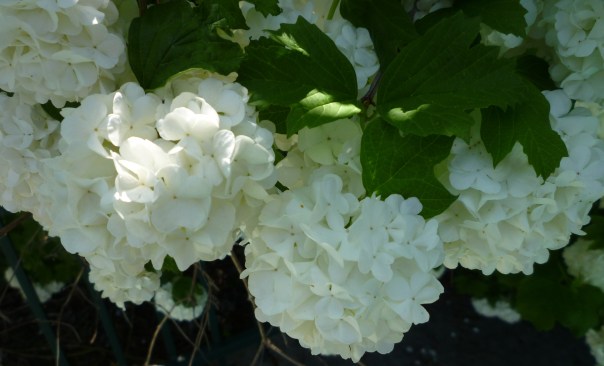
Some of us had colored eggshells left over from Pascha, to sprinkle on the graves. I didn’t have anything like that for Mr. Glad’s grave but a friend shared his with me. I hope to be ready next year, as I’ve conceived a plan, to make use of the blooms of our big snowball bush (viburnum) which are usually at their peak about this time. On the graves of those awaiting the Resurrection, they would be a lovely adornment.
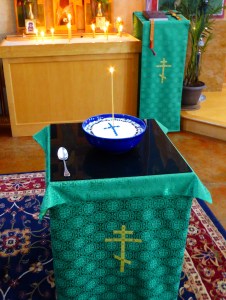
 in the Orthodox Church a memorial service is often held at three months (as we did at 40 days), and because we also are commemorating The Nativity of St. John the Baptist today, it was convenient to have these prayers right after the Liturgy. I made koliva again but decorated it a little differently.
 f each one of us does not end at death on this earth and birth into heaven. We place a seal on everyone we meet. This responsibility continues after death, and the living are related to the dead for whom they pray. In the dead we no longer belong completely to the world; in us the dead still belong to history. Prayer for the dead is vital; it expresses the totality of our common life.
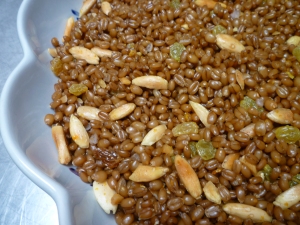
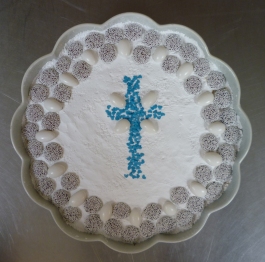 It is traditional in Orthodox churches to have a short memorial forty days after a death, and though my husband was not Orthodox, I am, and I am the one remembering and praying for him. Last week my priest generously held this service, called a panikhida, and I prepared the dish of boiled wheat called koliva for us all to eat together at the end of the service.
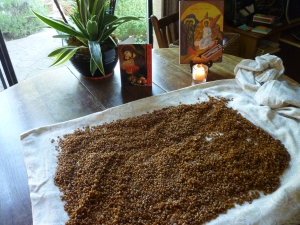 The essential ingredient is boiled wheat – but actually, even that is not essential, because sometimes it is rice, or lacking wheat, barley or another grain can be substituted. But the image of a kernel of grain being buried endures, as in the Gospel of John Christ speaks of His own coming death, “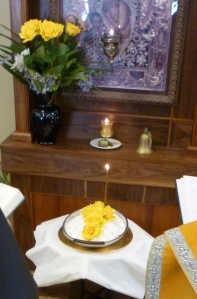
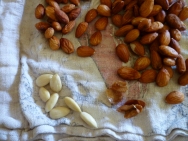
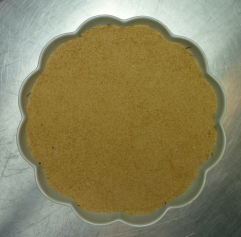 t I put the final layers of my dish together in the church kitchen where I could not find any waxed paper. My alternative method didn’t work so well, which is why the surface of my finished product has some flat areas, some imprints of my fingers, and some sugar untouched.
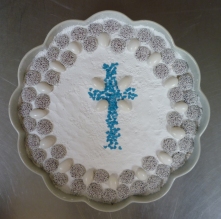 f chocolate or a candy. The koliva recipe was judged to be excellent.