 Pascha goes on and on! So we have Paschal Bright Week services, Monday, Tuesday, Wednesday….
Christ rose on the first day of the week, Sunday. The Church has always considered this to be be the eighth day as well, the beginning of a new order of things. I don’t really understand this. But our bishop mentioned it this morning, Bright Monday, when he talked about the grace that extends throughout the week hinting at the newness of life given us in Christ’s Resurrection.
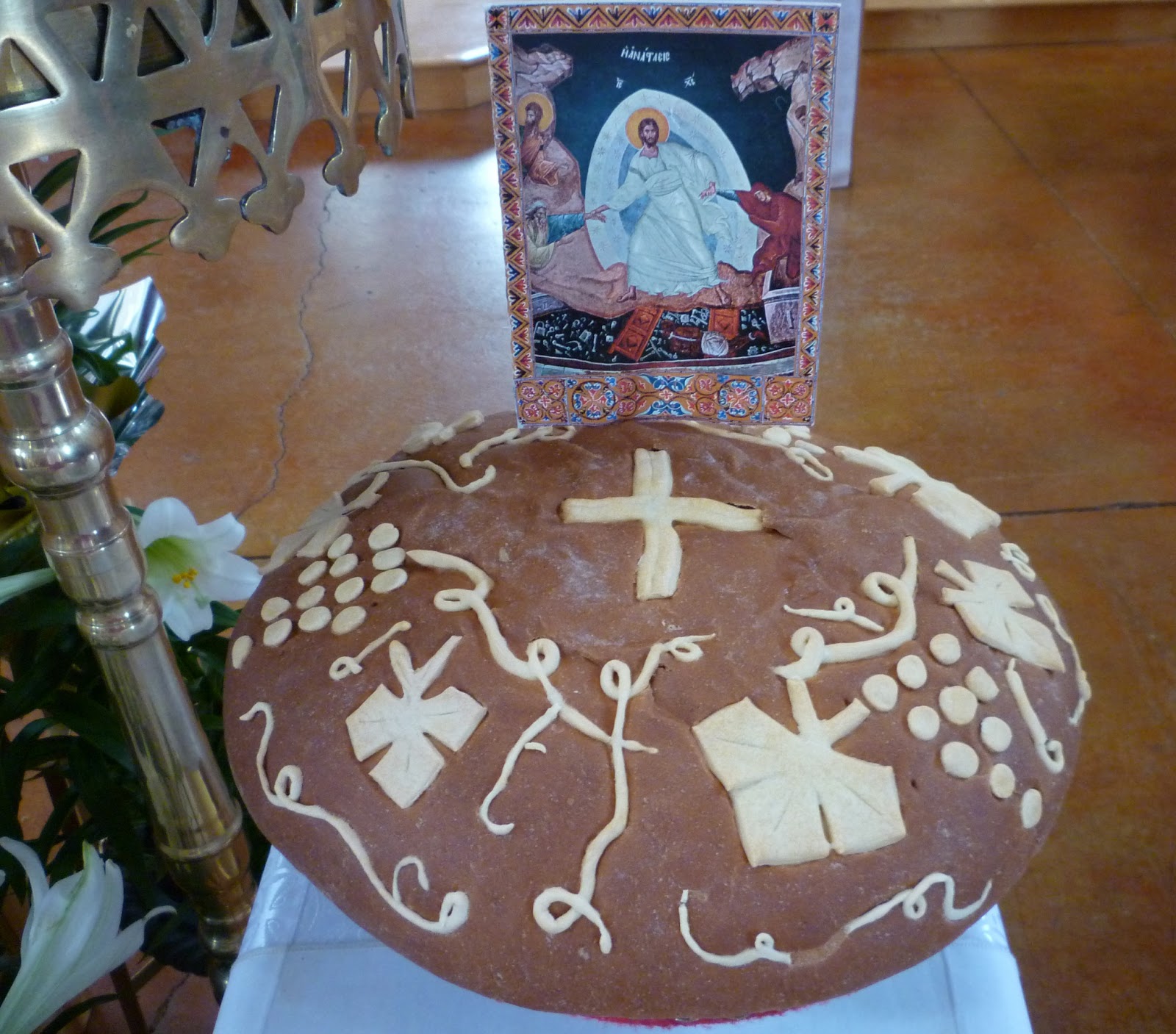
We all are feeling the newness. Today we lived in the joy of Christ’s presence and celebrated it in many ways, including a loaf of bread. This year it was baked by a young girl with the help of a more experienced baker. It must weigh over five pounds — I know, because I was honored to carry it in the procession around the church, and then standing on the porch as the gospel for the day was read.
This bread is called the Artos and “symbolizes the physical presence of the resurrected Christ among the disciples.” It will remain in the church all week and be carried in procession after Divine Liturgy those days; on Saturday it will be cut into pieces and distributed to the parishioners.
Below is a photo I found online of a Bright Week procession elsewhere. It seems it might be the only photo available — maybe everyone wants to actively participate in these blessed processions and not stand apart to be a photographer.

On Pascha night I remembered that I have a piece of last year’s Artos in my refrigerator. I’m sure I was saving it for a time when I was ill or afflicted, and I must never have thought that I was terribly bad off at any time during the year. Praise God for that. So I’ll have to eat it for joy this week and put a new portion in reserve for any upcoming needs. Having been exposed to the air for a whole week it becomes dry and keeps very well!
The day of our Lord’s Resurrection is another case, it seems, of how we live in the present life and at the same time we live in the reality and anticipation of God’s coming Kingdom. St. Gregory Palamas wrote in a sermon “On the Sabbath & The Lord’s Day”:
Whatever is said in praise of the 7th day applies even more to the 8th, for the latter fulfills the former. It was Moses who unwittingly ascribed honor to the 8th day, the Lord’s Day. The Jubilee year (Leviticus 25:8ff), which Moses regarded as a year of forgiveness and named accordingly, was not counted among the ‘weeks of years’ under the law , but came after them all, and was an eighth year proclaimed after the last of these 7 year periods. Moses did the same with regards to periods of 7 weeks.
However, the lawgiver did not only introduce in this hidden way the dignity of the 8th day, which we call the Lord’s Day because it is dedicated to the Lord’s resurrection, but also on the feast called “Trumpets” referred to the 8th day as ‘the final solemn assembly’ (cf. Lev.23:36 LXX, Numbers 29:35) meaning the completion and fulfillment of all the feasts. At that point he clearly said that the 8th day would be holy for us, proclaiming in advance how divine, glorious, & august Sunday was to be after everything pertaining to the law had passed away.
But I see that Metropolitan Anthony in a passage I quoted just last week tells us that we are living this present life in the Seventh Day:
…the seventh day will be seen as all the span of time that extends from the last act of creation on the part of God to the last day, the eighth day, the coming of the Lord, when all things will be fulfilled, all things will come to an end, reach their goal, and blossom out in glory. It is within this seventh day, which is the whole span of history, that the creativeness of man is to find its scope and its place.
In this whole span of history we have much work to do, including our bread-baking and flower-arranging to celebrate Christ’s rising from the dead. St. Isaac of Syria tells a bit about how the fullness of our Eighth Day is yet to come, and seems to see things somewhat differently from Met. Anthony:
The Lord’s Day is a mystery of the knowledge of the truth that is not received by flesh and blood, and it transcends speculations. In this age there is no eighth day, nor is there a true Sabbath. For he who said that ‘God rested on the seventh day,’ signified the rest [of our nature] from the course of this life, since the grave is also of a bodily nature and belongs to this world. Six days are accomplished in the husbandry of life by means of keeping the commandments; the seventh is spent entirely in the grave; and the eighth is the departure from it.

It certainly is a mystery to my small mind, but I am always comforted by these realities of the faith that show how great is our God, and His plans for us, so high as the heavens are above the earth, that they are hard to grasp with our minds. And I’m full of that joy that is not received by flesh and blood, of the glorious risen Savior Christ. He is here every day.







 Gladsome Lights
